A tanker pumping out excess sewage from the Lightlands Lane sewage pumping station in Cookham, Berskhire which flooded after heavy rainfall, January 10, 2024
SEWAGE flowed into England’s waterways for more than 1.87 million cumulated hours in 2025 despite drier conditions than prior years, official figures released today showed.
Nearly 300,000 incidents of untreated sewage were spilled through overflow systems into rivers, lakes and seas last year.
The practice of dumping sewage is meant to take place only in what water companies call “exceptional circumstances,” meant to prevent sewers from being overwhelmed in case of storms or heavy rain and backing up into homes.
Findings from the second year of full monitoring of the network by the Environmental Agency revealed that there were 291,492 spills of this type across England in 2025.
Despite these figures marking a reduction from the previous year, down more than a third (35 per cent) from 450,398 in 2024, campaigners have continued to slam the mismanagement of Britain’s water systems, calling for private water firms to be taken back into public control.
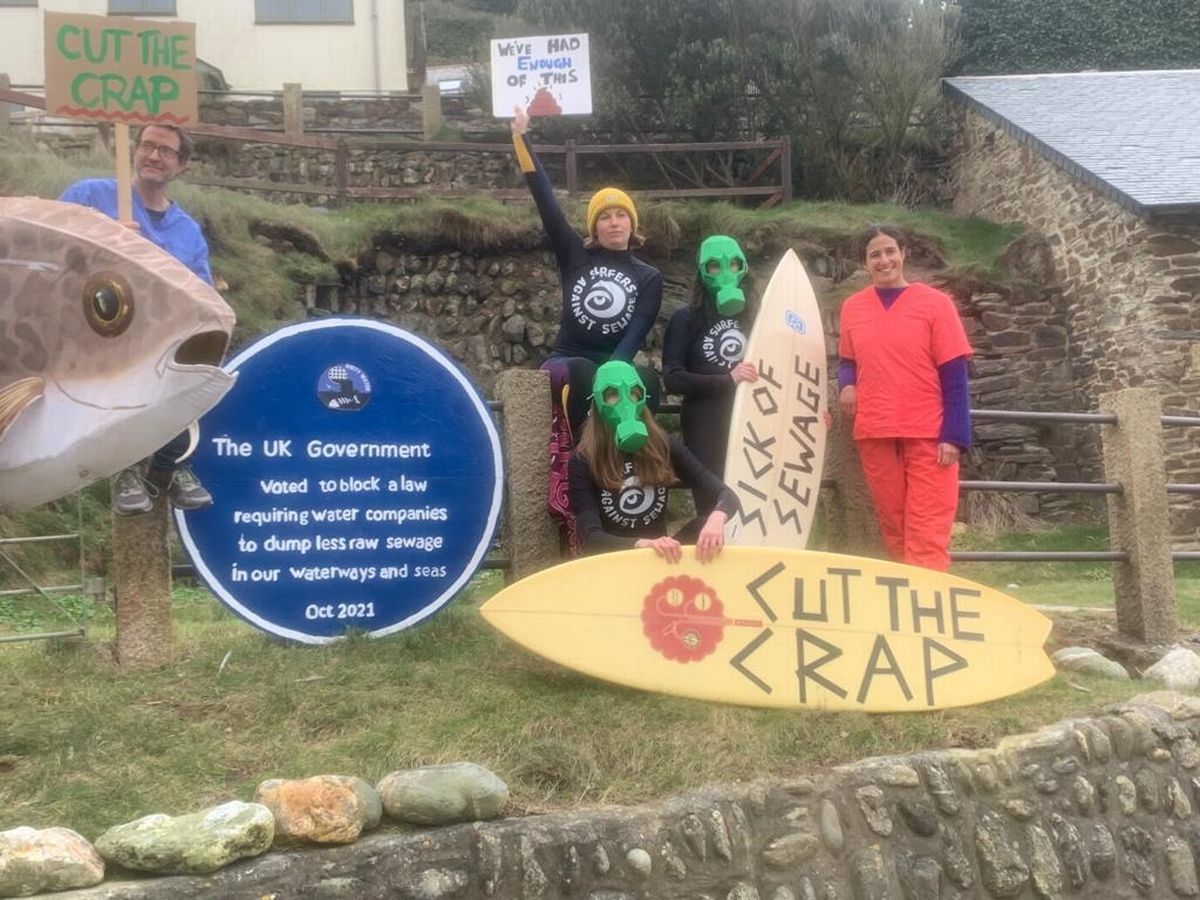
April 2023 Surfers Against Sewage and Extinction Rebellion protests in St Agnes, Perranporth, Truro and Charlestown which unveiled spoof Blue Plaques to the MPs and Conservative Government who allowed raw sewage to be dumped in the sea (Image: Surfers Against Sewage)
Colin Skellett and David Cameron in 2011. Wessex Water paid Skellett £157,000 for three months’ work from July to September 2024, when he stepped down as chief executive after 36 years in charge. Photograph: PA Images/Alamy
Company owners say bonus was unrelated to water business and complied with ban after pollution conviction
The former chief executive of Wessex Water received a £170,000 bonus from its parent company last year despite a ban on performance-related pay after criminal pollution failures on his watch.
Colin Skellett received a total of £693,000 in pay from the water company’s Malaysian-owned parent company, YTL Utilities (UK), including the bonus, according to its accounts up to June 2025.
The bonus prompted strong criticism from the Liberal Democrats, which said it showed that the government’s bonus ban was “nowhere near strong enough”.
Wessex was banned from paying bonuses for the year after it was criminally convicted in November 2024 for a sewage pumping station failure six years earlier, which killed more than 2,000 fish and resulted in the company paying a fine of £500,000. In June the government banned bonuses covering the 2024-25 financial year for the chief executives and finance bosses of Wessex and five other companies. Wessex received another £11m fine last month over more sewage failures.
However, the water industry regulator, Ofwat, said that Skellett was able to retain the bonus under the law, because it was related to a different part of the parent company’s business. YTL is developing housing, offices and an arena in an area north of Bristol known as Brabazon.
A spokesperson for Wessex and YTL said that the bonus “entirely relates to his new role and was entirely funded by YTL. In his new role Colin is responsible for YTL UK group businesses including the development of Brabazon New Town”.
April 2023 Surfers Against Sewage and Extinction Rebellion protests in St Agnes, Perranporth, Truro and Charlestown which unveiled spoof Blue Plaques to the MPs and Conservative Government who allowed raw sewage to be dumped in the sea (Image: Surfers Against Sewage)
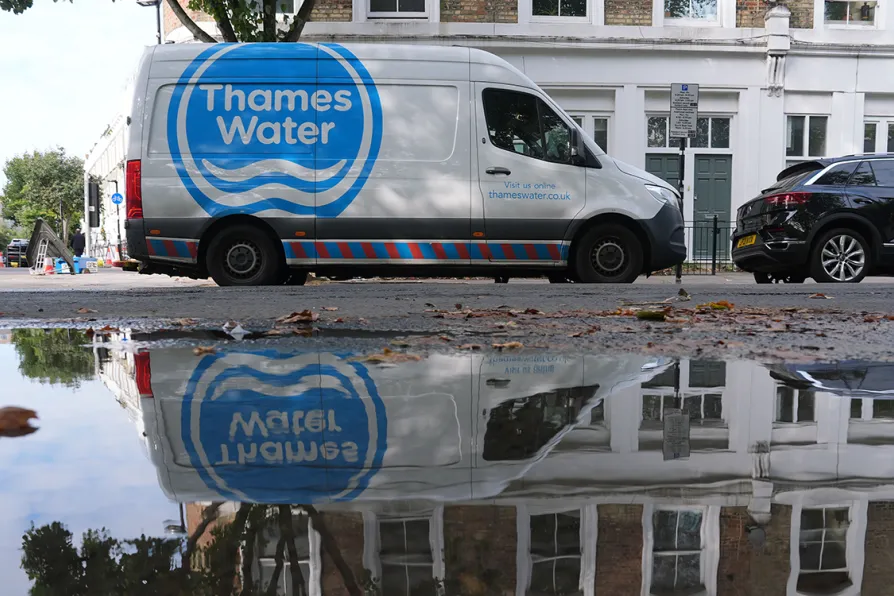
Thames Water has been crippled by huge debts. Photograph: Sam Oaksey/Alamy
Lenders say a ‘full return to legal, regulatory and environmental compliance’ under new rescue plan would not be completed until at least 2035-2040
Thames Water may not fully comply with rules on pollution of England’s waterways for as long as 15 years, according to a new plan by creditors who are scrambling to avoid the utility being forced into government administration.
The creditors who in effect own Thames Water have said they will commit to paying fines for pollution, as well as writing off more of their loans and investing more in the company, in new proposals published on Thursday.
However, the creditors also said that “a full return to legal, regulatory and environmental compliance” under their plan would not be completed until at least the 2035-2040 period, raising the prospect of sewage levels above legal limits in some places for at least a decade. They will argue for further leniency on fines from the regulator, Ofwat, during that period, and that it will be impossible for the company to make upgrades across London and south-east England more quickly because of the scale of the work needed after years of neglect.
The group of financial institutions, under the new London & Valley Water holding company, has been locked in talks with Ofwat since May over acceptable terms for the hugely complex restructuring of Britain’s biggest water company.
Thames Water has been crippled by huge debts built up over two decades by owners who have been criticised for paying out dividends without investing enough in its leaking pipes and malfunctioning treatment works. That contributed to widespread public outrage over the level of sewage in Britain’s rivers and seas.
April 2023 Surfers Against Sewage and Extinction Rebellion protests in St Agnes, Perranporth, Truro and Charlestown which unveiled spoof Blue Plaques to the MPs and Conservative Government who allowed raw sewage to be dumped in the sea (Image: Surfers Against Sewage)
England’s privatised water industry may one day be considered a textbook case study of failed corporate responsibility, regulation and governance. The Cunliffe review, the recent report into England’s privatised water industry, concluded that the financial regulator, OfWat, needs to be disbanded and a new water regulator will be introduced.
For that to work effectively, better pollution monitoring and more clearly defined pollution incident criteria are essential. While politicians and water companies have claimed to be reducing pollution incidences, they might not strictly be tackling sources of pollution, so communications must be carefully scrutinised for disinformation.
The UK’s environment minister Steve Reed MP has described the water industry as “broken”. The public have rising water bills. Water companies owe over £60 billion in debts and have left the country with uncertain water security in the face of climate change.
The Environment Agency (EA) in England recently announced that serious pollution incidents in 2024 rose by 60% to 75 from 47 in the previous year. The EA classifies pollution incidents using a four-point scale called the common incident classification scheme. Trained EA officers consider the evidence reported via their incident hotline to assess its credibility and severity.
Get your news from actual experts, straight to your inbox.Sign up to our daily newsletter to receive all The Conversation UK’s latest coverage of news and research, from politics and business to the arts and sciences.
Category 1 is for major incidents, 2 for significant, 3 for minor incidents and 4 for no impact. Category 1 and 2 typically involve visible signs of dead fish floating. For salmon, if more than 10 adult or 100 young fish are dead, this is category 1. With fewer than ten adult and 100 young fish dead, it’s category 2.
No dead fish, no serious problem? The EA can also record damage on protected habitats as “pollution incidents” but these are harder to substantiate without investigative research that takes time and money.
Last year, more than 450,000 sewage discharges were recorded by event duration monitors. These are devices fitted to the end of overflow pipes that indicate when and for how long they have been discharging.
These discharges represent 3.6 million hours of untreated sewage going into our rivers and coasts. These contain chemical contaminants including pharmaceuticals, detergents and human pathogens. Only 75 incidents were recorded as serious or significant in 2024. Another 2,726 were classed as minor.
So lots of sewage discharges are not being classified as pollution incidents, despite containing pollutants. The EA advises its investigating officers to “record substantiated incidents that result in no environmental impact, or where the impact cannot be confirmed, as a category 4”.
The EA has been criticised for turning up late to 74% of category 1 and 2 pollution incidents and for being pressured to ignore low-level pollution – all claims that they have denied. However, they admit they are constrained by finances. Any new regulator must be adequately resourced and independent.
Pollution isn’t always classified as an official pollution incident. YueStock/Shutterstock
In their recent report into pollution incidences, the EA states that they respond to all category 1 and 2 (serious and significant) water industry incidents and will be increasing their attendance at category 3 (minor) incidents. They highlight that more inspections will identify more issues. This shows some acceptance that the more incidents they attend, the more would be substantiated or recorded appropriately.
Most sewage discharges would not have been reported to, or recorded by, the EA as pollution incidents because they were permitted discharges from combined stormwater overflows. Water companies are allowed to discharge untreated wastewater under exceptional rainfall or snowfall conditions to prevent sewage backing up through the pipes.
Extra water flow in rivers from rainfall is meant to dilute chemical contaminants in wastewater. However, some discharges can last days or weeks. The EA is currently investigating whether water companies have been breaching their permits and discharging untreated wastewater when there is low or even no rainfall.
What counts as pollution?
The UN classifies pollution as “presence of substances and energy (for example, light and heat) in environmental media (air, water, land) whose nature, location, or quantity produces undesirable environmental effects”. This definition differs markedly from the EA’s working definition of pollution incidents.
Many sewage discharges containing low concentrations of pollutants won’t kill fish but might still be harmful to fish larvae or small insects, for example.
However, the broad picture from EA data is that invertebrate communities at least are in a better state than they were three decades ago before wastewater treatment plants were upgraded following the EU’s Urban Wastewater Directive.
Some pollutants bioaccumulate through the food chain, so they become concentrated in top predators such as orcas. Some chemicals mimic reproductive hormones even in low concentrations and can feminise fish, for example. High levels of nutrients from agriculture and sewage in rivers can cause fungal diseases in seagrass meadows.
Other families of chemicals build up in wildlife and people, such as persistent “forever chemicals”, much of which comes from wastewater discharges. Continued discharges of antibiotics into waterways might not be classified as pollution incidents but still pose a substantial risk to human and ecosystem health through bacteria developing antibiotic resistance.
The government has just committed to cut sewage pollution by 50% by December 2029 based on 2024 data. But it’s not yet clear whether these involve cutting the frequency of discharges, the duration or both.
This data could also be manipulated so that a large number of small discharges can be consolidated into one official discharge event. Currently, the volume of discharges from stormwater overflows isn’t known. Without this vital data we can’t ascertain the risk posed by their contaminants.