Baby bull sharks are thriving in Texas and Alabama bays as the Gulf of Mexico warms

Spread the love

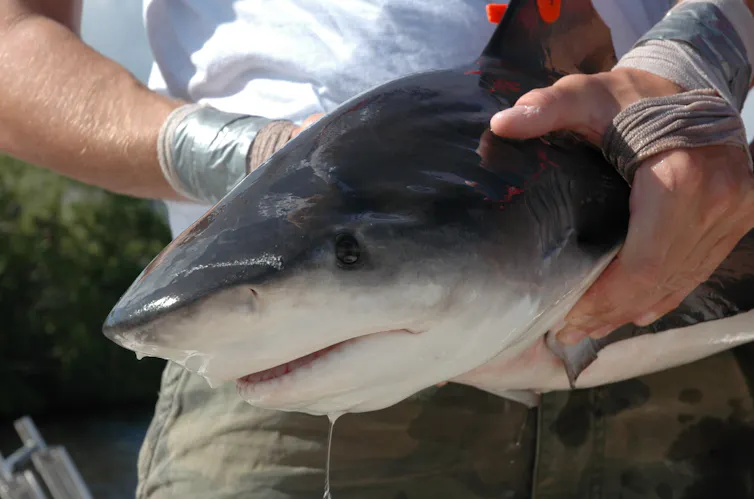
A scientist checks on a young bull shark in Texas. Philip Matich

James Marcus Drymon, Mississippi State University; Lindsay Mullins, Mississippi State University, and Philip Matich, Texas A&M University

In late spring, estuaries along the U.S. Gulf Coast come alive with newborn fish and other sea life. While some species have struggled to adjust to the region’s rising water temperatures in recent years, one is thriving: juvenile bull sharks.

We study this iconic shark species, named for its stout body and matching disposition, along the Gulf of Mexico. Over the past two decades, we have documented a fivefold increase in baby bull sharks in Mobile Bay, Alabama, and a similar rise in several Texas estuaries, as our new study shows.

Despite the bull shark’s fearsome reputation, baby bull sharks are not cause for concern for humans in these waters.

While adult bull sharks are responsible for an occasional unprovoked attack, baby bull sharks haven’t fully developed the skills needed to hunt larger prey. And you’re still far more likely to be killed by bees, wasps or snakes than sharks.

The fascinating life of a young bull shark

Most sharks are fully marine and spend their entire lives in the ocean. Bull sharks, however, are one of a handful of shark species that use freshwater environments as nurseries.

Baby bull sharks have been found in the Alabama River, 75 miles north of the ocean, and up the Mississippi River as far as Illinois. They have evolved to tolerate fresh water by reducing the need for salts and urea in their bodies compared to marine sharks, and actively taking in more salts through their food and across their gills.

In Texas, young bull shark numbers have been increasing in estuaries like Galveston Bay and Sabine Lake over the past 40 years, particularly where rivers like the Trinity, Sabine and Neches intersect with these ecosystems. These areas may offer protection from predators, such as bigger sharks.

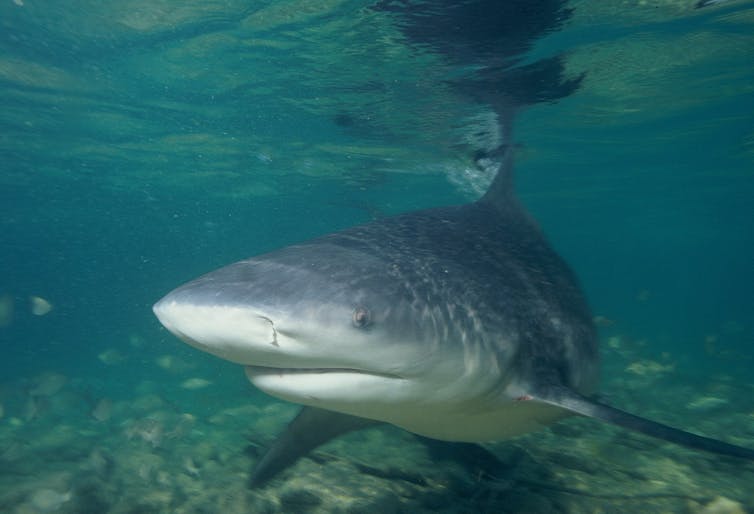
A bull shark swims in shallow water, with its fin just breaking the surface.
In 2012-2023, Texas reported seven shark bites, and Alabama reported two, none of them fatal, according to the International Shark Attack File. After white sharks and tiger sharks, bull sharks have had the most reported unprovoked shark attacks on humans globally. Albert Kok via Wikimedia Commons, CC BY-SA

The presence of bull sharks in these estuaries also contributes to their health and stability.

Because bull sharks frequently move between freshwater and marine ecosystems, they can act as mobile links that connect these two aquatic environments. Bull sharks often feed in one environment, salty water for example, and then rest and excrete nutrients in freshwater bays. Feeding and resting in different locations can improve the ability of these ecosystems to withstand disturbances like warming weather conditions, because if one habitat is disturbed, the other is still supported.

Like a spider web, food webs are connected by many intersecting threads. The more threads, the stronger the web. The use of both freshwater and marine habitats by bull sharks increases the number of these threads through their predator-prey interactions, thereby strengthening the ecosystem.

Waters are warming

As the planet warms, coastal ocean temperatures are rising. In the Gulf of Mexico, water temperatures have risen more than 3 degrees Fahrenheit (more than 1.5 degrees Celsius) due to climate change.

On a global scale, warming waters are harming more fish species than they are helping. Higher temperatures increase food requirements and stress levels, while making fish more susceptible to disease and reducing the survival of their young. A variety of fish populations in the Gulf of Mexico, including mullet and flounder, have declined as warmer conditions affected their spawning.

At the same time, the waters used by baby bull sharks have expanded in part due to this warming, creating a dynamic habitat.

An easy way to understand how sharks use dynamic habitat is to capture them with nets and measure the characteristics of the surrounding environment. In our sampling data, we could see that the mean annual water temperatures on the Alabama and Texas coasts increased at the same time the bull shark populations rose.

In coastal Alabama, we found that the relative abundance of baby bull sharks has increased fivefold over the past 20 years. Slight increases in temperature over that time provided the best explanation for this population increase.

Of all the temperatures recorded in that study, there was no maximum temperature threshold detected for baby bull sharks. So far, at least since 2003, it’s been “the warmer the better” for a baby bull shark.

We observed a similar trend in coastal Texas from Sabine Lake to Matagorda Bay, where warming estuaries supported increased abundances of baby bull sharks up to eightfold over the past 40 years. Warmer waters allowed baby bull sharks to remain in their natal estuaries longer during their first year before overwintering in the Gulf of Mexico, increasing their survival to the next life stage.

Collectively, our recent studies indicate that warming waters are currently beneficial for young bull sharks. But just like your favorite dessert, too much of a good thing can be detrimental.

All animals, including bull sharks, have maximum and minimum temperatures at which they can function. If temperatures get too hot or too cold, this can lead to problems, whether through direct stress on the shark’s bodily functions or on its ecosystem at large.

Some of our previous work from Florida shows that baby bull sharks will leave coastal nurseries in response to episodic cold snaps to avoid cold-stress. Sharks that didn’t leave died. The same may be true for hot temperatures, although conditions have not yet reached that point in the Gulf of Mexico based on our research.

A changing world

It’s clear that climate change is altering coastal ecosystems. Our work shows the direct benefit to young bull sharks, but how the observed population growth is affecting other species in the coastal estuaries remains to be seen.

A gray bull shark almost blends in with the seagrass.
A bull shark swims in a seagrass bed. Saving the Blue

The rise in bull sharks may affect other fish species, including bull shark prey like mullets, drums, herrings and catfish. More bull sharks could eventually mean fewer of the fish that humans rely on. In warmer water, sharks burn more energy.

Ultimately, tracking how the distributions of species like bull sharks change over time remains a critical priority for understanding future shifts in fish populations and the health of our coastal ecosystems.

James Marcus Drymon, Associate Extension Professor in Marine Fisheries Ecology, Mississippi State University; Lindsay Mullins, Ph.D. Student in Marine Science, Mississippi State University, and Philip Matich, Instructional Assistant Professor of Marine Biology, Texas A&M University

This article is republished from The Conversation under a Creative Commons license. Read the original article.
Continue ReadingBaby bull sharks are thriving in Texas and Alabama bays as the Gulf of Mexico warms

Oceans without sharks would be far less healthy – new research

Spread the love

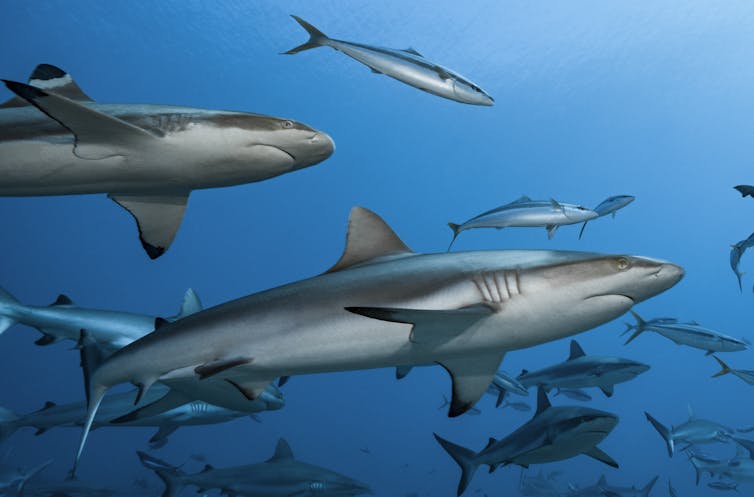
Gray reef sharks and blacktip reef sharks near Tahiti, French Polynesia. Alexis Rosenfeld/Getty Images

Michael Heithaus, Florida International University

There are more than 500 species of sharks in the world’s oceans, from the 7-inch dwarf lantern shark to whale sharks that can grow to over 35 feet long. They’re found from polar waters to the equator, at the water’s surface and miles deep, in the open ocean, along coasts and even in some coastal rivers.

With such diversity, it’s no surprise that sharks serve many ecological functions. For example, the largest individuals of some big predatory species, such as tiger and white sharks, can have an oversized role in maintaining balances among species. They do this by feeding on prey and sometimes by just being present and scary enough that prey species change their habits and locations.

In a newly published study, colleagues and I surveyed decades of research on sharks’ ecological roles and considered their future in oceans dominated by people. We found that because sharks play such diverse and sometimes important functions in maintaining healthy oceans, their current decline is an urgent problem. Since 1970, global populations of sharks and rays have decreased by more than 70%.

People are killing many types of sharks at unsustainable rates, mainly through overfishing. We see a need for nations to rethink where and how to conserve sharks for healthy oceans. https://www.youtube.com/embed/rB4zSDv3oSk?wmode=transparent&start=0 Sharks and rays are overfished as food sources and for oils produced in their livers. Fishing has extended into ever-deeper waters, where many little-studied species live.

How sharks foster seagrasses

Along the remote coast of Western Australia, more than two decades of work shows that the mere presence of tiger sharks shapes the entire seagrass ecosystem by changing where and how big grazers, such as sea turtles and sea cows, feed.

Having tiger sharks nearby protects wide swaths of seagrass from being overgrazed, allowing it to grow into thick underwater meadows that provide habitat for juvenile fish and shellfish. These species are important food for other animals and for humans.

A thick carpet of seagrass underwater with light shining down from the surface.
A healthy seagrass bed in Shark Bay, Western Australia, protected from overgrazing by the presence of tiger sharks. Michael Heithaus, CC BY-ND
A sandy bottom with sparse tufts of seagrass
This seagrass bed in Australia’s Shark Bay is in an area with few sharks. It has been heavily grazed and offers little cover for fish or other species. Michael Heithaus, CC BY-ND

In places where tiger sharks have declined and turtle populations have expanded, seagrasses are being overgrazed. In Bermuda, for example, the exploding turtle population has led to an almost total collapse of seagrasses.

White sharks produce some of the same effects. Along the California coast, where white shark numbers are increasing, otters are spending more time in the safety of protected inland waters and less time in the open waters of Monterey Bay. The otters prey on crabs, which in turn feed on grazing invertebrates such as sea slugs that clean algae from seagrasses. More otters means fewer crabs, more grazers and healthier seagrasses.

Kelp forests and reefs

Kelp forests are dense stands of large brown algae that grow in shallow zones near coasts. Along the U.S. West Coast, overhunting drove local populations of sea otters to extinction by the early 1900s. This caused huge kelp forest losses by allowing sea urchins – a favorite food of otters – to spread and consume kelp.

Over the past 50 years, otter populations have rebounded with federal protection. But as white sharks expand their ranges northward, they are preventing otters from expanding their range because there aren’t kelp forests for the otters to hide in.

The otters will likely expand their ranges only once kelp forests become established. This complicates restoration efforts, since otters won’t be removing enough urchins for kelp to become established.

When sharks are present near coral reefs, fish avoid the sharks by sticking close to the safety of the reef. This reduces grazing on seagrasses and algae across wide areas. There is still much to learn, however, about when, where and how sharks might be important for coral reef health.

Food and nutrient sources

Sharks can also be prey. Some, including large species like white sharks, are important food sources for some killer whale populations around the world. Smaller sharks, including blacktip sharks, can be key menu items for larger sharks, such as great hammerheads.

As sharks consume prey in one place and excrete waste elsewhere, they move nutrients throughout the ocean. In the Pacific, for example, gray reef sharks move nitrogen from the offshore waters where they feed to the coral reefs where they spend their days, providing important fertilizer for ocean food webs.

In Florida’s coastal waters, young bull sharks feed during brief visits to the ocean, then return to safer, nearly freshwater rivers, where they spend most of their time and release nutrients in their waste.

Sometimes sharks’ presence helps other fish. In the open ocean, sharks’ rough scales make perfect scratching posts for fish to remove parasites.

Protecting sharks’ roles

Our review makes clear that sharks play diverse roles in maintaining healthy oceans. We see important implications for shark conservation.

Step 1 would be to set goals beyond simply ensuring that there are sharks in the oceans and to target species that have key ecological roles.

Within populations, it is important to protect certain types of individual sharks. For example, the largest tiger sharks are the ones that shape the behavior of turtles and sea cows, benefiting seagrass ecosystems. Intensive fishing worldwide makes it extremely challenging for large sharks that can live for decades or even centuries to survive and grow to ecologically important sizes.

Working with local communities in coastal areas could build support for protecting these large ocean predators, much as conservationists are working on land to protect iconic predators such as wolves. Nations could build networks of large protected areas that forbid shark fishing, focusing on key areas where individual sharks may roam. https://www.youtube.com/embed/8cQK9b6RAxo?wmode=transparent&start=4 Redesigning fishing gear to target desired species and reduce catch of sharks and other nontarget species can make fishing more sustainable.

Research shows that sharks benefit from creating protected areas, limiting shark catch outside these zones and restricting use of fishing gear that does the most harm to sharks, such as gill nets and longlines. With a clearer understanding of sharks’ ecological value, my colleagues and I hope to see focused action at all levels to protect these essential animals.

Michael Heithaus, Executive Dean of the College of Arts, Sciences & Education and Professor of Biological Sciences, Florida International University

This article is republished from The Conversation under a Creative Commons license. Read the original article.

Continue ReadingOceans without sharks would be far less healthy – new research

Human Activity Pushing More Than 1 in 5 Migratory Species Toward Extinction: UN

Spread the love

Original article by JULIA CONLEY republished from Common Dreams under Creative Commons (CC BY-NC-ND 3.0).

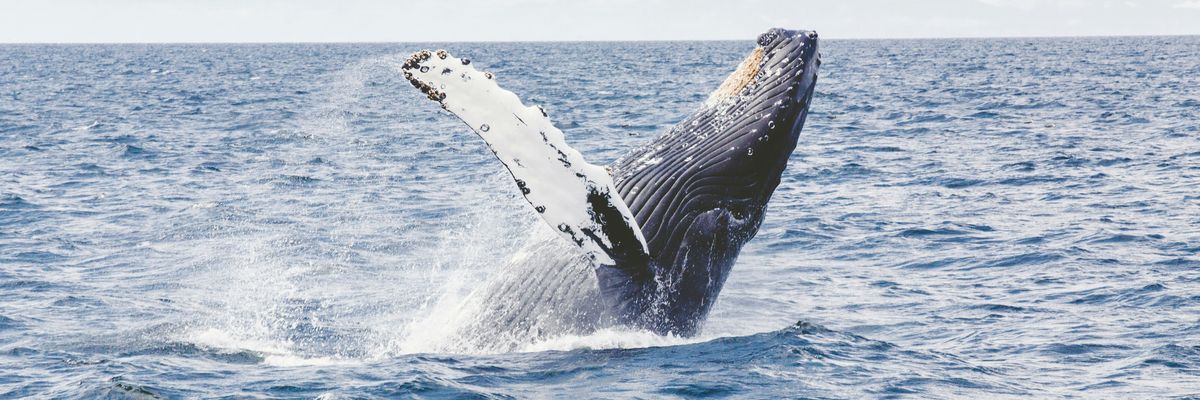
A humpback whale is seen in the ocean. (Photo: Thomas Kelley/Unsplash)

“The global community has an opportunity to translate this latest science of the pressures facing migratory species into concrete conservation action,” said one U.N. official.

As world governments gathered in Uzbekistan Monday for the United Nations conference on migratory species, they centered the theme “Nature Knows No Borders”—an idea that a new landmark report said must take hold across the globe to push policymakers in all countries and regions to protect the billions of animals that travel each year to reproduce and find food.

The Convention on the Conservation of Migratory Species of Wild Animals (CMS) marked the opening of the 14th Conference of the Parties (CMS COP14) to the United Nations biodiversity treaty by releasing the first-ever State of the World’s Migratory Species report, showing that nearly half of migrating species are declining in population.

The crisis is especially dire for more than 1 in 5 species that are threatened with extinction, and 70 species listed under the CMS which have become more endangered, including the steppe eagle, the Egyptian vulture, and the wild camel.

The populations of nearly all species of fish listed in the U.N. treaty, including sharks and rays, have declined by 90% since the 1970s.

The two biggest drivers of endangerment and threatened extinction are overexploitation—including incidental and intentional capture—and habitat loss, and both are directly caused by human activity.

Seven in 10 CMS-listed species are threatened by overexploitation, while 3 in 4 of the species are at greater risk of dying out due to habitat loss, as humans expand energy, transportation, and agricultural infrastructure across the globe.

The climate crisis and planetary heating, pollution, and the spread of invasive species—thousands of which are introduced by humans—are also major threats to migratory species, the report says.

“Unsustainable human activities are jeopardizing the future of migratory species—creatures who not only act as indicators of environmental change but play an integral role in maintaining the function and resilience of our planet’s complex ecosystems,” said Inger Andersen, undersecretary-general of the U.N. and executive director of the U.N. Environment Program (UNEP). “The global community has an opportunity to translate this latest science of the pressures facing migratory species into concrete conservation action. Given the precarious situation of many of these animals, we cannot afford to delay.”

Migratory species “reinforce” the fact that nature does not observe borders put in place by humans, Andersen added in a video posted on social media, and humans must work across borders to ensure these species are protected.

According to the report, nearly 10,000 of the world’s key biodiversity areas are crucial for the survival of migratory species, but more than half are not designated as areas that must be conserved—and 58% are under threat due to human activities.

Mapping and taking adequate steps to protect “the vital locations that serve as breeding, feeding, and stopover sites for migratory species” is a key priority, said the CMS in a statement.

“Migratory species rely on a variety of specific habitats at different times in their lifecycles,” said Amy Fraenkel, CMS executive secretary. “When species cross national borders, their survival depends on the efforts of all countries in which they are found. This landmark report will help underpin much-needed policy actions to ensure that migratory species continue to thrive around the world.”

In addition to increasing understanding of migration paths and minimizing human infrastructure in the pathways, the report recommended that policymakers “strengthen and expand efforts to tackle illegal and unsustainable taking of migratory species”; scale up efforts to tackle climate change and light, noise, chemical, and plastic pollution; and consider expanding CMS listings to include more at-risk migratory species in need of international attention.

“There are many things that are needed to be done on addressing the drivers of environmental change, such as agriculture for habitat destruction, the sprawl of cities, we have to look at rail, road, and fences,” said Fraenkel. “One of the most important things for migratory species is something we call ecosystem integrity: they need particular sites to breed, feed, and travel. If those sites cannot be accessed or don’t exist any more, then it’s obviously going to be detrimental.”

The report focused on 1,189 migratory species identified by the U.N. as needing protection, but found that another 399 migratory species are either threatened or near threatened with extinction.

“People might not realize that whales, lions, gorillas, giraffes, and many birds are migratory species,” Fraenkel said.

At the opening ceremony of CMS COP14, Andersen called on policymakers to live up to the conference’s theme “by ensuring free passage of migratory species and by ensuring that, through multilateralism, we reach a hand across every border to ensure long-term sustainability, for people and for planet.”

Reversing population decline is possible, the report emphasized, pointing to coordinated local action in Cyprus that reduced illegal bird netting by 91% and “hugely successful” conservation and restoration work in Kazakhstan, “which has brought the saiga antelope back from the brink of extinction.”

“I ask parties to consider how to work in harmony with other processes for mutually assured success,” said Andersen, “all in the interests of sustainable economies and societies.”

Original article by JULIA CONLEY republished from Common Dreams under Creative Commons (CC BY-NC-ND 3.0).

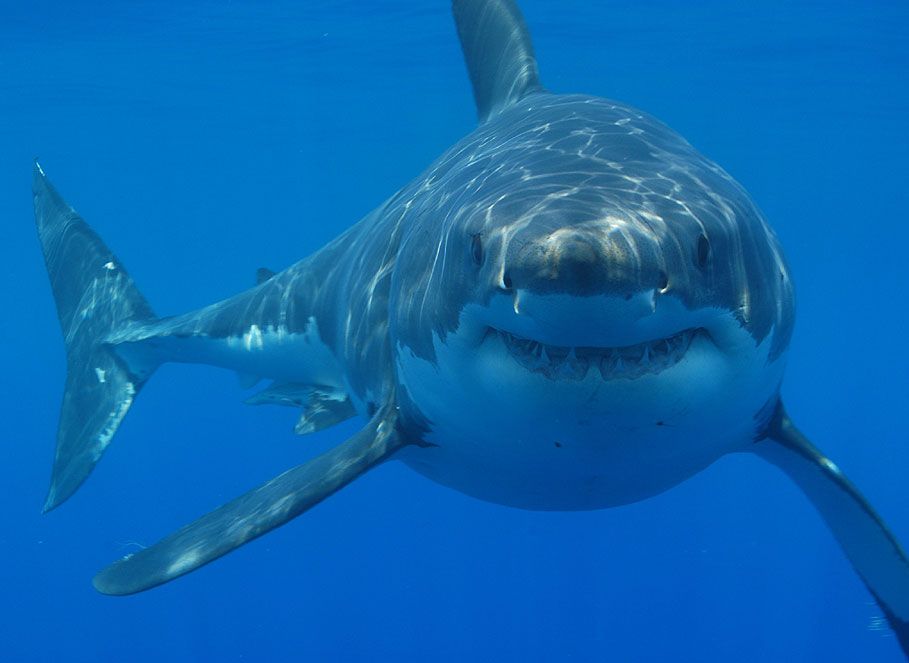
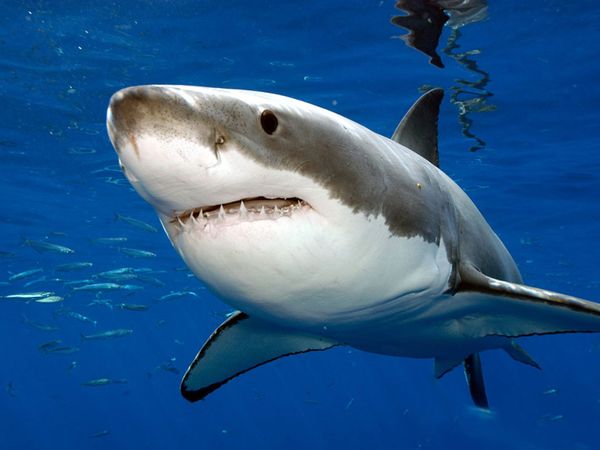
Image of a Great White Shark
Image of a Great White Shark, think it might be the same wun actually.
Continue ReadingHuman Activity Pushing More Than 1 in 5 Migratory Species Toward Extinction: UN

Within Decade, Planet’s Natural World Facing Largest Mass Extinction Event Since Dinosaurs

Spread the love

Latest analysis by World Wildlife Fund warns humanity—possible “victim of it own lifestyle”—might ultimately be added to list of threatened species.

JULIA CONLEY December 30, 2021

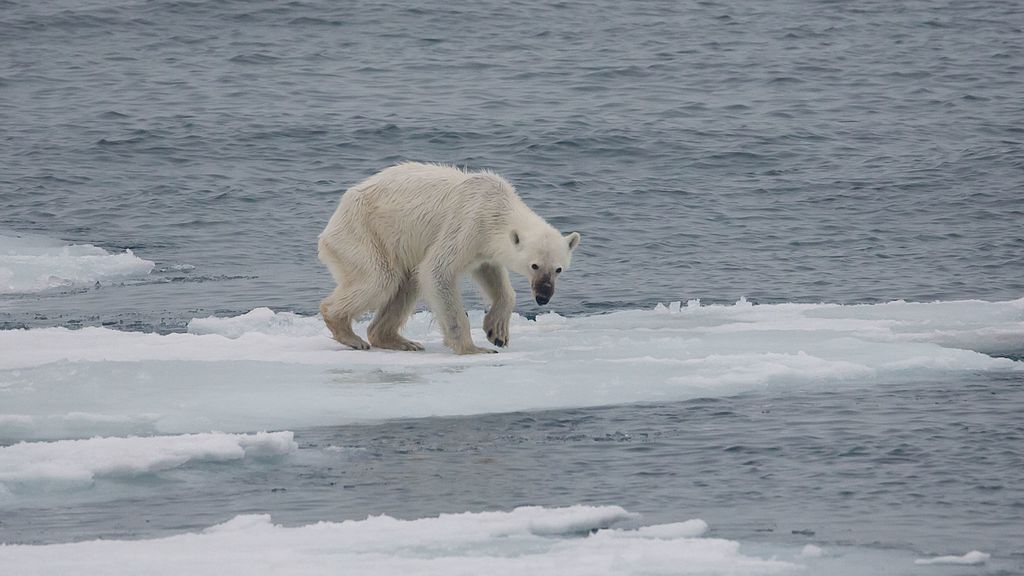
In summer, some polar bears do not make the transition from their winter residence on the Svalbard islands to the dense drift ice and pack ice of the high arctic where they would find a plethora of prey. This is due to global climate change which causes the ice around the islands to melt much earlier than previously. The bears need to adapt from their proper food to a diet of detritus, small animals, bird eggs and carcasses of marine animals. Very often they suffer starvation and are doomed to die. The number of these starving animals is sadly increasing.AWeith This file is licensed under the Creative Commons Attribution-Share Alike 4.0 International license.
https://en.wikipedia.org/wiki/File:Endangered_arctic_-_starving_polar_bear.jpg

Increasingly dire ecological damage and severe impacts of the climate crisis are pushing the natural world towards a mass extinction event unparalleled since the age of the dinosaurs, conservationists in Germany warned this week, with humanity possibly facing self-annihilation if behaviors do not change.

Releasing its annual “Winners and Losers” list on Wednesday, the World Wildlife Fund’s German branch said 40,000 of the 142,500 species listed on the Red List of Threatened Species by the International Union for Conservation of Nature (IUCN) are “threatened with extinction.”

“If the earth is sick, so will the people [be], because we depend on vital ecosystems and biodiversity for our own safe and healthy life.”

The Red List is now longer than it has ever been since the IUCN began cataloging threatened species in 1964.

More than 40% of amphibians, 27% of shark and ray species, a third of reef building corals, and more than a quarter of all mammals on the Red List are threatened with extinction.

At the current rate of species loss, “around one million species could go extinct within the next decade—which would be the largest mass extinction event since the end of the dinosaur age,” WWF Germany said in a statement.

With planet-heating atmospheric carbon dioxide emissions reaching a record high this year—contributing to drought, habitat loss, extreme weather, and health problems in humans as well as other species—the organization noted that humans should view the extinction crisis as one that could affect them directly.

“Species conservation is no longer just about defeating an environmental problem, but is rather about the question of whether or not humanity will eventually end up on the Red List in an endangered category—and thereby become a victim of its own lifestyle,” WWF Germany director Eberhard Brandes said.

“If the earth is sick, so will the people [be],” he added, “because we depend on vital ecosystems and biodiversity for our own safe and healthy life.”

The “losers” on the WWF’s list include the polar bear, which is already suffering from the erosion of its Arctic habitat as the northern region becomes warmer. The Arctic Ocean could be completely free of ice by 2035 at the current rate of loss, making it increasingly difficult for the bears to find food.

Sharks and rays also made the list, the result of overfishing, habitat loss, and the climate crisis. A third of all sharks and rays in the oceans were classified as threatened in 2021, the WWF said.

African forest elephants have been considered “critically endangered” for the first time this year, as their population in Central and West Africa has plummeted by 86% in the past three decades.

The inclusion of 40,000 species on the IUCN’s list of threatened species represents a major acceleration of biodiversity loss. In 2010, 17,300 species were considered to be under threat, according to The Guardian.

The WWF’s list of “winners” this year includes bearded vultures, which have benefited from a resettlement program in the last 30 years that’s resulted in more than 300 of the birds now living in the Alpine region; the Iberian lynx, whose population has increased more than tenfold in the past 18 years; and Siamese crocodiles in Cambodia. Eight young crocodiles were found by researchers this year, marking the first time in more than a decade that the species has reproduced in nature.

“The winners of the list show that there are still opportunities for species protection,” said Brandes. “If we implement effective nature conservation measures, we can protect plants, animals and, ultimately, the climate.”


From https://www.commondreams.org/news/2021/12/30/within-decade-planets-natural-world-facing-largest-mass-extinction-event-dinosaurs licensed under Creative Commons (CC BY-NC-ND 3.0). Feel free to republish and share widely.

Continue ReadingWithin Decade, Planet’s Natural World Facing Largest Mass Extinction Event Since Dinosaurs