Movement leaders in the US say Trump’s agenda will be met with a strong fightback

Spread the love

Original article republished from peoples dispatch under a Creative Commons Attribution-ShareAlike 4.0 (CC BY-SA) license.
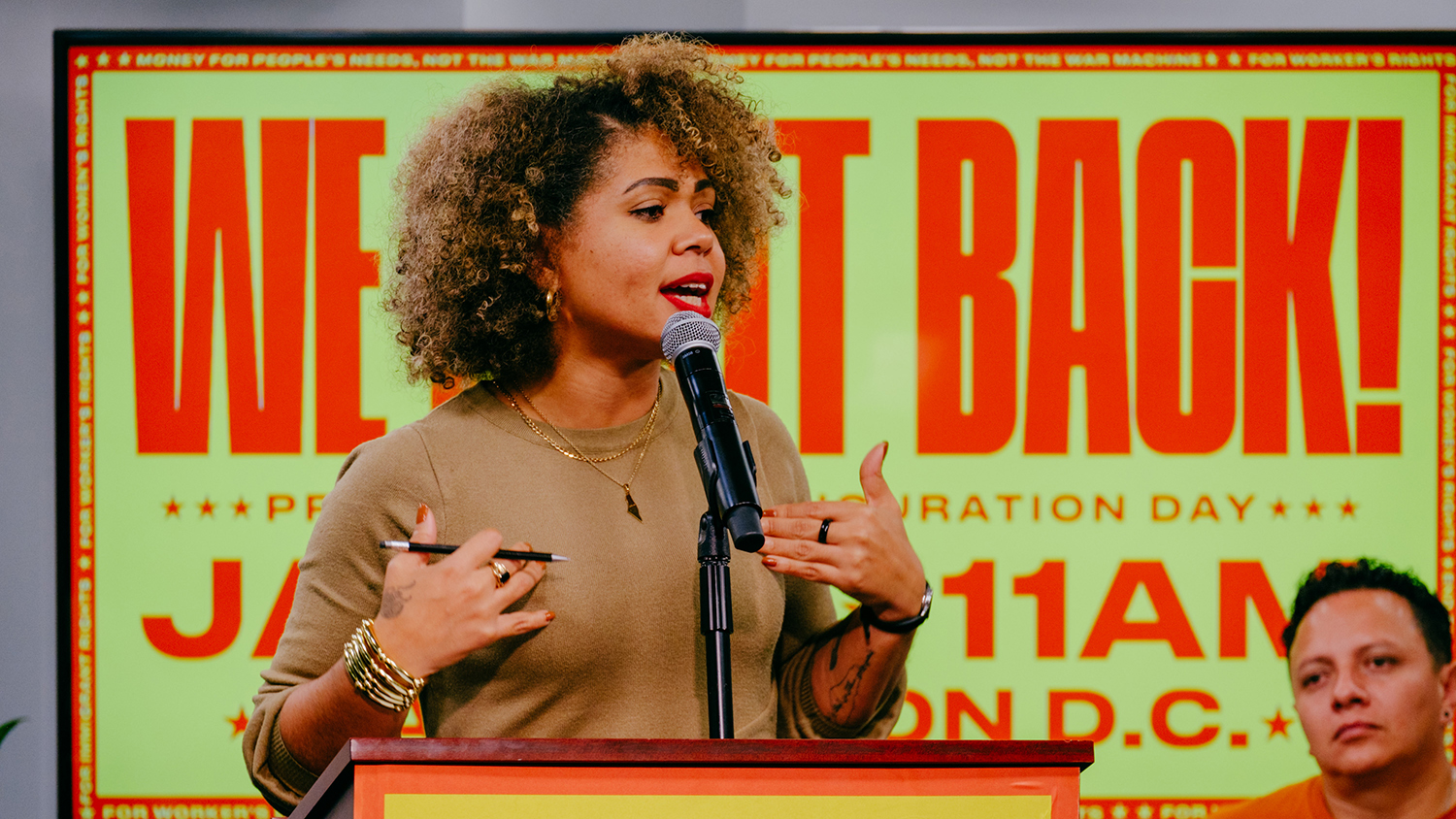
Claudia De la Cruz speaks at “What is to be done?” panel on November 8 (Photo: Wyatt Souers)

US-based movement leaders take up the task of answering the burning question: “What is to be done?”

Just two days after Donald Trump’s landslide victory against Vice President Kamala Harris, US socialists and movement leaders took up the task of answering the burning question: What is to be done following Trump’s win?

Hundreds of people gathered at the People’s Forum in New York City on November 8 for a panel discussion which featured the presidential candidate of the Party for Socialism and Liberation, Claudia De la Cruz, who ran against both Trump and Harris in a explicitly socialist campaign, Brian Becker, executive director of the anti-war organization the ANSWER Coalition, Eugene Puryear, journalist with BreakThrough News, Jorge Torres, part of the National Day Laborer Organizing Network with extensive experience organizing undocumented immigrant workers, and Miriam Osman, leader in the Palestinian Youth Movement, which has played a central role in the Palestine solidarity movement across North America.

Layan Fuleihan, Education Director of the People’s Forum, opened up the discussion. “We, the workers, the social movements, the immigrant families, the young people, the anti-war movement, the working class as a whole, we are faced with many urgent questions,” she said. 

“How will we confront this continual rise of the right? Will we be driven by fear and apathy or pessimism? Will we stay home? Or will we organize our forces and chart our own path forward? Will we follow the lead of the Democratic Party and mourn their loss? Or will we assert that we reject the billionaire agenda no matter which party is executing its orders?”

Speakers put the blame for Trump’s win not on a shift to the right by working class people, but on the failures of the Democratic Party. Claudia De la Cruz spoke to what she called the “scapegoating of working class sectors” by the Democrats. 

“They are saying we have to blame Black men, that we have to blame Latino men, that we have to blame immigrant communities, that we have to place judgment on those who didn’t go out and vote,” she said. 

In reality, according to De la Cruz, “it is the spinelessness of the Democratic Party that has brought us here.” 

“While Trump won this election, we cannot pretend that the Democrats have not allowed and conducted attacks against the working class people for decades,” De la Cruz said. “If we think about the last 16 years, the Democratic Party had power for 12 of those years, and they didn’t do anything. Not a single thing to protect or expand our rights. In fact, they sat back and watched how our rights were placed on a chopping block and said, we can’t do anything about it.” 

Torres, who himself comes from a migrant background and was undocumented, spoke not only of the fear that exists within immigrant communities of Trump’s anti-migrant policy promises, but also the resolve to fight back. According to Torres, for the past few months, immigrant day laborers within the NDLON network were very scared of what would happen in the event of a Trump win. Trump has promised to deport between 15 to 20 million people in the largest mass deportation in US history, a policy which could result in family separations affecting up to 1 in 3 Latinos in the country. 

But this did not paralyze these communities, who instead came together in a renewed resolve to “start organizing for real,” Torres described. Communities began to ask one another, “What does that mean when we say the people save the people?”

“We made a decision that it was about time to organize local communities in popular committees across the country,” Torres said. “We decided to organize popular assemblies across the country. In around one month we organize almost 25 assemblies across the country. And now we have almost 45+ committees led by workers, led by undocumented people, led by people that really are directly impacted.” Torres also mentioned that NDLON is working closely with the Landless Rural Workers’ Movement (MST) in Brazil, speaking to deep ties of international solidarity.

According to Torres, “most of the committees have lost their belief and hope and the Democratic Party or the Republican Party.” 

“By now it is time to organize, and we just have us, and we don’t have no one else,” Torres asserted. 

According to Eugene Puryear, Trump’s policy promises to round up migrant workers should be a call to action for a mass movement to defend immigrant communities. This movement can find inspiration from the history of the movement for the abolition of slavery in the United States. Puryear recalled the history of the Fugitive Slave Act, which imposed harsh punishments on those who sheltered runaway slaves. But this certainly did not stop abolitionists and anti-slavery activists from protecting slaves anyway. 

“Whether or not the law said one thing, there was a higher law: that they had to fight against slavery no matter the risk,” Puryear described. 

“So [abolitionists] formed things called vigilance committees, all across the country, that said that when a fugitive slave is brought before the bar into the courthouse, we will go to the courthouse and we will physically resist the imposition of returning them back. That we will physically remove them from the courthouse if we have to, and put them on the Underground Railroad and send them to Canada. And maybe we won’t succeed. Maybe we’ll be beaten. In many cases, these were serious tussles. People were pulling out guns. Maybe we’ll even be killed. But we would rather risk our lives than allow our formerly enslaved brothers and sisters to be taken back.”

There are parallels between the Fugitive Slave Act of 1850 and Trump’s promise to remove tens of millions of migrants from the country by force, Puryear argued. And the historic tasks of the mass movement, therefore, are similar to those shortly before slavery was abolished. “You can say it’s scary, and it is scary. You can say it’s odious, it is odious. But when they start bringing the trucks around to round people up, you can also say, I’m going to step outside of my door and I’m going to link arms with my neighbors. And if you’re going to throw them out, you better throw me out with them because we’re standing together no matter what,” Puryear said.

Brian Becker also echoed this same militant fighting spirit, rooted in the lessons of past movements. Becker drew attention in particular to the movement that arose after 2016 in opposition to Trump’s first election. 

“There’s another side to the question of what is to be done, and that is what is to not be done,” Becker said. “Let’s learn the lesson of the first Trump administration when Trump came into office. So many people went to the airports because he said, we’re going to ban Muslims from coming into the country. Massive protests on Inauguration Day. We outnumbered Trump supporters. This was the anti-Trump resistance,” he described.

“But what happened? The Democratic Party completely co-opted that movement, completely took over that movement, because they said you have to resist Trump, the person, which meant that the best and practical way to do it, is to get rid of Trump by electing the Democrats.”

This co-optation marked the end of this mass movement, which because merely a “tail to the Democratic Party,” Becker described. 

According to Becker, “the problem isn’t just Trump. The problem is the capitalist system and the ruling class parties. The Democrats and the Republicans are not an opposition to capitalism. They are the voice of capitalism.”

Becker spoke to the need to “build a political program” independent of the two establishment parties, which speaks to the needs of the masses of people. 

Miriam Osman of the Palestinian Youth Movement spoke to the way that the movement in solidarity with Palestine has given people in the US renewed political clarity regarding the similarities between both major parties. “Our task is to draw more and more people into our struggle against the shared enemy, the shared enemy of the Palestinian people, the shared enemy of the working people of the world, and the shared enemy of working people in the United States,” which is the US ruling class, Osman articulated. “Our task is to build power. Our task is to unify our efforts, because this is the only thing that’s going to give us the force to transform this system.”

Original article republished from peoples dispatch under a Creative Commons Attribution-ShareAlike 4.0 (CC BY-SA) license.
Continue ReadingMovement leaders in the US say Trump’s agenda will be met with a strong fightback

Exploiting black labor after the abolition of slavery

Spread the love

Exploiting black labor after the abolition of slavery

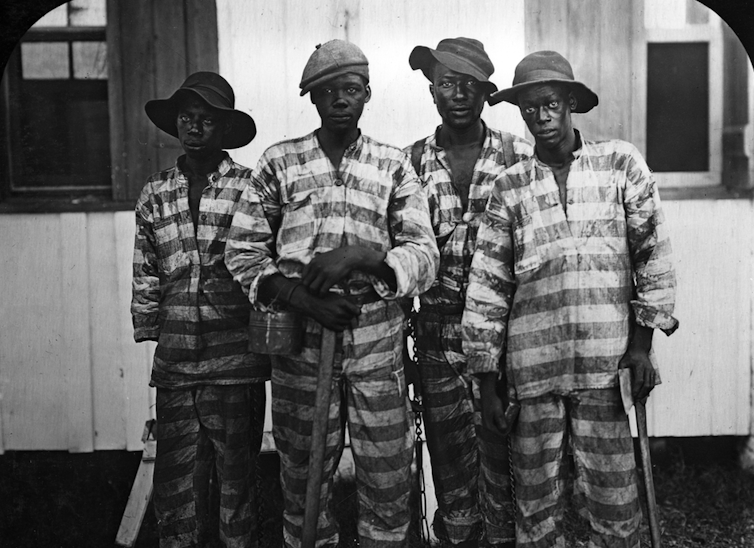
Convicts leased to harvest timber in Florida around 1915.

Kathy Roberts Forde, University of Massachusetts Amherst and Bryan Bowman, University of Massachusetts Amherst

The U.S. criminal justice system is riven by racial disparity.

The Obama administration pursued a plan to reform it. An entire news organization, The Marshall Project, was launched in late 2014 to cover it. Organizations like Black Lives Matter and The Sentencing Project are dedicated to unmaking a system that unjustly targets people of color.

But how did we get this system in the first place? Our ongoing historical research project investigates the relationship between the press and convict labor. While that story is still unfolding, we have learned what few Americans, especially white Americans, know: the dark history that produced our current criminal justice system.

If anything is to change – if we are ever to “end this racial nightmare, and achieve our country,” as James Baldwin put it – we must confront this system and the blighted history that created it.

During Reconstruction, the 12 years following the end of the Civil War and the abolition of slavery, former slaves made meaningful political, social and economic gains. Black men voted and even held public office across the South. Biracial experiments in governance flowered. Black literacy surged, surpassing those of whites in some cities. Black schools, churches and social institutions thrived.

As the prominent historian Eric Foner writes in his masterwork on Reconstruction, “Black participation in Southern public life after 1867 was the most radical development of the Reconstruction years, a massive experiment in interracial democracy without precedent in the history of this or any other country that abolished slavery in the nineteenth century.”

But this moment was short-lived.

As W.E.B. Du Bois wrote, the “slave went free; stood a brief moment in the sun; then moved back again toward slavery.”

History is made by human actors and the choices they make.

According to Douglas Blackmon, author of “Slavery by Another Name,” the choices made by Southern white supremacists after abolition, and the rest of the country’s accommodation, “explain more about the current state of American life, black and white, than the antebellum slavery that preceded.”

Designed to reverse black advances, Redemption was an organized effort by white merchants, planters, businessmen and politicians that followed Reconstruction. “Redeemers” employed vicious racial violence and state legislation as tools to prevent black citizenship and equality promised under the 14th and 15th amendments.

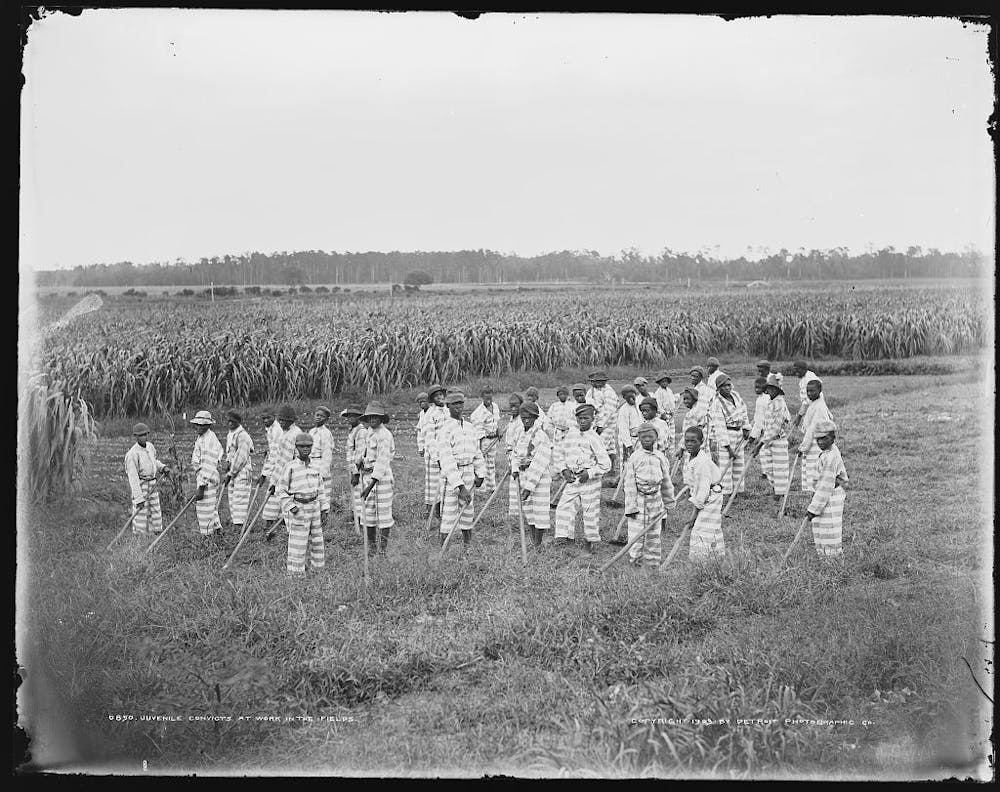
Juvenile convicts at work in the fields, 1903. Library of Congress/John L. Spivak

By the early 1900s, nearly every southern state had barred black citizens not only from voting but also from serving in public office, on juries and in the administration of the justice system.

The South’s new racial caste system was not merely political and social. It was thoroughly economic. Slavery had made the South’s agriculture-based economy the most powerful force in the global cotton market, but the Civil War devastated this economy.

How to build a new one?

Ironically, white leaders found a solution in the 13th Amendment, which ended slavery in the United States in 1865. By exploiting the provision allowing “slavery” and “involuntary servitude” to continue as “a punishment for crime,” they took advantage of a penal system predating the Civil War and used even during Reconstruction.

A new form of control

With the help of profiteering industrialists they found yet a new way to build wealth on the bound labor of black Americans: the convict lease system.

Here’s how it worked. Black men – and sometimes women and children – were arrested and convicted for crimes enumerated in the Black Codes, state laws criminalizing petty offenses and aimed at keeping freed people tied to their former owners’ plantations and farms. The most sinister crime was vagrancy – the “crime” of being unemployed – which brought a large fine that few blacks could afford to pay.

Black convicts were leased to private companies, typically industries profiteering from the region’s untapped natural resources. As many as 200,000 black Americans were forced into back-breaking labor in coal mines, turpentine factories and lumber camps. They lived in squalid conditions, chained, starved, beaten, flogged and sexually violated. They died by the thousands from injury, disease and torture.

For both the state and private corporations, the opportunities for profit were enormous. For the state, convict lease generated revenue and provided a powerful tool to subjugate African-Americans and intimidate them into behaving in accordance with the new social order. It also greatly reduced state expenses in housing and caring for convicts. For the corporations, convict lease provided droves of cheap, disposable laborers who could be worked to the extremes of human cruelty.

Every southern state leased convicts, and at least nine-tenths of all leased convicts were black. In reports of the period, the terms “convicts” and “negroes” are used interchangeably.

Of those black Americans caught in the convict lease system, a few were men like Henry Nisbet, who murdered nine other black men in Georgia. But the vast majority were like Green Cottenham, the central figure in Blackmon’s book, who was snatched into the system after being charged with vagrancy.

A principal difference between antebellum slavery and convict leasing was that, in the latter, the laborers were only the temporary property of their “masters.” On one hand, this meant that after their fines had been paid off, they would potentially be let free. On the other, it meant the companies leasing convicts often absolved themselves of concerns about workers’ longevity. Such convicts were viewed as disposable and frequently worked beyond human endurance.

The living conditions of leased convicts are documented in dozens of detailed, firsthand reports spanning decades and covering many states. In 1883, Blackmon writes, Alabama prison inspector Reginald Dawson described leased convicts in one mine being held on trivial charges, in “desperate,” “miserable” conditions, poorly fed, clothed, and “unnecessarily chained and shackled.” He described the “appalling number of deaths” and “appalling numbers of maimed and disabled men” held by various forced-labor entrepreneurs spanning the entire state.

Dawson’s reports had no perceptible impact on Alabama’s convict leasing system.

The exploitation of black convict labor by the penal system and industrialists was central to southern politics and economics of the era. It was a carefully crafted answer to black progress during Reconstruction – highly visible and widely known. The system benefited the national economy, too. The federal government passed up one opportunity after another to intervene.

Convict lease ended at different times across the early 20th century, only to be replaced in many states by another racialized and brutal method of convict labor: the chain gang.

Convict labor, debt peonage, lynching – and the white supremacist ideologies of Jim Crow that supported them all – produced a bleak social landscape across the South for African-Americans.

Black Americans developed multiple resistance strategies and gained major victories through the civil rights movement, including Brown v. Board of Education, the Civil Rights Act and the Voting Rights Act. Jim Crow fell, and America moved closer than ever to fulfilling its democratic promise of equality and opportunity for all.

But in the decades that followed, a “tough on crime” politics with racist undertones produced, among other things, harsh drug and mandatory minimum sentencing laws that were applied in racially disparate ways. The mass incarceration system exploded, with the rate of imprisonment quadrupling between the 1970s and today.

Michelle Alexander famously calls it “The New Jim Crow” in her book of the same name.

Today, the U.S. has the highest incarceration rate of any country in the world, with 2.2 million behind bars, even though crime has decreased significantly since the early 1990s. And while black Americans make up only 13 percent of the U.S. population, they make up 37 percent of the incarcerated population. Forty percent of police killings of unarmed people are black men, who make up merely 6 percent of the population, according to a 2015 Washington Post report.

It doesn’t have to be this way. We can choose otherwise.

Kathy Roberts Forde, Chair, Associate Professor, Journalism Department, University of Massachusetts Amherst and Bryan Bowman, Undergraduate journalism major, University of Massachusetts Amherst

This article is republished from The Conversation under a Creative Commons license. Read the original article.

Question: Why does WordPress not allow the category ‘Black Americans’ with a capital ‘B’?

Continue ReadingExploiting black labor after the abolition of slavery

Commentary and analysis of recent political events

Spread the love

That Conservative, illiberal Nick Clegg is keen to do the Tories’ work

Clegg leaves the door open to further welfare cuts

George Osborne has made it clear that he plans to introduce in welfare cuts if the Tories win the next election, including a possible reduction in the £26,000 household benefit cap and new limits on child benefit, but where does Nick Clegg stand? At the Deputy PM’s final monthly press conference of the year, I asked him whether he was prepared to consider a reduction in the benefit cap in the next parliament. He told me:

It’s not something that I’m advocating at the moment because we’ve only just set this new level and it’s £26,000, which is equivalent to earning £35,000 before taxI think we need to keep that approach, look and see how it works, see what the effects are, but not rush to start changing the goalposts before the policy has properly settled down.

The key words here are “at the moment”. While Clegg again declared that he believed the priority should be to remove universal pensioner benefits from the well-off (“you start from the top and you work down”), he was careful not rule out a cut in the level of the cap.

Spiked has a good article on modern slavery being make-believe and Theresa May’s Modern Slavery bill addressing a non-existant problem. This blog has addressed slavery not existing. Spiked are on the Want to make a worthwhile donation this Solstice? page.

Firefighters to strike on Christmas Eve and New Year’s Eve. Tony Blair intervened directly in a firefighters’ strike while the FBU was headed by a Labourite idiot. Strange to see Blair referring to the “real world” since he was a total stranger to it.

Image of GCHQ donught buildingHome Secretary Theresa May fails to provide any evidence that the Guardian’s publishing the Edward Snowden leaks have damaged national security as claimed by boss of MI5, Andrew Parker. Keith Vaz, chair of the home affairs committee told May “What you have given us today, and what we have heard so far, is only second-hand information. Mr Parker and Sir John are making statements in open session and nobody knows what the follow-up is.” and “Everyone is appointed by the prime minister … They are asking questions of each other, and giving answers to each other … That is exactly why we need to see them [the agency heads]. But you don’t want us to see them at all.”

Why Cameron is wrong to declare ‘mission accomplished’ in Afghanistan

What the welfare cuts mean for us: ‘The feeling of dread never goes away’

Hungry Christmas: Food Bank Use Soars

2013 in Review: Unions Are the Only Defence Ordinary People Have Left

Poorer than your parents – post-war pensions boom ‘is coming to an end’

Federal judge holds NSA telephone surveillance unconstitutional

Lord Hanningfield says of allowance claims: ‘I have to live, don’t I?’

For the Sake of Humanity Society Must Unleash War on the Tories

SILENT TO THE GRAVE (The Waterhouse Report)

Continue ReadingCommentary and analysis of recent political events

Politics news allsorts

Spread the love

Image of reams of paper on a palletThe ConDem coalition government has published the HS2 bill. At 49,910 pages long it evades democracy by preventing representations. 891 pages would need to be read every day to simply read it in the 8 weeks for representations. It presents a wonderful opportunity for protestors although it will waste a lot of paper and ink. No MPs were seen under the bill in parliament as it was passed almost unanimously last night.

A source close to the government said “That was a good wheeze – it was one of Lansley’s again. Drowning the NHS in bureaucracy, castrating 38degrees, charities and the unions with the lobbying bill and now this. We’ve decided to ruthlessly pursue our narrow class interests now that it’s accepted that we have no chance to win the general election. HS2 should sustain us for a decade or two if we take it easy on the port.”

The Guardian asks what it would take to regain Labour voters. The comments are clearly calling for nationalisation of utilities and trains and to abandon Neo-Liberalism. No chance of that with this ‘Labour’ party.

I must confess that even I was taken in by Miliband pretending to be a Socialist at the conference this year. It only lasted about two days. It’s very clear what the Labour party needs to do to attract voters. I’m effectively disenfranchised without a choice between the three main Neo-Liberal parties. It’s clear that there are many that feel exactly the same.

Shadow Home Office Minister Diana Johnson makes a valid point about Theresa May supporting migrant domestic slavery by tying their visas to one employer.

Unfortunately she also accepts uncritically the current case of “invisible handcuffs” slavery saying “The Labour party would deal with this case proportionately. We would try the ‘invisible handcuffs’ factional splitter Maoist squatters case in the special Court of Make-believe and convict to ten years in the pretend prison at the back of the wardrobe.”

No mention of Cameron’s plans for web censorship. Let’s hope it’s quietly forgotten.

Continue ReadingPolitics news allsorts