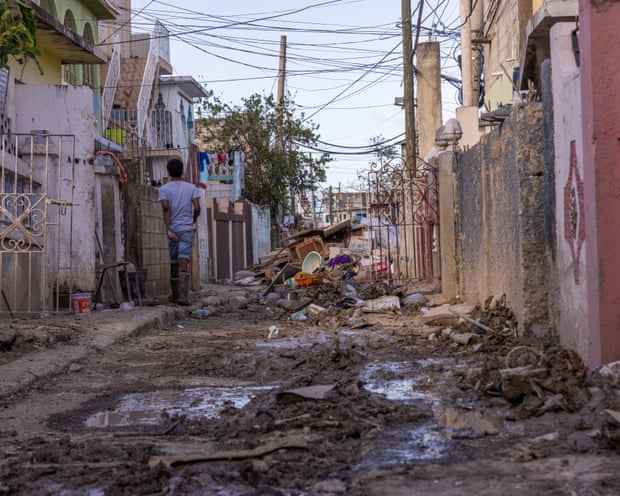
The aftermath of Hurricane Melissa in Catherine Hall, Montego Bay, Jamaica, on 4 November 2025. Photograph: Ina Sotirova/The Guardian
The record-breaking 252mph winds of Hurricane Melissa that devastated Caribbean islands at the end of October were made five times more likely by the climate crisis. Scorching wildfire weather in Spain and Portugal during the summer was made 40 times more likely, while June’s heatwave in England was made 100 times more likely.
Attribution science has made one thing clear: global heating is behind today’s extreme weather. That greenhouse gas emissions warmed the planet was understood. What can now be shown is that this warming produces record heatwaves and more violent storms with increasing frequency.
What we can do to minimise, or at least reduce, the risks to life from such events – as well as more gradual changes – is what climate adaptation experts think about all the time. The alarming consensus is that we are not doing anywhere near enough. The result is paid for in lives: floods and cyclonic storms across Thailand, Sri Lanka and Indonesia left hundreds dead at the end of November.
…
For the rich world, adaptation is prudent. For the poor world, it is survival. The latest UN report is unequivocal: developing countries will need more than $310bn annually by 2035, yet received just $26bn in 2023. Catastrophic floods in Asia and worsening droughts in Africa this year point to the growing need to accelerate climate adaptation.
Under the Paris agreement, nationally determined contributions (NDCs) – country plans to tackle global heating – are meant to cover both emissions reduction and adaptation to climate impacts.
But NDCs end up focusing mostly on cutting greenhouse gases and establishing decarbonisation pathways. That needs to change. National adaptation plans, which came out of Cop16, need to be foregrounded. These put adaptation centre stage – and demand real plans, real finance, real justice. They ask the question that really matters now: how do vulnerable nations survive a warming world that emissions cuts alone can’t stop?
Donald Trump urges you to be a Climate Science denier like him. He says that he makes millions and millions for destroying the planet, Burn, Baby, Burn and Flood, Baby, Flood.Nigel Farage urges you to ignore facts and reality and be a climate science denier like him and his Deputy Richard Tice. He says that Reform UK has received £Millions and £Millions from the fossil fuel industry to promote climate denial and destroy the planet.Elon Musk urges you to be a Fascist like him, says that you can ignore facts and reality then.
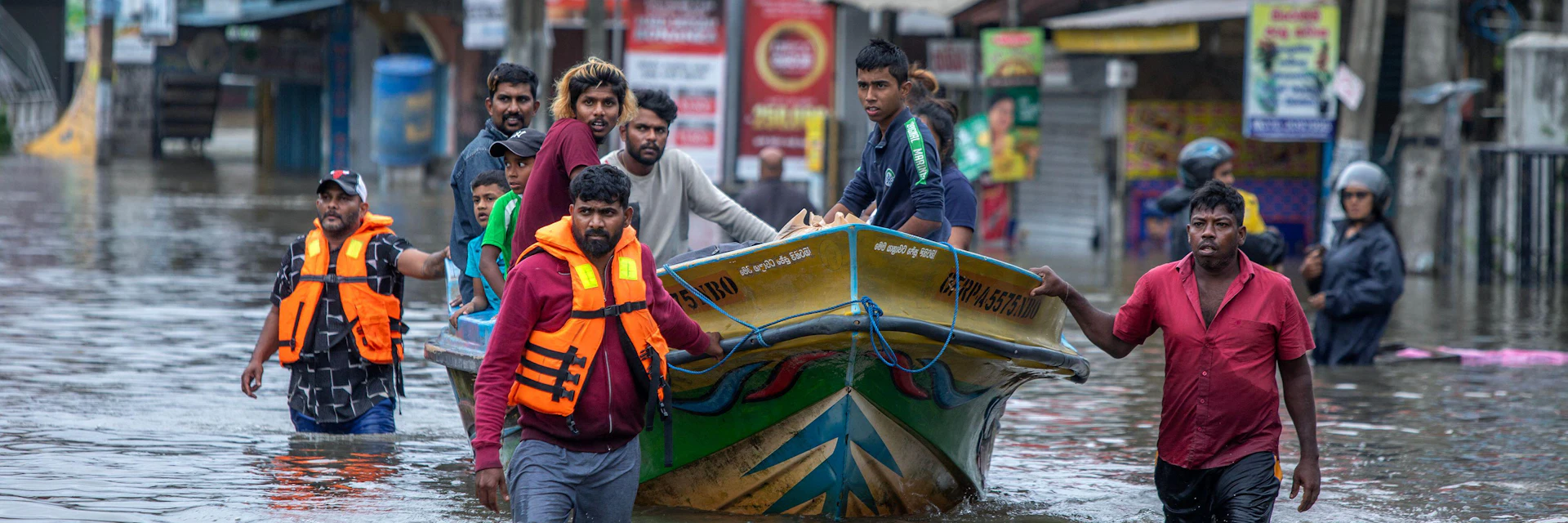
The final week of November was devastating for several South Asian countries. Communities in Sri Lanka, Indonesia and Thailand were inundated as Cyclones Ditwah and Senyar unleashed days of relentless rain. Millions were affected, more than 1,500 people lost their lives, hundreds are still missing, and damages ran into multiple millions of US dollars. Sri Lanka’s president even described it as the most challenging natural disaster the island has ever seen.
When disasters like this happen, the blame often falls on a failure in early warnings or poor preparedness. This was the case with major floods in Kerala, south India, in 2018, which devastated my hometown.
But this time, the forecasts were largely accurate; the authorities knew the storms were coming, yet the devastation was still immense.
So, if the forecasts were good enough, why were the impacts still so severe?
Weak winds, extreme rain
One emerging explanation is that these storms were not dangerous because of their winds, but because they produced unusually intense rainfall.
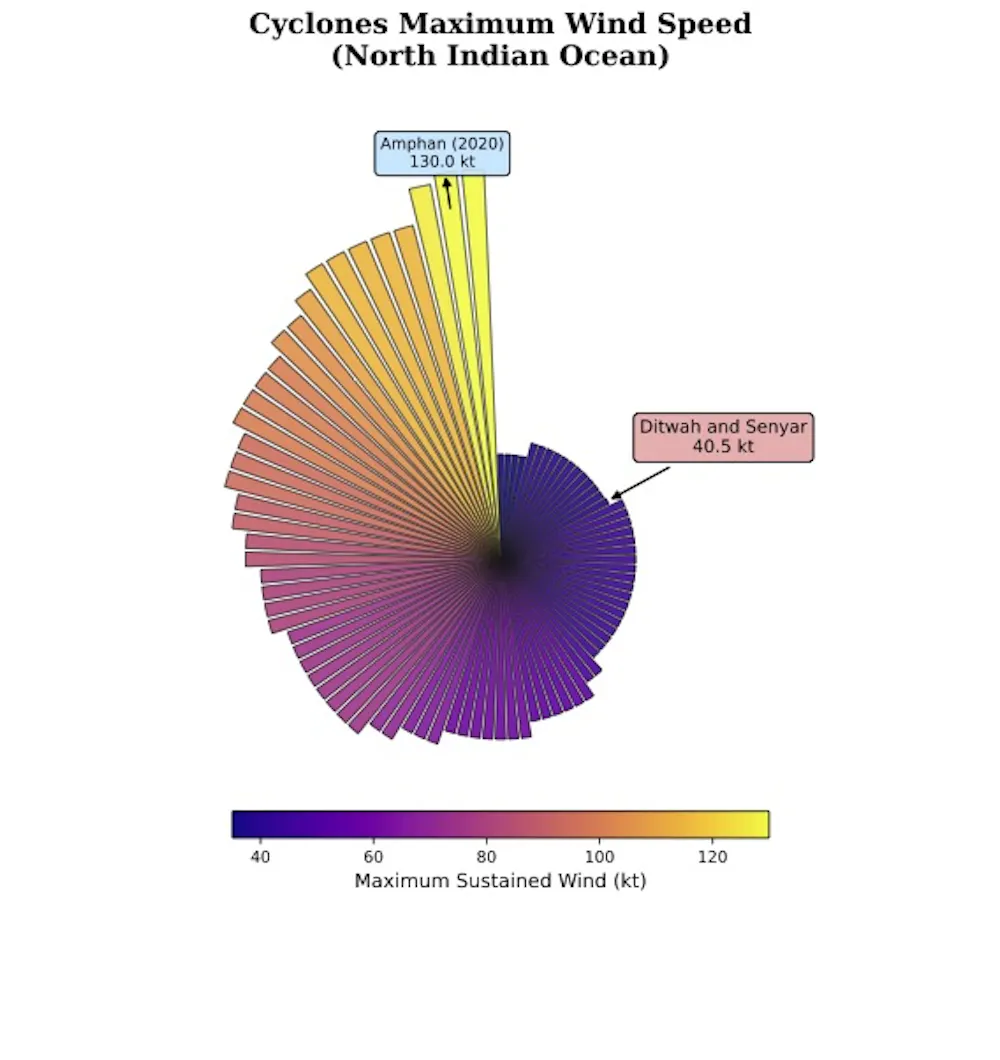
This graph of all cyclonic storms over the north Indian Ocean since 2001 shows Ditwah and Senyar weren’t particularly windy. (Wind speed measured in knots. 1 knot is about 1.15 mph or 1.85 kph) Ligin Joseph (data: IBTrACS), CC BY-SA
Consider Cyclone Ditwah. Its peak winds were around 75 km/h (47 mph). That’s windy, but nothing special. In the UK, it would be classified merely as a “gale” rather than a “storm”. It was far weaker than the 220 km/h winds of the powerful 1978 cyclone that also struck Sri Lanka. Yet Ditwah still caused massive devastation.
What explains this apparent contradiction? It’s too early to say definitively, but climate change is likely a part of the story. Even when storms are not especially strong in wind terms, the amount of rain they carry is increasing.
A warmer atmosphere holds more water
A well established meteorological rule helps explain why. For every degree of global warming, the atmosphere can hold about 7% more moisture.
As the planet warms, the air above us becomes a larger reservoir, waiting to dump more water on us. When storms form, they can tap into this expanded supply, often in extremely short bursts. Even if wind speeds are modest, the rainfall alone can be catastrophic.
The oceans matter even more
Warming oceans play an even more powerful role, as cyclones draw their energy from warm ocean waters. Satellite data from late November shows just how warm the eastern Indian Ocean was, with large areas more than 1°C above normal during Ditwah and Senyar.
In the days before the cyclones formed (20–24 November), the oceans were even warmer than usual, creating conditions that could have fuelled and intensified the rainfall. Ligin Joseph (Data: OISST; track positions are approximate), CC BY-SA
Such warm anomalies are no longer unusual. The oceans have absorbed more than 90% of the excess heat trapped by greenhouse gases, and long-term observations show a clear upward trend in ocean temperatures.
That doesn’t necessarily mean cyclones are becoming more frequent – their formation still depends on other ingredients, such as low wind shear (small differences in wind speed and direction with height) and the right atmospheric structure.
What warmer oceans do change, however, is the amount of energy available to any storm that does manage to form. When the ocean is warmer, cyclones have more fuel and evaporation increases, loading the atmosphere with moisture that can fall as intense rain once a storm develops. Even weak cyclones can therefore hold exceptional amounts of rain.
Evaporation averaged for 26–27 November. Ditwah especially travelled over warm waters supplying large amounts of moisture to the atmosphere. Ligin Joseph (Data: ERA5), CC BY-SA
The winds near the surface help this process along. As they move across the ocean, they sweep away the moisture-filled air just above the water and replace it with drier air, allowing evaporation to continue. Put together, warmer oceans, higher evaporation, and an atmosphere that can store more moisture, these factors can significantly intensify the rainfall associated with cyclones.
Coastline hugging makes flooding worse
Local geography amplified these effects. Both Ditwah and Senyar formed unusually close to land and travelled along the coastline for an extended period. This meant they stayed over warm waters long enough to continuously draw moisture, but remained close enough to land to dump that moisture as intense rainfall almost immediately.
Cyclone Ditwah, in particular, moved slowly as it approached Sri Lanka. Slow-moving storms can be especially dangerous as they repeatedly dump rain over the same area. Even if winds are weak, this combination of warm seas, coastal proximity and slow forward speed can be devastating.
A new threat
These storms suggest that climate change – especially ocean warming – is reshaping the risks posed by cyclones. The most dangerous storms may no longer simply be the ones with the strongest winds, but also the ones with the most moisture.
Forecasting systems, including new AI-powered weather models, are getting better at predicting cyclone tracks and wind speeds. Yet rainfall-driven flooding remains far harder to forecast. As oceans continue to warm, governments and disaster agencies will need to prepare for storms that may be weak in wind but extreme in rain.
These insights are based on preliminary analysis and emerging scientific understanding. More detailed peer-reviewed studies will be needed to pinpoint exactly why Ditwah and Senyar produced such extreme rainfall. But the pattern that is emerging – weak cyclones delivering outsized floods in a warming world – must not be ignored.
Donald Trump urges you to be a Climate Science denier like him. He says that he makes millions and millions for destroying the planet, Burn, Baby, Burn and Flood, Baby, Flood.Nigel Farage urges you to ignore facts and reality and be a climate science denier like him and his Deputy Richard Tice. He says that Reform UK has received £Millions and £Millions from the fossil fuel industry to promote climate denial and destroy the planet.
Members of an international diplomatic delegation scramble for cover after coming under Israeli fire during a May 21, 2025 visit to the besieged Jenin refugee camp in the illegally occupied West Bank of Palestine. (Photo: Mohammad Ateeq/AFPTV/AFP via Getty Images)
Among those shot at were representatives of three nations that threatened “concrete actions” if Israel doesn’t end its assault and siege on Gaza and others that support a genocide case against the country.
Israeli occupation forces fired what they called “warning shots” at a large delegation of international diplomats visiting the besieged Jenin refugee camp in the West Bank on Wednesday, an incident many critics said was an attempt to intimidate countries that just two days earlier issued an ultimatum to stop annihilating Gaza and others that have joined a genocide case against Israel.
Palestinian officials were briefing a group of more than 20 diplomats about the crisis in the illegally occupied West Bank—where Israeli soldiers and settlers have killed and wounded thousands of Palestinians including hundreds of children since October 2023 while pushing ahead with massive land theft and colonization—when they came under fire.
According to the Israeli Foreign Ministry, the delegation “deviated” from the route approved by Israeli occupation authorities “and entered an area where they were not authorized to be,” prompting Israel Defense Forces (IDF) soldiers to fire “warning shots to distance them away.”
“The IDF regrets the inconvenience caused,” the ministry added.
Israeli soldiers intentionally fired at a delegation of about 30 Arab & EU diplomats, ambassadors and consuls, visiting Jenin refugee camp, in the West Bank. Israel claims “it was an accident” and that they fired “warning shots” because they “felt in danger”. Israel was trying to intimidate them.
Israeli media reported IDF troops fired shots in the air. However, video footage of the incident appears to show soldiers aiming their guns and firing straight ahead in the direction of the diplomats as they scrambled for cover. Israeli officials have often been caught lying about the actions of IDF troops in Palestine.
The delegation included diplomats from the European Union and countries including Austria, Brazil, Bulgaria, Canada, Chile, China, Egypt, France, India, Japan, Jordan, Lithuania, Mexico, Morocco, Poland, Portugal, Romania, Russia, Spain, Sri Lanka, Turkey, and the United Kingdom.
Another video documenting the moment the diplomats and representatives from over 24 countries and the EU were intimidated by Israeli soldiers as they gathered in front of the besieged Jenin Camp. pic.twitter.com/5uJTOE9pRi
On Monday, three of those countries—France, the United Kingdom, and Canada—issued a rare joint statement condemning Operation Gideon’s Chariots, the ongoing Israeli campaign to conquer and indefinitely occupy all of Gaza and ethnically cleanse much of its population.
On Tuesday, the U.K. announced it is suspending negotiations with Israel on a free trade agreement, explaining that “it is not possible to advance discussions on a new, upgraded FTA” with a government “that is pursuing egregious policies in the West Bank and Gaza.”
Israeli Prime Minister Benjamin Netanyahu and Yoav Gallant, his former defense minister, are wanted by the International Criminal Court for alleged war crimes and crimes against humanity in Gaza including extermination and forced starvation.
The U.K. additionally sanctioned three far-right Israeli extremists, including settler leader Daniella Weiss, as well as three illegal settlement outposts and two groups “that have supported, incited, and promoted violence against Palestinian communities in the West Bank.”
Also on Tuesday, European Commission Vice President Kaja Kallas—who is the E.U.’s foreign policy chief—said the 27-nation bloc would review its political and economic agreement with Israel in light of the “catastrophic” situation in Gaza.
Brazil, Chile, China, Egypt, Jordan, Mexico, Spain, and Turkey have either joined or expressed support for the South Africa-led genocide case against Israel currently before the International Court of Justice—which last year found that Israel’s 58-year occupation of the West Bank, including East Jerusalem, and Gaza is an illegal form of apartheid that must be ended as soon as possible.
France's Foreign Minister confirms that Israeli soldiers shot at EU ambassadors and diplomats in Jenin.
Had any other country done this, it would have been considered an act of war. Imagine if Russia had done this?
Israel’s 592-day assault and siege on Gaza has left more than 189,000 Palestinians dead, maimed, or missing and over 2 million others forcibly displaced, starved, or sickened, according to the Gaza Health Ministry.
The Palestinian Authority Ministry of Foreign Affairs condemned what it called Wednesday’s “heinous crime” against the diplomats.
“The delegation was undertaking an official mission to observe and assess the humanitarian situation and document the ongoing violations perpetrated by the occupying forces against the Palestinian people,” the ministry said. “This deliberate and unlawful act constitutes a blatant and grave breach of international law and of the fundamental principles of diplomatic relations as enshrined in the 1961 Vienna Convention on Diplomatic Relations.”
Kallas said Wednesday that “any threats on diplomats’ lives are unacceptable.”
“Israel is also a signatory to the Vienna Convention, I mean the obligation to guarantee the security of all foreign diplomats,” Kallas noted. “We definitely call on Israel to investigate this incident and also hold accountable [those] who are responsible for this.”
The governments of other countries whose diplomats were targeted on Wednesday condemned the incident, with some, including France and Italy, summoning their Israeli ambassadors.
Genocide denier and Current UK Prime Minister Keir Starmer is quoted that he supports Zionism without qualification. He also confirms that UK air force support has been essential in Israel’s mass-murdering genocide. Includes URLs https://www.declassifieduk.org/keir-starmers-100-spy-flights-over-gaza-in-support-of-israel/ and https://youtu.be/O74hZCKKdpAUK Labour Party government ministers Keir Starmer, Angela Rayner and Rachel Reeves explain that they are partners complicit in Israel’s Gaza genocide. The UK has provided Israel with arms, military and air force support. They explain that they don’t do gas chambers but do do forced marches, starvation, destroy hospitals, mass-murders of journalists and healthcare workers.