Critics of US Complicity in Gaza Genocide Slam State Department Report

Spread the love

Original article by JESSICA CORBETT republished from Common Dreams under Creative Commons (CC BY-NC-ND 3.0). 
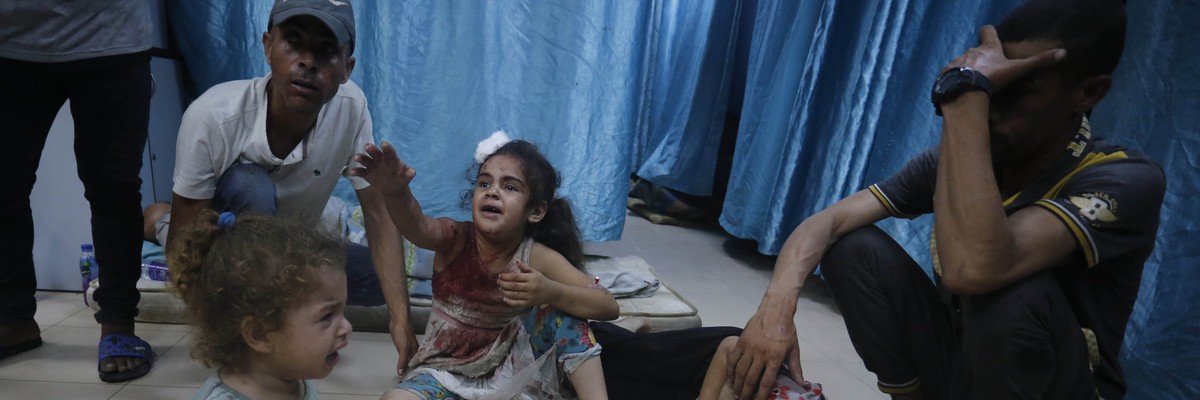
Injured Palestinians, including children, are brought to Al-Aqsa Martyrs Hospital for treatment after an Israeli attack on July 9, 2024 in Deir Al-Balah, Gaza.
 (Photo: Ashraf Amra/Anadolu via Getty Images)

While the report stresses that “Israel has an inherent right to defend itself,” a related press release doesn’t mention Gaza. One expert said, “I guess they left out the genocide they’re arming and funding.”

The Biden administration broadly and the State Department in particular have faced intense criticism throughout the U.S.-backed Israeli war on the Gaza Strip, and Wednesday was no exception, as an annual genocide report was sent to Congress.

The State Department report is required under the Elie Wiesel Genocide and Atrocities Prevention Act of 2018, named for a Holocaust survivor who wrote about his experiences at the Auschwitz and Buchenwald Nazi concentration camps.

A department press release explains that the report “details U.S. interagency efforts to address genocide, war crimes, and crimes against humanity around the world. It also chronicles whole-of-government work over the past year to promote atrocity prevention programs, protect civilians at risk, and hold perpetrators accountable in places where some of the most heinous crimes have been committed.”

“Our government cannot continue cherry-picking what war crimes and genocide they choose to acknowledge.”

The Intercept‘s Prem Thakker shared the department’s full three-paragraph statement about the report on social media and pointed out that the two nations mentioned are Sudan, where there is a civil war, and Ukraine, which is battling a Russian invasion.

Notably missing—though mentioned in the report—is Israel’s nine-month assault on Gaza, which has been enabled by U.S. diplomatic and weapons support, and is the subject of a South Africa-led genocide case before the International Court of Justice.

Responding to Thakker’s posts, Assal Rad, an expert in Middle East history, said, “I guess they left out the genocide they’re arming and funding.”

Justice Democrats declared: “This is shameful. Our government cannot continue cherry-picking what war crimes and genocide they choose to acknowledge—especially not when we’re the ones funding it.”

The 23-page report includes three paragraphs on Israel and Gaza:

Hamas is a brutal terrorist organization that has vowed to annihilate Israel and repeat the October 7, 2023 massacre, during which it murdered almost 1,200 Israelis, took more than 240 people hostage, and committed horrific acts of sexual violence. In response, Israel has engaged in military actions in Gaza with the stated intent of defending itself against future Hamas attacks. By the end of the reporting period, tens of thousands of Palestinians were killed and over a million displaced as a result of Israel’s military actions.

Israel has an inherent right to defend itself consistent with international law, in response to the October 7 attack, and the United States has made clear that Israel has a moral obligation and a strategic imperative to protect civilians, investigate allegations of any wrongdoing, and ensure accountability for any abuses or violations of international human rights law and violations of [international humanitarian law, or IHL]. As President [Joe] Biden stated in his 2024 State of the Union address: “Israel has an added burden because Hamas hides and operates among the civilian population. But Israel also has a fundamental responsibility to protect innocent civilians in Gaza. This war has taken a greater toll on innocent civilians than all previous wars in Gaza combined.” Secretary [of State Antony] Blinken has urged Israel to do everything possible to avoid civilian casualties and has consistently reiterated at the highest levels that Israel’s military operations in Gaza must comply with IHL.

The Department of State provides a variety of assistance for those impacted in Israel, the West Bank, and Gaza through U.N. Women, U.N. Food and Agriculture Organization, U.N. Development Program, U.N. Population Fund, U.N. Children’s Fund, Office for the U.N. High Commissioner for Human Rights, other U.N. agencies, and international organizations that operate in Israel and Gaza. Additionally, the Department of State hosted U.N. Special Representative of the Secretary-General on Sexual Violence in Conflict Pramila Patten in March to discuss her report and recommendations following her fact-finding visit to Israel and the West Bank regarding allegations of [gender-based violence].

As of Wednesday, Israel’s war has killed at least 38,243 people in Gaza and injured another 88,243, according to health officials in the Hamas-governed Palestinian enclave. Thousands more remain missing and presumed dead. Israeli forces have devastated civilian infrastructure, leaving a trail of bombed-out homes, hospitals, schools, and mosques.

In a letter published in the medical journal The Lancet last week, three public health experts wrote that “applying a conservative estimate of four indirect deaths per one direct death to the 37,396 deaths reported, it is not implausible to estimate that up to 186,000 or even more deaths could be attributable to the current conflict in Gaza.”

Israel has also limited the flow of humanitarian aid into Gaza. Although the United Nations has not formally declared a famine, 10 top U.N. experts said Tuesday that “we declare that Israel’s intentional and targeted starvation campaign against the Palestinian people is a form of genocidal violence and has resulted in famine across all of Gaza.”

Since October, multiple U.S. government employees, including State Department officials, have resigned over the administration’s complicity in genocide, including weapons support—which the department previously addressed in a May report to Congress.

The May report—the release of which was blasted as a “Friday news dump”—says that it “is reasonable to assess” that U.S. weapons “have been used by Israeli security forces since October 7 in instances inconsistent with its IHL obligations or with established best practices for mitigating civilian harm,” but concludes that Israel can continue receiving arms support.

The earlier report also expresses “deep concerns” about Israel’s actions regarding relief efforts but states that “we do not currently assess that the Israeli government is prohibiting or otherwise restricting the transport or delivery of U.S. humanitarian assistance within the meaning of Section 620I of the Foreign Assistance Act.”

Later that month, Stacy Gilbert, one of the State Department officials who resigned, said that “there is consensus among the humanitarian community” that Israel has obstructed relief efforts, adding: “That’s why I object to that report saying that Israel is not blocking humanitarian assistance. That is patently false.”

Original article by JESSICA CORBETT republished from Common Dreams under Creative Commons (CC BY-NC-ND 3.0). 

Continue ReadingCritics of US Complicity in Gaza Genocide Slam State Department Report

UN Experts Say ‘Targeted Starvation Campaign’ by Israel Has Led to Famine Across Gaza

Spread the love

Original article by JULIA CONLEY republished from Common Dreams under Creative Commons (CC BY-NC-ND 3.0).

Fatma Hijazi, the mother of 10-year-old Palestinian boy Mustafa Hijazi, who died due to malnutrition and lack of medication, holds the lifeless body of her child in Deir al-Balah, Gaza on June 14, 2024. (Photo: Ashraf Amra/Anadolu via Getty Images)

The starvation of Palestinians in Gaza “is a form of genocidal violence,” said 10 rights experts.

While the United Nations still has not formally declared a famine in Gaza after nine months of Israel’s near-total blockade on humanitarian aid, 10 top U.N. experts on Tuesday said they have seen enough.

“We declare that Israel’s intentional and targeted starvation campaign against the Palestinian people is a form of genocidal violence and has resulted in famine across all of Gaza,” said the experts.

Michael Fakhri, special rapporteur on the right to food, was joined in the statement by other experts including Francesca Albanese, special rapporteur on the situation of human rights in the Palestinian territory occupied since 1967, and Paula Gaviria Betancur, special rapporteur on the human rights of internally displaced persons.

They said the recent deaths of three children in various parts of the enclave led the experts, who do not speak on behalf of the United Nations as a whole, to declare a famine has taken hold.

“Fayez Ataya, who was barely six months old, died on May 30, 2024 and 13-year-old Abdulqader Al-Serhi died on June 1, 2024 at the Al-Aqsa Hospital in Deir Al-Balah,” said the experts. “Nine-year-old Ahmad Abu Reida died on June 3, 2024 in the tent sheltering his displaced family in Al-Mawasi, Khan Younis. All three children died from malnutrition and lack of access to adequate healthcare.”

“With the death of these children from starvation despite medical treatment in central Gaza, there is no doubt that famine has spread from northern Gaza into central and southern Gaza,” they continued.

At least 34 Palestinians in Gaza—the majority being children—have now died from malnutrition since October, when Israel began its bombardment of the enclave in retaliation for a Hamas-led attack and Defense Minister Yoav Gallant announced there would “be no electricity, no food, no fuel” allowed in to Gaza.

Israeli officials said in response to Tuesday’s statement that it has increased the aid allowed into Gaza recently, but hundreds of delivery trucks remain stranded in Egypt and a floating pier built by the U.S. has not significantly improved the humanitarian crisis.

The U.N. experts said that with the first death of a child from malnutrition and dehydration, it should have been considered “irrefutable that famine has taken hold.”

“When a two-month-old baby and 10-year-old Yazan Al Kafarneh died of hunger on February 24 and March 4, respectively, this confirmed that famine had struck northern Gaza,” they said. “The whole world should have intervened earlier to stop Israel’s genocidal starvation campaign and prevented these deaths… Inaction is complicity.”

The Integrated Food Security Phase Classification, which is backed by the U.N., said last month that Gaza is at high risk for famine and that nearly half a million people were facing “catastrophic” food insecurity, with an extreme lack of food.

In May, Human Rights Watch co-founder Aryeh Neier, who had previously hesitated to say Israel was committing genocide in Gaza, said Israel’s “sustained policy of obstructing the movement of humanitarian assistance into the territory” ultimately convinced him that Israeli officials are “engaged in genocide.”

In March, the International Court of Justice ordered Israel to ensure its military refrain from violating the Genocide Convention by preventing humanitarian aid from reaching people in Gaza, saying that “the catastrophic living conditions of the Palestinians in the Gaza Strip have deteriorated further” and that “famine is setting in.”

A woman named Ghaneyma Joma told Reuters on Monday at a hospital in Khan Younis that she feared her son would soon die of starvation.

“It’s distressing to see my child… lying there dying from malnutrition because I cannot provide him with anything due to the war, the closing of crossings, and the contaminated water,” she told the outlet.

The Council on American-Islamic Relations called on the U.S. government, the biggest international funder of Israel’s military and a persistent defender of its actions in Gaza, to ensure that a cease-fire agreement is reached and that Palestinians receive necessary humanitarian aid.

“The intentional starvation of the Palestinian people in Gaza can only occur with the active complicity of the Biden administration in Israel’s campaign of genocide,” said Ibrahim Hooper, national communications director for the group. “This complicity must end, and the Palestinian people must be offered a future in which they are free of occupation and can live in dignity.”

Original article by JULIA CONLEY republished from Common Dreams under Creative Commons (CC BY-NC-ND 3.0).

Zionist Keir Starmer is quoted "I support Zionism without qualification." He's asked whether that means that he supports Zionism under all circumstances, whatever Zionists do.
Zionist Keir Starmer is quoted “I support Zionism without qualification.” He’s asked whether that means that he supports Zionism under all circumstances, whatever Zionists do.
Continue ReadingUN Experts Say ‘Targeted Starvation Campaign’ by Israel Has Led to Famine Across Gaza

Israel Is Using Starvation as a Weapon of War in Gaza and the World Has Failed to Stop It

Spread the love

Original article by RAMZY BAROUD republished from Common Dreams under Creative Commons (CC BY-NC-ND 3.0). 
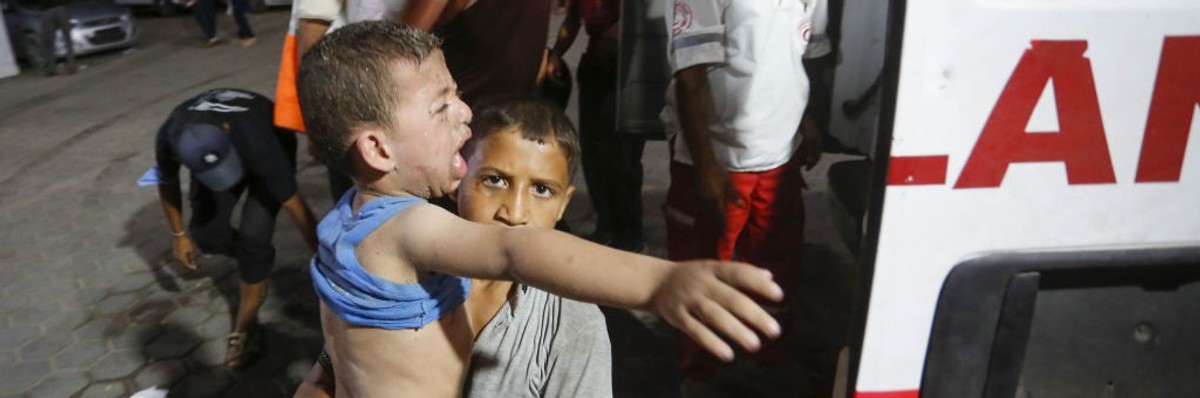
Relief workers distribute food in Gaza City, Gaza on March 14, 2024. (Photo: Dawoud Abo Alkas/Anadolu via Getty Images)

Providing aid to Gaza and ensuring the reconstruction of the strip must not be a political item for negotiations. It is a basic human right that must be honored under any circumstance.

Humanitarian aid should never be politicized though, quite often, the very survival of nations is used as political bargaining chips.

Sadly, Gaza remains a prime example. Even before the current war, the Gaza Strip suffered under a 17-year hermetic blockade, which has rendered the impoverished area virtually “unlivable.”

That very term, “unlivable” was used by the then-United Nations Special Rapporteur for the Situation of Palestine, Michael Lynk, in 2018.

Scenes and images of thousands of starving Palestinians chasing after boxes of aid parachuted into Gaza will remain etched in the collective memory of humanity as an example of our failed morality.

As of mid-December of last year, “nearly 70% of Gaza’s 439,000 homes and about half of its buildings have been damaged or destroyed,” The Wall Street Journal reported, citing experts who conducted a thorough analysis of satellite data.

As tragic as the situation was in December, now it is far worse.

Sixty-seven percent of Gaza’s water, sanitation facilities, and infrastructure have been destroyed or damaged, according to a statement by the United Nations Agency for Palestinian Refugees, UNRWA, on June 19, leading to the spreading of infectious diseases, which has ravaged the beleaguered population for months.

The spread of disease is also linked to the accumulation of garbage everywhere in Gaza. Earlier, the refugees agency reported that “as of June 9, over 330,000 tons of waste have accumulated in or near populated areas across Gaza, posing catastrophic environmental (and) health risks.”

The situation was already disastrous. Indeed, three years before the war, the Global Institute for Water, Environment, and Health (GIWEH) said, in a joint statement with the Euro-Mediterranean Human Rights Monitor, that 97% of Gaza water was undrinkable and unfit for human consumption.

Yet, so far, any conversation on allowing aid to Gaza, or the rebuilding of Gaza after the war, has been placed largely within political contexts.

By shutting down all border crossings, including the Egypt-Gaza Rafah Crossing—which, on June 17, was set ablaze—Israel has politicized food, fuel, and medicine as tools in its war in the strip.

This is not a mere inference, but the actual statement made by Israeli Minister of Defense Yoav Gallant, who on October 9 declared that he had ordered a “complete siege” and that “there will be no electricity, no food, no fuel, no water” entering Gaza.

The timing of the statement, which has indeed been put into action from the first day of the war, suggests that Israel did not apply the strategy as a last resort. It was one of the most important pieces in the war stratagem, which remains in effect to this day.

Instead of pressuring Israel, Washington tried to obtain its own political leverage, also by politicizing aid. On March 2, the U.S. Air Force started airdropping aid into northern Gaza. A far more conducive and less humiliating option for Palestinians, however, would have been direct U.S. pressure on Israel to allow access to aid trucks arriving through Rafah, Karem Abu Salem Crossing, or any other.

Scenes and images of thousands of starving Palestinians chasing after boxes of aid parachuted into Gaza will remain etched in the collective memory of humanity as an example of our failed morality.

News reports spoke of people who were killed under the weight of the dropped “aid,” much of which had fallen in the Mediterranean, never to be retrieved.

Even the Gaza pier, constructed by the U.S. military on the Gaza shore in May, did little to alleviate the situation. It merely transported 137 aid trucks, according to the U.S.’ own estimation, enough to cover Gaza’s need for food for a few hours only.

During the years of siege, an average of 500 trucks arriving daily in Gaza has kept the 2.3 million population of the strip alive, though malnourished.

To deal with the outcome of the war, and to stave off current starvation, especially in the north, the number of aid trucks would have to be much higher. Yet, whole days would pass without a single truck making its way to the suffering population. This is unacceptable.

Not only did the international community fail at ending the war, it has also failed in delinking humanitarian aid from political and military objectives.

The problem with politicizing aid is that innocent civilians become a bargaining chip for politicians and military men. This goes against the very foundation of international humanitarian law.

According to the International Committee of the Red Cross, citing the Hague Regulations, “international humanitarian law is the branch of international law that seeks to impose limits on the destruction and suffering caused by armed conflict.” In Gaza, no such “limits” have been “imposed” by anyone.

Providing aid to Gaza and ensuring the reconstruction of the strip must not be a political item for negotiations. It is a basic human right that must be honored under any circumstance.

Meaningful pressure must be placed on Israel to end the Gaza siege, and urgent plans must be drafted, starting today, by representatives of U.N. humanitarian institutions, the Arab League, and Palestinian and Gaza authorities to be the entities responsible for delivering aid to Gaza.

Humanitarian aid to Gaza must not be used as political leverage, or a tool in a cruel war, whose primary victims are millions of Palestinian civilians.

Original article by RAMZY BAROUD republished from Common Dreams under Creative Commons (CC BY-NC-ND 3.0). 
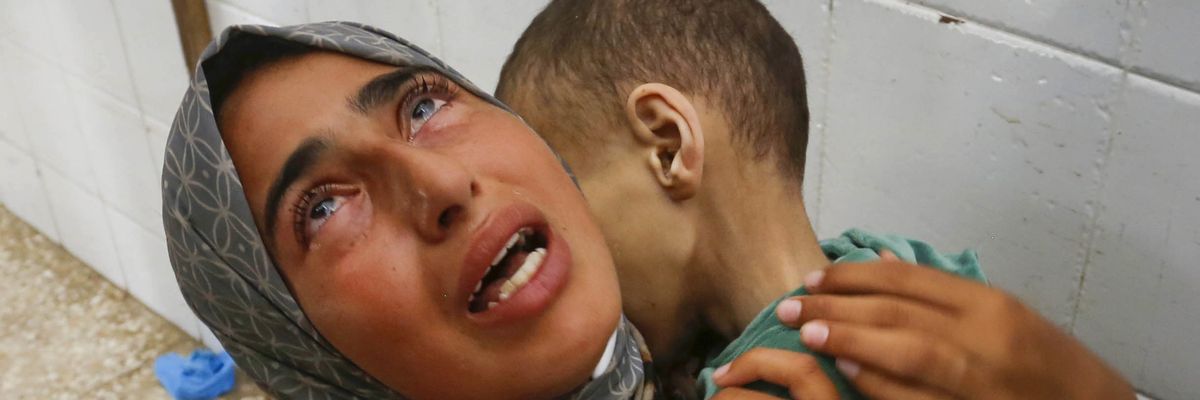
Vote For Genocide Vote Labour.

Zionist Keir Starmes is quoted "I support Zionism without qualification." He's asked whether that means that he supports Zionism under all circumstances, whatever Zionists do.
Zionist Keir Starmes is quoted “I support Zionism without qualification.” He’s asked whether that means that he supports Zionism under all circumstances, whatever Zionists do.
Continue ReadingIsrael Is Using Starvation as a Weapon of War in Gaza and the World Has Failed to Stop It

The Gaza Project Exposes Israel’s ‘Chilling Pattern’ of Killing Journalists

Spread the love

Original article by BRETT WILKINS republished from Common Dreams under a CC licence.

Forbidden Stories and its Gaza Project partners investigated Israel’s killing of journalists in Gaza and elsewhere.
 (Illustration: Forbidden Stories/The Gaza Project)

“This is one of the most flagrant attacks on press freedom that I can remember,” said one campaigner. “The impact on press freedom in Gaza, in the region, and the rest of the world is something we cannot accept.”

With more than 100 media professionals—nearly all of them Palestinian—killed in Gaza since October, a group of 50 reporters from 13 international organizations this week shared the results of a new investigative journalism initiative aimed at exposing the deadly toll Israel’s onslaught has taken on those reporting it to the world.

The Gaza Project—led by the Paris-based nonprofit Forbidden Stories—”analyzed nearly 100 cases of journalists and media workers killed in Gaza, as well as other cases in which members of the press have been allegedly targeted, threatened, or injured since October 7,” when Hamas-led attacks on Israel left more than 1,100 people dead and over 240 others kidnapped.

“Faced with what is being reported as the record number of journalists killed, Forbidden Stories, whose mission is to pursue the work of journalists who are killed because of their work, set out to investigate the targeting of journalists,” the group said

“For four months, Forbidden Stories and its partners investigated the circumstances of their killings, as well as those who have been targeted, threatened, and injured in the West Bank and Gaza,” it added. “These investigations point to a chilling pattern and suggest some journalists may have been targeted even though they were identifiable as press.”

Gaza Project member Committee to Protect Journalists (CPJ) has condemned what it called an “apparent pattern of targeting journalists and their families,” noting cases in which media workers were killed while wearing press insignia and after being threatened by Israeli officials.

“This is one of the most flagrant attacks on press freedom that I can remember,” CPJ program director Carlos Martínez de la Serna said of the ongoing war. “The impact on press freedom in Gaza, in the region, and the rest of the world is something we cannot accept.”

Basel Khair Al-Din, a Palestinian journalist in Gaza who believes he was targeted by a drone strike while wearing a press vest, said, “Whereas this press vest was supposed to identify and protect us, according to international laws, international conventions, and the Geneva Conventions, it is now a threat to us.”

“It’s this vest that almost got us killed, as has happened to so many of our fellow journalists and media workers,” he added.

Groups like Human Rights Watch (HRW) and Amnesty International have called for official investigations into Israeli killing of journalists including an October 13 attack that killed 37-year-old Lebanese Reuters videographer Issam Abdallah and wounded half a dozen other journalists who were covering cross-border clashes between Israeli troops and Hezbollah fighters in southern Lebanon.

Dylan Collins, an American deputy editor at Al Jazeera English, was wounded while administering first aid to Christina Assi, an Italian Agence-France Presse journalist whose legs were blown off in the attack.

Reuters determined that an Israeli tank crew “fired two shells in quick succession” at the journalists, who HRW said were “clearly identifiable as members of the media, and had been stationary for at least 75 minutes.” HRW “found no evidence of a military target near the journalists’ location.”

Amnesty International, meanwhile, asserted that the Israel Defense Forces (IDF) strike was “likely a direct attack on civilians that must be investigated as a war crime.”

Asa Kasher, the lead author of the IDF’s Code of Ethics, told Forbidden Stories that “no member of the press should have been killed under normal circumstances of hostilities in Gaza.”

“It shouldn’t happen, even a single one,” he added. “It’s illegal. It’s unethical. The person who does it should be brought to court.”

Israel’s alleged deliberate targeting of journalists is part of the evidence presented in a South Africa-led genocide case against Israel being reviewed by the International Court of Justice in The Hague.

Separately, the chief prosecutor at the International Criminal Court (ICC), also located in the Dutch city, is seeking arrest warrants for Israeli Prime Minister Benjamin Netanyahu, Israeli Defense Minister Yoav Gallant, and three Hamas leaders for alleged war crimes and crimes against humanity including extermination and forced starvation in the case of the Israelis and extermination, rape, and torture in the case of Hamas.

The international press freedom group Reporters Without Borders last month filed a third ICC complaint alleging “war crimes against journalists in Gaza.”

According to Palestinian and international officials, at least 37,718 Palestinians—mostly women and children—have been killed during Israel’s 264-day assault on Gaza, which has also left more than 86,300 people wounded and 11,000 others missing and feared dead and buried beneath the rubble of hundreds of thousands of homes and other bombed-out buildings.

Around 90% of Gaza’s 2.3 million people have also been forcibly displaced, and the Israeli siege on Gaza has caused widespread—and deadly—starvation and what the head of the United Nations food agency called a “full-blown famine” in northern parts of the strip.

Original article by BRETT WILKINS republished from Common Dreams under a CC licence.

Zionist Keir Starmes is quoted "I support Zionism without qualification." He's asked whether that means that he supports Zionism under all circumstances, whatever Zionists do.
Zionist Keir Starmes is quoted “I support Zionism without qualification.” He’s asked whether that means that he supports Zionism under all circumstances, whatever Zionists do.

Continue ReadingThe Gaza Project Exposes Israel’s ‘Chilling Pattern’ of Killing Journalists

Israeli Military Has Killed 500 Gaza Healthcare Workers—Two a Day Since Assault Began

Spread the love

Original article by JAKE JOHNSON republished from Common Dreams under a CC licence.

Mourners carry the body of Palestinian doctor Hani al-Jaafarawi, Gaza’s ambulance and emergency teams chief, during his funeral in Gaza City, Gaza on June 24, 2024. (Photo: Omar Al-Qattaa/AFP via Getty Images)

“This cannot be allowed to continue any longer,” said one advocate. “Every potential serious violation must be independently investigated and those responsible brought to justice.”

Doctors and humanitarian organizations demanded international investigations and action on Wednesday after the United Nations announced that Israel’s military has now killed 500 healthcare workers in Gaza—roughly two per day on average—during its nearly nine-month assault on the besieged Palestinian enclave.

The U.N. Human Rights Office said in a statement Tuesday that Israeli forces’ killing of hundreds of healthcare workers has “occurred against the backdrop of systematic attacks on hospitals and other medical facilities in violation of the laws of war.” The World Health Organization has documented more than 460 attacks on healthcare workers and infrastructure in Gaza since October 7.

“The latest health worker reportedly killed was Mr. Hani Al Ja’afarwi, head of Emergency and Ambulance Services at a health clinic in Gaza City on 23 June 2024,” said the U.N. Human Rights Office. “Many health workers have also died with their family members when residential buildings were struck by the Israel Defense Forces (IDF).”

The U.N.’s latest tally did not include Fadi Al-Wadiya, a 33-year-old Médecins Sans Frontières (MSF) staffer who was killed along with five other people Tuesday in an attack in Gaza City. MSF did not explicitly assign blame for the attack, which the group described as “yet another brutal example of the senseless killing of Palestinian civilians and healthcare workers in Gaza.”

Rohan Talbot, director of advocacy and campaigns at Medical Aid for Palestinians (MAP), said Wednesday that “hospitals, medical staff, and civilians all have protected status under international law, law that the Israel military has flagrantly ignored every day through its repeated targeting of healthcare facilities and staff.”

“Though now happening at an unprecedented rate in Gaza, attacks on Palestinian healthcare by the Israeli military have recurred over many years, ever-worsening because of chronic impunity,” said Talbot. “This cannot be allowed to continue any longer. Every potential serious violation must be independently investigated and those responsible brought to justice.”

Not a single hospital is fully functioning in the Gaza Strip after months of relentless Israeli bombing, and medical workers have been forced to treat airstrike victims and other patients in overwhelmed facilities without necessary equipment and medications, including anesthesia.

As Israel’s blockade leaves the occupied territory’s population without sufficient access to clean water and other essentials, infectious diseases have been spreading rapidly as the health crisis spirals out of control, starvation proliferates, and the death toll mounts.

“Systematic attacks on healthcare by Israeli forces are exacerbating the worst humanitarian crisis ever seen in Gaza,” MAP said Wednesday. “More than 37,000 Palestinians have been killed and at least 86,000 injured since Israel’s assault began, with an estimated 10,000 still trapped under rubble, most presumed dead. Instead of being able to safely provide medical care for those in urgent need, Palestinian healthcare workers have themselves come under both indiscriminate and apparent targeted attack by the Israeli military.”

Tanya Haj-Hassan, a doctor who volunteered in a hospital with MAP earlier this year, said that “Palestinian healthcare workers have told me that when they leave the hospital, civilians give them civilian clothing because wearing scrubs is putting a target sticker on their back.”

“This is how systematically healthcare has been targeted in Gaza,” Haj-Hassan added.

Haider Al-Qudra, executive director of the Palestine Red Crescent Society (PRCS) in Gaza, told MAP that “as long as the international community does not take any measures against Israeli forces that continue to violate international humanitarian law, we will lose more personnel working to meet the health and humanitarian needs of citizens on the frontline.”

“Because of this systematic targeting from Israeli forces,” said Al-Qudra, “34 PRCS staff have lost their lives, most of them emergency medical services staff, including 19 while they tried to respond to emergency calls from citizens.”

Original article by JAKE JOHNSON republished from Common Dreams under a CC licence.

The Gaza Project Exposes Israel’s ‘Chilling Pattern’ of Killing Journalists

Aid Group Warns New UN Figures Show ‘Hunger Catastrophe’ for Gaza Children

Over 20,000 Children Missing in Gaza, With ‘Unknown Number’ in Mass Graves: Report

Zionist Keir Starmes is quoted "I support Zionism without qualification." He's asked whether that means that he supports Zionism under all circumstances, whatever Zionists do.
Zionist Keir Starmes is quoted “I support Zionism without qualification.” He’s asked whether that means that he supports Zionism under all circumstances, whatever Zionists do.

Continue ReadingIsraeli Military Has Killed 500 Gaza Healthcare Workers—Two a Day Since Assault Began