‘Horror Is Growing By the Minute,’ Says Rights Group, as Israel Starves Gaza

Spread the love

Original article by JULIA CONLEY republished from Common Dreams under Creative Commons (CC BY-NC-ND 3.0). 
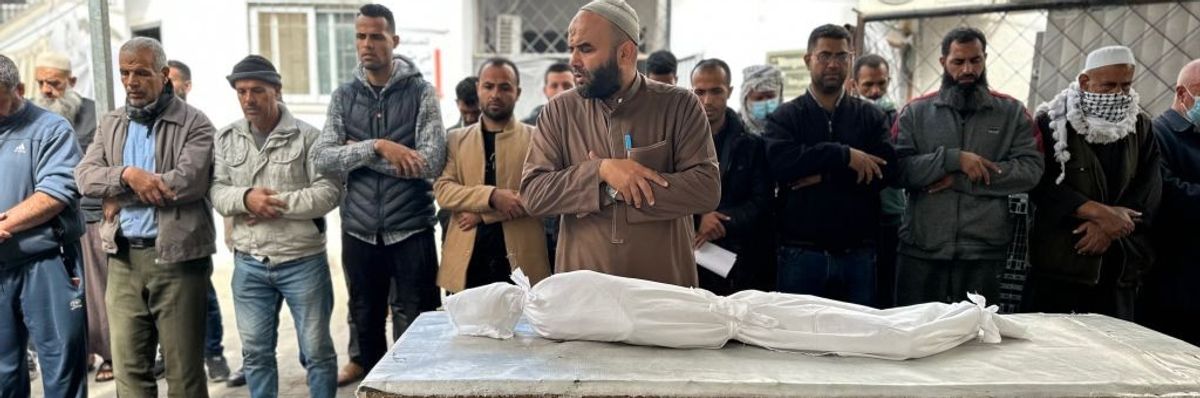
Children wait for food relief in the southern Gaza Strip city of Rafah on December 31, 2023. (Photo: Rizek Abdeljawad/Xinhua via Getty Images)

“If current conditions persist,” said Israeli group B’Tselem, “there is significant risk that famine will be declared throughout the entire Gaza Strip within six months.”

The Israeli government “can, if it chooses to,” save more than 2 million people who are starving in Gaza by ending its blockade on aid, an Israel-based human rights group emphasized in a report on Monday, condemning the country for continuing to allow just a fraction of the food needed in the enclave through border crossings as it relentlessly bombs civilian targets.

“Everyone in Gaza is going hungry,” said B’Tselem in the dispatch, bluntly titled, “Israel Is Starving Gaza.”

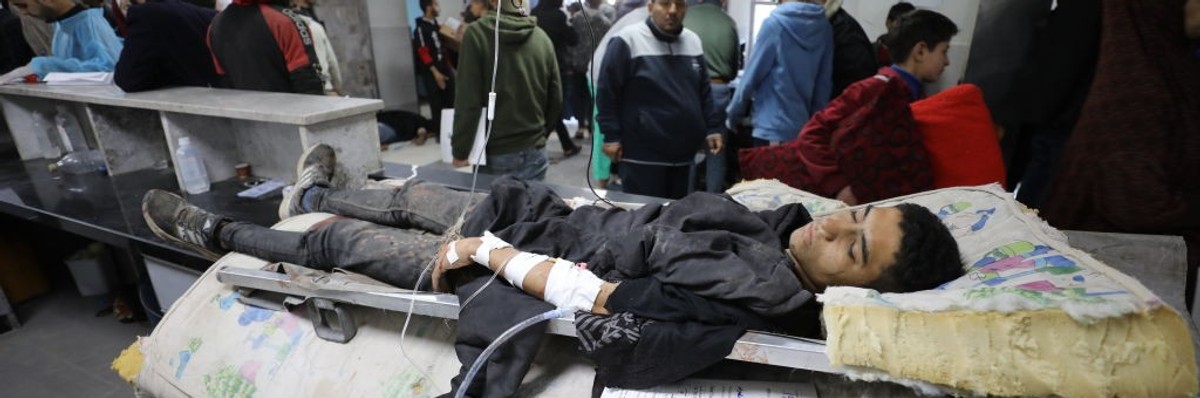
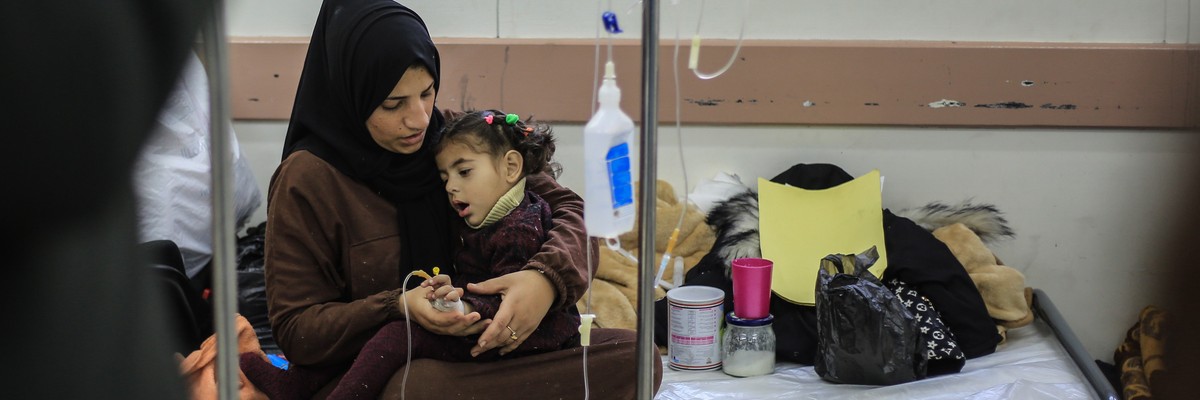
The organization pointed to a recent analysis by the Integrated Food Security Phase Classification Famine Review Committee from late last month, which found that about 93% of Gaza’s over 2 million people were suffering from “acute food insecurity” at Phase 3, while more than 15%—378,000 people—were already at the most dire classification, Phase 5, with “extreme food shortages, hunger, and exhaustion.”

By February 7, the entire population of Gaza is expected to reach Phase 3, and “if current conditions persist,” said B’Tselem, “there is significant risk that famine will be declared throughout the entire Gaza Strip within six months.”

“Such a declaration is made when 20% of households read Phase 5, when 30% of children suffer from extreme malnutrition, and when two adults or four children out of 10,000 die of hunger every day,” said the group.

Before Israel began its U.S.-backed bombardment of Gaza in retaliation for Hamas’ October 7 attack, about 80% of Gaza residents relied on humanitarian aid to survive.

Israel’s destruction of cultivated fields, bakeries, food warehouses, and factories has meant that residents now wholly depend on food supplies from outside Gaza.

That aid is still available, B’Tselem stressed, but cannot reach people because “Israel is deliberately denying the entry of enough food to meet the population’s needs.”

About 500 aid trucks entered Gaza daily before the assault began, but only about 120 trucks are allowed through just two crossings—Rafah and Kerem Shalom—on a daily basis.

The Rafah crossing is a designed for passenger vehicles rather than “massive commercial transports,” and the recent opening of the Kerem Shalom crossing was “merely a token addition that has failed to alleviate the hardship,” said B’Tselem.

“The little food that does get in is very difficult to distribute due to constant bombings, destroyed roads, frequent communications blackouts, and shelters overflowing with hundreds of thousands of [internally displaced people] crowding into smaller and smaller areas,” said the group.

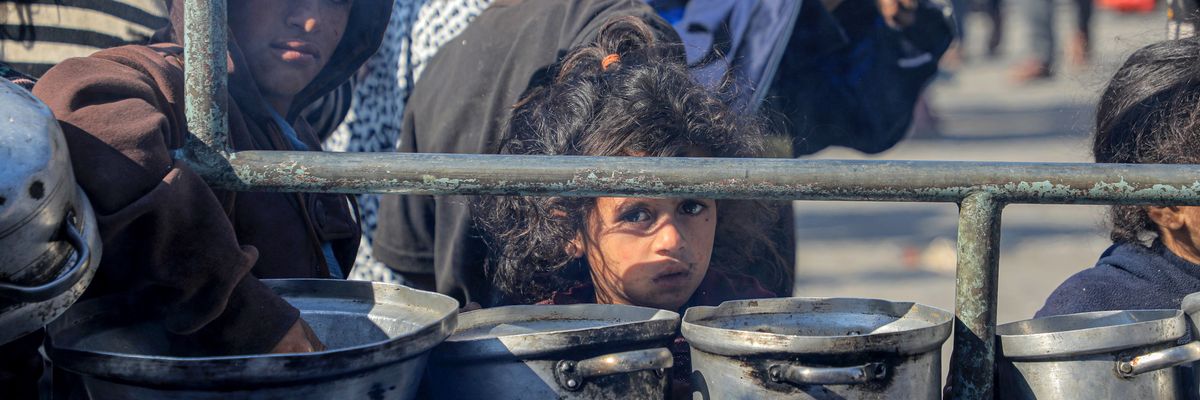
Israel’s continued blockade has resulted in “children begging for food, people waiting in long lines for paltry handouts, and hungry residents charging at aid trucks,” B’Tselem added. “The horror is growing by the minute, and the danger of famine is real.”

Martin Griffiths, undersecretary-general for humanitarian affairs and emergency relief coordinator at the United Nations, said late last week that Israel’s air and ground assault on Gaza has rendered the enclave “uninhabitable.”

“A public health disaster is unfolding,” said Griffiths. “Infectious diseases are spreading in overcrowded shelters as sewers spill over. Some 180 Palestinian women are giving birth daily amidst this chaos. People are facing the highest levels of food insecurity ever recorded. Famine is around the corner.”

“For children in particular, the past 12 weeks have been traumatic: No food. No water. No school,” he added. “Nothing but the terrifying sounds of war, day in and day out.”

Last month, Human Rights Watch accused Israel of using starvation as a “method of warfare”—a war crime according to international humanitarian law.

“Changing this policy is not just a moral obligation,” said B’Tselem. “Allowing food into the Gaza Strip is not an act of kindness but a positive obligation under international humanitarian law: Starvation as a method of warfare is prohibited, and when a civilian population lacks what it needs to survive, parties to the conflict have a positive obligation to allow rapid and unimpeded passage of humanitarian aid—including food.”

“These two rules are considered customary law,” added the group, “and violating them constitutes a war crime under the Rome Statute of the International Criminal Court.”

Original article by JULIA CONLEY republished from Common Dreams under Creative Commons (CC BY-NC-ND 3.0). 

Continue Reading‘Horror Is Growing By the Minute,’ Says Rights Group, as Israel Starves Gaza

Israel Is Starving Gaza Civilians as ‘Method of Warfare’: Human Rights Watch

Spread the love

Original article by JULIA CONLEY republished from Common Dreams under Creative Commons (CC BY-NC-ND 3.0). 

A view of empty shelves are seen at a supermarket amidst Israel’s bombardments as Palestinians have trouble finding necessary food in Khan Yunis, Gaza on November 11, 2023.  (Photo: Mustafa Hassona/Anadolu via Getty Images)

“It’s critical to understand this is not simply a byproduct of the conflict, an unfortunate result of a terrible situation,” said one campaigner. “It is Israeli government policy.”

From bombing food production hubs and systematically razing crop fields to halting aid deliveries, Israel is waging a multi-pronged effort to starve the people of Gaza amid the Israel Defense Forces’ bombardment of the enclave, Human Rights Watch said in a report Monday—with evidence drawn from the Israeli government’s own statements as well as survivors’ accounts.

The group demanded that countries such as the United States, United Kingdom, Canada, and others that have provided Israel with military aid and other support since the country began its latest escalation against Gaza in October speak out against the use of starvation as a weapon of warfare—a war crime under the Rome Statute of the International Criminal Court.

“For over two months, Israel has been depriving Gaza’s population of food and water, a policy spurred on or endorsed by high-ranking Israeli officials and reflecting an intent to starve civilians as a method of warfare,” said Omar Shakir, Israel and Palestine director at Human Rights Watch (HRW). “World leaders should be speaking out against this abhorrent war crime, which has devastating effects on Gaza’s population.”

HRW pointed to satellite imagery it has collected in northern Gaza since the IDF began its air and ground assault in retaliation for an attack by Hamas on southern Israel on October 7.

The images have shown orchards, greenhouses, and farmland that have been razed over the last two months, “apparently by Israeli forces, compounding concerns of dire food insecurity.”

Only sand and dirt have been left behind where farmers in northeastern Gaza grew citrus, potatoes, dragon fruit, and prickly pear since Israeli forces took control of the area in mid-November and “systematically razed” the fields, said the group.

Palestinians in Gaza, home to about 2.3 million people, have lost the ability to grow their own food as Israel has refused to allow food, water, and fuel deliveries into the enclave, leaving bakeries and grocery store shelves empty.

Before the Israeli bombardment began, about 500 aid trucks filled with food and other goods entered Gaza on a daily basis to provide sustenance amid Israel’s unlawful occupation and its land, air, and sea blockade that began 16 years ago. Israel has allowed only 100 aid trucks to cross through Egypt’s Rafah crossing since October 7. The U.N. humanitarian coordinator for the Occupied Palestinian Territory, Lynn Hastings, said earlier this month that fuel deliveries—needed for farming, cooking, water desalination, healthcare operations, and other necessities—have been “utterly insufficient.”

Prior to the current escalation, about half of Gaza’s population was facing acute food insecurity and 80% were reliant on humanitarian aid.

The World Food Program (WFP) at the U.N. said earlier this month that 9 in 10 households in northern Gaza and 2 in 3 homes in the south had been without food for at least one full day and night since Israel’s assault. It also warned that 38% of families who had been displaced from their homes in northern Gaza were experiencing “severe levels of hunger” and that the enclave faces a “high risk of famine.”

“It’s critical to understand this is not simply a byproduct of the conflict, an unfortunate result of a terrible situation. It is Israeli government policy,” said Andrew Stroehlein, European media and editorial director for HRW.

In addition to the halting of aid and the destruction of Gaza’s agricultural sector, the last operational wheat mill was bombed on November 15 ensureing “that locally produced flour will be unavailable in Gaza for the foreseeable future,” said HRW.

The group interviewed 11 civilians who described their struggles with finding sufficient food in recent weeks.

A man identified as Taher said that after his family fled south to Gaza City in November, they resorted to eating “just once a day to survive.”

“The city was out of everything, of food and water,” he told HRW. “If you find canned food, the prices were so high… We were running out of money. We decided to just have the necessities, to have less of everything.”

Majed, who left his home in the north after his house was bombed, killing his six-year-old son, said he, his wife, and their four surviving children had no way of making bread for more than a month when they temporarily stayed in Gaza City.

“In those 33 days we didn’t have bread because there was no flour,” he said. “There was no water—we were buying water, sometimes for $10 a cup. It wasn’t always drinkable. Sometimes, [the water we drank] was from the bathroom and sometimes from the sea. The markets around the area were empty. There wasn’t even canned food.”

HRW noted that the Israeli government itself has made numerous statements in recent weeks pointing to the deliberate destruction of Gaza’s food access and the starvation of civilians.

Defense Minister Yoav Gallant infamously called Palestinians in Gaza “human animals” when he announced the “complete siege” and cutting off of aid into the enclave on October 9.

“No electricity, no food, no water, no fuel—everything is closed,” Gallant said.

Col. Yogev Bar-Shesht, deputy head of the Civil Administration, said in an interview that eliminating Palestinians’ ability to grow food is a deliberate tactic.

“Whoever returns here, if they return here after, will find scorched earth,” he said. “No houses, no agriculture, no nothing. They have no future.”

HRW’s report came as the death toll in Gaza hit at least 19,453, with more than 50,800 injured and thousands believed to be buried underneath rubble.

Article 54(1) of the First Additional Protocol to the Geneva Conventions and Article 14 of the Second Additional Protocol both prohibit starvation of civilians as a method of warfare.

“Although Israel is not a party to Protocols I or II, the prohibition is recognized as reflective of customary international humanitarian law in both international and noninternational armed conflicts,” said HRW.

The worsening humanitarian catastrophe, and Israel’s refusal to operate within the bounds of international law, “calls for an urgent and effective response from the international community,” said Shakir.

“The Israeli government is compounding its collective punishment of Palestinian civilians and the blocking of humanitarian aid,” he said, “by its cruel use of starvation as a weapon of war.”

Original article by JULIA CONLEY republished from Common Dreams under Creative Commons (CC BY-NC-ND 3.0). 

Continue ReadingIsrael Is Starving Gaza Civilians as ‘Method of Warfare’: Human Rights Watch

Gaza facing ‘immediate possibility of starvation,’ UN warns

Spread the love

https://www.morningstaronline.co.uk/article/gaza-facing-immediate-possibility-of-starvation-un-warns

Palestinians look for survivors after an Israeli air strike destroys a building, November 17, 2023

PEACE campaigners slammed Israeli authorities and world leaders today after the United Nations warned Gaza faced the “immediate possibility of starvation.”

Even before the fast approaching winter Palestinians are already struggling to survive in desperate conditions created by a lack of fuel, which means aid agencies are unable to transport urgently needed food and medical supplies to the besieged people of the territory.

UN World Food Programme (WFP) Mideast regional spokeswoman Abeer Etefa said that, since the beginning of Israel’s retaliation against Hamas’s October 7 uprising, Gaza has received only around 10 per cent of its required food supplies each day. Dehydration and malnutrition are growing as a result, with nearly all residents in need of food.

Speaking from Cairo, Egypt, Ms Etefa said: “Food production has come to an almost complete halt, markets have collapsed, fishermen cannot access the sea, farmers cannot reach their farms.

WFP executive director Cindy McCain said: “With winter rapidly approaching, shelters unsafe and overcrowded and a lack of clean water, civilians face the immediate possibility of starvation.”

https://www.morningstaronline.co.uk/article/gaza-facing-immediate-possibility-of-starvation-un-warns

Continue ReadingGaza facing ‘immediate possibility of starvation,’ UN warns

Oxfam Accuses Israel of ‘Using Starvation as Weapon of War’ in Gaza

Spread the love

Original article by JAKE JOHNSON republished from Common Dreams under Creative Commons (CC BY-NC-ND 3.0).

“Millions of civilians are being collectively punished in full view of the world,” said Oxfam International’s regional Middle East director.

The humanitarian group Oxfam International on Wednesday accused Israel of “using starvation as a weapon of war” in the besieged Gaza Strip, where hunger and thirst are growing rapidly as just a trickle of aid has been allowed to enter the territory amid the Israeli military’s relentless bombing campaign.

Citing United Nations data, Oxfam said in a statement that just 2% of the food that would have been delivered to Gaza prior to Israel’s latest assault has been able to enter the strip since October 9, when the Israeli government announced a total blockade of the strip.

International law prohibits the use of starvation as a method of warfare.

In recent days, Israel has allowed several truck convoys carrying food, drinking water, and medical supplies to reach southern Gaza through the Egyptian border, but U.N. officials said that’s nowhere near enough to meet the growing needs of Gazans, more than a million of whom have been displaced by Israeli airstrikes.

“The aid which resumed from Egypt over the weekend is a mere drop in the ocean of what is needed,” Jeremy Laurence, spokesperson for the office of the U.N. High Commissioner for Human Rights, said Tuesday.

Oxfam noted Wednesday that “despite 62 trucks of aid being allowed to enter southern Gaza via the Rafah crossing since the weekend, only 30 contained food and in some cases, not exclusively so.”

“This amounts to just one truck every three hours and 12 minutes since Saturday,” the group said.

Sally Abi Khalil, Oxfam’s regional Middle East director, said in a statement that the situation in Gaza “is nothing short of horrific.”

“Where is humanity?” she asked. “Millions of civilians are being collectively punished in full view of the world, there can be no justification for using starvation as a weapon of war. World leaders cannot continue to sit back and watch, they have an obligation to act and to act now.”

The United Nations estimates that more than 1.6 million people in Gaza—roughly 70% of the enclave’s population—are in dire need of humanitarian assistance. Brian Lander, deputy head of emergencies at the World Food Program, toldReuters earlier this week that around 465 trucks of aid per day are necessary to help desperate Gazans who have resorted to drinking sewage-contaminated water and frequently skipping meals.

At best, according to Lander, 20 trucks of aid are reaching Gaza each day.

“Every day the situation worsens… How much more are Gazans expected to endure?”

Oxfam said Wednesday that while some food items such as flour, oil, and sugar are stocked in intact Gaza warehouses, “many of them are located in Gaza City,” making it “physically impossible to deliver items due to the lack of fuel, damaged roads, and risks from airstrikes.”

Israel has been accused of bombing Gaza bakeries, where people have lined up in recent days to buy bread—sometimes waiting for hours just to get a loaf.

“The electricity blackout has also disrupted food supplies by affecting refrigeration, crop irrigation, and crop incubation devices,” the group said. “Over 15,000 farmers have lost their crop production and 10,000 livestock breeders have little access to fodder, with many having lost their animals.”

Oxfam implored the United Nations and U.N. member states to “prevent the situation from deteriorating even further” by backing an immediate cease-fire and allowing “unfettered, equitable access to the entire Gaza Strip for humanitarian aid.”

“Every day the situation worsens,” said Abi Khalil. “Children are experiencing severe trauma from the constant bombardment, their drinking water is polluted or rationed and soon families may not be able to feed them too. How much more are Gazans expected to endure?”

Original article by JAKE JOHNSON republished from Common Dreams under Creative Commons (CC BY-NC-ND 3.0).

Continue ReadingOxfam Accuses Israel of ‘Using Starvation as Weapon of War’ in Gaza