Original article by Devin B. Martinez republished from peoples dispatch under a Creative Commons Attribution-ShareAlike 4.0 (CC BY-SA) license.
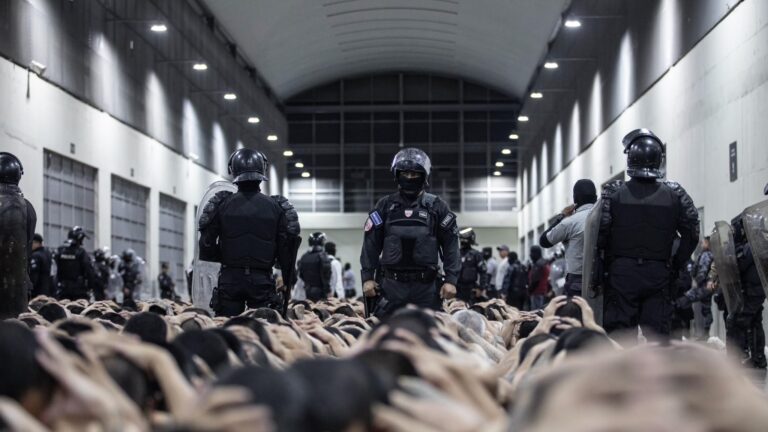
The alliance between Trump’s expanding deportation campaign and Salvadoran President Bukele’s carceral authoritarianism has major implications for human rights and the future of democracy.
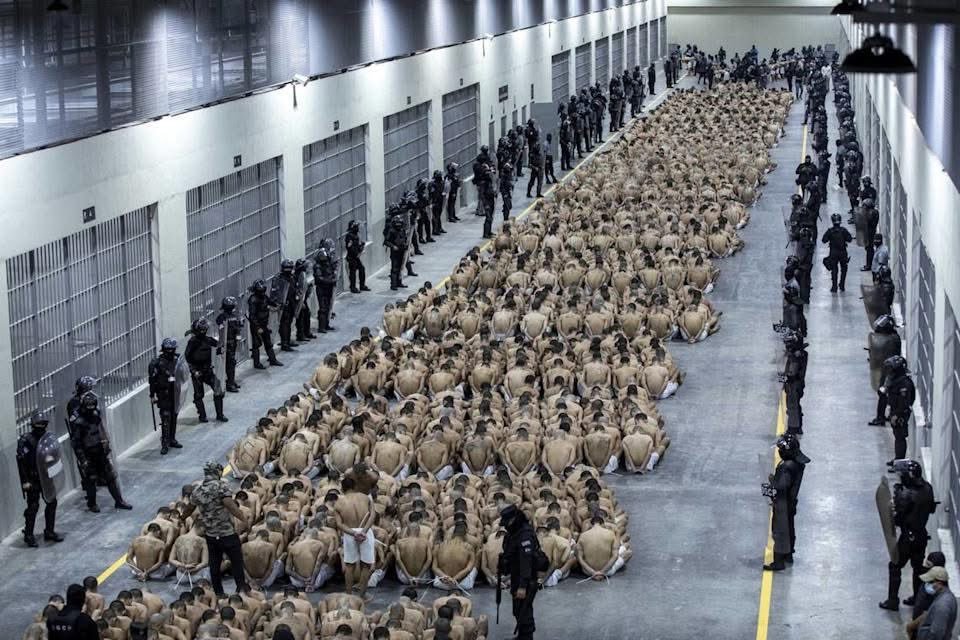
In February 2023, the Salvadoran government released drone footage of thousands of shirtless men with shaved heads, shackled and crouched in tight formation, being herded into a newly built prison called the Center for the Confinement of Terrorism – CECOT.
The high-tech mega-prison was constructed at breakneck speed under the rule of President Nayib Bukele as he declared victory in the so-called “war on gangs” in the country.
Known as the largest prison in the world, CECOT can hold up to 40,000 people. However, plans to expand the mega-prison to double its current capacity (80,000) are already underway, with the US expected to “send enough to fill it,” as reported by the Wall Street Journal.
From state of emergency to state of exception
The year before CECOT’s inauguration, President Nayib Bukele declared a “state of emergency,” suspending constitutional rights like due process, legal defense, and freedom of assembly, and allowing measures like mass arrests, and indefinite pretrial detention.
“CECOT is nothing more than an extermination prison for the poor,” says Marisel Ramírez, a member of the Popular Resistance and Rebellion Bloc, a coalition of Salvadoran trade unions, civil society groups, and political organizations. “The regime invests in mega-prisons instead of health, education, or structural reforms.”
Today, El Salvador’s detention rate has outpaced that of the United States – the former world leader in incarceration by far. 1 in every 57 Salvadorans is now incarcerated, triple the rate of the US.
In March 2025, various human rights organizations in El Salvador, such as Human Rights Institute of the Central American University (IDHUCA); Foundation for the Study and Application of the Law (FESPAD); Passionist Social Service, among others, produced a report compiling documented cases of mistreatment, torture, and the inhumane conditions of detainees over the three years of the “state of exception.” Their findings include:
- 85,000+ people have been detained by the state during this period
- 6,889 cases of human rights violations have been filed by human rights organizations
- 52% of detainees are 19–30 year-old men
- 265–375 deaths in state custody have been verified by different data agencies
Their report demands the repeal of the “state of exception,” reparations for the families and victims of human rights violations, and independent investigations of all human rights abuses.
Welcome to CECOT
Many of CECOT’s prisoners are denied due process. Visitation is prohibited. Communication with family, friends, and even lawyers is prohibited. Inmates are also completely stripped of privacy. Cells are packed with up to 80 people for 23.5 hours a day. They share metal bunks and an open toilet, under constant surveillance by prison guards. There is no form of education or recreation offered at the facility. Letters and reading material are prohibited. And there are no reports of any inmates being released. CBS News reported El Salvador’s justice minister saying, “the only way out is in a coffin.”
In fact, Google Earth images and videos have recently circulated social media showing a CECOT courtyard that appears to be stained with blood.
CECOT has become a symbol of a global trend towards militarization, mass incarceration, and political repression under the guise of “domestic security.” As Trump’s offshore detention of migrants in CECOT shines an international spotlight on Bukele’s policies, urgent questions are arising:
- How far will the US go in utilizing Bukele’s repressive infrastructure for its own agenda?
- How did a self-described “dictator” rise to power in El Salvador?
- How are communities in El Salvador responding?
The US – Bukele alliance
While CECOT was built for domestic repression and incarceration, it is now a site of international collaboration between extreme-right-wing governments. Bukele’s prison has been openly endorsed – and now directly funded – by the US government.
On March 15, in an unprecedented move, the Trump administration deported roughly 250 Venezuelan migrants to CECOT prison in El Salvador, ignoring a federal judge’s order to halt the deportations. Invoking the Alien Enemies Act (AEA) of 1798 against Venezuelan nationals accused of being part of the gang Tren de Aragua, Trump attempted to pave a “legal” pathway for his policy of mass deportations. Yet a report from CBS News claims that the majority of those deported have no criminal record in the US, and human rights and advocacy groups have rejected any legal basis for Trump’s use of the AEA.
One of the deportees, a Maryland resident and union worker named Kilmar Abrego Garcia, has become a central figure in the broader legal and political crisis surrounding Trump and Bukele’s authoritarian alliance.
The case of Kilmar Abrego Garcia
Kilmar was born in El Salvador and holds protected status in the US, where he has lived for over 14 years. The Trump administration admitted he was deported in error and the Supreme Court has ordered the US government to facilitate his return. Nevertheless, Trump has defied the order, and Bukele refuses to release Abrego. Recently, Trump has accused Abrego of being part of the Salvadoran gang, MS-13, without evidence or due process.
Since the day CECOT was inaugurated, the government has used social media to promote positive ideas about the prison and Bukele’s iron-grip approach. Far-right politicians and YouTube influencers are regularly welcomed to tour CECOT, posing in front of groups of detainees for their online audiences. However, Maryland Senator Chris Van Hollen was denied entry to the facility on April 16, when he traveled to El Salvador to advocate for Kilmar’s release.
In the late hours of April 17, the senator was finally able to meet with Abrego off-site from the prison. Kilmar’s wife credited the growing movement for justice for this small win in a statement released by the advocacy group CASA:
“Now I know that my husband is alive…Thank you to everyone, including Senator Van Hollen, my CASA family, all our Union’s, faith leaders and community for continuing this fight for my family to be reunited.”
In a press conference held on April 18 in Dulles International Airport, the Maryland Senator told reporters that the Maryland father is not being held at CECOT but is still being illegally detained in a different Salvadoran prison. “The reason they relented is pretty clear — they were feeling the pressure,” said the senator.
The USD 6 million deal behind CECOT
The use of El Salvador’s prison system to detain migrants with no clear end in sight has faced heavy criticism, especially in the wake of the mistaken deportation and detention of Abrego Garcia.
During his visit to El Salvador, US Senator Van Hollen raised this same question to Vice President Félix Ulloa regarding Abrego Garcia, who said that the Trump administration is paying El Salvador to keep migrants like him at CECOT.
The Trump administration has reportedly agreed to pay El Salvador USD 6 million to house hundreds of migrants deported from the US for up to a year. In Van Hollen’s press conference on April 18, he told reporters that the deal between Trump and Bukele may be for as much as USD 15 million.
“Homegrowns are next”
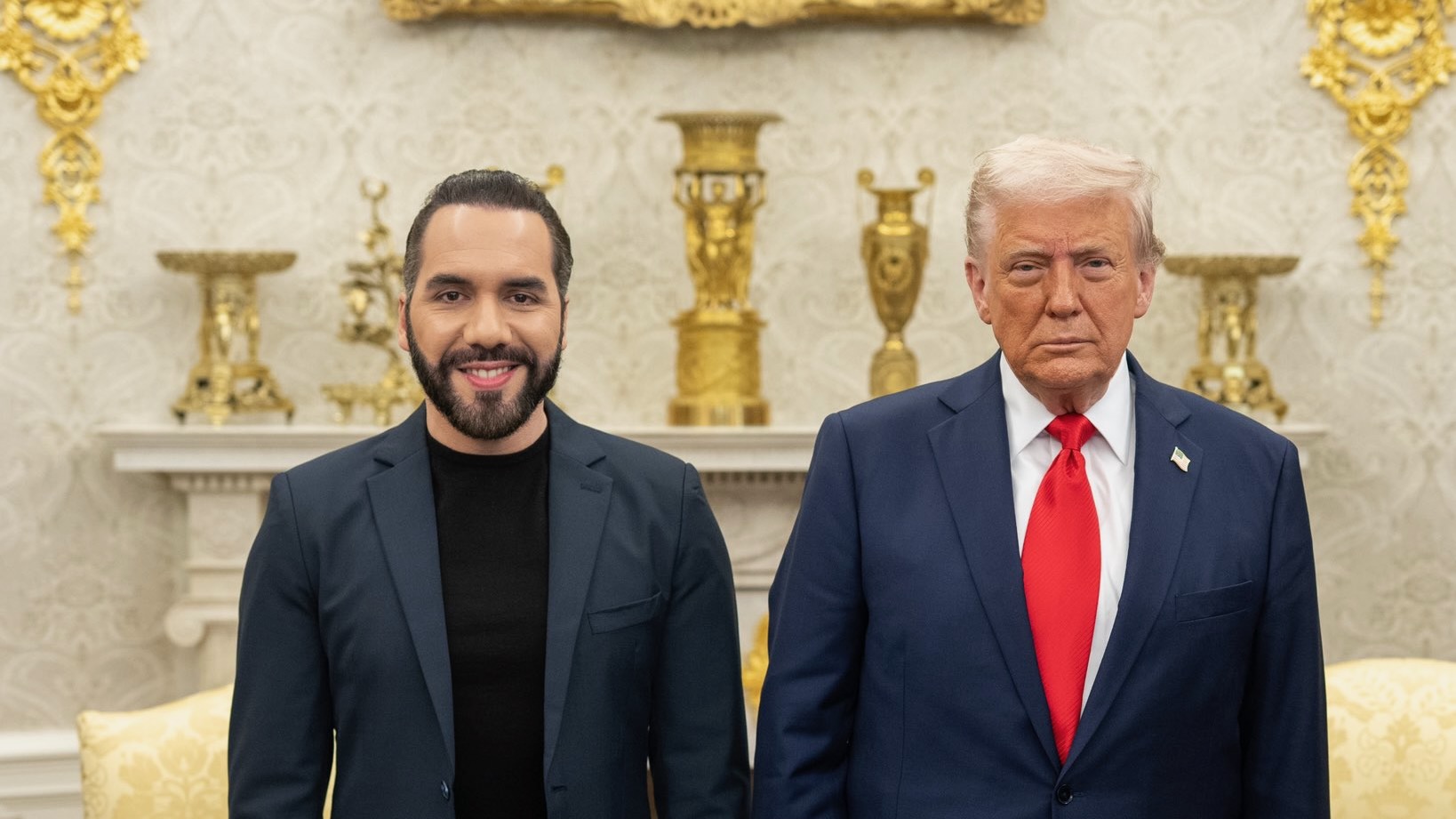
However, migrants are not the only ones being targeted for deportation to CECOT. During Bukele’s White House visit on April 14, Trump was recorded saying he wants to send US citizens to CECOT too. The “homegrown criminals” are next. “You’ve got to build about five more places,” he said. To which Bukele responded, “we’ve got space.”
Legal experts and human rights organizations have asserted that the offshore detention of US citizens is illegal, but Trump confirmed “We are looking into it, and we want to do it.”
The US – Bukele alliance represents a convergence in the growing international authoritarian trend. But this alliance didn’t emerge overnight. It is the result of a deliberate political project that Bukele has been advancing for years. But to understand how the country got to this point, we have to look back at how Bukele transformed El Salvador into, as he calls it, a dictatorship.
The world’s “coolest dictator”
For years, El Salvador faced one of the highest homicide rates in the world, driven by the extortion practices of gangs, like MS-13 and Barrio 18. Communities were often caught in the crossfire, with widespread insecurity and little trust in state institutions to protect them. Bukele rose to power promising an end to the violence, using harsh anti-gang rhetoric and militarization to gain popular support amid a climate of fear and frustration.
However, according to organizers with the Popular Resistance and Rebellion Bloc, Bukele’s security policy is based on a pact with the gangs – not a war on them. They explain that while the president claims there are 80,000 gang members and terrorists in prison, the National Civil Police only reports the seizure of 4,000 weapons, 20,000 cell phones, and USD 4 million. There have been no arrests of top gang leaders, nor have those who have committed crimes in the US been extradited to that country.
Movement leaders describe Bukele’s rise as one of clear authoritarianism – cloaked in anti-gang rhetoric, backed by the US, and enforced through mass repression. He enjoys popular support “because people perceive improved security, and he has imposed the idea that traditional parties were corrupt and waged a war that led to tragedies.”
Activists also assert that eliminating the left in the country as a political option has been a deliberate goal of Bukele’s “business clan.” They say Bukele has specifically targeted the FMLN, a former guerilla group that led the armed struggle against US-backed dictatorship in the 1980s, and later helped secure key democratic reforms through the Peace Accords.
“The FMLN is a victim of a smear campaign by the regime…whose influence in the state and society has significantly diminished. After governing for 10 years, the FMLN has no presence in the Legislative Assembly and no longer governs any mayoralties,” reads a statement by the Bloc.
Here is a brief timeline of the Bukele’s rise to power from the perspective of movements on the ground:
2019 – Bukele elected president
- Breaking with the two dominant parties (ARENA and FMLN), he formed the party Nuevas Ideas, and presented himself as a young, social media savvy reformist.
2020 – Bukele storms Legislative Assembly with military
- Flanked by heavily armed soldiers and police, Bukele enters the Legislative Assembly to pressure lawmakers to approve a USD 109 million loan, in order to further militarize his police and soldiers for the “war on gangs.”
- International human rights groups condemn the action, while activists draw connections to El Salvador’s history of military dictatorships.
2021 – Removes Constitutional Court judges, adopts Bitcoin
- Replacing judges in the Constitutional Court with loyalists, and removing the Attorney General, Bukele gains unchecked control over all three branches of government.
- El Salvador becomes the only country in the world to adopt Bitcoin as a legal tender, despite mass protests.
- Bukele’s new court rules that presidential reelection is now legal, ignoring a constitutional ban. Bukele announces his intent to run for reelection in 2024.
- The US government applies some pressure on Bukele to maintain legal appearances.
- Critics argue that a major part of Bukele’s propaganda is the idea that he’s “changing the country,” using symbolic gestures, minor public projects, and some changes to the state like reducing the number of provincial and municipal governments.
2022 – “State of emergency” declared
- Following a spike in homicides, Bukele declares a “state of emergency,” suspending constitutional rights, and launching a so-called “war on gangs.”
- Mass arrests without warrants begin. Many are detained without evidence or due process. Organizers call the state of emergency a “mechanism of social containment.” They report popular leaders being targeted, generating fear and limiting popular protests.
2023 – CECOT prison unveiled
- The 40,000 person-capacity mega-prison is inaugurated with a propaganda blitz displaying prisoners in dehumanizing ways.
- Bitcoin investment loses over 50% of its value, costing El Salvador hundreds of millions.
- The Bukele family, which owns 12 large companies, monopolizes public procurement and appropriates state resources. The public procurement law is practically repealed, limiting public access to details about government spending and contracts.
2024 – Bukele wins reelection
- Despite a constitutional ban on reelection, Bukele runs for president and wins. He is backed by his courts and military, amid a climate of fear and mass imprisonment justified by “domestic security” rhetoric.
- The US government supports his illegal reelection.
- Political opposition in government has been practically eliminated. 55/60 representatives are from Bukele’s party, NI. 43/44 mayoralities are controlled by NI and its allies. The majority of the population rejects the FMLN and even the traditional, non-governing right parties.
- Bukele reverses a landmark ban on metal mining, sparking a nationwide protest movement.
Today, Bukele’s “state of exception” continues indefinitely. Reports of torture, disappearances, and political arrests grow. People’s movements for the freedom of political prisoners, and against the “state of exception” continue to build, the most important of these is the Popular Resistance and Rebellion Bloc.
Meanwhile, the Salvadoran President is promoting himself worldwide as a model far-right leader and enjoying a lucrative alliance with the US government.
Salvadoran resistance
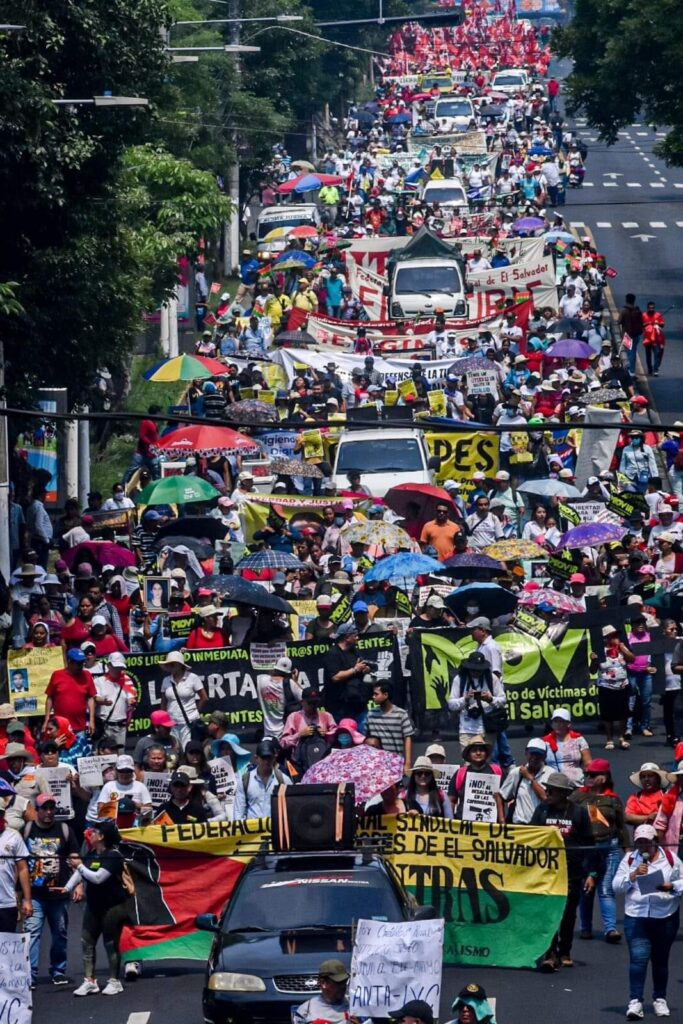
The Popular Resistance and Rebellion Bloc is an organization of 35 social organizations from various sectors of society: students, women, peasants, unions, professionals, and more.
Marisel Ramírez, a member and organizer with the Bloc, told Peoples Dispatch: “These organizations came together in January 2021 to denounce the major setbacks we have suffered since the Bukele business clan took office, and to demand an end to the government’s repressive policies.”
Explaining the Bloc’s strategies and tactics, Marisel said that “the organizations that belong to the bloc act according to their own demands, highlighting the serious human rights violations committed under the state of emergency.”
She outlined several fronts of their struggle:
1. Movement of Victims of the State of Emergency (MOVIR)
- Families of the detainees mobilize their communities and protest the arbitrary arrests, demanding justice and freedom for their loved ones.
2. Salvadoran Student Force
- Students are consistently fighting back against the arrests of university students under the state of exception.
3. Feminist Resistance
- Women are organizing and mobilizing around the economic, emotional, and familial impacts of the arbitrary arrests of innocent people, as well as the abuse of power by the military and police.
- These forces, Marisel said, “demand ‘sexual favors’ in exchange for ‘benefits’ – not taking people away, expediting judicial processes, and access to personal hygiene products.”
4. The Confederation of Salvadoran Agrarian Reform Federations (CONFRAS)
- Mobilizes peasants and farm workers and denounces the shortage of agricultural labor caused by the high migration triggered by the state of exception.
Despite Bukele’s iron-grip approach and mass incarceration campaign, resistance in El Salvador is growing – led by families of the detained and disappeared, student organizers, feminist collectives, and peasant unions who refuse to be silenced. Their struggle aims to demonstrate that CECOT is not just a prison – it is a weapon of political power aimed at the poor and fueled by international complicity.
What’s becoming increasingly clear is that the US is seeking to expand its deportation machine and outsource incarceration and repression to third countries like El Salvador. As these transnational policies develop, urgent questions remain: How far will Trump go in bulldozing any legal barriers to utilizing this repressive model? Will US citizens begin facing deportation and detention in CECOT? How will the people in the US respond to this deepening authoritarian alliance?
Original article by Devin B. Martinez republished from peoples dispatch under a Creative Commons Attribution-ShareAlike 4.0 (CC BY-SA) license.