Dangerous heat for Tour de France riders only a ‘question of time’

Spread the love

Original article by Giuliana Viglione republished from Carbon Brief under a CC license.
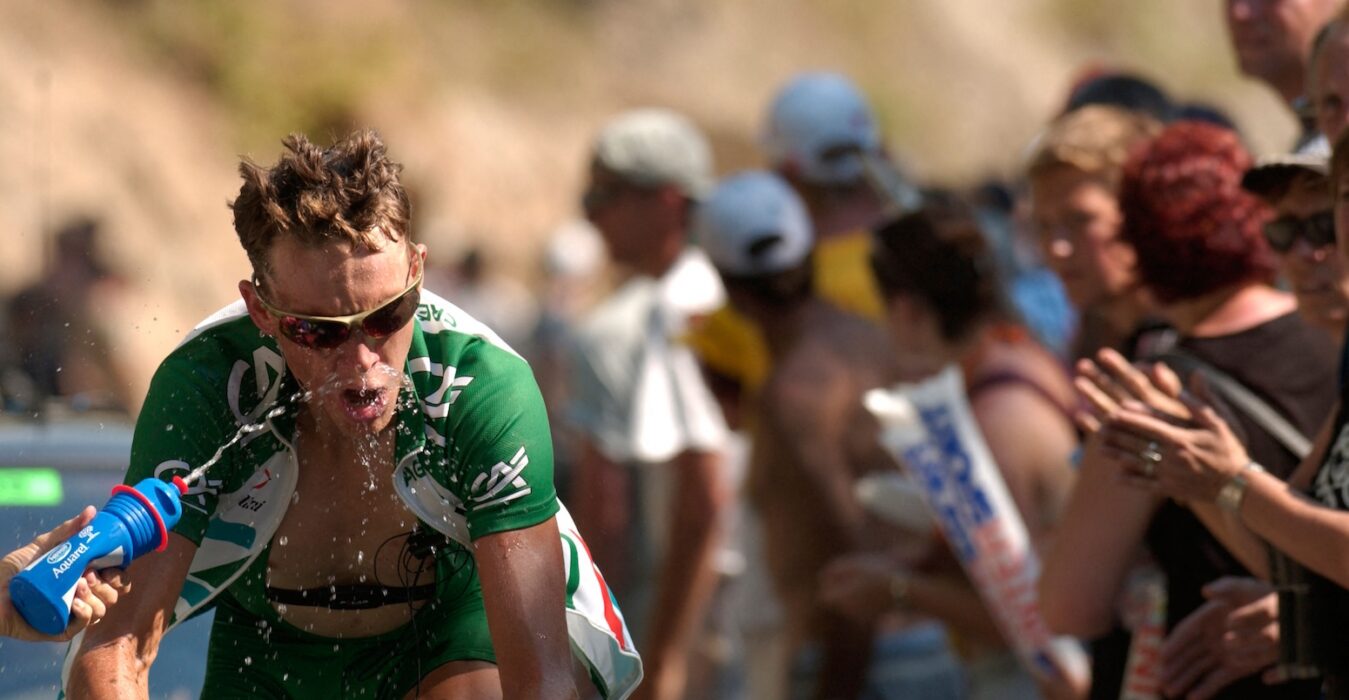
Dangerous heat for Tour de France riders only a ‘question of time’. Tour de France cyclist. Credit: Geoff Waugh / Alamy Stock Photo

Rising temperatures across France since the mid-1970s are putting Tour de France competitors at “high risk”, according to new research.

The study, published in Scientific Reports, uses 50 years of climate data to calculate the potential heat stress that athletes have been exposed to across a dozen different locations during the world-famous cycling race. 

The researchers find that both the severity and frequency of high-heat-stress events have increased across France over recent decades. 

But, despite record-setting heatwaves in France, the heat-stress threshold for safe competition has rarely been breached in any particular city on the day the Tour passed through. 

(This threshold was set out by cycling’s international governing body in 2024.)

However, the researchers add it is “only a question of time” until this occurs as average temperatures in France continue to rise.

The lead author of the study tells Carbon Brief that, while the race organisers have been fortunate to avoid major heat stress on race days so far, it will be “harder and harder to be lucky” as extreme heat becomes more common.

‘Iconic’

The Tour de France is one of the world’s most storied cycling races and the oldest of Europe’s three major multi-week cycling competitions, or Grand Tours

Riders cover around 3,500 kilometres (km) of distance and gain up to nearly 55km of altitude over 21 stages, with only two or three rest days throughout the gruelling race.

The researchers selected the Tour de France because it is the “iconic bike race. It is the bike race of bike races,” says Dr Ivana Cvijanovic, a climate scientist at the French National Research Institute for Sustainable Development, who led the new work.

Heat has become a growing problem for the competition in recent years.

In 2022, Alexis Vuillermoz, a French competitor, collapsed at the finish line of the Tour’s ninth stage, leaving in an ambulance and subsequently pulling out of the race entirely. 

Two years later, British cyclist Sir Mark Cavendish vomited on his bike during the first stage of the race after struggling with the 36C heat.

The Tour also makes a good case study because it is almost entirely held during the month of July and, while the route itself changes, there are many cities and stages that are repeated from year to year, Cvijanovic adds.

‘Have to be lucky’

The study focuses on the 50-year span between 1974 and 2023.

The researchers select six locations across the country that have commonly hosted the Tour, from the mountain pass of Col du Tourmalet, in the French Pyrenees, to the city of Paris – where the race finishes, along the Champs-Élysées.

These sites represent a broad range of climatic zones: Alpe d’ Huez, Bourdeaux, Col du Tourmalet, Nîmes, Paris and Toulouse.

For each location, they use meteorological reanalysis data from ERA5 and radiant temperature data from ERA5-HEAT to calculate the “wet-bulb globe temperature” (WBGT) for multiple times of day across the month of July each year.

WBGT is a heat-stress index that takes into account temperature, humidity, wind speed and direct sunlight.

Although there is “no exact scientific consensus” on the best heat-stress index to use, WBGT is “one of the rare indicators that has been originally developed based on the actual human response to heat”, Cvijanovic explains.

It is also the one that the International Cycling Union (UCI) – the world governing body for sport cycling – uses to assess risk. A WBGT of 28C or higher is classified as “high risk” by the group.

WBGT is the “gold standard” for assessing heat stress, says Dr Jessica Murfree, director of the ACCESS Research Laboratory and assistant professor at the University of North Carolina at Chapel Hill.

Murfree, who was not involved in the new study, adds that the researchers are “doing the right things by conducting their science in alignment with the business practices that are already happening”.

The researchers find that across the 50-year time period, WBGT has been increasing across the entire country – albeit, at different rates. In the north-west of the country, WBGT has increased at an average rate of 0.1C per decade, while in the southern and eastern parts of the country, it has increased by more than 0.5C per decade.

The maps below show the maximum July WBGT for each decade of the analysis (rows) and for hourly increments of the late afternoon (columns). Lower temperatures are shown in lighter greens and yellows, while higher temperatures are shown in darker reds and purples.

Six Tour de France locations analysed in the study are shown as triangles on the maps (clockwise from top): Paris, Alpe d’ Huez, Nîmes, Toulouse, Col du Tourmalet and Bordeaux. 

The maps show that the maximum WBGT temperature in the afternoon has surpassed 28C over almost the entire country in the last decade. The notable exceptions to this are the mountainous regions of the Alps and the Pyrenees.
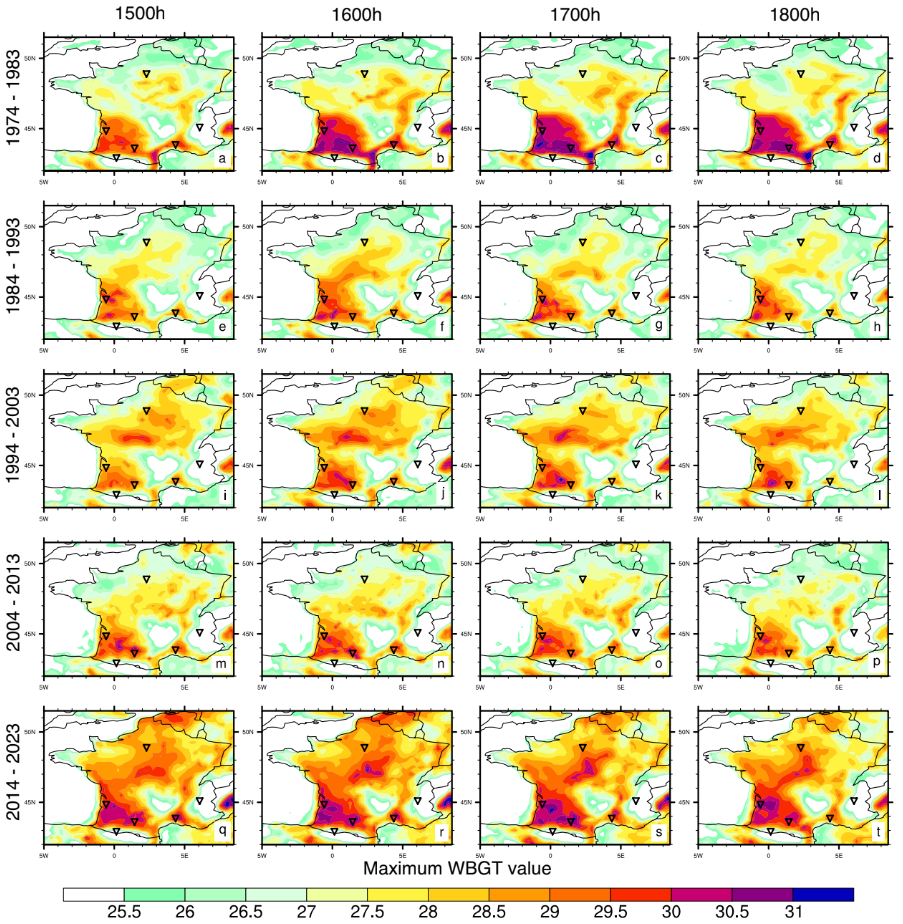
Maximum WBGT across France for the month of July from 1974-2023. Rows show the values for each decade and columns show the hourly values for 3:00pm, 4:00pm, 5:00pm and 6:00pm. Lower temperatures are shown in lighter greens and yellows, while higher temperatures are shown in darker reds and purples. Triangles indicate the six Tour de France locations analysed in the study.
Maximum WBGT across France for the month of July from 1974-2023. Rows show the values for each decade and columns show the hourly values for 3:00pm, 4:00pm, 5:00pm and 6:00pm. Lower temperatures are shown in lighter greens and yellows, while higher temperatures are shown in darker reds and purples. Triangles indicate the six Tour de France locations analysed in the study. Source: Cvijanovic et al. (2026)

The researchers also find that most of the country has crossed the 28C WBGT threshold – which they describe as “dangerous heat levels” – on at least one July day over the past decade. However, by looking at the WBGT on the day the Tour passed through any of these six locations, they find that the threshold has rarely been breached during the race itself.

For example, the research notes that, since 1974, Paris has seen a WBGT of 28C five times at 3pm in July – but that these events have “so far” not coincided with the cycling race.

The study states that it is “fortunate” that the Tour has so far avoided the worst of the heat-stress. 

Cvijanovic says the organisers and competitors have been “lucky” to date. She adds: 

“It has worked really well for them so far. But as the frequency of these [extreme heat] events is increasing, it will be harder and harder to be lucky.”

Dr Madeleine Orr, an assistant professor of sport ecology at the University of Toronto who was not involved in the study, tells Carbon Brief that the paper was “really well done”, noting that its “methods are good [and its] approach was sound”. She adds:

“[The Tour has] had athletes complain about [the heat]. They’ve had athletes collapse – and still those aren’t the worst conditions. I think that that says a lot about what we consider safe. They’ve still been lucky to not see what unsafe looks like, despite [the heat] having already had impacts.”

Heat safety protocols

In 2024, the UCI set out its first-ever high temperature protocol – a set of guidelines for race organisers to assess athletes’ risk of heat stress.

The assessment places the potential risk into one of five categories based on the WBGT, ranging from very low to high risk. 

The protocol then sets out suggested actions to take in the event of extreme heat, ranging from having athletes complete their warm-ups using ice vests and cold towels to increasing the number of support vehicles providing water and ice.

If the WBGT climbs above the 28C mark, the protocol suggests that organisers modify the start time of the stage, adapt the course to remove particularly hazardous sections – or even cancel the race entirely.

However, Orr notes that many other parts of the race, such as spectator comfort and equipment functioning, may have lower temperatures thresholds that are not accounted for in the protocol, but should also be considered.

Murfree points out that the study’s findings – and the heat protocol itself – are “really focused on adaptation, rather than mitigation”. While this is “to be expected”, she tells Carbon Brief:

“Moving to earlier start times or adjusting the route specifically to avoid these locations that score higher in heat stress doesn’t stop the heat stress. These aren’t climate preventative measures. That, I think, would be a much more difficult conversation to have in the research because of the Tour de France’s intimate relationship with fossil-fuel companies.”

Original article by Giuliana Viglione republished from Carbon Brief under a CC license.

Neo-Fascist Climate Science Denier Donald Trump says Burn, Baby, Burn.
Nigel Farage urges you to ignore facts and reality and be a climate science denier like him and his Deputy Richard Tice. He says that Reform UK has received £Millions and £Millions from the fossil fuel industry to promote climate denial and destroy the planet.
Donald Trump urges you to be a Climate Science denier like him. He says that he makes millions and millions for destroying the planet, Burn, Baby, Burn and Flood, Baby, Flood.
Continue ReadingDangerous heat for Tour de France riders only a ‘question of time’

Ed Miliband says Tories are ‘anti-science’ for abandoning net zero consensus

Spread the love

https://www.theguardian.com/environment/2025/jul/14/ed-miliband-says-tories-are-anti-science-for-abandoning-net-zero-consensus

Ed Miliband said the Conservatives had ‘abandoned 20 years of bipartisanship when to comes to climate’. Photograph: UK Parliament

Energy and net zero secretary lays out stark picture of how climate crisis and nature depletion is affecting UK

Ed Miliband has accused the Conservatives of being “anti-science” by abandoning a political consensus on net zero as he gave MPs a stark outline of how the climate crisis and nature depletion are already affecting the UK.

In the first of what is promised to be an annual “state of the climate” report, the energy and net zero secretary set out the findings of a Met Office-led study that detailed how the UK was already hotter and wetter, and faced a greater number of extreme weather events.

Miliband, who told the Guardian before the statement that politicians who rejected net zero policies needed to be accountable for their decisions, called for opposition parties to unite around the need for urgent action.

But speaking after Miliband, Andrew Bowie, a shadow energy minister, criticised what he called the government’s “shrill” language, saying the party was sticking by Kemi Badenoch’s decision to ditch the 2050 target for the UK to reach net zero.

Miliband quoted the former prime minister Theresa May, who put net zero targets into law in 2019 and had argued that the real climate zealots were “populists who offer only easy answers to complex questions”. He added: “I couldn’t put it better myself.”

“The lesson is clear. The choices we make as a country have influenced the cause of global action, and in doing so, reduced the impact of the climate and nature crisis on future generations in Britain. To those who say Britain cannot make a difference. I say: you are wrong. Stop talking our country down. British leadership matters.”

UK Conservative Party leader Kemi Badenoch explains her reality that the Earth is flat, the Moon is made of cheese and that she was born from Unicorn horn dust
UK Conservative Party leader Kemi ‘not a genocide’ Badenoch explains her reality that the Earth is flat, the Moon is made of cheese and that she was born from Unicorn horn dust
Nigel Farage urges you to ignore facts and reality and be a climate science denier like him. He says that Reform UK has received millions and millions from the fossil fuel industry to promote climate denial and destroy the planet.

Continue ReadingEd Miliband says Tories are ‘anti-science’ for abandoning net zero consensus

Report Shows How Deadly Texas Floods Were Driven by Human-Induced Climate Crisis

Spread the love

Original article by Brad Reed republished from Common Dreams under Creative Commons (CC BY-NC-ND 3.0). 

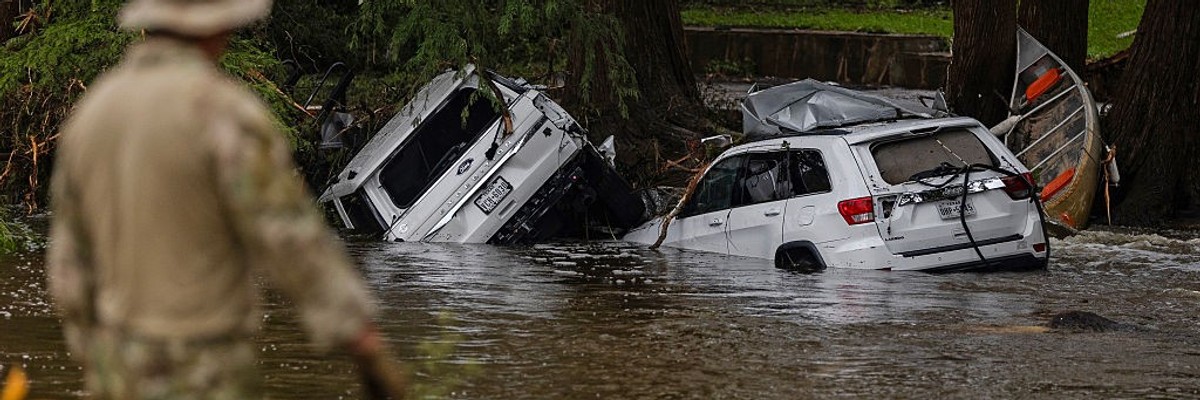
Vehicles sit submerged as a search and rescue worker looks through debris for any survivors or remains of people swept up in the flash flooding on July 6, 2025 in Hunt, Texas. (Photo: Jim Vondruska/Getty Images)

“Very exceptional meteorological conditions” preceded the Texas floods, climate scientists have found.

A new report from a trio of prominent climate researchers has concluded that the devastating floods that hit central Texas over the last three days were made significantly worse due to the impacts of human-induced climate change.

A study published on Monday by ClimaMeter found that the floods in Texas were caused by “very exceptional meteorological conditions” that cannot be explained merely by natural variability.

The authors—Davide Faranda of the Institut Pierre-Simon Laplace in France, Mireia Ginesta of the University of Oxford in the U.K., and Tommaso Alberti of the Istituto Nazionale di Geofisica e Vulcanologia in Italy—contend that the meteorological conditions present at the start of the Texas floods on July 4 “were characterized by slightly negative surface pressure anomalies over Central Texas, with values ranging up to –2 hPa, indicating the presence of a weak low-pressure system over the region.” They also found that “temperatures were significantly below the climatological average for this time of year, with anomalies reaching –5°C across much of the area affected by the flooding.”

The researchers then compared how extreme weather events that occurred under meteorological conditions similar to those present during this week’s floods would have manifested had they occurred in the years from 1950 until 1986, a three-decade period during where human-induced climate change had yet to cause a global surface temperature spike. They concluded that the meteorological conditions ahead of the deadly Texas floods this year were up to 7% wetter than those that had proceeded past floods in the region.

The ClimaMeter study adds heft to statements made by climate scientists over the weekend who argued that there was no question that human-induced climate change—which is driven largely by the extraction and burning of fossil fuels—had tipped the floods into historic disaster territory.

“The tragic events in Texas are exactly what we would expect in our hotter, climate-changed, world,” said Bill McGuire, professor emeritus of geophysics and climate hazards at University College London. “There has been an explosion in extreme weather in recent years, including more devastating flash floods caused by slow-moving, wetter, storms, that dump exceptional amounts of rain over small areas across a short time.”

As of this writing, at least 80 people have been confirmed dead as a result of the Texas floods while dozens more people have been reported as missing. The Washington Post reports that data from the Federal Emergency Management Agency’s Integrated Public Alert and Warning System shows that Kerr County, Texas didn’t send out an Amber Alert-style push message to local residents until Sunday, two days after the floods overwhelmed the area’s rivers and creeks.

Original article by Brad Reed republished from Common Dreams under Creative Commons (CC BY-NC-ND 3.0). 

Donald Trump urges you to be a Climate Science denier like him. He says that he makes millions and millions for destroying the planet, Burn, Baby, Burn and Flood, Baby, Flood.
Nigel Farage urges you to ignore facts and reality and be a climate science denier like him. He says that Reform UK has received millions and millions from the fossil fuel industry to promote climate denial and destroy the planet.
Power-mad orange gasbag Donald Trump says Burn, Baby, Burn.
Power-mad climate science denying Neo-Fascist orange gasbag Donald Trump says Burn, Baby, Burn.

Continue ReadingReport Shows How Deadly Texas Floods Were Driven by Human-Induced Climate Crisis