


Original article by Jake Johnson republished from Common Dreams under Creative Commons (CC BY-NC-ND 3.0).
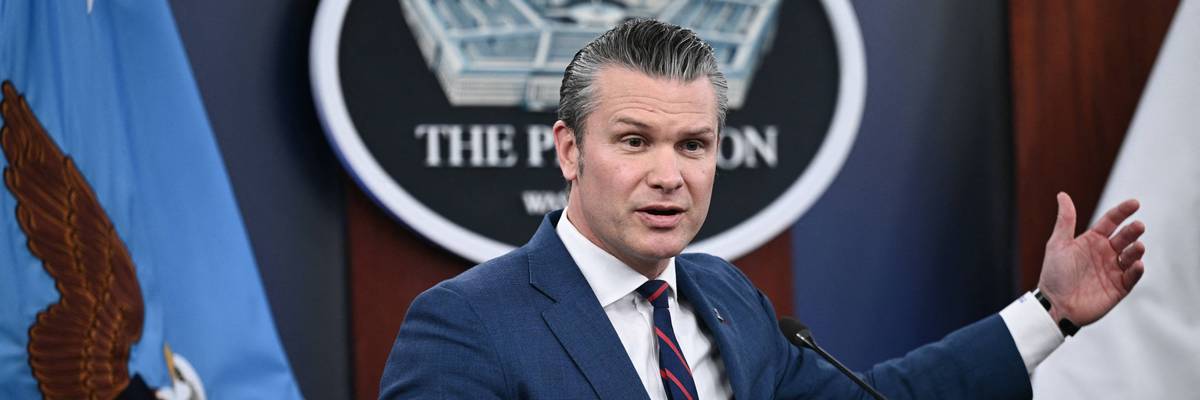
US Pentagon Secretary Pete Hegseth’s dismissal on Monday of what he called “stupid rules of engagement” in the illegal war against Iran amounted to an invitation for American and allied forces to commit war crimes, human rights organizations and other critics warned.
Hegseth’s remarks came during a press conference alongside the top US general, Joint Chiefs of Staff Chairman Dan Caine. The Pentagon chief boasted that the US is “unleashing the most lethal and precise air power campaign in history,” “all on our terms with maximum authorities,” unbound by “stupid rules of engagement,” and undeterred by “what so-called international institutions say”—an apparent reference to the United Nations.
RECOMMENDED…
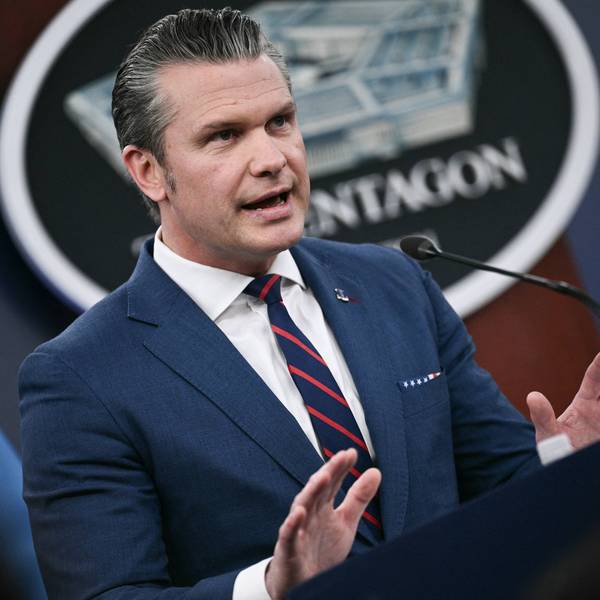

Hegseth, an accused war criminal who successfully lobbied President Donald Trump to pardon alleged or convicted war criminals during his first White House term, also praised Israel for its willingness to dispense with rules of engagement, “unlike so many of our traditional allies who wring their hands and clutch their pearls, hemming and hawing about the use of force.”
Human Rights Watch (HRW) said in a statement Monday that “these remarks are concerning in light of Hegseth’s actions in the past year that have weakened US military posts and mechanisms intended to ensure compliance with international humanitarian law, also known as the laws of war.”
“Rules of engagement are official military directives that tell military forces when, where, how, and against whom force may be used. They must always be in accordance with the laws of war,” said HRW. “Hegseth abolished ‘civilian environment teams’ and other mechanisms intended to limit harm to civilians during operations. The 2026 National Defense Strategy omitted references to civilian protection and the Defense Department rolled back restrictions on its use of antipersonnel landmines and moved ahead with cluster munitions procurement despite these weapons’ foreseeable immediate and long-term harm to civilians.”
“Human Rights Watch will endeavor to assess whether these Defense Department actions unlawfully increase the risk of harm to civilians during US military operations,” the group added. “US civilian and military officials should reaffirm US compliance with the laws of war and restore the personnel and oversight structures that help protect civilians during armed conflict.”
Historian Seth Cotlar wrote on social media that Hegseth’s comments underscored that “we are a rogue murder state now, and positively proud of it.”
The Pentagon chief’s remarks came days after a girls’ school in Iran was bombed, allegedly by US or Israeli forces. The US Central Command said it was “looking into” the attack, which killed 165 people—most of them girls between the ages of 7 and 12. The Guardian notes that the school was “adjacent to a cluster of buildings that form the local Islamic Revolutionary Guard Corps (IRGC) barracks and support buildings.”
An Al Jazeera investigation concluded the school strike was likely “deliberate.”
The Euro-Mediterranean Human Rights Monitor said in a statement over the weekend that “any deliberate attack on a school or on civilians, as well as any indiscriminate or disproportionate attack that violates the principles of distinction and proportionality, constitutes a grave breach and may amount to a war crime where intent to target the school is established or where the attack is indiscriminate or disproportionate.”
Hegseth has previously derided limitations on US troops’ conduct overseas as “stupid.” During remarks to hundreds of generals last year, the Pentagon chief declared that we “untie the hands of our warfighters to intimidate, demoralize, hunt, and kill the enemies of our country.”
“We unleash overwhelming and punishing violence on the enemy,” Hegseth said at the time. “No more politically correct and overbearing rules of engagement.”
Original article by Jake Johnson republished from Common Dreams under Creative Commons (CC BY-NC-ND 3.0).



Original article by Julia Conley republished from Common Dreams under Creative Commons (CC BY-NC-ND 3.0).
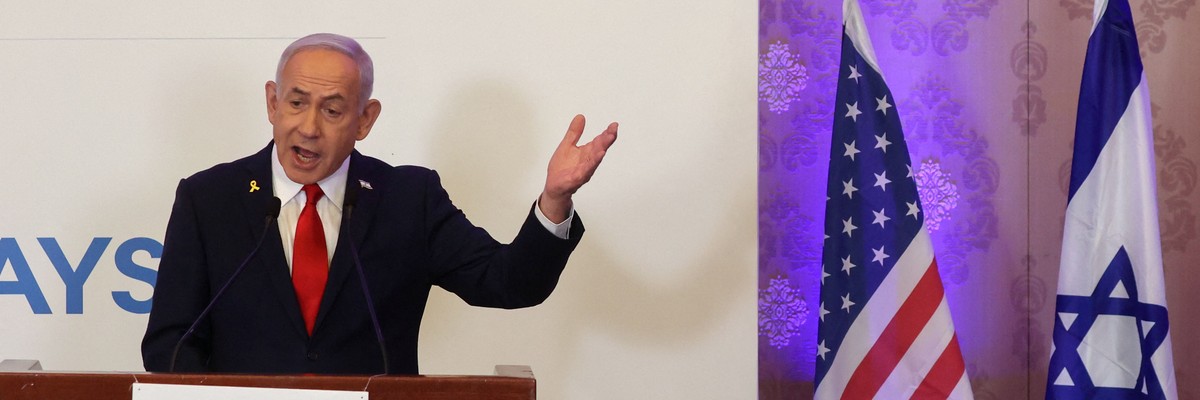
Ahead of a meeting with his security ministers, Israeli Prime Minister Benjamin Netanyahu confirmed once again Thursday that his government plans to take control of the entire Gaza Strip—”a direct assault on international law,” as one group said this week, and one that his own military leaders have opposed.
In an interview with Fox News, Netanyahu was asked whether his government aims to take over all of Gaza, 75% of which it now claims to control, as officials have stated this week.
“We intend to,” the prime minister said, saying his country would take control of the enclave “in order to assure our security, remove Hamas there, enable the population to be free of Gaza, and to pass it to civilian governance that is not Hamas and not anyone advocating the destruction of Israel.”
Netanyahu convened a security meeting after the interview, seeking approval for his plan to expand Israel’s offensive in Gaza to areas in the central part of the territory where hostages are believed to be held, which the Israel Defense Forces (IDF) have largely avoided since it began bombarding Gaza in October 2023.
The assault has forcibly displaced nearly the entire population of 2.1 million Palestinians, killed more than 61,000, and injured more than 150,000 as Israel’s near-total blockade has pushed the enclave toward famine and starved to death nearly 200 people, including at least 96 children.
The prime minister did not delve into specifics about the plan, but claimed Israel does not “want to govern” Gaza.
“We don’t want to be there as a governing body,” he said. “We want to hand it over to Arab forces.”
IDF Chief of Staff Eyal Zamir has expressed opposition to the proposal, and three military officials told The New York Times Thursday that the military would prefer a new cease-fire deal rather than intensifying fighting.
Cease-fire talks between Hamas and Israel have recently hit a deadlock.
Setting up a system of occupation in Gaza like the one Israel controls in the West Bank would take “up to five years of sustained combat,” officials told the Times.
Muhammad Shehada, a visiting fellow at the European Council on Foreign Relations, explained how Netanyahu and his Cabinet, including Finance Minister Bezalel Smotrich, likely plan to carry out “the final phase of the genocide” in Gaza, having recently set aside funds “for winning the war” in the enclave.
“Israel will move to annihilate the three remaining areas that haven’t been wiped out fully yet: Gaza City, Deir Al-Balah, and the central refugee camps (i.e. Nuseirat),” said Shehada. “Those three areas have been heavily bombed, invaded by the IDF, shelled nonstop but they have not been depopulated and fully razed to the ground like Rafah, Khan Younis, Jabaliya, Beit Hanoun, etc.”
Palestinian-American analyst Yousef Munayyer denounced Netanyahu’s stated plan as “stupid, criminal, and horrifying.”
Palestinians have expressed fears this week that the latest Israeli proposal would kill far more civilians in Gaza as the IDF moves into areas where hundreds of thousands of people have been forced to move.
“They’re talking about occupying areas that are packed with so many people,” Mukhlis al-Masri, a 34-year-old Palestinian who fled to Khan Younis from his home in northern Gaza, told the Times. “If they do that, there will be incalculable killing. The situation will be more dangerous than anyone can imagine.”
Mairav Zonszein, a senior analyst on Israel at the International Crisis Group, said Netanyahu’s comments on Thursday included “a slip, but a revealing one”: that Israel wants to “enable the population to be free of Gaza” following the IDF’s decimation of the enclave.
“Netanyahu’s threat to ‘take control’ of all of Gaza is like his threat in 2020 to annex the West Bank,” said Zonszein. “Israel already controls and destroyed most of Gaza, and already de facto annexed the West Bank. So while Palestinians will suffer more, Israeli strategy hasn’t changed one bit.”
Original article by Julia Conley republished from Common Dreams under Creative Commons (CC BY-NC-ND 3.0).

Original article by Sam Bright republished from DeSmog
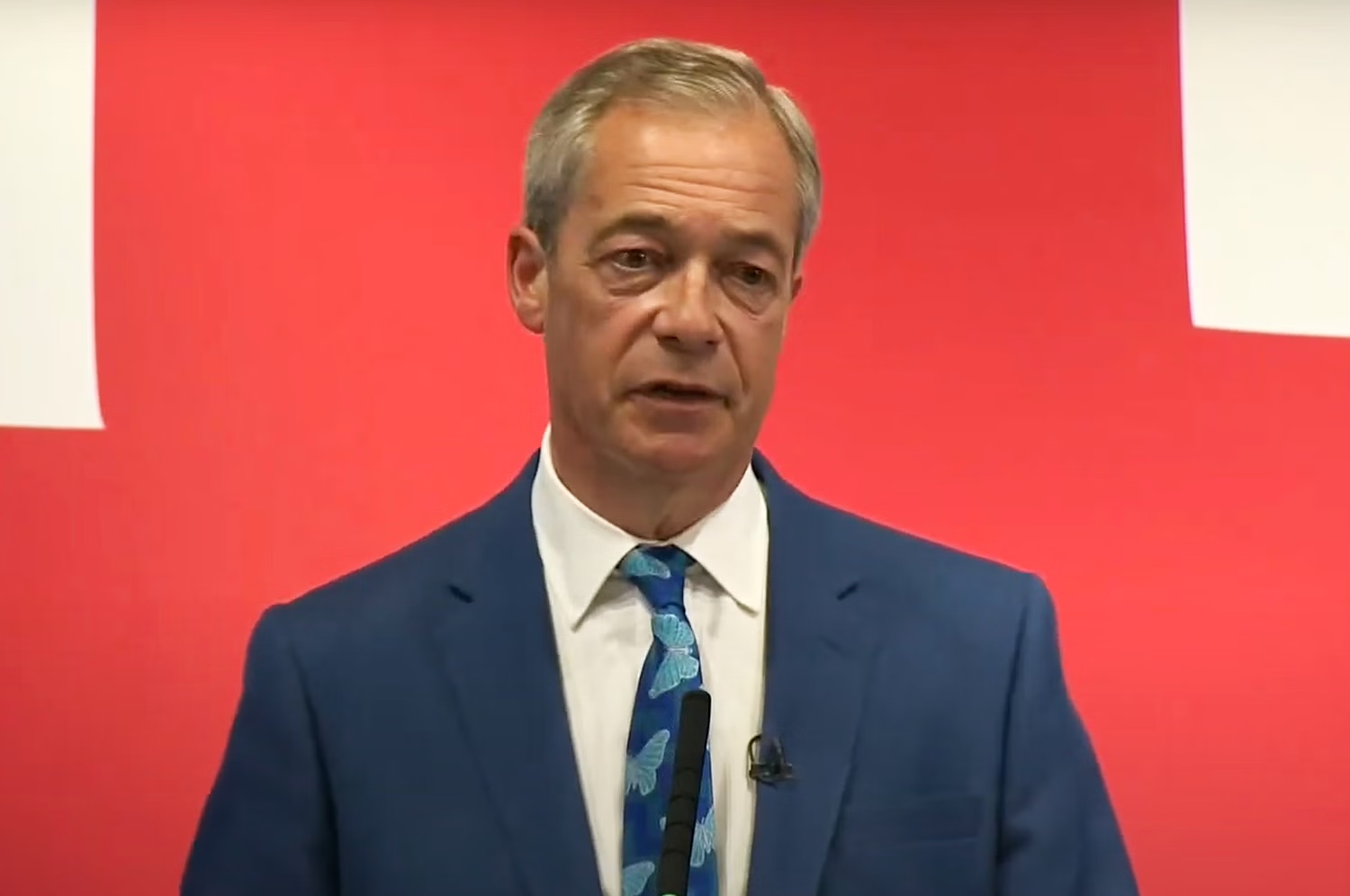
Pro-Brexit campaigner Nigel Farage has announced that he will be standing to be an MP at the upcoming general election and will be replacing Richard Tice as leader of the populist party Reform UK.
Farage, who says that he hopes to become “the voice of opposition” in Parliament, has long been a vocal opponent of climate action and a critic of climate science – campaigning for a referendum on the UK’s 2050 net zero emissions target.
When he was the leader of the UK Independence Party (UKIP), the party’s 2015 and 2017 election manifestos pledged to rip up green measures, repeal the UK’s Climate Change Act, withdraw from the 2015 Paris Agreement – the flagship deal to tackle global emissions – and support fossil fuel extraction.
These reflected Farage’s personal views on climate action. In 2015, he told the libertarian website Spiked: “I think wind energy is the biggest collective economic insanity I’ve seen in my entire life. I’ve never seen anything more stupid, more illogical, or more irrational.”
Farage is a presenter on GB News, the right-wing broadcaster that has regularly provided a platform to climate science denial and attacks on green reforms since it launched in June 2021.
Speaking on GB News in August 2021, Farage said that he was “very much an environmentalist” and that he couldn’t “abide things like plastics in our seas, pollution in our rivers.” However, on the issue of climate change, he added: “What annoys me though, is this complete obsession with carbon dioxide almost to the exclusion of everything else, the alarmism that comes with it, based on dodgy predictions and science.”
The world’s foremost climate science body, the UN’s Intergovernmental Panel on Climate Change (IPCC), has stated it is “unequivocal that human influence has warmed the atmosphere, ocean and land”, while scientists at NASA have found that the last 10 years were the hottest on record. Earth’s average surface temperature in 2023 was the warmest since records began in 1880.
The IPCC has also stated that carbon dioxide “is responsible for most of global warming” since the late 19th century, which has increased the “severity and frequency of weather and climate extremes, like heat waves, heavy rains, and drought”.
Farage has been a vocal critic of net zero. He has claimed that the policy is an “act of self harm” and has called for it to be scrapped.
He has said: “It will not bring economic benefits. It will make everybody a whole lot poorer. And yet the lemmings in Parliament are taking us towards an economic cliff,” adding: “I can’t think of an issue on which the public and politicians are more divided.”
In fact, politicians are markedly less in favour of climate action than the general public. New polling by YouGov for the Energy and Climate Intelligence Unit (ECIU) has shown that almost two-thirds (62 percent) of the public believe the best way to achieve energy security is to reduce the use of fossil fuels and instead expand the use of renewable energy, compared to 48 percent of MPs.
The Climate Change Committee, which advises the government on its net zero policies, has estimated that the cost of achieving net zero will be less than 1 percent of UK GDP, while the government independent spending watchdog – the Office for Budget Responsibility – has said that, “the costs of failing to get climate change under control would be much larger than those of bringing emissions down to net zero”.
Farage has also claimed that, “If green technology is going to work, it ought to work without ordinary folk subsidising it” – referring to the government grants and investment dedicated to developing clean energy sources. The UK government has given £20 billion more in support to fossil fuel producers than their renewable energy peers since 2015.
Farage has also spread conspiracy theories about anti-pollution measures being used to control people’s lives.
In a video posted on Twitter, he argued that Mayor of London Sadiq Khan’s calls to reduce air pollution by cutting car engine use would pave the way to “climate lockdowns”.
He said: “Mark my words this isn’t going to end with 20mph zones and low-traffic neighbourhoods. No no. This is the beginning of climate lockdowns. We will have, in years to come, days where we’re told we can’t drive, we can’t do this, you can’t do that while Sadiq Khan is leading the way. Remember you heard it here first. Climate lockdowns.”
The Institute for Strategic Dialogue has highlighted how climate lockdown claims are part of “a conspiratorial narrative which claims that global elites are using climate change as a pretext to restrict individual freedoms and civil liberties.”
Farage used his announcement to state his belief that Labour will win the general election, which will be held on 4 July, and that the Conservative Party has “crushed itself”. With the Tories predicted to lose in a landslide, Farage appears to believe that he can lead a new right-wing movement.
The Reform leader was already a key figure in the party prior to today’s announcement, effectively owning the party as well as serving as its president. Reform operates as a private company without a democratic structure, so Farage’s majority shareholding meant that could have appointed himself as leader at any time.
Despite Farage failing to be elected as an MP when he stood in seven previous general elections, and Reform only winning two councillors in May’s local elections, polls indicate that Farage may succeed in becoming the MP for Clacton.
If this is the case, Farage will be advocating in Parliament for the anti-climate policies that have been proposed by his party.
Reform has called for the UK’s net zero emissions target to be scrapped, and has proposed holding a referendum on the policy – a campaign launched by Farage in 2022.
The party’s policy agenda states that: “Westminster’s net zero plans send our jobs and money overseas, making us net poorer and net colder”, adding that net zero policies are “net stupid”.
The party’s former leader Tice, who will now become its chairman, is a prominent climate science denier. Tice has claimed that “there is no climate crisis”, and has also expressed the view that “CO2 isn’t a poison. It’s plant food”.
Of the £2.5 million that Reform UK has received in donations since the 2019 election, around 92 percent (£2.3 million) of that income has been given by fossil fuel interests, polluting industries, or climate science deniers.
Original article by Sam Bright republished from DeSmog
Original article by Finlay Johnston and Indra Warnes republished from Open Democracy.
Boris Johnson’s inability to make decisions “significantly impacted the pace and clarity of decision-making” in the early days of the pandemic, his former communications director told the Covid inquiry today.
Lee Cain, who worked for Johnson in 2020, said the then prime minister “oscillated” over whether to lock down for ten days after a meeting between senior government figures decided it was both essential and inevitable.
Attendees to the meeting, which took place on 14 March 2020, included Cain, Johnson, and Johnson’s special adviser, Dominic Cummings.
In his written evidence to the inquiry, Cain said: “The collective agreement in the room was that a full lockdown was the only strategy which could suppress the spread of Covid-19, save the NHS from collapse and ultimately buy the government more time.”
He continued: “It was only a matter of when, how hard, and how long the lockdown had to be.”
Johnson announced the first national lockdown on 23 March, ten days later. One factor in that delay, suggested Andrew O’Connor KC, counsel to the inquiry, was “indecison on the part of the prime minister”.
Quoting from Cain’s written evidence, O’Connor said: “The system works at its best when there’s clear direction from Number 10 and the prime minister, these moments of indecision significantly impacted the pace and clarity of decision-making across government.”
The inquiry was shown a WhatsApp message sent from Cain to Cummings on 19 March 2020, in which Cain complained he was “exhausted” by the prime minister. Asked by O’Connor why he was felt this way, Cain described Johnson as “challenging”.
Cain said: “Anyone who’s worked with the prime minister for a period of time will become exhausted with him sometimes. He can be quite a challenging character to work with, just because he will oscillate, he will take a decision from the last person in the room.”
O’Connor went on to ask Cain if he felt Johnson was “up to the job” of being prime minister in March 2020.
“It was the wrong crisis for this prime minister’s skillset,” Cain said, adding: “If you look at something like Covid, you need quick decisions and you need people to hold the course, and you know, have that strength of mind to do that over a sustained period of time and not constantly unpick things.”
In an earlier WhatsApp, Cummings had described Johnson as being in “jaws wank mode” in a meeting with Sunak, a reference to Johnson’s frequent statements that he did not want to be compared to the mayor who closed the beaches in the film Jaws.
Cummings added: “I’ve literally said the same thing ten fucking times and he [Johnson] still won’t absorb it”.
The inquiry also saw messages from 3 March 2020, in which Cain told Cummings that Johnson “doesn’t think [the pandemic] is a big deal and he doesn’t think anything can be done and his focus is elsewhere, he thinks it’ll be like swine flu and he thinks his main danger is talking economy into a slump”.
The inquiry continues.
Original article by Finlay Johnston and Indra Warnes republished from Open Democracy.