‘Dystopian’: UAE Used Global Climate Summit to Push $100 Billion in New Oil Deals

Spread the love

Original article by JULIA CONLEY republished from Common Dreams under Creative Commons (CC BY-NC-ND 3.0). 

United Arab Emirates’ minister of industry and CEO of the Abu Dhabi National Oil Company, Sultan Ahmed Al Jaber, speaks at an event in Houston on March 6, 2023.  (Photo: Mark Felix/AFP via Getty Images)

“Make no mistake, COP28 was hijacked by the interests of the fossil fuel industry,” said one campaigner.

A new analysis released by human rights and anti-corruption group Global Witness on Wednesday left no room for doubt, said one campaigner, that the host country of last year’s United Nations climate summit, the United Arab Emirates, prioritized fossil fuel interests over the planet.

“Make no mistake, COP28 was hijacked by the interests of the fossil fuel industry,” said Patrick Galey, senior investigator for Global Witness, referring to the 28th Conference of the Parties of the United Nations Framework Convention on Climate Change (UNFCCC).

The analysis showed that the UAE’s Abu Dhabi National Oil Company (ADNOC) used the COP28 presidency of its CEO, Sultan Ahmed Al Jaber, to seek deals worth nearly $100 billion with oil, gas, and petrochemical companies in at least 12 countries.

Fossil fuel firms, said Galey, “weren’t content simply to block or stall genuine climate policy but used the opportunity to pursue more climate-wrecking oil and gas deals.”

Al Jaber previously denied that ADNOC used COP28 to further its business interests after a leak of briefing documents that instructed the company to discuss fossil fuel deals with at least 16 states that were present at the talks.

According to Global Witness, the company sought deals with at least 11 of those countries and at least one other that had not been included in the leaked documents.

The group’s investigation found that the UAE redoubled its investment in oil and gas in Egypt in 2023, the year Al Jaber presided over COP28. ADNOC finalized a deal with TotalEnergies Marketing Egypt, purchasing a 50% stake in the company for a reported $200 million—resulting in the UAE now jointly operating 240 service stations across the country and contributing to its record profits posted in 2023.

Other deals sought by ADNOC with COP28 participants include a joint venture with BP to buy a 50% stake in NewMed Energy in Israel and multiple bids for a stake in Braskem, the largest petrochemical producer in Latin America. The company is part-owned by Brazil’s state-run oil and gas producer Petrobas.

ADNOC also finalized deals worth an estimated $17 billion with Lukoil in Russia and Wintershall in Germany to develop the Hail and Ghasha gas field in the UAE.

Global Witness’ findings bolstered a report by the Center for Climate Reporting and the BBC in November, which showed Al Jaber used his position at COP28 to push for fossil fuel deals with foreign governments.

The report confirms the worst fears of climate campaigners, who were incensed in early 2023 when Al Jaber was named the president of the U.N.’s largest annual climate conference and warned of conflicts of interest due to his position at the helm of ADNOC.

As it turns out, said Galey, “the UAE knew exactly what it was doing and was not let down—COP28 seems to have been molded towards the benefit of its state oil company.”

“As depressing as it is dystopian, climate talks must never be allowed to create more climate chaos,” he added.

The analysis was released weeks after U.S. Sen. Jeff Merkley (D-Ore.) and Rep. Jan Schakowsky (D-Ill.) led 24 Democratic lawmakers in writing to Secretary of State Antony Blinken and White House Senior Advisor John Podesta, urging them to support conflict of interest guidelines ahead of COP29, which is scheduled to take place in November in Baku, Azerbaijan.

With Mukhtar Babayev, the country’s ecology and natural resources minister who worked for a state-owned oil and gas company for more than 20 years, set to preside over the conference, Galey said that “COP28 seems to have provided other petrostates with a sinister playbook to copy and paste from.”

“As the UAE passes the baton onto Azerbaijan, we are now looking at the possibility of consecutive COPs being hijacked for the interests of big polluters and their profits,” said Galey, noting that scientists have warned the planet is “dangerously close” to heating that exceeds 1.5°C.

Global Witness pointed to recently announced plans to partially privatize the State Oil Company of Azerbaijan (SOCAR) ahead of COP29, “with its downstream and petrochemical subsidiaries made available to help attract foreign investments.”

Rep. Rashida Tlaib (D-Mich.), who signed the letter spearheaded by Merkley and Schakowsky, said Global Witness’ report “is a disturbing warning about the potential for further fossil fuel corruption at COP29, which incredibly will also be hosted by another fossil fuel executive.”

“I will continue urging the U.S. and UNFCCC to adopt new policies to prevent these absurd conflicts of interest that frustrate the international community’s work to address the urgent threats of climate change,” she said.

Global Witness reached out to ADNOC, SOCAR, and COP29 for comment regarding its investigation, and was told that ADNOC is working to “secure, reliable, and responsible supply of energy to support a just, orderly, and equitable global energy transition and that allegations regarding Al Jaber’s deal-making at COP28 are “false, not true, incorrect, and not accurate.”

A COP29 spokesperson said Azerbaijan is “100% committed to bringing countries together with the ambition of keeping the 1.5° target within reach.”

Rep. Barbara Lee (D-Calif.), said in a statement Wednesday that Babayev should be removed “from any leadership role at COP29.”

“It is an absolute scandal that the UNFCCC has two years running put an oil and gas executive in charge of this event,” she said, “thus putting foxes in charge of the henhouse.”

Original article by JULIA CONLEY republished from Common Dreams under Creative Commons (CC BY-NC-ND 3.0). 
Continue Reading‘Dystopian’: UAE Used Global Climate Summit to Push $100 Billion in New Oil Deals

Five Key Narratives to Watch For at COP28

Spread the love

Original article republished from DeSmog.

Here’s DeSmog’s take on what to expect at this year’s climate summit, from Big Oil’s influence, to a new Big Ag agenda, to promotion of sketchy solutions that would keep oil and gas burning for decades to come.

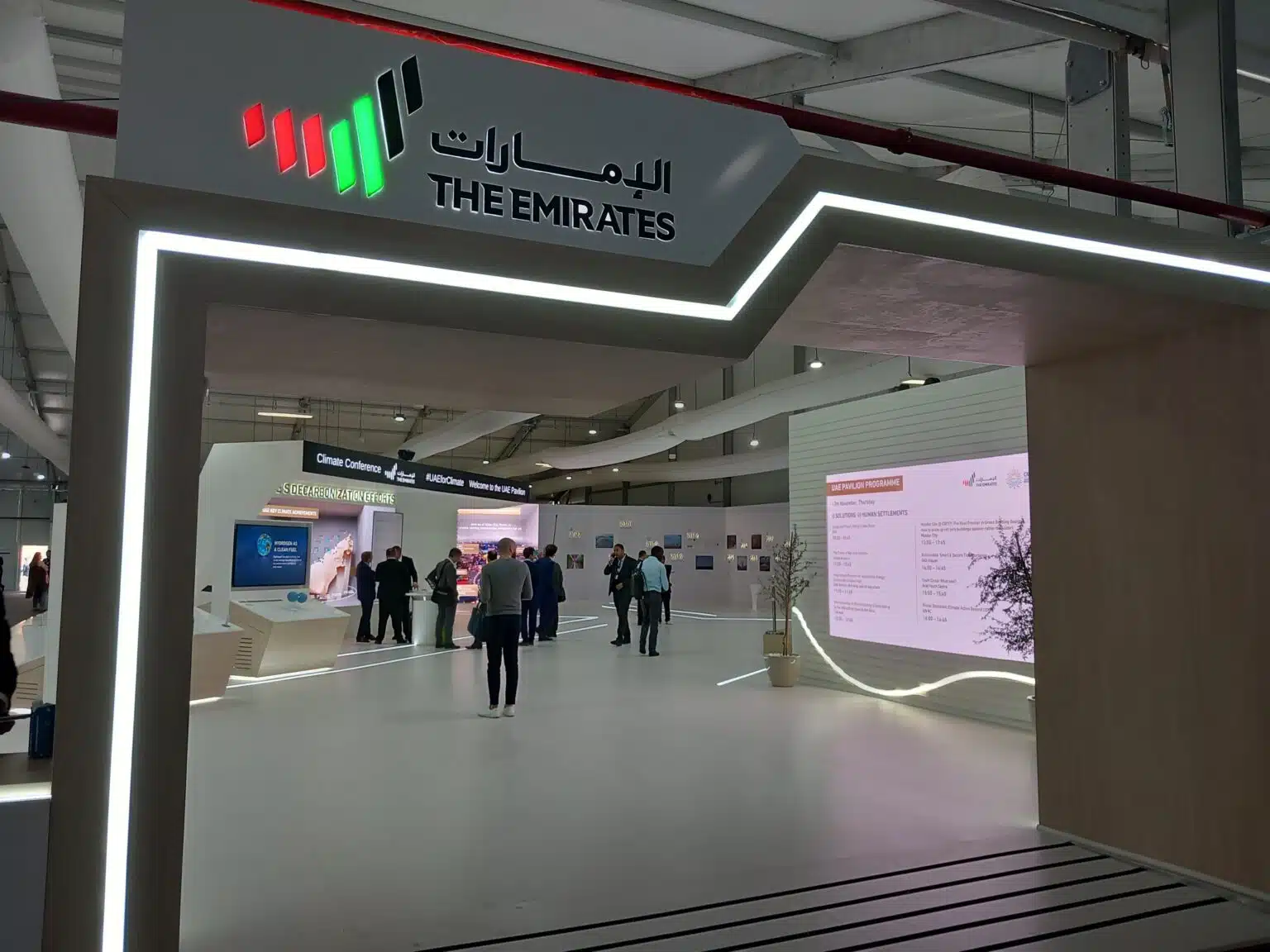
The United Arab Emirates’ pavilion at COP27. Credit: Adam Barnett

The annual United Nations climate negotiations are just a week away. Known as COP28 — since it’s the 28th year of the “conference of the parties” to the United Nations climate agreement — it will be hosted by the United Arab Emirates in Dubai from November 30 through December 12. 

COP28 will be especially significant, as it will feature the first-ever “global stocktake,” of how much progress — or lack thereof — countries and other stakeholders have made toward meeting the goal established in 2015’s Paris Agreement of limiting warming to “well below” 2º degrees Celsius. 

Negotiators at COP28 will also aim to make progress on key climate issues including loss and damage finance, a just energy transition, and closing the emissions gap.

As the climate crisis accelerates, so, too, do efforts by the fossil fuel industry to derail steep reductions in carbon pollution by mid-century, in part by promoting false solutions. Below, we’ve rounded up recent coverage to help you make sense of the key denial and greenwashing narratives that will be front and center during the event.

A Big Presence from Big Oil

After all, this is the first annual climate conference with a Big Oil exec at the top: COP28 President Sultan Ahmed Al Jaber

Al Jaber, the person leading these global climate negotiations, is the CEO of the Abu Dhabi National Oil Company (ADNOC). He has openly called for fossil fuel companies’ “help to drive the solutions,” and advocated overcoming “the hurdles to scale up and commercialize hydrogen and carbon capture technologies” — two so-far unproven climate solutions being heavily promoted by the fossil fuel industry. A big presence from Big Oil would be in line with trends at the past two summits: 636 fossil fuel lobbyists registered to attend last year’s conference in Sharm el-Sheikh, Egypt, while 503 registered for 2021’s gathering in Glasgow.

Dive deeper with our Climate Disinformation Database profile of Sultan Ahmed Al Jaber, our coverage of his appointment as COP28 president, and our reporting last year on fossil fuel lobbyists at COP27.

An Industry Push for CCS

The fossil fuel industry will paint carbon capture and storage (CCS) as a climate solution during this year’s conference. Critics argue it is anything but. 

Of the 32 commercial CCS facilities operating worldwide, 22 use most, or all, of their captured carbon dioxide (CO2) to pump more oil out of depleted wells. Burning that oil creates far more CO2 than what is captured. 

DeSmog recently analyzed 12 large-scale CCS projects around the world and found countless missed carbon capture targets, as well as cost overruns, with taxpayers picking up the tab via billions of dollars in subsidies. Despite these failures, Big Oil publicly champions CCS and pushes projects over communities’ objections. Privately, the industry shares critics’ concerns.

With the Biden administration channeling billions of dollars into investments and tax credits for CCS, the United States is likely to be a key CCS supporter at the conference.

Dive deeper with our explainer on how CCS is used for “enhanced oil recovery,” our investigation into CCS’s biggest fails, hear what Big Oil is saying about CCS in private.

Greenwashing by Big Agriculture

This year’s climate conference is coming on the heels of the world’s hottest year, with devastating floods around the world affecting the global food supply, and more than 330 million people worldwide facing famine. So COP28 leaders have released a four-point “food and agriculture” agenda for the summit that calls for governments and industry to collaborate on finding new solutions to climate change–driven food insecurity. 

However, some of the biggest companies in agribusiness, are using greenwashing to shift the debate away from meaningful action. DeSmog has debunked six concepts that the world’s largest food and farming companies will be co-opting in hopes of swaying debates and discussions in  Dubai — including “regenerative agriculture,” “nature-based solutions,” and “climate neutrality.” Stay tuned for DeSmog’s coverage from Dubai — our team will be keeping a close eye on Big Ag.

Dive deeper with our coverage of how food systems are linked to fossil fuel consumption, investigations into the meat and dairy groups downplaying their industries’ climate impacts, and the ties between Big Ag and right-wing politicians in the EU.

PR Spin That Promotes Denial and Delay

Ever wonder how a top oil-producing nation like the United Arab Emirates earned hosting duties for this year’s climate summit, or why the chief of UAE’s state oil company ADNOC, Sultan Ahmed Al Jaber, has ascended to one of the top roles in global climate negotiations? Reporting by DeSmog revealed that from 2007 to 2009, Edelman, the largest public relations firm in the world, ran a campaign to bolster the UAE and Al Jaber’s green images. 

Advertising and PR agencies like Edelman have long burnished the public’s perceptions of fossil fuel interests, and are still creating advertising campaigns for big polluters that distract from and delay climate action — such as sponsored-content for a pesticides giant or leading climate communications while catering to Big Oil. Still, within the ad industry, pressure is mounting to stop working with fossil fuel clients. Some companies and organizations are even dropping ad and PR firms for taking on new fossil fuel industry accounts

Follow DeSmog’s coverage as we highlight the PR spin at COP28.

Dive deeper with our Climate Disinformation Database profiles of PR and ad firms EdelmanOgilvy, and FleishmanHillard, our investigation into Edelman’s campaign to burnish Al Jaber and the UAE’s green creds, and our coverage of the backlash to Havas winning Shell’s business.

Anticipate Disinformation 

Disinformation strategies and narratives will be on display throughout the summit — much as we reported during COP27, where fossil fuel-linked groups spent around $4 million on social media ads that spread false climate claims. 

The disinformation may flow thicker and faster than ever during COP28. As DeSmog has reported, over the past five years climate greenwashing has “gone through the roof,” as major polluters turn to greenwashing to avoid accountability for the climate crisis. In part, this may be a response to the increasing number of climate lawsuits and legal complaints against misleading climate claims. Attorneys general across the U.S. have charged fossil fuel companies with defrauding consumers by lying about the impacts of burning coal, oil, and gas — while activists and campaigners in Europe seek to hold Big Oil accountable under regulations against misleading advertising.

To understand disinformation tactics and where they come from, dig into DeSmog’s reporting about past greenwashing campaigns. We recently shone a light on the way the gas industry borrowed Big Tobacco’s tactics to promote doubt over the health effects of gas stoves. Or read our investigation into how corporate polluters and their political allies have been using the same rhetoric of delay for the past six decades when faced with the prospect of regulation.

Dive deeper with our column on why greenwashing works and how to fight it, our Q&A with Climate Investigations Center researcher Rebecca John, and our investigation into Shell’s knowledge of climate change.

Original article republished from DeSmog.

Continue ReadingFive Key Narratives to Watch For at COP28

Capturing Cop28 chief’s oil firm emissions would take centuries – study

Spread the love

https://www.theguardian.com/environment/2023/nov/15/capturing-cop28-chiefs-oil-firm-emissions-would-take-centuries-study

Analysis deems technology promoted by Sultan Ahmed Al Jaber ‘dangerous red herring’

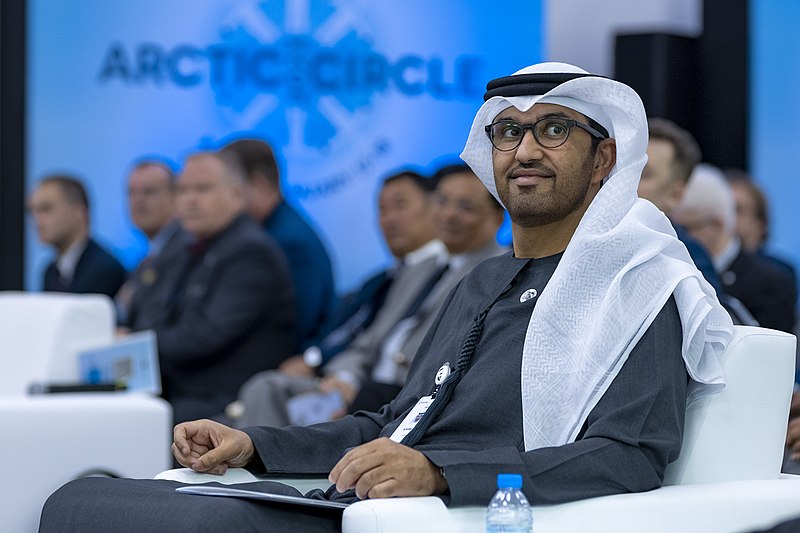
Dr. Sultan al Jaber. Image: Arctic Circle, CC BY 2.0, via Wikimedia Commons

Climate-wrecking emissions produced by the oil company of the Cop28 president, Sultan Ahmed Al Jaber, would take hundreds of years to remove using the carbon capture technology he has been promoting.

With just weeks to go until the crucial Cop28 climate summit, Al Jaber, who is the boss of United Arab Emirate oil company Adnoc, has been backing carbon capture as one solution to the climate crisis.

But analysis by Global Witness has found it would take the company 343 years to capture all the CO2 emissions it will produce in just the next six years.

Jonathan Noronha Gant from Global Witness said the findings proved carbon capture was “a dangerous red herring” that would do nothing to tackle the climate crisis.

“Sultan Al Jaber’s Cop is shaping up to be the Cop of false solutions, inundated by fossil fuel lobbyists pushing empty promises. If Al Jaber is serious – if we are serious – we must immediately reject the CCS [carbon capture and storage] false solution and tackle the existential oil and gas problem head on.’’

https://www.theguardian.com/environment/2023/nov/15/capturing-cop28-chiefs-oil-firm-emissions-would-take-centuries-study

Continue ReadingCapturing Cop28 chief’s oil firm emissions would take centuries – study