Experts Decry US ‘Summary Execution’ of Alleged Drug Runners Off Venezuelan Coast

Spread the love

Original article by Brett Wilkins republished from Common Dreams under Creative Commons (CC BY-NC-ND 3.0). 
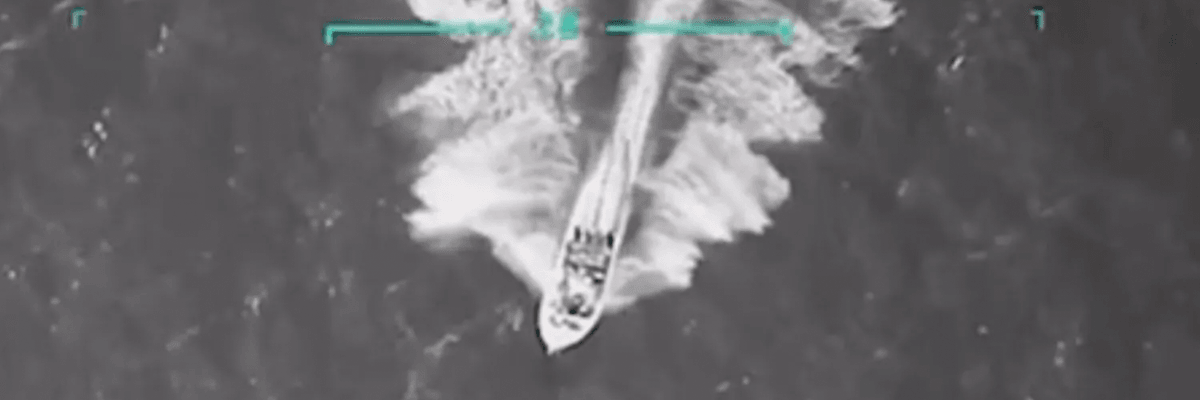
This image was posted on social media by President Donald Trump and shows a boat that was allegedly transporting cocaine off the coast of Venezuela when it was destroyed by US forces on September 2, 2025. (Photo: President Donald Trump/Truth Social)

“Drug trafficking is a crime, not an act of war,” noted one critic. “Traffickers must be arrested, not summarily executed.”

Legal and human rights experts said that Tuesday’s deadly US attack on a boat the Trump administration claimed was transporting cocaine off the coast of Venezuela violated international law.

“Drug trafficking is a crime, not an act of war,” former Human Rights Watch director Kenneth Roth said on social media following the strike, which US President Donald Trump said killed 11 people. “Traffickers must be arrested, not summarily executed, which US forces just illegally did.”

“Trump admits he ordered a summary execution—the crime of murder,” Roth added. “Drug traffickers are not combatants who can be shot on sight. They are criminal suspects who must be arrested and prosecuted.”

Declassified video showing the U.S. committing a war crime when it fired on a civilian vessel near Venezuela.Being suspected of carrying drugs does not carry a death sentence and certainly not without due process.

Arturo Dominguez 🇨🇺🇺🇸 (@extremearturo.bsky.social) 2025-09-02T23:02:57.529Z

Michael Becker, an associate professor of international law at Trinity College, Dublin in Ireland, told the BBC Wednesday that the Trump administration’s designation of the Venezuela-based Tren de Aragua and other drug trafficking groups as terrorist organizations “stretches the meaning of the term beyond its breaking point.”

“The fact that US officials describe the individuals killed by the US strike as narcoterrorists does not transform them into lawful military targets,” Becker said. “The US is not engaged in an armed conflict with Venezuela or the Tren de Aragua criminal organization.”

“Not only does the strike appear to have violated the prohibition on the use of force, it also runs afoul of the right to life under international human rights law,” Becker added.

Although the United States is not a signatory to the United Nations Convention on the Law of the Sea, US military legal advisers have asserted that the country should “act in a manner consistent with its provisions.”

Luke Moffett, a professor of international law at Queens University Belfast in Northern Ireland, told the BBC that while “force can be used to stop a boat,” this should generally be accomplished using “nonlethal measures.”

Such action, said Moffett, must be “reasonable and necessary in self-defense where there is immediate threat of serious injury or loss of life to enforcement officials,” and the US attack was likely “unlawful under the law of the sea.”

“It reflects the worst of US militarism—secretive, unilateral, and contemptuous of due process, human rights, and the rule of law.”

The peace group CodePink said Wednesday that “even if Washington’s claims are accurate, drug trafficking does not justify a death sentence delivered by missile.”

“International law is clear: The use of force is only lawful in self-defense or with explicit UN Security Council authorization,” the group continued. “This strike had neither. It reflects the worst of US militarism—secretive, unilateral, and contemptuous of due process, human rights, and the rule of law.”

“Under US law, it’s equally indefensible,” CodePink argued. “The Constitution gives Congress, not the president, the power to authorize war. Unilateral action may only be used in emergencies or self-defense, and this strike meets neither.”

CodePink continued:

With the US Southern Command assets already deployed in the region, why blow up a vessel instead of capturing and interrogating the crew? If the goal were really to uncover evidence of [Venezuelan President Nicolás] Maduro’s alleged involvement, this reckless approach raises only two possibilities: Either the narrative is fabricated and Washington used it as a pretext for a deadly show of force or it’s real, and the US chose extrajudicial killing over law, evidence, and humanity.

CodePink called on Congressional Progressive Caucus Chair Greg Casar (D-Texas) “to lead the fight in Congress to stop this escalation,” urging him to “introduce legislation to block unauthorized military force, hold hearings to expose the dangers of border militarization, insist on transparency of all relevant directives, and rally Congress to cut off funding for these reckless operations.”

Tuesday’s attack came amid Trump’s deployment of an armada of naval warships off the coast of Venezuela, whose socialist government has long endured US threats of regime change—and sometimes more.

Infused with the notion that it has the right to meddle anywhere in the hemisphere under the Monroe Doctrine, the US has attacked, invaded, occupied, and otherwise intervened in Latin American and Caribbean nations well over 100 times since the dubious declaration was issued by President James Monroe in 1823.

Since the late 19th century, oil-rich Venezuela has seen US interventions including involvement in border disputes, help with military coups, support for dictators, and attempts to subvert the Bolivarian Revolution—including by officially recognizing opposition figures claiming to be the legitimate presidents of the country.

Critics of US imperialism highlighted Washington’s hypocritical policies and practices toward Venezuela.

“Venezuela produces no cocaine, but US warships patrol its coastline under the banner of a ‘drug war,'” New Hampshire Peace Action organizing director Michael “Lefty” Morrill wrote Wednesday.

Meanwhile, neighboring Colombia and nearby Peru—the world’s two leading cocaine producers—get no such treatment. Nor does Ecuador, which has emerged as one of the world’s leading trafficking hubs.

Morrill also briefly explored bits of the long US history of supporting narcotraffickers when strategically expedient, noting that former Panamanian President Manuel Noriega “was first a CIA asset, then branded a narco-dictator and dragged to a US prison.”

“The Taliban was once a strategic partner in Afghanistan’s opium trade, before being cast as the world’s largest trafficker,” he added. “‘Drugs’ are not simply powders; they are pretexts, shaped to fit the contours of empire.”

Original article by Brett Wilkins republished from Common Dreams under Creative Commons (CC BY-NC-ND 3.0). 

Orcas discuss how Trump was re-elected and him being an insane, xenophobic Fascist.
Elon Musk urges you to be a Fascist like him, says that you can ignore facts and reality then.
Donald Fuhrump says that Amerikkka doesn't bother with crimes or charges anymore, not being 100% Amerikkkan and opposing his real estate intentions is enough.
Donald Fuhrump says that Amerikkka doesn’t bother with crimes or charges anymore, not being 100% Amerikkkan and opposing his real estate intentions is enough.

CODEPINK Condemns Illegal U.S. Missile Strike Near Venezuelan Waters ›

Continue ReadingExperts Decry US ‘Summary Execution’ of Alleged Drug Runners Off Venezuelan Coast

US Urged to Condemn Israel’s ‘Summary Execution’ of Two Journalists

Spread the love

Original article by EDWARD CARVER republished from Common Dreams under Creative Commons (CC BY-NC-ND 3.0). 

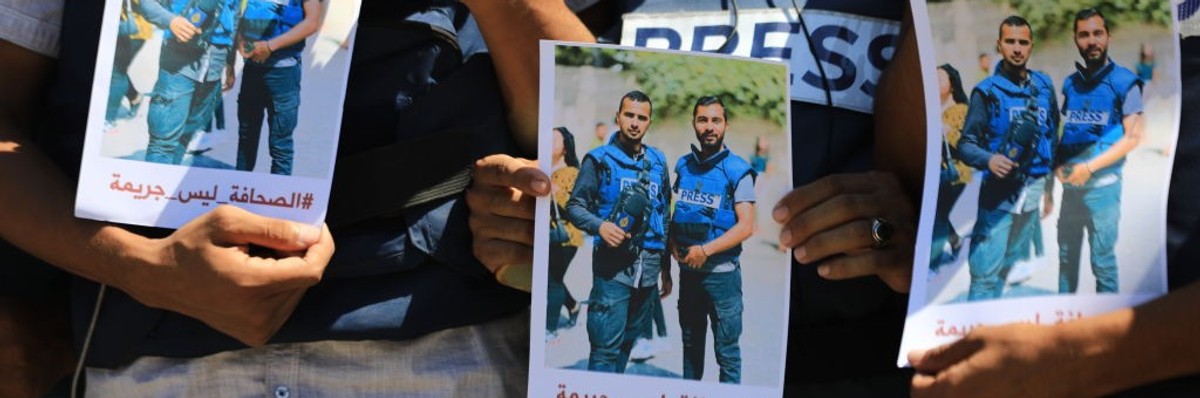
Palestinian Al Jazeera journalist Ismail al-Ghoul and cameraman Rami al-Rifee were killed by Israeli forces on July 31, 2024. (Photo: Dawoud Abo Alkas/Anadolu via Getty Images)

International outcry and a reporter’s pointed questions weren’t enough to get the State Department to denounce the killings of Al Jazeera journalists.

A Palestinian journalist on Thursday pressed a U.S. State Department spokesperson to characterize the killings of two Al Jazeera journalists by Israeli forces as summary execution.

The heated press briefing followed an airstrike on Wednesday that killed Al Jazeera reporter Ismail al-Ghoul and cameraman Rami al-Rifee, and sparked global outrage. Israel’s military acknowledged targeting al-Ghoul, saying he was “eliminated” because he was a Hamas “terrorist,” an allegation the Qatar-based network said was “baseless.”

The death toll of Palestinian journalists and media workers now stands at least 108, including several intentionally targeted by Israel forces, according to the Committee to Protect Journalists (CPJ).

Said Arikat, the Washington bureau chief of Al-Quds, an Arabic-language newspaper based in Jerusalem, called the strike a “premeditated crime to kill a journalist for doing their job” and a “summary execution” in the press briefing, but State Department spokesperson Vedant Patel declined to affirm the characterizations or condemn the airstrike.

Al-Ghoul and al-Rifee were killed in northern Gaza after reporting from near the home of Ismail Haniyeh, the Hamas political leader who was assassinated in Tehran earlier on Wednesday. They wore press vests and had signs on their vehicle identifying them as journalists; they had last contacted their news desk just 15 minutes before the strike, Al Jazeera reported.

The Israel Defense Forces (IDF) presented no evidence in a social media post claiming that al-Ghoul was a terrorist and Hamas operative. In March, al-Ghoul reported being stripped, handcuffed, and blindfolded during the course of a 12-hour detainment by Israeli forces; he had been covering an Israeli attack on al-Shifa hospital in Gaza City. Witnesses said Israeli forces severely beat al-Ghoul at the hospital before arresting him.

Anas al-Sharif, another Al Jazeera reporter in Gaza, was on site at a different hospital on Wednesday when his colleagues’ bodies were brought in, and he spoke about the role al-Ghoul had played in the outlet’s war coverage.

“Ismail was conveying the suffering of the displaced Palestinians and the suffering of the wounded and the massacres committed by the [Israeli] occupation against the innocent people in Gaza,” he told his own news outlet.

“The feeling—no words can describe what happened,” he added.

In protest of the killings, Palestinian journalists gathered to throw off their press vests and vowed to continue showing the suffering of Gazans through their work, despite the dangers they faced.

Condemnation of the killings of the two Al Jazeera journalists came not just from Gaza but all over the world.

CPJ CEO Jodie Ginsberg said in a statement that she was “dismayed” by the killings and that journalists are civilians who should never be targeted.

Defending Rights & Dissent, a U.S.-based civil liberties nonprofit, also condemned the killing of al-Ghoul and said the reasons for it were clear.

“When you ‘eliminate’ journalists, it’s much easier to hide war crimes, it’s easier to spread lies, it’s easier to commit genocide,” Sue Udry, the group’s executive director, said in a statement.

In response to the killing, the International Committee of the Red Cross (ICRC) said that journalists “must be protected, and we decry attacks against them.”

William Schomburg, head of the ICRC’s sub-delegation in Gaza, said in a statement that his team had just met with al-Ghoul the previous week to get an update on the humanitarian situation in Gaza. “Journalists in all wars play a central role in highlighting the plight of civilians and in speaking for the voiceless,” Schomburg said.

Reporters Without Borders (RSF, in French), a Paris-based nonprofit, wrote in unequivocal terms about the need for Israel to stop killing journalists.

“RSF is deeply disturbed to see the Israel Defense Forces using social media to justify their targeted killing of Al Jazeera journalist Ismail al-Ghoul,” the organization wrote on social media. “Journalists are not terrorists. This campaign of violence against media in Gaza must stop now.”

The Freedom of the Press Foundation also responded forcefully to the IDF’s claim about al-Ghoul.

“Documenting a war isn’t terrorism, it’s journalism,” the group wrote on social media. “If the IDF can prove al-Ghoul was working for Hamas’ military, it should do so immediately. If not, this looks like a flimsy excuse for intentionally murdering a journalist from an outlet Israel dislikes.”

Israeli forces have killed at seven journalists or media workers affiliated with Al Jazeera during the war, and Israel shut down the network’s local operations in May, citing a security threat, though critics said it was a case of censorship—an attempt to hide the brutality of the assault on Gaza.

In total, 113 journalists and media workers have died since the war began, including two Israelis and three Lebanese, according to CPJ, which says this has been the deadliest period for journalists anywhere in the world since it began collecting data in 1992.

The international outcry over all of the killings has ramped up pressure on the U.S.—which has backed the Israeli assault with weapons and diplomatic support— to condemn them, and Wednesday’s strike on al-Ghoul and al-Rifee has only increased that pressure. Still, Patel, the spokesperson, wouldn’t issue any such condemnation on Thursday.

Arikat also pressed Patel to call for the release of Palestinian journalists being held in Israeli detention centers without charges, but Patel didn’t do so.

Original article by EDWARD CARVER republished from Common Dreams under Creative Commons (CC BY-NC-ND 3.0). 

Continue ReadingUS Urged to Condemn Israel’s ‘Summary Execution’ of Two Journalists