The taxman has the numbers needed to estimate how much cash is lost to overseas havens – but it isn’t sharing the details
An MP has demanded HMRC release its official estimate of how much tax is being lost to offshore havens – information we discovered is currently being withheld by the authority.
A Freedom of Information request by TaxWatch, shared with TBIJ, revealed that in apparent contrast to its previous claims, HMRC holds data needed to estimate the offshore tax gap. But it would not hand the information over.
“We urgently need HMRC to clarify the situation – otherwise we will never crack down on tax dodging,” said Lloyd Hatton MP, who sits on the Public Accounts Committee.
The offshore tax gap is the difference between the amount of tax the UK should collect from offshore sources, and what it actually receives. It puts a number on the cost to the public when people and companies move their money offshore to avoid, evade or fail to declare tax.
HMRC has previously claimed that it holds no estimate for the overall offshore tax gap. But in response to a recent FOI request, the tax authority revealed that it does in fact hold a figure for “offshore tax at risk”.
This number is the amount of tax HMRC thinks could be lost because of avoidance, evasion and non-compliance. HMRC has said itself that this could be used to work out the offshore tax gap. All HMRC would need to do is subtract from it another number called the “compliance yield” – the amount HMRC did manage to claw back through enforcement activities.
HMRC has even published its figures on the compliance yield for offshore-related tax, meaning it already has data needed to calculate the offshore tax gap figure.
But in response to our FOI request, HMRC refused to disclose the “tax at risk” figure on the basis it could “prejudice the effective conduct of public affairs”.
The correspondence calls into question direct statements made earlier this year by the head of HMRC to the Public Accounts Committee (PAC), whose role is to scrutinise government departments.
In February, the authority’s CEO Jim Harra wrote to the PAC’s chair to say his organisation did not hold figures on the total offshore tax gap. Instead, he referred to a number published by the agency in 2024.
Back then, this partial number – gathered from self-assessment tax returns – was referred to as “experimental statistics” and it estimated that tax from offshore sources was underpaid to the tune of only £0.3bn.
We urgently need HMRC to clarify the situation – otherwise we will never crack down on tax dodging
Lloyd Hatton, MP
This figure has been called into question as too low by the Public Accounts Committee. By comparison, the UK’s entire tax gap is estimated by HMRC to be nearly £50bn.
Commenting on the new FOI correspondence, Hatton said: “The Public Accounts Committee report [in July] showed that HMRC is incapable of identifying those super-wealthy individuals who choose to squirrel away their wealth – often using offshore accounts in tax havens.
“Without this, it cannot effectively pursue those who deliberately avoid or evade paying their fair share of tax.
“The Committee has pressed for greater transparency concerning tax lost offshore, without this information we cannot properly assess whether HMRC’s compliance efforts are effective or adequately resourced. And – even more crucially – we cannot go after egregious tax dodging.”
A spokesperson for TaxWatch said: “We understand that HMRC has a responsibility to ensure that it’s publishing accurate information. But there seems undue secrecy around this figure, which is routinely published for other types of tax and taxpayer.”
It marks yet another turn in the hunt for clarity on just how much tax is avoided or evaded offshore. In 2022, then Treasury Minister Lucy Frazer vowed that HMRC would publish the much-desired offshore tax gap figure, but in the run-up to the general election, HMRC demurred.
A spokesperson for HMRC said: “We are working to assess the feasibility of broadening the scope of the published estimate of the offshore tax gap, as stated to the Public Accounts Committee, and will report back to them.”
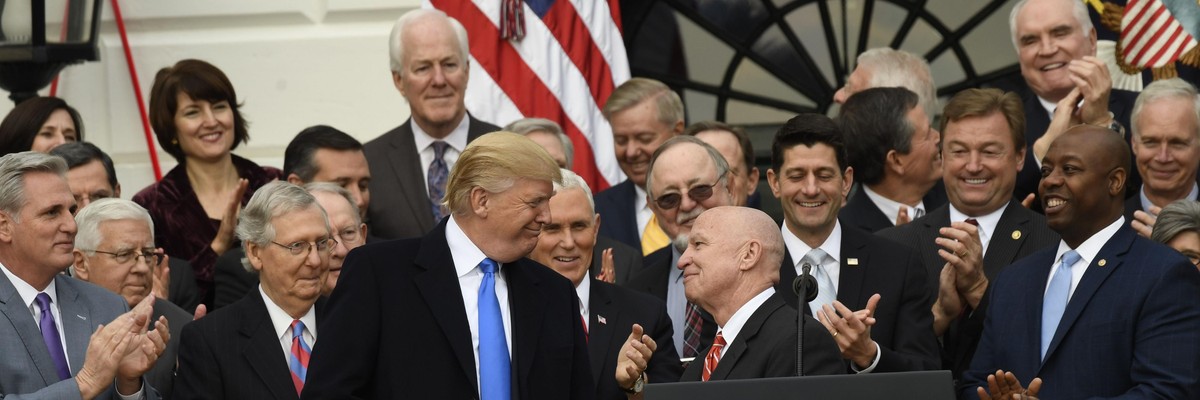
U.S. President Donald Trump smiles at House Ways and Means Committee Chairman Rep. Kevin Brady (R-Texas) after speaking about the passage of tax cut legislation at the White House in Washington, D.C. on December 20, 2017. (Photo: Saul Loeb/AFP via Getty Images)
In legislatures, the courts, and our executive offices, we have a system rigged in favor of the ultra-rich, rigged by everything from acts of Congress and judicial rulings to IRS budgets and audit policies.
By all appearances, former U.S. President Donald Trump has cut a sweet deal with a dozen or two of America’s richest billionaires: Finance his campaign and he’ll keep their federal taxes super low—or even lower them—once he’s sitting back in the White House.
How much do billionaires like this deal? This much: In April, hedge fund billionaire John Paulsen held a Palm Beach fundraiser for Trump that brought in $50.5 million. Immediately after Trump’s late May conviction on 34 felony counts in Manhattan, Timothy Mellon, the grandson of the classic plutocrat Andrew Mellon, ponied up $50 million. Miriam Adelson, the billionaire widow of Las Vegas kingpin Sheldon Adelson, appears eager to kick in as much as $100 million.
This past spring, meanwhile, billionaires Elon Musk and David Sacks reportedly held a secret dinner party for Trump, with attendees including the illustrious deep pockets Peter Thiel, Rupert Murdoch, and Michael Milken.
The rich themselves have actually become more brazen about avoiding taxes. Just try to stop us, they seem to be saying.
America’s billionaires clearly see politics as one route to ensuring they pay as little as possible at tax time. But they don’t just make their presence felt at election time. America’s rich have their thumbs firmly on the scale of all three branches of government. In legislatures, the courts, and our executive offices, we have a system rigged in favor of the ultra-rich, rigged by everything from acts of Congress and judicial rulings to IRS budgets and audit policies.
Some of this rigging we can all easily see. The dividends and long-term capital gains of the ultra-rich have for decades faced a maximum tax rate barely half the maximum rate applicable to other forms of income. And the investment income of the rich, unlike the paychecks of working people, faces no Social Security tax.
In 2017, the first year of the Trump presidency, intense lobbying efforts helped rich business owners to a special tax rate for their business income. In 2018 alone, according to ProPublica, that special rate translated into a $67 million gift to Mike Bloomberg, whose personal wealth now reportedly exceeds $100 billion.
But these glaring privileges the rich enjoy at tax time only tell part of the billionaire tax story. Other parts get precious little attention. In 2004, for instance, lawmakers in Congress enacted a penalty for the failure to disclose potentially abusive tax avoidance transactions on tax returns. The penalty on the surface looked substantial: 75% of the tax sought to be avoided. But Congress capped the penalty at $100,000, a move that turned the penalty into a minor nuisance for billionaires seeking to avoid millions of dollars in taxes.
In our current rich people-friendly tax climate, IRS staff who want to do the right thing face tough going. Recently, for example, one former IRS staffer, Michael Welu, went public with his concerns that the IRS itself has both official and unofficial policies that end up treating audited rich taxpayers much more gently than small business owners.
Welu found the upper management of the IRS division tasked with auditing the super rich—and the corporations they run—distinctly uninterested in investigating America’s richest and their “most egregious, ridiculous schemes” for avoiding taxes.
IRS officials like Michael Welu do occasionally speak out. But only tax wonks truly have any real sense of how much obscure tax code penalties and IRS audit policies favor the rich. And most of those tax wonks work for the rich.
The rich themselves have actually become more brazen about avoiding taxes. Just try to stop us, they seem to be saying.
Take the recently decided Supreme Court case, Moore v. United States. Working through an array of right-wing organizations, the conservative mover-and-shaker Leonard Leo attempted to use a challenge to an obscure one-time tax as a vehicle to preempt Congress from ever taxing the wealth or unrealized gains of the ultra-rich. Ultimately, the court decided the case without ruling on whether the rich can be taxed on their wealth or unrealized gains. But the opinions that four of the nine justices handed down made it clear that they stand prepared to do the billionaire bidding should a direct challenge to a tax on the wealth or unrealized gains of billionaires come before them.
Billionaires now have at least three Supreme Court justices firmly in their pockets. Reporting by ProPublica has revealed the massive gifts that have been flowing from Harlan Crow and other billionaires to Justice Clarence Thomas as well as the generous gifts that billionaire Paul Singer has been sending Justice Samuel Alito’s way. Justice Neil Gorsuch has had his entire career, including his appointment to the court, funded by the billionaire Philip Anschutz.
Those three justices, along with Justice Amy Coney-Barret, have now made it patently obvious they will not allow billionaires to be taxed on their unrealized gains or their wealth. Does anyone really think the billionaires won’t have the crucial, majority-making fifth vote from Justice Brett Kavanaugh when they need it?
Republican members of Congress are showing even less shame than our Supreme Court justices. Last year, these GOP lawmakers held the country hostage in negotiations to increase the country’s debt limit. Their price for agreeing to raise the debt limit, thereby avoiding a default on the country’s debt? They demanded—and won—a reduction in a scheduled IRS budget increase that would been used to increase enforcement moves against rich taxpayers.
The purported motive for this legislative hostage taking—“concern” over the federal deficit—made for an absurd justification. The proposed increase in the IRS budget would have been recovered, several times over, through increased tax collections. The IRS budget reductions the Republican lawmakers extracted will, in fact, only increase the federal deficit. But those reductions will serve a political purpose. They’ll protect the GOP’s richest patrons from tax enforcement.
The mainstream media, to no one’s surprise, did a miserable job of exposing this Republican dishonesty in the debt limit negotiations. But at one point in our recent past a courageous soul did emerge to expose the rot in our tax system. What happened? The ultra-rich and their henchmen in Congress make sure that this soul faced a punishment far more severe than any punishment ever meted out to those few rich Americans who actually get caught evading their taxes due.
That courageous soul, Charles Littlejohn, worked as an IRS contractor. He leaked tax return information related to Trump and America’s billionaires to TheNew York Times and ProPublica. ProPublica used that leaked information to write over 50 stories about billionaire tax avoidance, embarrassing and angering many of our richest in the process. Two of them even brought lawsuits, one against the IRS and the other against Littlejohn’s employer.
Ultimately, Littlejohn pled guilty to one count of unauthorized tax return information disclosure, a crime that carries a recommended sentence of four to 10 months. But 25 Republican members of Congress, undoubtedly at the behest of their billionaire patrons, wrote the judge in the case and urged the harshest possible sentence of five years. The judge obliged, stating in her sentencing remarks that Littlejohn posed a graver threat to democracy than the January 6 rioters. As tax law professor Reuven Avi-Yonah has noted, Littlejohn is now serving a sentence far harsher than any imposed on rich Americans convicted of tax evasion.
Littlejohn’s extreme sentence did not reflect the one single count of unauthorized tax return information disclosure he pled guilty to. That sentence reflects his “crime” of exposing the tax avoidance of the billionaire class.
Try this thought experiment: Imagine if Littlejohn had released the return information of 1,000 or so taxpayers with modest incomes to ProPublica. Imagine that ProPublica had then publicly detailed all the tip income that servers and bartenders among these taxpayers had failed to report and all the social meals that small business owners in the sample had claimed as business expenses. If Littlejohn had then pled to one count of unauthorized disclosure, would 25 members of Congress have intervened? Would the judge have imposed a sentence over six times the maximum recommended in federal sentencing guidelines?
Doesn’t it become dangerous to society when the punishment for a crime depends on who the victim happens to be?
We are now living that danger. Our billionaires sit firmly in control. And they will do whatever it takes to make sure they never pay tax at an appropriate level—even if that means locking a human being up for a preposterously long time just to send a message.
Original article by Ed Siddons republished from TBIJ under a Creative Commons Attribution-NonCommercial-NoDerivs 3.0 Unported License.
Basic mistake was made in pursuit of fine against man thought to have cost the exchequer £1bn in lost revenue
HMRC squandered the chance to hold a notorious promoter of tax avoidance schemes to account after making a “rudimentary” error at tribunal, new documents reveal.
According to a recently published tax tribunal judgement, the UK tax authority was attempting to bring a £14m penalty against Paul Baxendale-Walker, a former lawyer and tax adviser. HMRC estimates his schemes to have cost the exchequer some £1bn in lost taxes according to a separate court filing.
Baxendale-Walker denied a “false collection of allegations” put to him by TBIJ, and said the £14m penalty was “a fiction … conjured” by HMRC.
The judgement raises questions about HMRC’s handling of the promoters of tax avoidance schemes at a time when tax has become a battleground in the forthcoming general election.
‘There’s a lack of battlefield command within HMRC’
HMRC has enjoyed some substantial victories in recent years, including a £650m windfall and fraud conviction against former F1 mogul Bernie Ecclestone, and a landmark £615m deferred prosecution agreement with the owner of Ladbrokes and Coral. But experts suggest it has failed to adequately hold enablers of tax dodging to account.
“This is screwing it up 101,” said Ray McCann, the former president of the Chartered Institute of Taxation and a senior HMRC investigator of more than 30 years. “I’m completely mystified as to why [HMRC] did what they did [… it appears] there’s a lack of battlefield command within HMRC.”
Baxendale-Walker, 60, gained notoriety after designing a number of tax avoidance schemes in the 1990s and 2000s that were later found not to be legal.
Court documents filed in a separate case in the United States cite HMRC estimates that his schemes cost the tax authority over £1bn in total. Baxendale-Walker disputed this figure to TBIJ, but did not provide evidence to support his claim. “He’s caused carnage,” said McCann.
HMRC was attempting to bring a penalty based on an information notice it obtained at tribunal in 2022, to force Baxendale-Walker to hand over documents to the authority. Baxendale-Walker told TBIJ that he did not have the documents to begin with, and HMRC said it would not comment on individual cases.
HMRC agreed to an extension requested by Baxendale-Walker, but in doing so made one of two mistakes, both of which involved missing a deadline for imposing a penalty.
The Upper Tribunal judge found that it did not matter which mistake HMRC had made, it had invalidated the £14m penalty regardless.
The judge struck out the proposed £14m fine in its entirety in a judgement handed down on 28 July 2023, which was made public this month.
McCann said: “When I was in [HMRC], I would never in a million years have deviated from what a tribunal had authorised because it always goes wrong. […] Now the penalty is history because [HMRC] screwed it up.”
Over the past two decades, Baxendale-Walker has been subject to various civil court cases, professional sanctions and criminal charges.
He was struck off as solicitor in 2006 for conflicts of interest relating to a tax avoidance scheme. In 2012, he was subject to a civil restraint order for filing repeated claims against the Law Society after his dismissal as a lawyer.
Paul Baxendale-Walker pleaded guilty to forgery in 2016Denise Truscello/WireImage via Getty Images
In 2016 he pleaded guilty to forgery after impersonating an investigator contracted by HMRC on a call to the Solicitors Regulatory Authority. Two years later, he was declared bankrupt following a court defeat that found him liable for some £16m on the basis of negligent tax advice.
“HMRC should have approached Paul Baxendale-Walker with extreme care,” said McCann. “Get some people working on his case who really know what they’re doing, don’t take any risks whatsoever, don’t deviate in any way from what the law says.”
‘If HMRC can’t get this guy, it’s hard to see how they can get anyone’
Dan Neidle, the founder of the independent thinktank Tax Policy Associates and former head of tax at global law firm Clifford Chance, said: “If HMRC can’t get this guy, it’s hard to see how they can get anyone.”
Paul Baxendale-Walker told TBIJ that his tax advice was made through a partnership that “paid every due penny of tax” and that he had retired a decade ago. He said HMRC’s £14m penalty was based on a “fictional tax liability” and “randomly chosen multiplier”.
He added: “Every citizen has the right to order their affairs so as to pay the least amount of tax … The evil is accruing a level of taxation which is at a record high since WW2. Not persons who lawfully advise others as to their civil rights and obligations.”
A spokesperson for HMRC said: “We do not comment on identifiable individuals or businesses.”
Original article by Ed Siddons republished from TBIJ under a Creative Commons Attribution-NonCommercial-NoDerivs 3.0 Unported License.