Climate Groups Call for Rich to Pay More as International Meetings Begin

Spread the love

Original article by EDWARD CARVER republished from Common Dreams under Creative Commons (CC BY-NC-ND 3.0). 
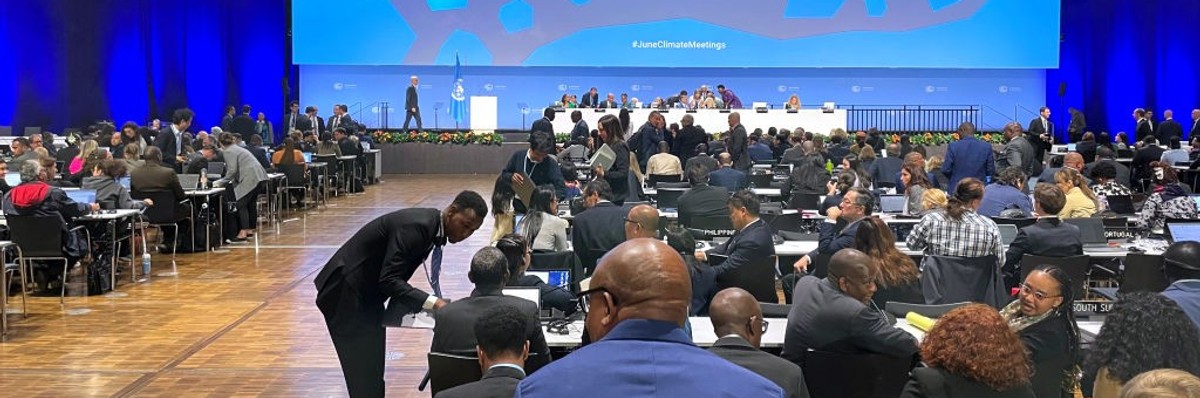
Delegates from around the world meet at an annual climate change conference in Bonn, Germany, on June 3, 2024, in preparation for the COP29 conference in November in Azerbaijan. (Photo: Christoph Driessen/Getty Images)

“We have to put the social justice element upfront,” an architect of the 2015 Paris agreement said as the world’s climate delegates gathered in Germany.

Advocates on Tuesday issued strong calls to action on climate finance for developing countries and an international agency released a report on the need to ramp up renewable energy production as the Bonn Climate Change Conference continued in Germany and G7 nations prepared to meet in Italy next week.

At the conference in Bonn, Friends of the Earth International pushed for more rich-country financing to pay for the rising costs of climate impacts in the Global South, while Laurence Tubiana, head of the European Climate Foundation and an architect of the 2015 Paris agreement, called for the global rich to pay their share through taxes and consumption levies.

Meanwhile, two organizations warned that countries aren’t on track to meet targets they set just last year. Oil Change International (OCI) published a briefing showing that G7 nations are expanding oil and gas commitments that undermine goals set at the United Nations Climate Change Conference (COP28) meeting in Dubai, and the International Energy Agency (IEA) issued a report showing that the world’s nations are not on track to meet their Dubai pledge to triple renewable energy production by 2030.

“The world is on fire because of decades of inaction by rich countries on reducing emissions, and their failure to pay the climate finance they owe to developing countries to transition to renewable energy systems for all, and to pay for rising costs for loss and damage and adaptation,” Sara Shaw, Friends of the Earth International program coordinator, said in a statement. “What is on the table to date is scales of magnitude away from what it needed. This year must be a year of breakthrough on climate finance.”

Climate representatives are meeting in Bonn this week and next to prepare for COP29 in November in Azerbaijan, where a key agenda item is expected to be financing for a green transition in the Global South. COP negotiations are conducted under the aegis of the United Nations Framework Convention on Climate Change (UNFCCC). At COP21 in 2015, nations signed the Paris agreement, a treaty that sought to limit global warming to less than 2°C above preindustrial levels.

Tubiana, an architect of that deal, said Tuesday that tackling climate change requires centering global justice in order to avoid conflict and gain public acceptance of climate measures.

“We have to put the social justice element upfront,” Tubiana, a French economist and diplomat, told The Guardian.

Tubiana said that raising the funds required for low-income nations will require holding both rich nations and people to account, via taxes and consumption levies, given that inequities exist not just between nations but also within them.

“This inequality is true not only between developed countries and developing ones, but within each country—the 1% of rich Chinese, or the 1% of very rich Indians, or the U.S. citizen—they have a lifestyle which is very, very similar, in terms of overconsumption,” she said.

The world’s richest and most powerful nations are not taking responsibility for climate action as they should, the new OCI briefing argues.

“Some G7 countries are massively expanding fossil fuel production at home, while others are investing in more fossil fuel infrastructure abroad,” the briefing states. “Both are catastrophic failures of leadership.”

OCI cites the United States, Italy, and Japan as particularly bad climate actors. The U.S. is the largest oil and gas producer in the world and has plans for massive expansions of the industry, despite President Joe Biden’s climate promises, the briefing notes. Italy has announced plans to double natural gas production. And both the U.S. and Japan have financed billions of dollars worth of oil and gas production in other countries just since the end of 2022, the document states, citing earlier OCI findings.

The IEA also spelled out unfulfilled commitments, while detailing progress that has been made on the energy transition. The agency looked at the domestic policies and targets of 150 countries to see how far along they were toward reaching the international target of tripling renewable power generation by 2030. It found that once added together, the nations’ domestic plans would get them about 70% of the way toward the 11,000 gigawatts of additional capacity required to meet the goal.

“There is a gap, but the gap is bridgeable,” Heymi Bahar, a senior energy analyst at the IEA and co-author of the report, toldThe Guardian.

Governments have not in most cases written these domestic plans into their Nationally Determined Contributions (NDCs) under the Paris agreement. The IEA report says that countries need to “bring their NDCs in line with their current domestic ambitions” and scale those ambitions up further still, to get from 70% to 100%. Moreover, they must follow through with their promises and achieve the targets they’ve set.

“This report makes clear that the tripling target is ambitious but achievable—though only if governments quickly turn promises into plans of action,” Fatih Birol, the IEA’s executive director, said in a statement.

The world added about 560 gigawatts of renewable capacity in 2023, a record increase, more than half of which came from China, according to the IEA. About half of planned capacity increases are in solar, with a quarter from wind power, the IEA report states.

Original article by EDWARD CARVER republished from Common Dreams under Creative Commons (CC BY-NC-ND 3.0). 
Continue ReadingClimate Groups Call for Rich to Pay More as International Meetings Begin

Greens respond to Labour’s economic plans

Spread the love
Green Party Co-leader Adrian Ramsay. Wikipedia CC.

Reacting to Labour’s plans to chase narrow economic growth over other priorities, Adrian Ramsay said: 

“The transition to a green economy provides major opportunities which we must grasp – opportunities for warmer homes, lower bills and good new jobs. The Green Party would invest in the technologies we need to ensure a sustainable and secure future.

“But we would not be chasing growth for growth’s sake. We need to ensure our economy works in a way that safeguards our climate and enables nature to flourish.

“And we need to make sure the economy we are building is fairer as well as greener. 

“This is why we would secure the investment needed to restore our public services by asking the very richest in society to contribute more. Even modest changes to the tax system for the wealthy could make a big differences – and only the Green Party is pledging to do this.”

Continue ReadingGreens respond to Labour’s economic plans

How realistic is a global fossil fuels tax to aid the green transition?

Spread the love

https://www.energymonitor.ai/features/how-realistic-is-a-global-fossil-fuels-tax-to-aid-the-green-transition

Upwards of $100trn of global spending on the green transition is typically estimated as being required by 2050. Credit: Thaiview/Shutterstock.

The Climate Damages Tax proposes a fee per tonne of CO2 embedded within the domestic extraction of coal, oil and gas.

A new report has claimed that a tax on the extraction of fossil fuels could raise $720bn by the end of the decade for to support the green transition in the world’s poorest countries.

Led by Stamp Out Poverty and backed by the likes of Greenpeace, Climate Action Network and Christian Aid, the Climate Damages Tax report, published earlier this week, examines the proposal that OECD countries, in particular members of the G7, should “lead in introducing a fee per tonne of CO2 embedded (CO2e) within the domestic extraction of coal, oil and gas.”

The report outlines that, if introduced in OECD countries in 2024 at a low initial rate of $5 per tonne of CO2e increasing by $5 per tonne each year, the tax would raise a total of $900bn by 2030. This, it says could be split so that 80% ($720bn) went to the newly established Loss and Damage Fund for helping developing countries with in responses to climate losses and damages and 20% ($180bn) was retained by countries for use domestically.

Certainly, ways to ensure money finds its way to transition efforts are necessary, with upwards of $100trn of global spending typically estimated as being required by 2050 – and some estimates being closer to $300trn.

David Hillman, director of Stamp Out Poverty and co-author of the Climate Damages Tax report said of the proposed tax: “This is surely the fairest way to boost revenues for the Loss and Damage Fund to ensure that it is sufficiently financed as to be fit for purpose.”

https://www.energymonitor.ai/features/how-realistic-is-a-global-fossil-fuels-tax-to-aid-the-green-transition

Continue ReadingHow realistic is a global fossil fuels tax to aid the green transition?

Taxing big fossil fuel firms ‘could raise $900bn in climate finance by 2030’

Spread the love

https://www.theguardian.com/environment/2024/apr/29/taxing-big-fossil-fuel-firms-raise-billions-climate-finance

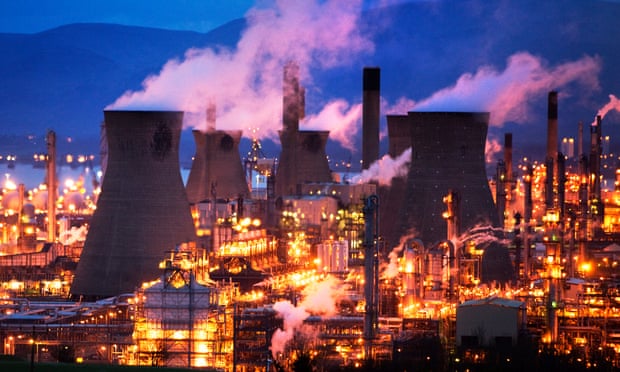
Grangemouth oil refinery in Scotland. The report authors say the proposed levy could be easily administered within existing tax systems. Photograph: Murdo Macleod/The Guardian

A new tax on fossil fuel companies based in the world’s richest countries could raise hundreds of billions of dollars to help the most vulnerable nations cope with the escalating climate crisis, according to a report.

The Climate Damages Tax report, published on Monday, calculates that an additional tax on fossil fuel majors based in the wealthiest Organisation for Economic Co-operation and Development (OECD) countries could raise $720bn (£580bn) by the end of the decade.

The authors say a new extraction levy could boost the loss and damage fund to help vulnerable countries cope with the worst effects of climate breakdown that was agreed at the Cop28 summit in Dubai – a hard-won victory by developing countries that they hope will signal a commitment by developed, polluting nations to provide financial support for some of the destruction already under way.

David Hillman, the director of the Stamp Out Poverty campaign and co-author of the report, said it “demonstrates that the richest, most economically powerful countries, with the greatest historical responsibility for climate change, need look no further than their fossil fuel industries to collect tens of billions a year in extra income by taxing them far more rigorously. This is surely the fairest way to boost revenues for the loss and damage fund to ensure that it is sufficiently financed as to be fit for purpose.”

https://www.theguardian.com/environment/2024/apr/29/taxing-big-fossil-fuel-firms-raise-billions-climate-finance

Continue ReadingTaxing big fossil fuel firms ‘could raise $900bn in climate finance by 2030’

World’s billionaires should pay minimum 2% wealth tax, say G20 ministers

Spread the love

https://www.theguardian.com/inequality/2024/apr/25/billionaires-should-pay-minimum-two-per-cent-wealth-tax-say-g20-ministers

A study from the World Bank showed that the pandemic had halted poverty reduction schemes. Photograph: Friedrich Stark/Alamy

The world’s 3,000 billionaires should pay a minimum 2% tax on their fast-growing wealth to raise £250bn a year for the global fight against poverty, inequality and global heating, ministers from four leading economies have suggested.

In a sign of growing international support for a levy on the super-rich, Brazil, Germany, South Africa and Spain say a 2% tax would reduce inequality and raise much-needed public funds after the economic shocks of the pandemic, the climate crisis and military conflicts in Europe and the Middle East.

They are calling for more countries to join their campaign, saying the annual sum raised would be enough to cover the estimated cost of damage caused by all of last year’s extreme weather events.

“It is time that the international community gets serious about tackling inequality and financing global public goods,” the ministers say in a Guardian comment piece.

“One of the key instruments that governments have for promoting more equality is tax policy. Not only does it have the potential to increase the fiscal space governments have to invest in social protection, education and climate protection. Designed in a progressive way, it also ensures that everyone in society contributes to the common good in line with their ability to pay. A fair share contribution enhances social welfare.”

Brazil chairs the G20 group of leading developed and developing countries and put a billionaire tax on the agenda at a meeting of finance ministers earlier this year.

https://www.theguardian.com/inequality/2024/apr/25/billionaires-should-pay-minimum-two-per-cent-wealth-tax-say-g20-ministers

Continue ReadingWorld’s billionaires should pay minimum 2% wealth tax, say G20 ministers