Jeremy Corbyn: Austerity Is Labour’s Choice

Spread the love

https://tribunemag.co.uk/2024/09/jeremy-corbyn-austerity-is-labours-choice

After 14 years of billionaires doubling their wealth, the political elite’s choice of starving pensioners and children shows austerity as a complete con job.
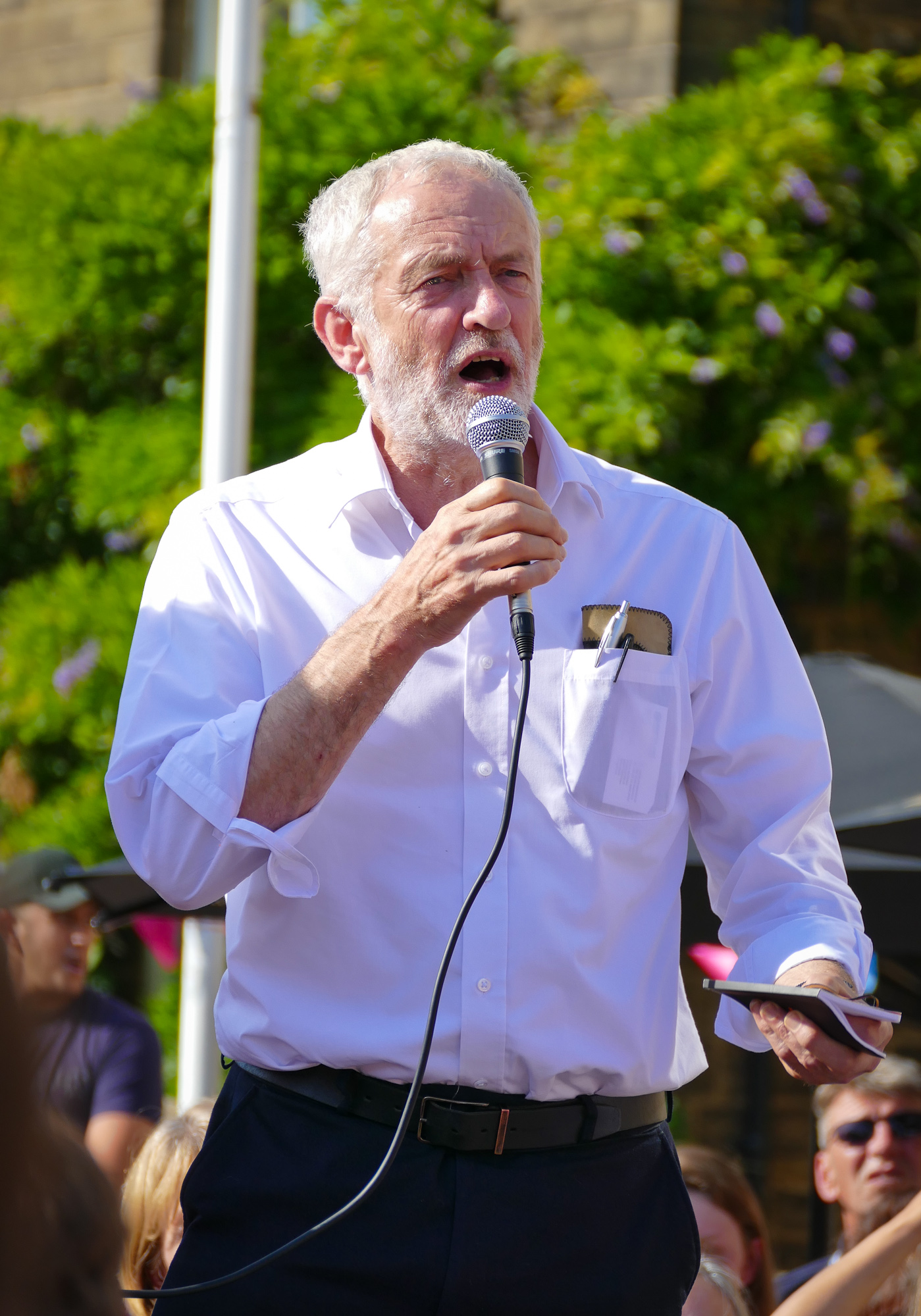
Image of Jeremy Corbyn MP, former leader of the Labour Party
Jeremy Corbyn MP, former leader of the Labour Party

Every day, my constituents make tough choices. Tough choices like deciding whether to heat their homes or put food on the table. Tough choices like taking out a loan to pay for this month’s rent. Tough choices like selling their home to pay for their family’s social care.

People are making tough choices because governments have made the wrong choices. We warned that Tory austerity would weaken our economy and decimate our public services. We were ignored, and the poorest in society paid the price. Austerity is not just a buzzword. It is the ongoing, brutal reality for millions of people who have been pushed into destitution. It is the face of desperation and anxiety of those forced into a spiral of debt. It is a freezing cold night for the record numbers of people sleeping rough on the streets. It is the graveyard for those left without vital support: more than 300,000 excess deaths have been attributed to austerity policies.

We often talk about austerity in terms of cuts to public spending, but that is just one side of the coin. By starving public services of resources, the government manufactured a convenient excuse for their privatisation. We saw this most acutely with the NHS: an underfunded public service does not just cause satisfaction to plummet, but the belief in the principle of public healthcare itself. Austerity was never about saving money (the UK’s debt pile increased every single year under the Tories). It was about transferring money from the poorest to the richest. Between 2010 and 2018, aggregate wealth in the UK grew by £5.68 trillion. 94% went to the richest 50% of households. 6% went to the poorest 50%. As child poverty was heading towards its highest levels since 2007, Britain’s billionaires more than doubled their wealth.

It was a political decision to defund, dismantle and auction off our public services. And it will be a political decision to repeat this failed economic experiment. ‘It’s going to be painful’, the Prime Minister told the nation last week, prepping the public for ‘difficult choices’ ahead. Did he get permission from the Tories to reuse their trademark slogans? Other ministers have gone one step further, indicating that they do not have any choice at all but to impoverish children and pensioners. Keeping children in poverty is unavoidable, apparently, if we want to restore the public finances. Scrapping the winter fuel allowance is a necessity, we were risibly told, if we want to stop a run on the pound.

It is astonishing to hear government ministers try to pull the wool over the public’s eyes. The government knows that there is a range of choices available to them. They could introduce wealth taxes to raise upwards of £10 billion. They could stop wasting public money on private contracts. They could launch a fundamental redistribution of power by bringing water and energy into full public ownership. Instead, they have opted to take resources away from people who were promised things would change. There is plenty of money, it’s just in the wrong hands — and we will not be fooled by ministers’ attempts to feign regret over cruel decisions they know they don’t have to take.

..

Article continues at https://tribunemag.co.uk/2024/09/jeremy-corbyn-austerity-is-labours-choice

Continue ReadingJeremy Corbyn: Austerity Is Labour’s Choice

Chancellor faces down would-be rebels ahead of winter fuel payment vote

Spread the love

https://www.theguardian.com/politics/article/2024/sep/09/chancellor-faces-down-would-be-rebels-ahead-of-winter-fuel-payment-vote

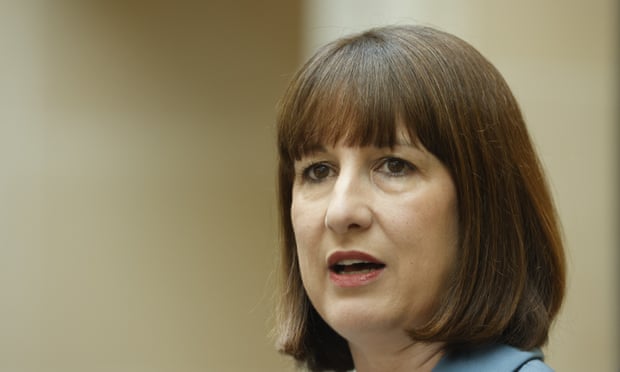
‘If we show that economic stability is the hallmark of Labour governments, there is no limit to what we can achieve,’ Reeves told Labour MPs. Photograph: Murdo MacLeod/The Guardian

Rachel Reeves tells Labour MPs that axing allowance for all but poorest pensioners will help plug £22bn hole in finances

The chancellor has faced down would-be rebels in a private meeting of Labour MPs ahead of the crunch vote on the government’s controversial plan to scrap the winter fuel allowance.

Rachel Reeves told a gathering of the parliamentary Labour party that the move was necessary, despite fears about the impact on millions of less-well-off pensioners, as it would help to plug a £22bn gap in the public finances.

She also warned that there would be more difficult decisions to make on the economy, despite dozens of Labour MPs considering abstaining in Tuesday’s vote to cut the £300-a-year payment for all but the poorest pensioners.

Government insiders ruled out any prospect of the Treasury offering any concession on the policy, despite the depth of concern from figures across the party. Many MPs are worried that elderly constituents just above the threshold will suffer.

Keir Starmer, meanwhile, is set to stick to the same theme by doubling down on the government’s tough economic message in a major speech to the Trades Union Congress, where he will say that “hard graft” is necessary to turn around the public finances.

https://www.theguardian.com/politics/article/2024/sep/09/chancellor-faces-down-would-be-rebels-ahead-of-winter-fuel-payment-vote

Keir Starmer says pensioners can freeze to death and poor children can starve and be condemned to failure and misery all their lives.

The dishonesty of Rachel Reeves

Continue ReadingChancellor faces down would-be rebels ahead of winter fuel payment vote

Starmer’s hints about the budget suggest UK is set for bleak four years

Spread the love

Original article by Paul Rogers republished from Open Democracy.

https://cdn2.opendemocracy.net/media/images/GettyImages-2159569411.max-760×504.jpg

Introducing a wealth tax would indicate this is a progressive government. But that seems unlikely

Taking as his theme the need to “fix the foundations” after “14 years of rot” under Tory rule, new Labour prime minister Keir Starmer this week delivered a message that should bring discomfort to everyone in the months and perhaps years to come.

Those “14 years of rot” are of no surprise to voters; indeed, they helped ensure a landslide Labour victory in the election in July. But Starmer’s plans to resolve them appear likely to be far harsher than many voters expected.

The chancellor of the Exchequer, Rachel Reeve, has made numerous hints that hard times are ahead. Her October budget will be uncompromising in its commitment to raising revenue to help fill a fiscal hole reckoned to be around £20bn – but much of this money seems likely to be taken from the poorer sections of society, not the rich.

Labour will retain unpopular policies introduced by the Conservatives – the ‘bedroom tax’ and limiting child benefit allowances to the first two children, for example – while introducing its own cost-cutting measures, such as reducing the winter fuel allowances for many pensioners.

These actions contribute to a growing sense that the Starmer government will prove to be decidedly right-of-centre in a country beset with deep divisions of wealth and poverty. Some areas may see an improvement, such as labour rights, but even there, it is a matter of the devil in the detail.

One area where the government does apparently have cash to spash, though, is military spending, which is set to be substantially increased despite the manifest failures in Afghanistan, Iraq and Libya, and the deeply unpopular Israeli wars on Gaza and the West Bank.

Labour’s attitude to Israel is certainly unlikely to change, with the Department for Business and Trade reporting on efforts to strike a new trade deal with the country, saying: “Our teams will be entering negotiating rooms as soon as possible, laser-focused on creating new opportunities for UK firms.” An official from the British Embassy in Israel also recently wrote of the “tremendous opportunity for collaboration between Israeli and British companies”.

A full-scale Strategic Defence Review is also underway, and there are few if any indications that it will start by addressing the grievous failures of the past two decades. If previous experience is anything to go by, it will likely also omit the main challenge to international security: climate breakdown. Without that, the review will not be worth the paper it is written on. Net zero secretary Ed Miliband may be doing his best to maintain the idea of a green transition but the issue would be sidelined by any major increase in government spending.

On the domestic front, less than two months into the new Labour government the contrast between Food Bank Britain and the ludicrous levels of runaway wealth is apparent. It was coincidentally yet powerfully illustrated just four days before Starmer’s pre-budget speech, by a full-page property advertisement from Sotheby’s in the Financial Times.

Of the seven properties on sale, one was a relatively modest three-bedroom apartment in Chelsea, on sale for a mere £5m, while the others included a six-bedroom house in Belgravia offered at £18m and a nine-bedroom/five-bathroom place near Regent’s Park for £20m. Another Regent’s Park number was on sale for £25m million, which at least had 7 bathrooms for the 6 bedrooms. Trumping all was a triplex number in Knightsbridge – £50m with exclusive access to Hans Place Gardens.

While we have to wait for the October budget announcements, we can be reasonably sure that there will be some attempts to raise modest amounts from the wealthier sectors of society, possibly involving changes in capital gains and inheritance taxes. But the best indicator of a changed government would be one willing to bring in wealth taxes, especially those directed at the super-rich.

Onee of Britain’s largest trade unions, Unite, recently proposed a 1% per annum tax on those with net assets of over £4m, which would include property, shares and bank holdings but not mortgaged property. That is estimated to yield £25bn a year but would be bitterly opposed, with the Daily Mail informing us that: “Millionaires are looking to flee the UK in their droves to escape Labour’s tax raids – with a record number of wealthy Britons tipped to leave the country this year.”

As things stand, the budget is expected to include substantial cuts in public spending that could be at least partly avoided by such a wealth tax, and it is worth noting that some European countries such as Switzerland and Spain have already introduced them. At least Britain’s wealthy won’t be fleeing “in their droves” to those countries.

If adopted in October, in even a modest form, a wealth tax would be a reasonable marker for a progressive government. If not, then an opportunity will be missed for placing Labour in a more progressive place in the political spectrum than currently seems at all likely.

Original article by Paul Rogers republished from Open Democracy.

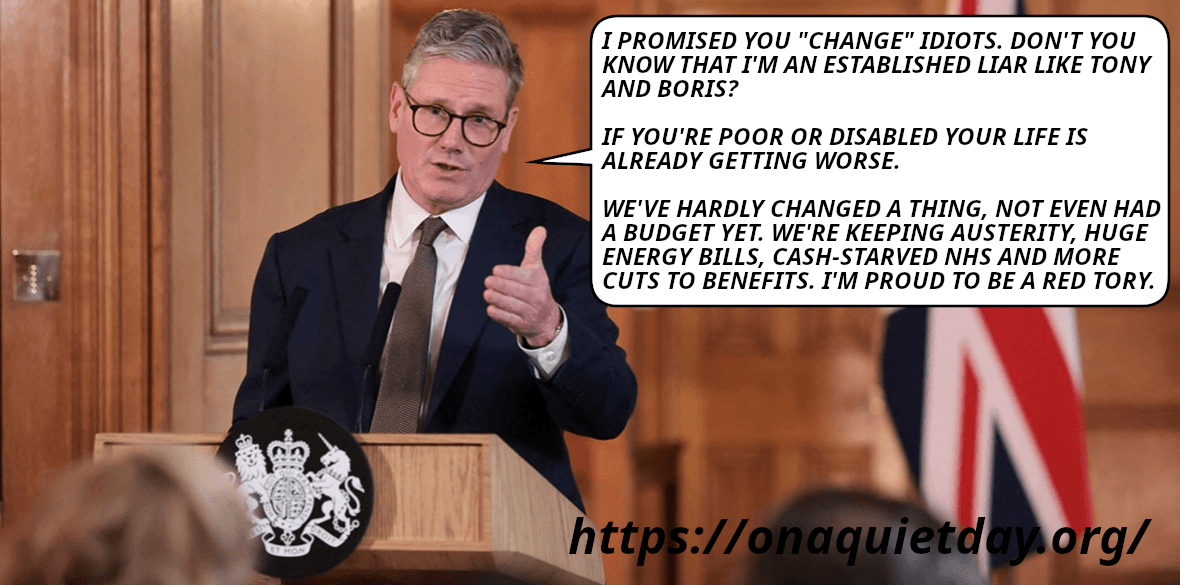
Keir Starmer confirms that he is continuing Tory policies and that he's proud to be a red Tory.
Keir Starmer confirms that he is continuing Tory policies and that he’s proud to be a red Tory.
Keir Starmer says pensioners can freeze to death and poor children can starve and be condemned to failure and misery all their lives.
Continue ReadingStarmer’s hints about the budget suggest UK is set for bleak four years

More economic pain and hardship isn’t what people voted for, says Carla Denyer

Spread the love
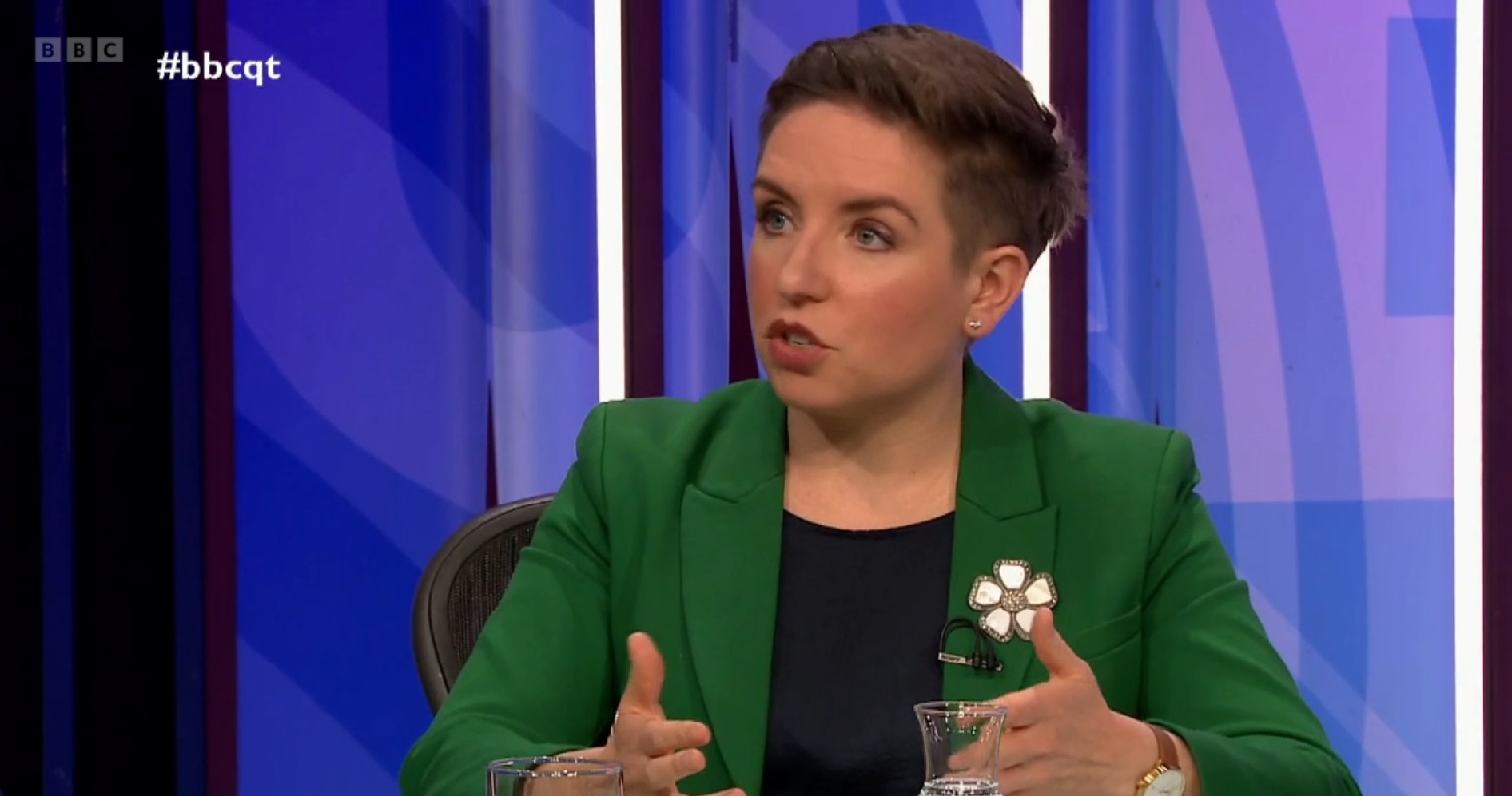
Image of the Green Party's Carla Denyer on BBC Question Time.
Image of the Green Party’s Carla Denyer on BBC Question Time.

Responding to Keir Starmer’s speech in which he said that the Labour government has inherited a £22bn black hole in the nation’s finances, as well as a “societal black hole”, co-leader of the Green Party Carla Denyer MP said:

“Enduring more economic pain and hardship isn’t what people voted for. They were told they were voting for change. Not voting for things to get worse before they get better. Labour needs to be honest about the fact that they could choose to make things better for everyone if they were bolder and braver.

“What is being framed as tough choices is actually about political choices. People don’t need a constant reminder that the Tories broke Britain. They need a new approach, not misguided fiscal rules that are set to make things worse.  

“We must generate the funds needed for investment by shifting the burden away from the poorest onto the wealthiest. Labour’s refusal to tax the super-rich shows that business as usual is very much still in business.  

Continue ReadingMore economic pain and hardship isn’t what people voted for, says Carla Denyer