Reform’s local councils are bringing climate denial into the mainstream

Spread the love

Original article by Josephine Moulds Grace Murray republished from TBIJ under a Creative Commons Attribution-NonCommercial-NoDerivs 3.0 Unported License.

Top polling party’s moves to ‘undeclare’ the climate emergency and scrap net zero targets could be a sign of things to come

Reform UK’s disregard of the climate crisis is already taking effect across the country. Since gaining control of 10 councils last May, the party has scrapped vital environmental goals. It has courted support from fossil fuel investors with a promise to “drill, baby, drill”. And its councillors have hijacked public debates with outright climate denialism.

Seven of the councils now controlled by Reform have abandoned important green measures. This includes ditching ambitious net zero targets and withdrawing the declaration of a climate emergency – which could threaten green investment and undermine action taken locally to deal with the crisis.

With Reform leading the polls and more local elections to come this year, what we’ve seen so far could be the tip of the iceberg.

For Lord Adair Turner, co-chair of the Energy Transitions Commission, the return of climate denial to public debate is “undoubtedly bad news” and presents a major setback for tackling the crisis. “We’ve got to work out how to convince people that there is a real, massive climate problem and that we do have the solutions now, which are available at relatively low cost,” he said.

We’ve been looking at how Reform has treated climate issues at a local level to gauge what might happen if it wins more councils this year – and if it comes to power in 2029.

The ‘global warming hoax’

One of Reform UK’s key campaigning pledges is the scrapping of net zero in order to cut energy bills. West Northamptonshire’s council leader Mark Arnull said: “Every resident who voted Reform UK voted for that and they must be heard.”

Of the 10 new Reform-controlled councils, seven promptly abandoned their climate promises. Of the remaining three, Lincolnshire did not have any significant climate pledges to scrap but Reform leaders there say they have “declared war” on green energy projects; Derbyshire confirmed its commitment to cutting emissions but ditched the objective to “work to address the causes, and adapt to the impacts, of climate change”; and Doncaster – which has a Reform majority but a Labour mayor and cabinet – has maintained its climate pledges.

The Reform councils’ position contrasts sharply with those controlled by other parties. Climate Emergency UK – a campaign organisation for council climate action – says it is not aware of any other local authorities that have scrapped their climate pledges. Across the UK, more than 300 councils have declared a “climate emergency” and many of those are backed up with ambitious net zero targets.

Polling suggests almost three quarters of people in the UK believe climate change is caused by human activity; a study of more than 88,000 climate-related studies found that 99.9% of peer-reviewed scientific papers agree.

Yet in public debates, some Reform councillors have put forward the opposite view. In Nottinghamshire, councillor Bert Bingham said: “I’ve been involved in sustainability projects for 25 years and I’ve never seen such nonsense as the anthropogenic global warming hoax.”

In Kent, Councillor Chris Hespe said: “It is often stated that anthropogenic climate change is ‘settled science’ and that the whole scientific community believes it. However, this is far from the case.”

Outright climate denial has permeated local debate. After Rachael Hatchett, a Green councillor in Derbyshire, spoke up in a debate about solar farms last year, she was heckled by another councillor shouting: “There is no climate change!”

Reform’s claim that scrapping net zero will cut energy bills is also misleading, according to energy experts. Dhara Vyas, chief executive of industry body Energy UK, told Carbon Brief it is “crystal clear what has driven electricity bills up in the UK … it’s the wholesale costs, driven by the price of gas”.

Liberal Democrat councillor Alex Ricketts said Reform’s climate denial would have real-world impacts for Kent’s constituents. Parts of the county are recognised to be at risk of flooding and local authorities have received funding from the Environment Agency to shore up sea walls and maintain other defences.

Ricketts said this money was allocated based on the science and policymaking that Reform criticises: “There are very real effects on the people of Kent by trying to debunk these things.”

Recommended Articles

In Durham, Reform proposed retracting the climate emergency and instead declaring a “care emergency” with a focus on special educational needs. Independent councillor Chris Lines said: “Politically, the rhetoric from Reform was that if you voted against it, you were labelled as someone who didn’t care about young people. Conflating the two issues was frankly appalling.”

Lines is concerned about the impact of these declarations on the economy, pointing to research showing that the low-carbon industry was worth £1.7bn to County Durham in 2021/22. “If I was a business in that growing sector looking to invest in an area, would I really want to come here, given the direction this council is going?”

Not all the debates on net zero have involved outright climate denial. In West Northamptonshire, councillors questioned how feasible climate policies were and raised concerns about their cost – an approach that academics have labelled “climate delay”, which can hinder action on climate change.

Alan Graves, the Reform UK leader in Derbyshire, said: “We do not deny that the climate is changing… The council continues to support practical, affordable measures that cut waste, improve efficiency, and reduce costs for residents.”

Responding to whether climate denial had spread in local councils, he said he could only speak for Derbyshire but that they weren’t focusing on “culture-war labels”.

Graves added: “We do not remove policies for ideological reasons. Where we have amended plans, it is because they were vague, unfunded, sometimes unfounded or undeliverable. Our responsibility is to be honest with the public about what can realistically be achieved within local government budgets.” Reform UK and the other councils mentioned did not respond to requests for comment.

A familiar playbook

Reform UK has proudly borrowed slogans from Donald Trump’s campaigns in the US. At a recent council meeting in Durham, Reform councillor Kyle Genner painted a vivid picture of the county’s “dilapidated and deprived estates … the joblessness … the lack of dignity and hope”. He urged his fellow councillors to support the reindustrialisation of the county – including the extraction of coal, oil and gas – to “make Durham great again”.

“I’m clearly not Donald Trump,” he said. “But I do like the idea of ‘drill, baby, drill’. I do like the idea of ‘jobs, baby, jobs’.”

Reform are in the climate denial camp and the Conservatives have moved into – not climate denial, but saying they want to get away from net zero

Lord Turner

The Reform leader of the council, Andrew Husband, said this local debate held a national significance. “It’s telling the North Sea oil and gas producers, ‘Don’t give up just yet’. We’re preparing County Durham for a Reform government in 2029 so we can hit the ground running. Simple as that.”

Back in Kent, former Reform councillor Fothergill said it was “ridiculous” the county was not exploiting its abundance of gas, coal and mineral resources.

In further echoes of the Trump administration, Reform councils across the country are erasing the words climate and environment from cabinet roles, committee names and planning documents.

Where Trump set up the Department of Government Efficiency spearheaded by Elon Musk, Kent county council introduced its own Department of Local Government Efficiency, or DOLGE.

Andrew Husband speaks during the Reform UK County Durham Conference last FebruaryIan Forsyth / Getty Images

Kent’s first head of DOLGE, Matthew Fraser Moat, highlighted what he said were “several, maybe tens of millions of pounds” wasted on the county’s declaration of a climate emergency. In September last year, he said this spending should be stopped, “given that there is no discernible benefit to the world’s climate from all of [Kent county council’s] efforts over the last seven years”.

Weeks later, Kent’s council leader said Reform had saved the county £32m over four years by “undeclaring the climate emergency”, and a further £7.5m by scrapping the county council’s transition to electric vehicles.

Fraser Moat, however, told the Financial Times this month that the Reform council “had not actually made any cuts”. ​​The DOLGE team reportedly expected to find vast amounts of waste but didn’t. Fraser Moat has since stepped down from the council’s cabinet, saying his comments were the result of a “lapse of judgement” and that his words had been twisted.

Blocking the bulldozers

Across the country, Reform-controlled councils have opposed solar projects. In Durham, the party has abandoned a plan to install solar panels on council buildings, which aimed to save the council money on energy bills.

In Lincolnshire, Reform councillor Sean Matthews told the BBC about a new solar farm development: “I’m going to do whatever I can to stop it, and that does include laying in front of those bulldozers.”

While it may not always stray into the outright climate denial Hatchett faced in Derbyshire, Ricketts said Reform’s opposition to solar is largely political. “They know that resonates with one part of their base that don’t want solar farms built on fields, but also with the other part that are anti-climate change measures.”

Time and again, the environmental issues raised in local councils came back to party politics. Independent councillor Ian McCord welcomed West Northamptonshire’s move to scrap net zero targets. “Those that are crying into their tofu and quinoa forget that they lost the May election,” he said.

This has shifted the debate on net zero across the political spectrum. Lord Turner said: “Reform, obviously, are in the climate denial camp but the Conservatives have moved into, not climate denial, but saying they want to get away from net zero.

“It’s a bit ironic that, in the face of catastrophic weather events around the world, we are losing [the cross-party] consensus. I’m under no illusion that we’re facing a more tricky situation than we were five or 10 years ago.”

This story was updated on Wednesday 25 February 2026 to reflect the fact that Nottinghamshire county council has not rescinded its climate emergency declaration.

Reporters: Josephine Moulds and Grace Murray
Environment editor: Rob Soutar
Deputy editor: Chrissie Giles
Editor: Franz Wild

Fact checker: Ero Partsakoulaki
Production editor: Alex Hess

TBIJ has a number of funders, a full list of which can be found here. None of our funders have any influence over editorial decisions or output.

Original article by Josephine Moulds Grace Murray republished from TBIJ under a Creative Commons Attribution-NonCommercial-NoDerivs 3.0 Unported License.

Nigel Farage urges you to ignore facts and reality and be a climate science denier like him and his Deputy Richard Tice. He says that Reform UK has received £Millions and £Millions from the fossil fuel industry to promote climate denial and destroy the planet.
Nigel Farage explains the politics of Reform UK: Racism, Fake anti-establishmentism, Deregulation, Corporatism, Climate Change Denial, Mysogyny and Transphobia.
Neo-Fascist Climate Science Denier Donald Trump says Burn, Baby, Burn.
Continue ReadingReform’s local councils are bringing climate denial into the mainstream

Legal pressures mount for Cargill over River Wye pollution

Spread the love

Original article by Andrew Wasley republished from TBIJ under a Creative Commons Attribution-NonCommercial-NoDerivs 3.0 Unported License.

The river Wye.

The case will argue the meat giant knew of the potential environmental consequences of industrial-scale chicken farming

The US meat and grain giant Cargill must compensate those affected by pollution in the River Wye or face court proceedings, lawyers preparing to sue the company have warned.

Legal papers served to the company by the law firm Leigh Day say hundreds of people have suffered loss and damage because of pollution linked to growing industrial chicken farming in the region. The firm also demands that Cargill cleans up the river.

Leigh Day’s letter to the company, seen by the Bureau of Investigative Journalism (TBIJ), also accuses two of Cargill’s UK entities – Avara Foods and Freemans of Newent – of jointly polluting the river with phosphorus. The companies have two months to respond to the allegations.

Natural England downgraded the river’s health rating last year, citing higher phosphorus levels and increased eutrophication – a phenomenon where a build-up of nutrients prompts some plants to grow excessively, depleting oxygen levels.

Fields of filth Factory farms committing thousands of environmental breaches

“Chicken manure is high in phosphorus, having a concentration four to five times higher than other forms of manure,” Leigh Day’s letter states.

Pollution of the Wye has become a national issue as the number of chicken farms nearby has grown. Today, Avara Foods is responsible for more than four fifths of the 20 million birds reared in the region, according to Leigh Day.

Until recently, waste from the farms was frequently spread on nearby land as a fertiliser, where it would run into adjacent waterways, including the Wye and its tributaries.

In the legal papers, Leigh Day accuses Cargill, Avara and Freemans of being responsible for “substantial water quality degradation and widespread algal blooms”, as well as “species decline [and] a loss of income from tourism, water sports, fishing, hospitality and other local businesses”.

Local house prices have also been affected, the letter notes, along with the quality of life for residents living next to industrial-scale farms.

Initially, Leigh Day only named Avara as a defendant, but in May it announced that Cargill would also face action. Avara is a joint venture between Cargill and Faccenda Foods – a major UK poultry processor. There are more than 100 intensive poultry farms in the Wye Valley over which Avara, and thus Cargill, “has significant legal and factual control”, Leigh Day claims.

Avara has previously said it is “confident that there is no case to defend” and that Leigh Day’s civil claim is “a year-old, opportunistic attempt to profit from a serious environmental issue”.

“It has no merit and is not supported by evidence or expert opinion,” the company said in March. “It ignores the long-standing use of phosphate-rich fertiliser by arable farms as well as the clear scientific data showing the issue of excess phosphorus considerably pre-dates the growth of poultry farms in the Wye catchment.”

The letter also notes that Avara supplies 4 million chickens to the UK retail, hospitality and food service sectors, and is a supermarket poultry supplier.

The case will argue that Cargill, which is headquartered in Minnesota but operates around the world, must share responsibility for the pollution of the Wye and related waterways.

Cargill knew of the potential consequences of industrial-scale chicken farming because of similar legal challenges in the US, Leigh Day argues. There, waste from poultry farms from a number of companies – including Cargill – was found to have contributed to historic river pollution in Oklahoma.

Leigh Day’s letter adds that Cargill’s importing of phosphorus-rich soy, which is then used to make poultry feed, has also contributed to the problem. TBIJ previously uncovered how Cargill soy from Brazil is shipped to Liverpool, where it is processed for use in animal feed at farms that supply Avara.

Leigh Day partner Oliver Holland told TBIJ: “We hope that Avara and Cargill will take this opportunity to engage constructively with the substance of the claim and work with us to avoid court proceedings being issued. However, if they do not, our clients will be issuing court proceedings and looking to proceed with this claim through the high court.”

Original article by Andrew Wasley republished from TBIJ under a Creative Commons Attribution-NonCommercial-NoDerivs 3.0 Unported License.

Continue ReadingLegal pressures mount for Cargill over River Wye pollution

HSBC helped oil and gas industry raise $47bn despite net-zero pledge

Spread the love

Original article by Josephine Moulds republished from The Bureau of Investigative Journalism under a Creative Commons Attribution-NonCommercial-NoDerivs 3.0 Unported License.
The bank’s work for businesses expanding production of fossil fuels is a stark contrast to its climate change promises

Every year business and world leaders jet into Davos to discuss climate change and other global issues at the World Economic Forum. And every year they are met with vigorous accusations of hypocrisy. Those accusations may well be levelled at the executives from HSBC – one of the world’s top funders of fossil fuel expansion – as they mingled with their peers in the pretty Swiss ski town this week, discussing how to develop a long-term strategy for climate, nature and energy.

HSBC says delivering a net-zero global economy is “a pillar of our strategy as a business”. In December 2022, the bank made the shock announcement that it would stop financing new oil and gas fields. Environmental campaigners celebrated, with the responsible investment charity ShareAction saying the decision set “a new minimum ambition for all banks committed to net zero”.

But on the same day, HSBC bankers started selling shares in the refining business of Saudi Aramco, one of the most aggressive expanders of oil and gas. An investor in HSBC told the Bureau of Investigative Journalism that the bank’s policy has been cleverly worded to allow it to fund some of the world’s biggest polluters while boasting about its green credentials.

An analysis of Refinitiv data by TBIJ has found that in the year since HSBC’s new policy was announced, the bank has helped raise more than $47bn (£37bn) for companies that are expanding the production of oil and gas, despite dire warnings from scientists that this will push the world beyond its survivable limits.

Fatih Birol, executive director of the International Energy Agency, told ITV News: “In the world, if we make large scale oil, gas and coal development, we cannot reach our 1.5 degrees target, full stop.” He said if a bank is serious about aligning its business with net zero, it cannot continue to fund companies developing new oil and gas fields.

Andrew Harper, chief responsibility officer at Epworth, an investment manager that holds HSBC shares, said: “[HSBC’s] policy, which is supposed to act as a safety net for the climate, is by design letting the bank circumvent its pledges by allowing them to adhere to the letter rather than the spirit of what they’re claiming.

“As investors, we’re not going to be fooled by the marketing, by the pledges, by these policies. We want to see real change and for them to seriously end new fossil fuel financing, no loopholes. Anything short of that is the bank trying to dupe its key stakeholders.”

HSBC said its policy allows the bank to continue providing finance “at a corporate level” and its approach “is based on the latest science for achieving net zero and follows the UN-backed approach for climate target setting and net zero alignment for banks”.

New projects, no problem

In its feted policy, HSBC notes that global demand for oil and gas to 2050 is “more than met by existing [oil and gas] fields”. It says the bank will therefore no longer provide finance for “new oil and gas fields and related infrastructure whose primary use is in conjunction with new fields”.

However, that has not stopped HSBC from funding companies that are exploiting new oil and gas fields, and providing the necessary infrastructure to do so.

In the first half of last year, HSBC, with other banks, helped the UAE’s state oil and gas company, Adnoc, raise $3.2bn from selling shares in its gas and logistics businesses. Adnoc will receive a further cash boost of $3bn in hefty dividends from Adnoc Gas.

Separately, HSBC helped arrange a $3.2bn loan for Borouge 4, a petrochemicals plant that will be a key customer for Adnoc’s gas, and was described by its project director as “an enabler of Adnoc’s growth strategy”.

Scientists agree that we cannot develop any new oil and gas fields if we are to limit global heating to 1.5C. Adnoc plans to increase oil production by 25% between 2023 and 2027, however, which would dramatically overshoot these limits.

Last year, Adnoc rubber stamped the exploitation of a vast new gas field off the UAE coast, which threatens a vital habitat for sea cows. Burning the gas Adnoc plans to extract from this field would produce 30m tonnes of carbon dioxide per year – more than Denmark’s annual emissions.

HSBC has similarly close ties with Saudi Arabia’s national oil company. The share sale for Saudi Aramco’s refining business, Luberef – which HSBC bankers were working on as it unveiled its new oil and gas policy – raised $1.3bn. After the share sale, Saudi Aramco remains a 70% shareholder of Luberef and has management control of the business.

A couple of months later HSBC bankers helped raise $3bn in bonds for Greensaif, a company set up for the sole purpose of taking a stake in Saudi Aramco’s gas pipelines business, alongside Saudi Aramco, which retained the controlling stake.

And in another wildly successful share offering, HSBC helped raise $1.2bn for Ades Holding, which provides oil drilling rigs primarily to Saudi Aramco, among other oil and gas expanders in the region. Adnoc and Saudi Aramco declined to comment.

Adnoc is investing heavily in offshore expansion in the United Arab Emirates Giuseppe Cacace/AFP via Getty Images

HSBC rejected the suggestion that its policies allow for financing that is at odds with a net zero transition. “Net zero-aligned scenarios require continued, though declining, financing of fossil fuel supplies to meet energy demand, security, and affordability during the transition.”

The bank said its policy makes clear that it will continue to provide finance for companies with transition plans that align with its climate commitments. “HSBC’s approach is to engage with our major oil and gas clients on their targets and transition plans, and to align our oil and gas financing portfolio to a 2030 net zero aligned financed emissions target.”

Transition plans

Saudi Aramco, the world’s biggest polluter, does not appear to be preparing for a transition away from fossil fuels. The company expects to grow oil production by 8% by 2027, and increase gas production by up to 60% by 2030. Last year UN experts sent a letter of concern to Aramco – and its banks, including HSBC – saying its ongoing expansion of fossil fuel production threatens human rights by worsening climate change.

HSBC has chased business in the oil-rich Middle East and was last year named the region’s best bank for financing by Euromoney. Julian Wentzel, HSBC’s head of global banking in the region, told the magazine: “We have been at the nucleus of every major deal in the region, providing the full suite of banking services to our valued partners.”

Ed Matthew, campaigns director of think tank E3G, told TBIJ: “There’s a complete conflict between [HSBC’s] ambition to be at the heart of Middle Eastern oil and gas development and their commitment to start to pull out of fossil fuel financing globally.

“They can’t have their cake and eat it. Either they’re serious about delivering on the Paris Agreement or they’re not. At the moment, they’re putting short-term profits ahead of a habitable planet.”

Aggressive fossil fuel expansion

HSBC also funded oil and gas businesses far beyond the Middle East. In December, the bank helped arrange a $5bn loan for TransCanada Pipelines, which is among the top companies in the world expanding infrastructure for oil and gas, according to the Rainforest Action Network. (TC Energy, which owns TransCanada Pipelines, said: “Sustainability is foundational in everything we do.”) A few weeks later, the bank helped secure a $4.7bn loan for Occidental Petroleum, which is buying a Texas oil driller to expand its operations in the biggest shale field in the US.

In Europe, HSBC was among the banks that arranged a $3.3bn loan for Eni, the Italian oil and gas expander. Eni announced last year that it plans to increase its oil and gas extraction by 3-4% a year until 2027.

Experts have praised HSBC’s oil and gas policy for prohibiting funding for infrastructure linked to new oil and gas fields, in addition to the projects themselves. But the bank has continued to raise money for companies involved in the frantic building of export terminals for natural gas on the US southern coast.

The expansion of gas drilling and export in the region has been described as a “carbon bomb” – if all the planned projects are built, the associated annual emissions would outstrip those of Russia. Last year, HSBC, together with a slew of other banks, helped arrange loans worth $14.3bn for two of the companies building gas export hubs in the region.

HSBC was also among a group of banks to arrange loans worth $6bn for Baker Hughes, which provides oilfield services and equipment to oil and gas companies around the world. It helped raise a further $790m in share sales for oil drilling services companies Saipem and Nabors during the year.

At Davos there has been plenty of debate about how to limit global heating to 1.5C but campaigners fear it will remain just that. “Davos has always been a lot of talk and not much action,” said E3G’s Matthew. He would like to see stricter regulation of fossil fuel funding. “We can’t just leave it in the hands of banks, we need stronger action by governments and central banks to help prevent these investments. They need to introduce penalties for banks which are continuing to finance fossil fuel expansion.”

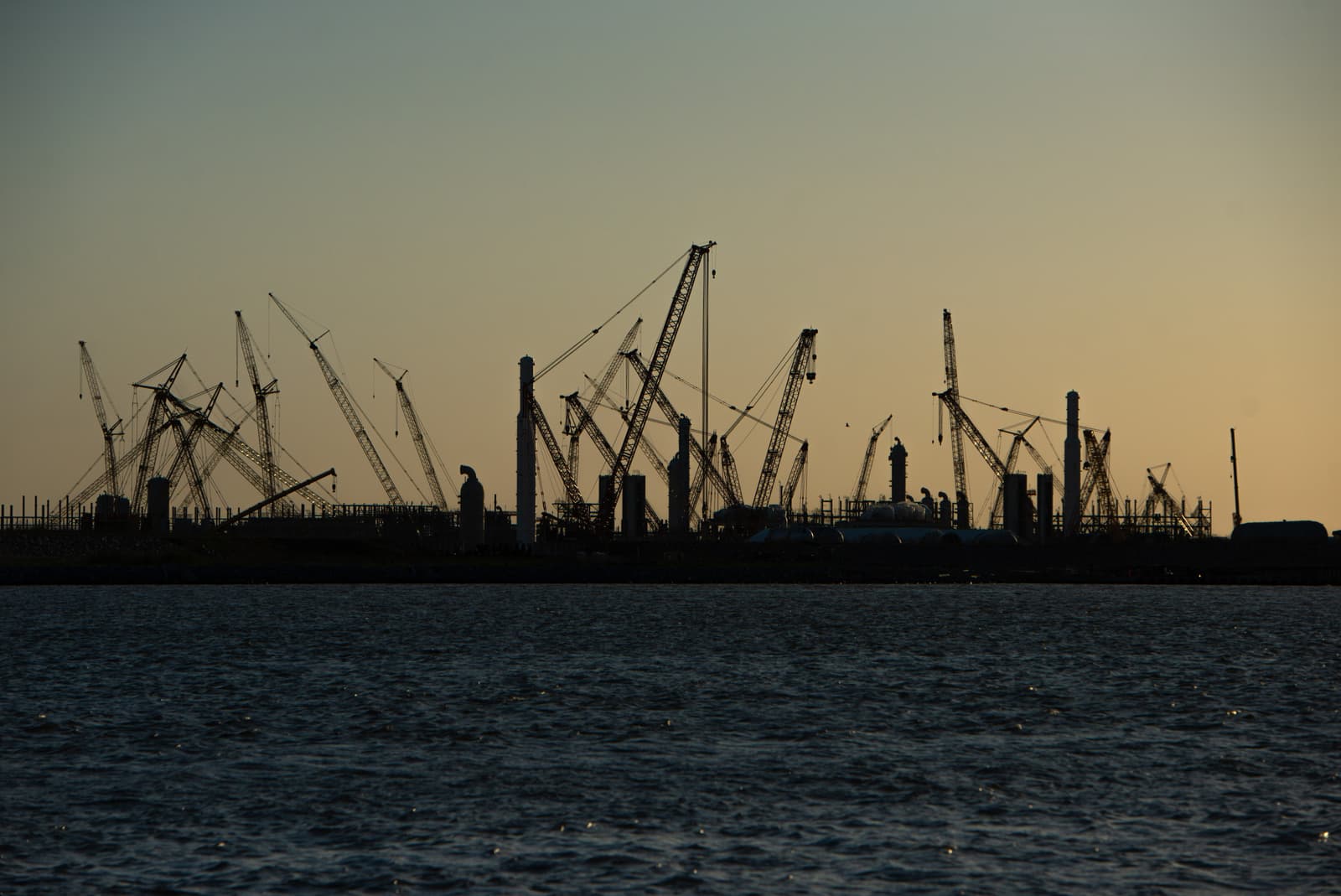
Header image: A liquified natural gas terminal on the Texas Louisiana border in the United States. Credit: The Washington Post via Getty Images.

Reporters: Josephine Moulds
Environment editor: Robert Soutar
Impact producer: Grace Murray
Deputy editor: Chrissie Giles
Editor: Franz Wild
Production editor: Frankie Goodway
Fact checker: Alice Milliken

This reporting is funded by the Sunrise Project. None of our funders have any influence over our editorial decisions or output.

Original article by Josephine Moulds republished from The Bureau of Investigative Journalism under a Creative Commons Attribution-NonCommercial-NoDerivs 3.0 Unported License.

Continue ReadingHSBC helped oil and gas industry raise $47bn despite net-zero pledge