The war Iran prepared for: How Tehran is raising the cost of war

Spread the love

This work by Middle East Monitor is licensed under a Creative Commons Attribution-NonCommercial-ShareAlike 4.0 International License

Missiles fired from Iran toward Israel are seen in the skies over Ramallah, West Bank on March 8, 2026. [Issam Rimawi – Anadolu Agency]

by Dr Ramzy Baroud  RamzyBaroud

Iran is pursuing a multi-layered strategy—military, economic, political, and diplomatic—to raise the cost of war and prevent regime change.

Iran’s strategy in the current war

As the war on Iran continues to expand across multiple fronts, Tehran appears to be pursuing a complex strategy that combines military escalation, economic leverage, domestic mobilization, and diplomatic signaling.

Rather than relying on what Iranian officials once described as “strategic patience,” the current approach suggests that Iran is attempting to fundamentally reshape the battlefield by increasing the costs of the war for the United States, Israel, and any regional actors that choose to participate.

The strategy appears to rest on several interconnected pillars designed not only to respond to military attacks but also to prevent the broader objective that Iranian leaders believe lies behind the war: regime change.

Overwhelming the battlefield

The most visible element of Iran’s strategy has been its attempt to expand the battlefield geographically and operationally.

Rather than focusing solely on Israeli territory, Iran has targeted a wide range of US and allied assets across the region. These include military bases, intelligence facilities, radar systems, and logistical infrastructure that support American operations.

The aim appears to be twofold.

First,

Iranian strikes are intended to impose a form of “strategic blindness” on opposing forces by degrading radar systems, surveillance networks, and early-warning capabilities.

Such attacks reduce the ability of the United States and Israel to monitor Iranian movements and respond effectively to missile launches or other military operations.

Second, by targeting US bases in multiple countries across the region, Iran is sending a clear message that the conflict will not remain geographically contained.

In practical terms, this means that any country hosting American military facilities risks becoming part of the battlefield.

Iranian officials have repeatedly emphasized that these strikes are directed at US military infrastructure rather than the sovereignty of host nations. Nevertheless, the message is unmistakable: if regional territory is used to launch attacks on Iran, that territory may also become a site of retaliation.

READ: Iran’s Assembly of Experts selects Mojtaba Khamenei as new Supreme Leader

This approach reflects a major shift away from Iran’s previous policy of measured responses and limited escalation.

Instead, Tehran appears to be pursuing a strategy designed to overwhelm the enemy on multiple fronts simultaneously, raising the political and military cost of continuing the war.

Economic warfare

Alongside its military operations, Iran is also leveraging one of the most powerful tools at its disposal: the geography of global energy supply.

The Strait of Hormuz—through which roughly a fifth of the world’s oil supply passes—has effectively become a war zone. Although Iran has not formally declared a blockade, the conditions created by the conflict have produced a functional shutdown of the waterway.

Missile exchanges, naval deployments, maritime attacks, and the growing threat environment have drastically reduced the willingness of commercial shipping companies to operate in the area. Insurance costs for tankers have surged, while several shipping operators have suspended or rerouted voyages altogether.

In practice, this means that the strait is not closed by decree but by the realities of war.

This distinction is important. Iran does not need to announce a blockade to achieve the strategic effects of one. The instability itself disrupts energy flows, drives oil prices upward, and injects uncertainty into global markets.

The consequences are felt far beyond the Gulf.

European economies—already weakened by energy shocks following the war in Ukraine—are particularly vulnerable to renewed volatility in oil and gas markets. Rising shipping costs, supply disruptions, and market speculation all compound the economic pressure.

For Tehran, this dynamic serves as a powerful form of indirect leverage.

The longer the war continues, the greater the economic consequences for the global system that underpins Western power. In this sense, the Strait of Hormuz functions not merely as a geographic chokepoint but as a strategic pressure valve capable of transmitting the costs of the conflict far beyond the battlefield.

Domestic cohesion

Another key pillar of Iran’s strategy lies within the country itself.

Western analysts had widely speculated that sustained military pressure—or a leadership decapitation strategy—could produce internal instability or even trigger a political crisis within Iran.

The killing of senior political and military figures, including high-ranking officials, appeared to be designed in part to create such a vacuum.

Yet the anticipated fragmentation has not materialized.

Instead, Iranian authorities have focused on projecting unity and political cohesion. Mass rallies and public demonstrations have taken place across multiple cities, with large crowds gathering in public squares to express support for the government and condemnation of the attacks.

These displays serve an important political function.

By filling public spaces with supporters, the government is attempting to pre-empt the emergence of alternative movements that might claim to represent a popular response to the war.

In effect, the strategy denies external actors the ability to argue that military intervention is intended to support domestic opposition or restore democratic governance.

For Washington and Tel Aviv, the assumption that internal unrest could become a decisive factor appears to have been a significant miscalculation.

Calibrated diplomacy

Despite the widening military confrontation, Iran has also sought to maintain a careful diplomatic balance with Arab governments.

Iranian officials have repeatedly emphasized that their strikes are directed at US military installations rather than the countries that host them.

This distinction is important.

Tehran’s broader objective appears to be preventing Arab states from becoming full participants in the conflict. While warning that any government enabling US military operations could face retaliation, Iran has simultaneously signaled that it does not seek confrontation with the region as a whole.

The message to Arab governments has therefore been dual-layered: do not allow your territory to be used for attacks on Iran, but if you avoid direct involvement, Iran does not consider you an enemy.

Such messaging reflects Tehran’s understanding that regional alignment could dramatically reshape the war’s dynamics.

READ: US intelligence assessment questions whether war could topple Iran’s regime

Strategic weaknesses

Despite the coherence of Iran’s overall approach, several weaknesses remain.

One of the most significant challenges lies in the realm of communication.

Iranian media outlets, operating under heavy pressure and frequent targeting, have struggled to project their narrative effectively to global audiences. Compared with the sophisticated international media infrastructure available to Western governments and Israel, Iran’s messaging often fails to reach wider international publics.

This limits Tehran’s ability to frame the conflict on its own terms.

A second challenge concerns the global anti-war movement.

While protests against the war have emerged in various cities around the world, they have not yet reached a scale capable of exerting decisive political pressure on governments supporting the conflict.

For Iran, the expansion of such protests could become a critical factor in constraining the military options available to Washington and its allies.

A war of strategy

Taken together, Iran’s actions suggest a leadership attempting to wage war according to a clearly defined strategic framework.

Military escalation, economic disruption, domestic mobilization, and diplomatic signaling all appear to function as parts of a single integrated approach designed to raise the cost of the conflict beyond what its adversaries may be willing to bear.

Whether the strategy ultimately succeeds remains uncertain.

What is increasingly evident, however, is that the war is evolving into a contest not only of military capabilities but also of strategic coherence.

For now, Iran appears to be operating according to a calculated plan, while its adversaries continue to search for a sustainable path forward in a rapidly expanding conflict.

OPINION: Instead of defeating China, Trump is accelerating its rise on the global stage

The views expressed in this article belong to the author and do not necessarily reflect the editorial policy of Middle East Monitor.

This work by Middle East Monitor is licensed under a Creative Commons Attribution-NonCommercial-ShareAlike 4.0 International License

Keir Starmer explains that UK is participating defensively in Trump and Israel's criminal war for Israel's genocidal expansion in Iran and states that he supports Zionism "without qualification".
Keir Starmer explains that UK is participating defensively in Trump and Israel’s criminal war for Israel’s genocidal expansion in Iran and states that he supports Zionism “without qualification”.
Orcas discuss rotting brain. Front Orca says "Wish someone would lock him up".
Orcas discuss rotting brain. Front Orca says “Wish someone would lock him up”.
Donald Trump warns against following the https://onaquietday.org blog, says that it's easy atm, she only needs to report war crimes supporting Israel's genocidal expansion.
Donald Trump warns against following the https://onaquietday.org blog, says that it’s easy atm, she only needs to report war crimes supporting Israel’s genocidal expansion.

Continue ReadingThe war Iran prepared for: How Tehran is raising the cost of war

US-Israeli Bombs Strike ‘The Fourth School in 6 Days’ in Iran: Report

Spread the love

Original article by Stephen Prager republished from Common Dreams under Creative Commons (CC BY-NC-ND 3.0).

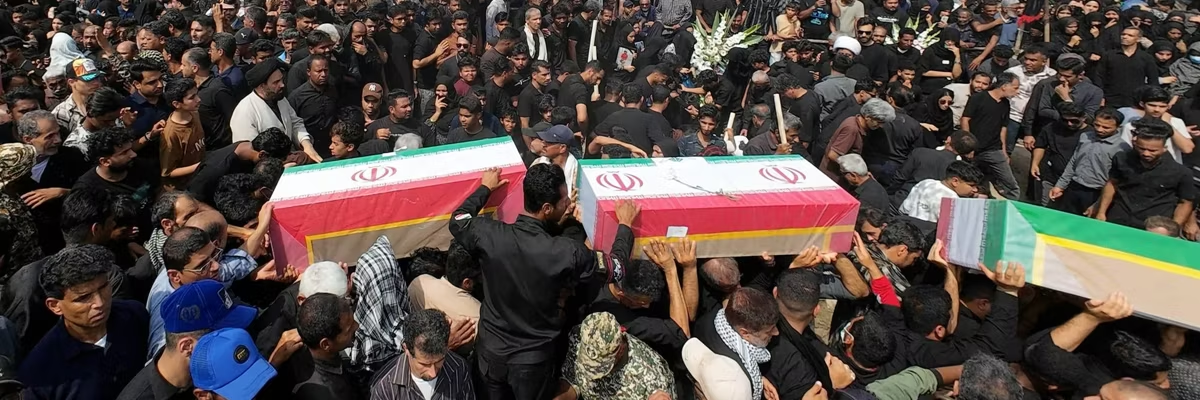
Caskets are carried by mourners as funerals are held for students and staff from a girls’ school, who authorities said were killed in a US-Israeli strike on February 28, on March 3, 2026 in Minab, Iran. (Photo by Handout/Getty Images)

“There are straight lines between what Israel has attempted to do… in Gaza, to completely decimate and collapse the systems that existed there, to what we are seeing in Iran,” said one expert.

US and Israeli missiles have hit a school in Iran for the fourth time in six days, according to videos shared on social media by a spokesperson for the Iranian Foreign Ministry on Friday.

Spokesperson Esmaeil Baqaei said that the Shahid Hamedani School, an elementary school in Niloufar Square, Tehran, had been “targeted by the American/Israeli aggressors.”

RECOMMENDED…

Explosions heard in Tehran as new Israeli airstrikes hit Iranian capital

US, Israel ‘Going Gaza on Iran’ as Death Toll Tops 500 Amid New Massacres

Funeral Held For Students And Staff Killed In School In Southern Iran

‘Up There With My Lai’: Investigations Find US Was Likely Behind Iranian School Massacre

He posted a video showing the school filled with dozens of young students prior to the attack, followed by scenes of the school in ruins, with several empty classrooms filled with rubble.

Baquaei said it showed “how the United States administration is helping the people of Iran.” He did not include any information about the number of casualties or the circumstances of the attack.

According to the United Nations Children’s Fund (UNICEF), at least 192 children have been killed across the Middle East since the US and Israel launched a regime change war this past Saturday.

Most of them were girls ages 7-12 who were killed on Saturday during an attack at a girls’ school in the southern Iranian town of Minab.

At least 175 people were reported to have been killed in the attack, which unnamed officials have said was “likely” carried out by the United States, according to Reuters. HuffPost reported that Pentagon officials have briefed Congress that the US “was most likely responsible.”

Eyewitnesses and relatives of the victims have told Middle East Eye that the attack was a “double-tap” strike in which survivors and first responders were targeted following the initial bombing. An Al Jazeera investigation has concluded that the attack was likely “deliberate.”

Iranian media have also published CCTV video of a separate strike on the same day, in which a missile landed next to a boys’ school in Qazvin, resulting in scenes of terrified students and teachers running for their lives.

CCTV video captures moment strike lands next to boys’ school in Iran

On Thursday, two other schools in the town of Parand, southwest of Tehran, were hit by missiles fired by the US and Israel, according to Iranian state media. The Fars News Agency shared photos of a classroom filled with debris. So far, no casualties from the attack have been reported.

US Secretary of Defense Pete Hegseth has said that as it wages its war in Iran, the US is not abiding by “stupid rules of engagement,” and has boasted of raining down “death and destruction from the sky all day long.”

According to data analyzed by the Human Rights Activists News Agency (HRANA), part of a US-based human rights monitor for Iran, at least 1,168 civilians have been killed by US-Israeli attacks since Saturday. The Iranian government on Friday put the death toll at 1,332 people.

More than 3,643 civilian sites have been damaged in attacks attributed to the US and Israel, according to figures released by the Iranian Red Crescent Society—among them have been 3,090 homes, 528 commercial centres, 13 medical facilities and nine Red Crescent centres.

Amjad Iraqi, a senior analyst at the International Crisis Group, told Al Jazeera that these routine attacks on civilian infrastructure increasingly resemble those carried out by Israel during its more than two-years of genocide in Gaza.

“There are straight lines between what Israel has attempted to do… in Gaza, to completely decimate and collapse the systems that existed there,” Iraqi said, “to what we are seeing in Iran, on a much more massive and dangerous scale, to bring down the Islamic Republic and to cause as much devastation as possible.”

Original article by Stephen Prager republished from Common Dreams under Creative Commons (CC BY-NC-ND 3.0).

Orcas discuss Genocide-supporting and complicit Zionists. Donald Trump, Keith Starmer, David Lammy, Rachel Reeves, Angela Rayner and Wes Streeting are acknowledged as evil genocide-complicit and supporting cnuts.
Experiencing issues with this image not appearing. I suspect because it's so critical of Zionist Keir Starmer's support of and complicity in Israel's genocides.
Genocide denier and Current UK Prime Minister Keir Starmer is quoted that he supports Zionism without qualification. He also confirms that UK air force support has been essential in Israel’s mass-murdering genocide. Includes URLs https://www.declassifieduk.org/keir-starmers-100-spy-flights-over-gaza-in-support-of-israel/ and https://youtu.be/O74hZCKKdpA
Elon Musk urges you to be a Fascist like him, says that you can ignore facts and reality then.
Continue ReadingUS-Israeli Bombs Strike ‘The Fourth School in 6 Days’ in Iran: Report

US, Israeli strikes hit parts of Iran’s state television headquarters in Tehran

Spread the love

This work by Middle East Monitor is licensed under a Creative Commons Attribution-NonCommercial-ShareAlike 4.0 International License.

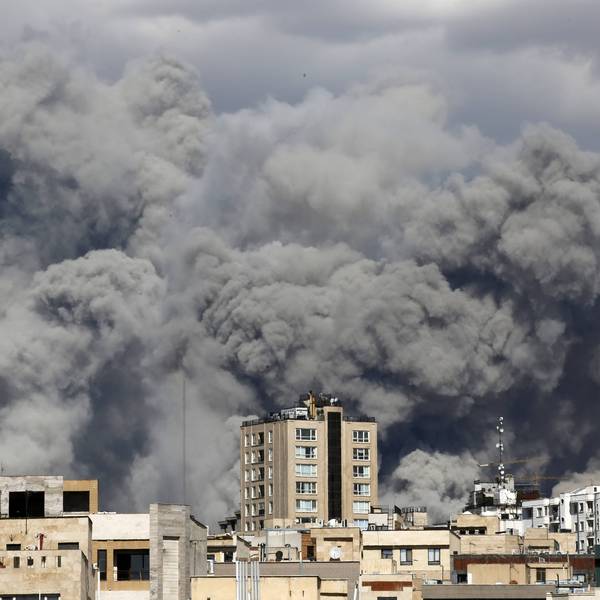
Smoke rises after explosions rocked multiple areas of Tehran, following Israel’s announcement of new attacks on Iran, on March 01, 2026. [Fatemeh Bahrami – Anadolu Agency]

Iran reported US-Israeli airstrikes on parts of the state television headquarters in the capital Tehran on Sunday evening, Anadolu reports.

The state-run Press TV said US and Israeli warplanes hit parts of the headquarters of Islamic Republic of Iran Broadcasting (IRIB) in Tehran.

Attacks also targeted residential districts in the capital, the broadcaster added.

Meanwhile, the state news agency IRNA reported that explosions were heard in the eastern, southeastern and central areas of Tehran.

READ: US-Israeli strike hits Red Crescent building, surrounding areas

No information was yet available about casualties.

The US and Israel launched an attack on Iran on Saturday, killing several top Iranian leaders, including Supreme Leader Ayatollah Ali Khamenei. Tehran retaliated with a series of drone and missile attacks that targeted Israel, US assets and several Gulf countries.

This came after an earlier wave of attacks by Tel Aviv and Washington in June last year, triggering a 12-day war before a ceasefire was announced.

READ: US strikes Iran’s ballistic missile facilities with B-2 stealth bombers: CENTCOM

Orcas discuss Donald Trump and the killer apes' concept of democracy. Front Orca warns that Trump is crashing his country's economy and that everything he does he does for the fantastically wealthy.
Orcas discuss Donald Trump and the killer apes’ concept of democracy. Front Orca warns that Trump is crashing his country’s economy and that everything he does he does for the fantastically wealthy.
Donald Fuhrump says that Amerikkka doesn't bother with crimes or charges anymore, not being 100% Amerikkkan and opposing his real estate intentions is enough.
Donald Fuhrump says that Amerikkka doesn’t bother with crimes or charges anymore, not being 100% Amerikkkan and opposing his real estate intentions is enough.
Orcas discuss rotting brain. Front Orca says "Wish someone would lock him up".
Orcas discuss rotting brain. Front Orca says “Wish someone would lock him up”.

Continue ReadingUS, Israeli strikes hit parts of Iran’s state television headquarters in Tehran

US Progressives Say Stop Supporting ‘Rogue Genocidal Regime’ as Israel Wages Illegal War on Iran

Spread the love

Original article by Brett Wilkins republished from Common Dreams under Creative Commons (CC BY-NC-ND 3.0). 

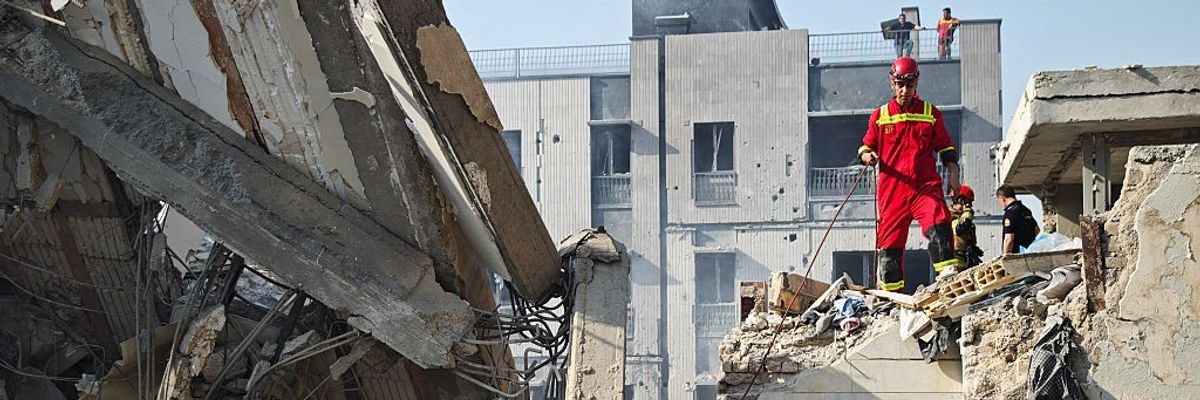
Rescue workers comb through the ruins of a residential building bombed by Israel on June 13, 2025 in Tehran, Iran. (Photo: Majid Saeedi/Getty Images)

“Trump must act immediately to suspend all military support to Israel and stop allowing U.S. arms to fuel war crimes, mass civilian death, and regional collapse,” said one critic.

Progressive U.S. lawmakers and human rights defenders demanded an end to unconditional American armed and diplomatic support for Israel after it launched a series of attacks on Iran early Friday, reportedly killing senior military officials and civilians including nuclear scientists, women, and children in a dramatic escalation that Iranian leaders vowed to avenge.

Israeli forces carried out at least five waves of airstrikes targeting not only Iran’s nuclear facilities but also its military leadership and capabilities, Al Jazeera reported. In addition to airstrikes, Israeli and international media reported that operatives from Mossad, Israel’s foreign spy agency, also conducted assassination and sabotage attacks in Iran.

The Israel Defense Forces (IDF) claimed that Islamic Revolutionary Guard Corps (IRGC) Commander-in-Chief Major Gen. Hossein Salami and Iranian Armed Forces Chief of Staff Major Gen. Mohammad Bagheri were assassinated, as were numerous Iranian nuclear scientists.

IDF attacks targeted cities including the capital Tehran, Natanz, Isfahan, Arak, Tabriz, and Kermanshah. Iranian television reports showed bombed-out apartment towers and said that an unknown number of civilians including women and children were killed in the strikes.

The attack on Natanz—home to Iran’s primary nuclear enrichment facility—sparked fears of radiological contamination.

Israeli Prime Minister Benjamin Netanyahu called the attack—dubbed Operation Rising Lion—a “preemptive strike,” a dubious form of warfare previously waged by forces including imperial Japan during the bombing of Pearl Harbor and the George W. Bush administration in Iraq.

Israeli President Isaac Herzog said the attacks were meant to “neutralize an immediate and existential threat to our people,” an apparent reference to Iran’s nuclear program. Successive U.S. administrations including President Donald Trump’s have concluded for decades that Iran is not trying to develop nuclear weapons.

During his first term, Trump unilaterally abrogated the Joint Comprehensive Plan of Action, also known as the Iran nuclear deal.

Last year, Israel and Iran carried out limited tit-for-tat attacks following the former’s assassination of Hassan Nasrallah, who led the Lebanon-based resistance group Hezbollah, and Hamas leader Ismail Haniyeh.

This time, Iranian leaders vowed “severe punishment,” with fears that the U.S. could be targeted due to its staunch support for Israel as it wages what the international community increasingly views as a genocidal war on Gaza. While U.S. Secretary of State Marco Rubio claimed that his country was not involved in the attacks, Israeli officials insisted there was close coordination with the Trump administration.

Iranian Supreme Leader Ayatollah Seyyed Ali Khamenei said Friday that “in the early hours of today, the Zionist regime extended its filthy and bloodstained hand to commit a crime in our beloved country, exposing its vile nature more than ever by targeting residential areas.”

“With this crime, the Zionist regime has prepared a bitter and painful fate for itself—and it will undoubtedly face it,” Khamenei added.

As the world braced for Iran’s response to the attacks, U.S. progressives called for a diplomatic solution and an end to American support for Israel.

“The Israeli government bombing Iran is a dangerous escalation that could lead to regional war,” Congresswoman Rashida Tlaib (D-Mich.) said on social media.

Tlaib asserted that Netanyahu, who is wanted by the International Criminal Court for alleged war crimes and crimes against humanity in Gaza and is facing a domestic criminal corruption trial, “will do anything to maintain his grip on power.”

“We cannot let him drag our country into a war with Iran,” she added. “Our government must stop funding and supporting this rogue genocidal regime.”

Referring to negotiations on a new Iran nuclear deal, Congresswoman Ilhan Omar (D-Minn.) said: “Just as talks with Iran were set to resume, Netanyahu launches a strike and declares a state of emergency. He is provoking a war Americans don’t want.”

“We should not allow ourselves to be dragged into yet another conflict, against our will, by a foreign leader pursuing his own agenda of death and destruction,” Omar added.

The U.S.-based peace group CodePink—some of whose members held an emergency protest outside the White House in Washington, D.C.—said that it “strongly condemn[s] Israel’s unprovoked and reckless attack on Iran, which risks igniting a catastrophic regional war.”

“This dangerous escalation threatens millions of lives across the entire Middle East,” the group added. “The U.S. must not continue to support and enable this illegal act of aggression.”

CodePink co-founder Medea Benjamin said: “It’s horrific that Israel is bombing yet another country. And Trump calls himself a peace president? He knew this was coming and stood by. This is entirely out of step with the will of the American people.”

“The whole world is desperate for peace in the Middle East, and instead, Israel decides to move the region closer to World War III,” Benjamin added.

Noting that nuclear talks with Iran were set to resume this weekend, the National Iranian American Council (NIAC) said that “this is an attack on peace and diplomacy.”

“Israeli political officials have demonstrated that U.S. diplomacy and a peaceful resolution with Iran is what they consider to be the true threats,” NIAC asserted.

“This much is clear: This is a war of choice, and an illegal and unprovoked attack,” NIAC added. “Trump must weigh in to stop this conflict before it spirals out of control, and to preserve the chance of maintaining diplomatic offramps.”

Michael Schaeffer Omer-Man, Israel-Palestine director at the advocacy group Democracy for the Arab World Now (DAWN), contended that “Israel deciding to launch a war against Iran at the very same time it faces unprecedented international isolation and pressure over its genocide in Gaza is a nightmarish outcome of impunity.”

DAWN executive director Sarah Leah Whitson said that “Israel has committed an unlawful, unprovoked attack on Iran to undermine the growing global efforts to sanction it for its illegal occupation and to disrupt Trump’s efforts to independently pursue America’s interests via diplomacy.”

Nihad Awad, national executive director at the Council on American Islamic Relations, issued the following statement:

We condemn Israel’s offensive strike on Iran and the broader pattern of aggression it represents. Netanyahu is using American weapons and taxpayer dollars to launch illegal and destabilizing wars across the region. President Trump must act immediately to suspend all military support to Israel and stop allowing U.S. arms to fuel war crimes, mass civilian death, and regional collapse. Secretary Rubio’s statement confirms what we already knew—Israel is acting recklessly, and the U.S. is letting it happen.

CodePink noted that “in the past month and a half alone, Israel has bombed Palestine, Lebanon, Syria, Yemen, and Iran.”

“There is no other choice,” the group added, “ARMS EMBARGO NOW!”

Original article by Brett Wilkins republished from Common Dreams under Creative Commons (CC BY-NC-ND 3.0). 

Continue ReadingUS Progressives Say Stop Supporting ‘Rogue Genocidal Regime’ as Israel Wages Illegal War on Iran

‘Diplomacy, Not Catastrophe’ Needed as Israel Appears Poised for US-Enabled War on Iran

Spread the love

Original article by Brett Wilkins republished from Common Dreams under Creative Commons (CC BY-NC-ND 3.0).

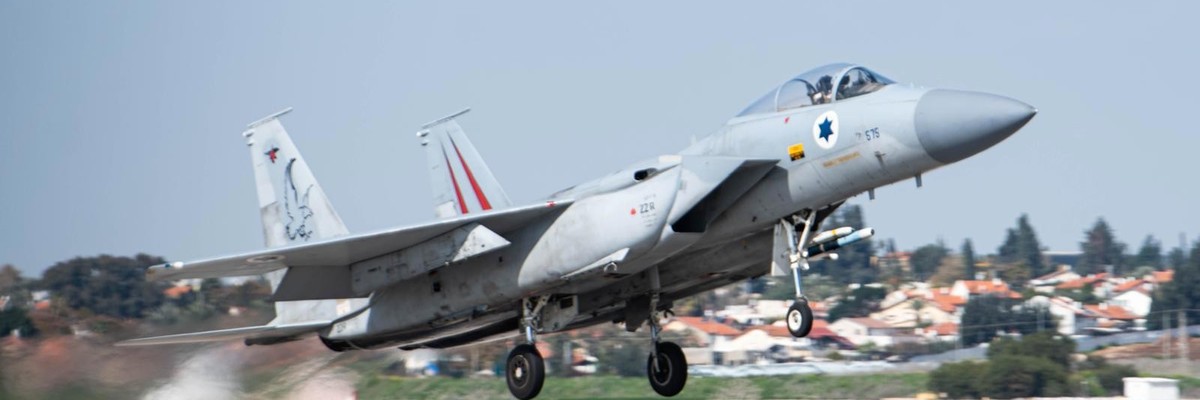
An Israel Defense Forces F-15 fighter takes off in this photo posted on the IDF’s website on May 19, 2025. (Photo: Israel Defense Forces)

“It would be a catastrophic mistake to be led into a war by the same neocons that claimed the Iraq war would be a cakewalk,” warned one group.

Israel is likely preparing to bomb Iran even as the Trump administration works toward a nuclear deal with Tehran, stoking fears of Iranian retaliation against U.S. military bases and other American or allied sites in an already inflamed region, and prompting calls for urgent diplomacy to avoid war.

U.S. and European officials told Western media Thursday that Israel is preparing to unilaterally attack Iran as negotiations between Washington and Tehran draw closer to a preliminary framework for an agreement to curb Iran’s nuclear development. The government of fugitive Israeli Prime Minister Benjamin Netanyahu opposes any such deal.

“If this escalates, innocent lives will be caught in the crossfire in Iran and across the region.”

American intelligence agencies have periodically concluded over the past two decades that Iran—which has not started a war since the 19th century but supports proxy attacks on Israel—is not developing nuclear weapons.

While President Donald Trump—who has repeatedly threatened to bomb Iran if a nuclear deal is not reached—has publicly opposed an Israeli attack on Iran, numerous observers are warning that Tehran and its proxies would very likely view the U.S. as complicit in any such action.

“If Israel does strike Iran in the next days or hours, and even if they do so in defiance of Trump’s warnings, the likelihood that the Iranians will perceive it as an independent act by Israel in defiance of Trump is essentially zero,” Trita Parsi, executive vice president of the Quincy Institute for Responsible Statecraft, said Wednesday on social media. “There is no plausible deniability.”

Vahid Razavi, an Iranian American advocate for human rights and ethics in technology and founder of ParentsPlea.com, told Common Dreams Thursday that “Israel will only attack Iran with the support and blessing of the United States.”

“The ‘good cop/bad cop’ game that Trump and Israel are playing in the region is a distraction,” Razavi added. “There is no substantial difference in U.S. and Israeli policy toward Iran.”

Iran has threatened an “unprecedented response” if Israel attacks.

“In case of any conflict, the U.S. must leave the region because all its bases are within our range, and we will target all of them in the host countries regardless,” Iranian Defense Minister Aziz Nasirzadeh said Thursday during a televised address.

Nasirzadeh’s remarks followed a Wednesday threat by an official from Ansar Allah that the Yemeni rebel group also known as the Houthis is “at the highest level of preparedness for any possible American escalation against us.”

“Any escalation against the Islamic Republic of Iran is also dangerous and will drag the entire region into the abyss of war,” the unnamed official toldNewsweek.

The Trump administration stands accused of war crimes in Yemen amid an escalation of the decadeslong U.S. bombing of the country as part of the so-called War on Terror. Successive U.S. administrations also backed a Saudi-led war on Yemen that has claimed hundreds of thousands of lives, while Israeli and British forces have bombed the country since 2024 in retaliation for Houthi missile attacks on Red Sea shipping and Israel.

Last October, Iran launched a limited missile strike on Israel in response to the assassinations of Hassan Nasrallah, who led the Lebanon-based resistance group Hezbollah, and Hamas leader Ismail Haniyeh. This prompted retaliatory Israeli attacks on targets in and around Tehran, including the headquarters of the elite Islamic Revolutionary Guards Corps.

The prospect of another Israeli attack on Iran prompted the U.S. on Wednesday to order the evacuation of some diplomats from Iraq and call for the voluntary departure of American military families from the region.

Meanwhile, numerous observers stressed the need for a diplomatic resolution to avoid a wider war in the Middle East—and possibly beyond.

“We must face the reality: if this escalates, innocent lives will be caught in the crossfire in Iran and across the region, and at home there may be new, dire threats to the civil liberties of our community,” the National Iranian American Council (NIAC) said in a statement Thursday.

“We are working to ensure our leaders hear us loud and clear: We need diplomacy, not catastrophe,” NIAC added. “We are organizing multiple actions in the coming days against a potential war and in support of peace and ask for your support to fuel this vital effort.”Former Democratic Ohio state Sen. Nina Turner succinctly said Wednesday: “No war with Iran. No war, period.”

Original article by Brett Wilkins republished from Common Dreams under Creative Commons (CC BY-NC-ND 3.0).

Thousands Across US Send Message to Trump: ‘No Threats, No Bombs, No War With Iran’

Continue Reading‘Diplomacy, Not Catastrophe’ Needed as Israel Appears Poised for US-Enabled War on Iran