Staging for a Strike? US Quietly Moves Bombers as Israel Prepares to Hit Iran

Spread the love

Original article by Robert Inlakesh republished from Mint Press News under a Creative Commons Attribution-NonCommercial-ShareAlike 3.0 International License.
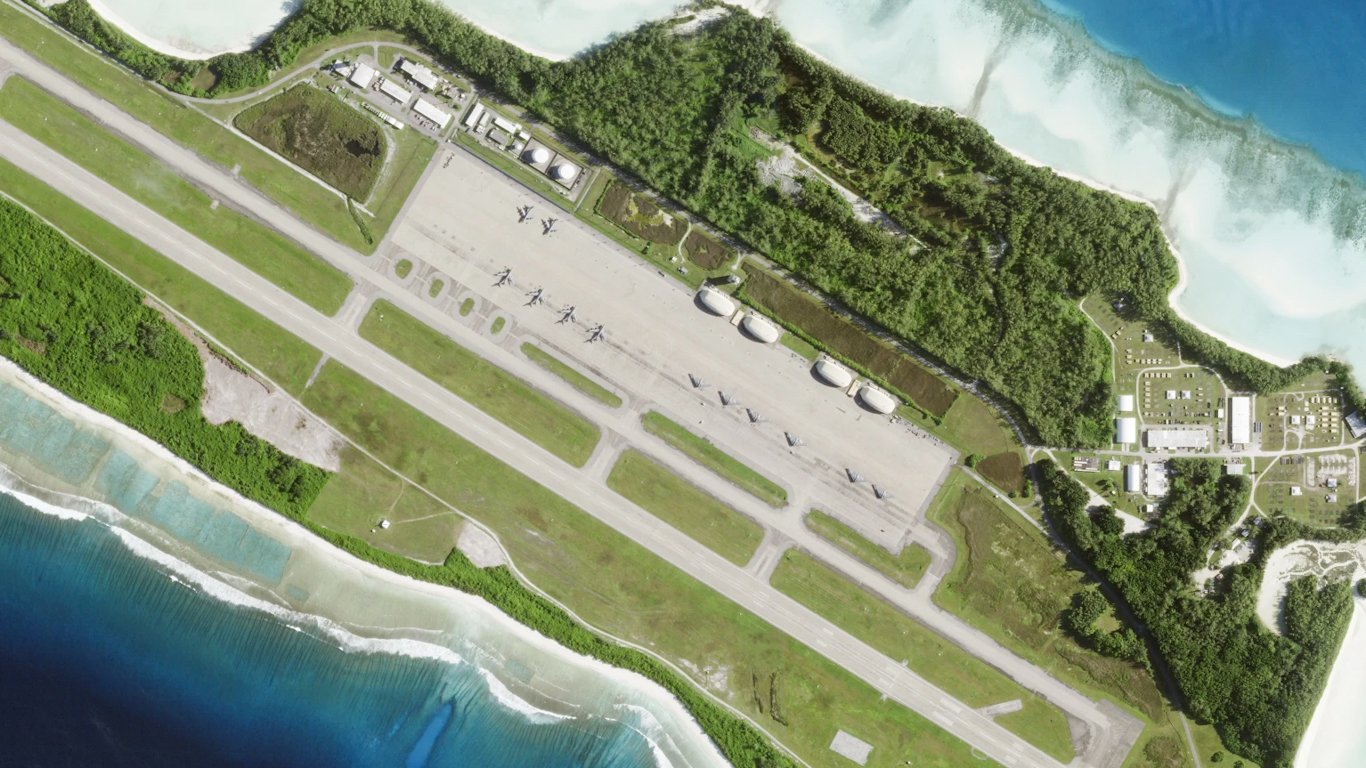
As threats of an Israeli strike on Iran grow louder, the United States is making quiet but unmistakable moves of its own. Over the past month, Washington has quietly repositioned strategic bombers and fighter squadrons to Diego Garcia, a remote U.S. military outpost in the Indian Ocean, squarely within striking distance of Tehran.

The official rationale is force protection. But the scale and nature of the deployments have sparked speculation that Washington is laying the groundwork for potential military involvement in an Israeli-led operation, or, at the very least, sending a message to Tehran that it won’t stand in the way.

Roughly a month ago, the U.S. Air Force deployed six B-2 Spirit bombers to Diego Garcia, a third of its active fleet of nuclear-capable stealth aircraft. These bombers, capable of flying directly from the U.S. to targets across the globe, don’t require forward deployment to be effective. Which is why their presence on a remote island in the Indian Ocean is raising eyebrows.

The B-2s have reportedly been used in prior strikes against Ansar Allah targets in Yemen, though with limited strategic effect. Following the declared conclusion of U.S. operations in Yemen, at least some of the B-2s were replaced by four B-52 strategic bombers, another long-range platform associated with show-of-force missions.

But then, additional firepower arrived. An entire squadron of F-15E Strike Eagle fighter jets was flown to the base. While these jets have strike capabilities, open-source intelligence analysts suggest they were likely deployed for base defense. That assessment, if correct, underscores that the Pentagon sees Diego Garcia not just as a staging ground, but as a potential target in a broader escalation.

Meanwhile, intelligence signals point to real movement on the Israeli side. A CNN report this Tuesday cited intercepted communications and activity on the ground indicating that Israel is preparing to strike Iranian nuclear facilities. U.S. officials reportedly believe the plans are active and serious.

In April, Donald Trump remarked that Israel would “lead” any such operation. That comment was interpreted by many as a nod of support, if not a green light, from Washington. Israeli Prime Minister Benjamin Netanyahu, for his part, has repeatedly warned that his government will not allow Iran to become a nuclear weapons state.

Yet even as diplomatic channels remained open, the introduction of new U.S. “red lines” appears to have derailed progress. U.S. Middle East envoy Steve Witkoff recently declared that Iran must halt all uranium enrichment, a demand not included in the original 2015 nuclear agreement, the Joint Comprehensive Plan of Action (JCPOA).

Iranian officials rejected the move outright. Foreign Minister Abbas Araghchi reiterated that enrichment is a sovereign right and a non-negotiable issue. Ayatollah Seyyed Ali Khamenei dismissed the new U.S. conditions as “nonsense.”

And on May 22, Araghchi issued a sharper warning: Iran, he said, would take “special measures to defend its nuclear facilities” if Israeli threats continued. The statement was deliberately vague, but left little doubt that Tehran is preparing for contingencies.

In Washington, meanwhile, influential think tanks are ratcheting up pressure for a hardline approach. The Washington Institute for Near East Policy (WINEP) has called for the complete dismantling of Iran’s enrichment infrastructure. The Foundation for Defense of Democracies (FDD) has urged more sanctions. The Atlantic Council argues the U.S. must avoid “reviving Obama’s Iran deal.”

Simultaneously, Dana Stroul, a former Biden official now at WINEP, has argued that Iran’s current weakness presents an opportunity for military action. Her view echoes a growing consensus across Washington’s think tank circuit: that Tehran is vulnerable, and now is the moment to strike.

These are the same voices that helped shape past U.S. interventions in the region. Their resurgence now, alongside tactical military deployments and rhetorical escalations, suggests a familiar pattern.

What’s missing from the conversation is any real public debate about the consequences. Not just for Iran, but for U.S. interests, regional stability, and the American public. A confrontation with Iran would carry significant consequences, yet few in Washington have publicly questioned whether such a conflict serves America’s national interest, save for outliers like Rep. Thomas Massie, who has drawn fire from powerful lobbies simply for asking whether this is our fight to begin with.

The buildup at Diego Garcia may be interpreted as precaution. But it’s also a reminder of how quickly precaution becomes policy, and policy becomes war, especially when shaped by proxies, pressure groups, and allies with very different interests.

Wars don’t always begin with votes. In fact, they often begin with quiet deployments far from view, and even farther from the American people they will ultimately affect.

Feature photo | This satellite image from Planet Labs PBC shows six U.S. B-2 stealth bombers parked at Camp Thunder Cove in Diego Garcia on April 2, 2025. Though officially deployed for operations in Yemen, the presence of these nuclear-capable aircraft in striking range of Iran has raised concerns that the U.S. is quietly preparing to support a potential Israeli attack. Photo | AP

Robert Inlakesh is a political analyst, journalist and documentary filmmaker currently based in London, UK. He has reported from and lived in the occupied Palestinian territories and hosts the show ‘Palestine Files’. Director of ‘Steal of the Century: Trump’s Palestine-Israel Catastrophe’. Follow him on Twitter @falasteen47

Original article by Robert Inlakesh republished from Mint Press News under a Creative Commons Attribution-NonCommercial-ShareAlike 3.0 International License.

Neo-Fascist Climate Science Denier Donald Trump says Burn, Baby, Burn.
Elon Musk urges you to be a Fascist like him, says that you can ignore facts and reality then.

Trump’s Break with Israel: Genuine Shift or Political Theater?
Continue ReadingStaging for a Strike? US Quietly Moves Bombers as Israel Prepares to Hit Iran

“Is killing over 40,000 women and children victory?” Ayatollah Khamenei asks

Spread the love

Original article by Abdul Rahman republished from peoples dispatch under a Creative Commons Attribution-ShareAlike 4.0 (CC BY-SA) license.

Imam Khamenei, the Leader of the Islamic Revolution, in a meeting on December 22. Photo: Khamenei.ir

The leader also emphasized that Iran does not have proxy forces in the region, but that its allies fight because of their belief in resisting oppression.

Iran’s Supreme Leader Ayatollah Seyyed Ali Khamenei asserted on Sunday, December 22 that no matter the temporary setbacks, the resistance will defeat the imperialist and Zionist forces in the region and that their claims of victory against the resistance are premature and hollow.

Khamenei was addressing hundreds of people during a religious ceremony in Tehran. He also refuted Western allegations that the resistance forces in the region fighting against imperialism and Zionist occupation, including Hezbollah, Hamas, Ansar Allah, and the Popular Mobilization Forces in Iraq, were in any way “proxies” of Iran. He emphasized that the forces part of the Axis of Resistance are driven by their faith and commitment to fight against oppression. He claimed that it is “the power of faith” which has “brought the faithful and honorable men to the resistance field” in Yemen, Lebanon and in Palestine. None of these groups are “acting on our behalf” Khamenei underlined. He also added that the Islamic Republic does not have proxies anywhere and neither does it need any such mechanism to act when needed, Iranian media reported.

Talking about the capture of power in Syria by the Hayat Tahrir al-Sham (HTS) and Israel’s invasion inside the country as temporary Khamenei said he was confident that it cannot be termed as “victory” for the zionist regime as claimed by Israeli Prime Minister Benjamin Netanyahu.

Following HTS’ control of Syrian state power on December 8, Israeli forces have advanced beyond the buffer zone in the Golan Heights, in violation of prior agreements. Netanyahu has also claimed that the victory of HTS against president Bashar al-Assad, was made possible because of the Israeli efforts. Israel has asserted its forces would remain inside Syria for as long as required.

Khamenei expressed hope that “God willing, soon in Syria,” young men will follow the examples of Yemen, Lebanon and Palestine and fight against oppression and the crimes imposed by the Zionist regime.” He reiterated his country’s resolve to “remove this regime [Zionist regime] from the region.”

“I predict that a powerful and honorable group will rise in Syria as well. A young Syrian has nothing to lose – his university is unsafe, his school is unsafe, his home is unsafe, his street is unsafe, his entire life is unsafe. What is he supposed to do?” Khamenei said.

Steadfast resistance against occupation

Khamenei called for “steadfast resistance” against the forces of occupation and dominance who are making the region unstable for their own narrow interests.

Khamenei noted that the US approach to the region is to control the regimes for its strategy to control the resources. It works against the interest of the people by either installing despotic regimes who align with its own interests or simply destabilizes a country by fomenting chaos and unrest in case it fails to install a favorable regime there. He gave the example of Syria where the US “resorted to unrest and created disorder.”

Khamenei warned against the repeated US attempts to create unrest in Iran as well. He however, expressed that all such attempts would be dealt with strongly by the Iranian state and such endeavors will never succeed.

Khamenei dismissed the claims made by Israel in terms of wars in Gaza and Lebanon. “Is killing over 40,000 women and children victory?” he asked. Even with this horrifying death toll from the last 14 months, the Zionist regime has not been able to defeat Hamas or other Palestinian resistance groups, he claimed. He reiterated that none of the original objectives proclaimed by Israel at the time of the beginning of the war in October 2023 have been achieved in Gaza or Lebanon.

“Have you destroyed Hamas or freed your captives in Gaza? Despite martyring a great leader like Sayyed Hassan Nasrallah, have you managed to eliminate Hezbollah in Lebanon?” Khamenei asked.

Original article by Abdul Rahman republished from peoples dispatch under a Creative Commons Attribution-ShareAlike 4.0 (CC BY-SA) license.

Continue Reading“Is killing over 40,000 women and children victory?” Ayatollah Khamenei asks

Female student arrested in Iran after stripping off in public on university campus

Spread the love

https://www.euronews.com/2024/11/02/female-student-arrested-in-iran-after-stripping-off-in-public-on-university-campus

Amnesty Iran called for the immediate and unconditional release of the student who reportedly stripped down in protest against the university’s strict dress code law.

An Iranian woman has been arrested after she stripped partially naked on a university campus, reportedly in protest against the strict dress code after she was physically harassed by security officers for wearing her hijab incorrectly, according to Amnesty Iran.

Video circulating on social media platform X, filmed by other university students in a classroom overlooking the Tehran Islamic Azad University campus, has attracted a lot of attention online, with many people applauding the woman for her “boldness” and “courage”.

No further information has been released about the identity of the individual.

In a post on X, Amnestry Iran pressed for her immediate and unconditional release.

The organisation called for the protection of the woman from “torture and other ill-treatment” pending her release and demanded that she must be granted access to family and a lawyer.

https://www.euronews.com/2024/11/02/female-student-arrested-in-iran-after-stripping-off-in-public-on-university-campus

Continue ReadingFemale student arrested in Iran after stripping off in public on university campus

Hamas leader’s killing in Tehran likely to further escalate violence in Middle East

Spread the love
Hassan Ammar/AP

Palestinian militant group Hamas says its top political leader, Ismail Haniyeh, has been killed in his home in Tehran. It blames Israel for the attack, saying it was “a Zionist airstrike on his residence in Tehran after he participated in the inauguration of Iran’s new president”.

Iran has not yet given any details on how Haniyeh was killed, but says it is under investigation.

With the war in Gaza showing no sign of abating and the whole Middle East on a knife’s edge, the killing raises questions about whether it may spark a wider regional war.

Who is Ismail Haniyeh?

Haniyeh is the most senior political leader of Hamas, based in Doha, Qatar. He was essentially the Hamas leader for the ceasefire negotiations with Israel in the Gaza War, brokered by the United States, Egypt and Qatar. These negotiations will obviously now be on hold.

While Israel has not yet claimed responsibility for his death – and this is unlikely, given it does not typically claim responsibility for covert actions – Haniyeh has long been on its list of targets.

What is surprising, though, is where and how it was done. Haniyeh was in Tehran to attend the swearing-in ceremony of Iran’s new president, Masoud Pezeshkian. Details of exactly what happened are still sketchy, but it appears Haniyeh was killed along with one of his bodyguards by an explosion in his building. We do not yet know if the explosion was from a remotely controlled bomb or a missile attack.

Iran’s Islamic Revolutionary Guard Corps (IRGC) is investigating the killing.

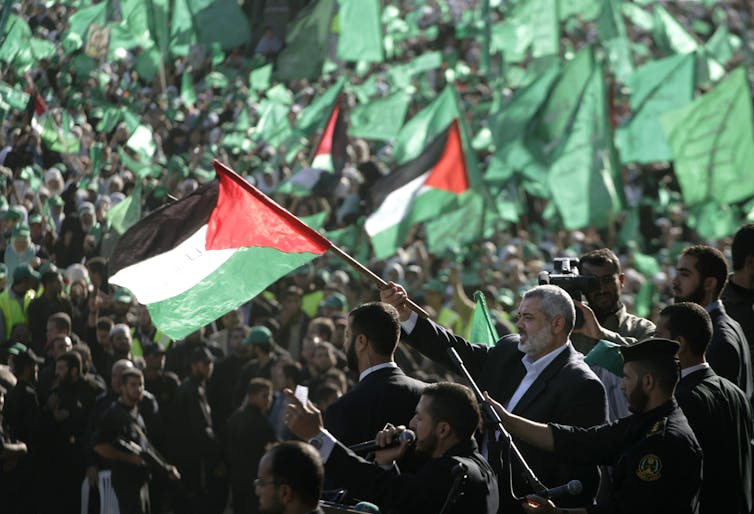
Haniyeh at a rally in 2007, when he was Palestine’s Prime Minister. EMILIO MORENATTI/AP

What does this mean for a wider regional war?

There are two important issues that will be under close scrutiny in the coming hours and days.

The first is that, assuming it was Israel that was responsible for Haniyeh’s killing, it raises the question of whether Iran will retaliate because Haniyeh was under the country’s protection when he was killed. His death is likely to cause enormous anger in Iran, and may in turn prompt retaliation against Israel on top of that from Hamas.

Tensions between Iran and Israel have been long been high. In April, Iran launched more than 300 missiles and drones at Israel in retaliation for an attack on the Iranian consulate in Damascus. The attack killed several senior IRGC leaders.

The attack on Haniyeh is indicative of a remarkable degree of intelligence and operational access that Israel seems to have in Iran at the moment. In recent years there has been a steady stream of Iranian scientists working on the nuclear program who have been killed. This includes the program’s “father”, Mohsen Fakhrizadeh, who was killed by a sophisticated remote-controlled machine gun in 2020.

However, there remain Hamas leaders on Israel’s list who, as far as can be discerned, are still alive. Gaza political leader Yahya Sinwar is apparently still directing the operations of militants there. In July, Israel carried out a strike that was believed to have killed the elusive military leader Mohammed Deif. However, Hamas has not acknowledged this, and Deif has survived several previous assassination attempts.

The second major question is whether Lebanon-based Hezbollah will launch an attack on Israel, at Iran’s behest.

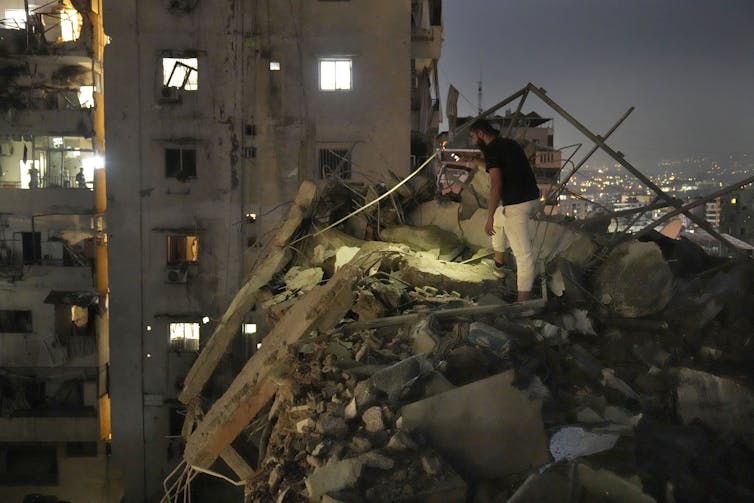
The Haniyeh killing comes within hours of an Israeli airstrike in southern Beirut, in which Israeli officials believe they have killed senior Hezbollah commander Fuad Shukr.

An Israeli airstrike on Southern Beirut, Lebanon threatens to further increase tensions in the region. Hussein Malla/AP

If Iran were to retaliate, it might be through Hezbollah from Lebanon. A major missile barrage from Hezbollah could potentially overwhelm Israel’s Iron Dome missile defence system.

Iran also has other allies on which it can call, including Shia militant groups in Syria and Iraq, as well as the Houthis in Yemen who have already launched a drone strike on Tel Aviv last week. Israel quickly retaliated.

What happens now is difficult to say until there is more information. But what is certain is that the killing of Haniyeh is likely to cause a significant escalation in the Gaza War, and possibly in the wider Middle East.

Ian Parmeter, Research Scholar, Centre for Arab and Islamic Studies, Australian National University

This article is republished from The Conversation under a Creative Commons license. Read the original article.

Continue ReadingHamas leader’s killing in Tehran likely to further escalate violence in Middle East