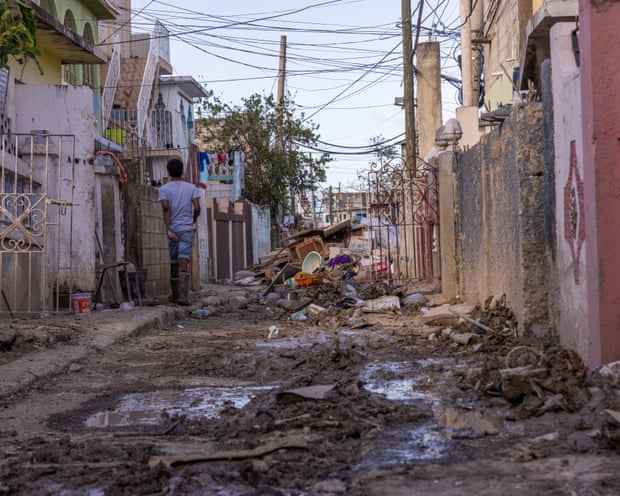
The aftermath of Hurricane Melissa in Catherine Hall, Montego Bay, Jamaica, on 4 November 2025. Photograph: Ina Sotirova/The Guardian
The record-breaking 252mph winds of Hurricane Melissa that devastated Caribbean islands at the end of October were made five times more likely by the climate crisis. Scorching wildfire weather in Spain and Portugal during the summer was made 40 times more likely, while June’s heatwave in England was made 100 times more likely.
Attribution science has made one thing clear: global heating is behind today’s extreme weather. That greenhouse gas emissions warmed the planet was understood. What can now be shown is that this warming produces record heatwaves and more violent storms with increasing frequency.
What we can do to minimise, or at least reduce, the risks to life from such events – as well as more gradual changes – is what climate adaptation experts think about all the time. The alarming consensus is that we are not doing anywhere near enough. The result is paid for in lives: floods and cyclonic storms across Thailand, Sri Lanka and Indonesia left hundreds dead at the end of November.
…
For the rich world, adaptation is prudent. For the poor world, it is survival. The latest UN report is unequivocal: developing countries will need more than $310bn annually by 2035, yet received just $26bn in 2023. Catastrophic floods in Asia and worsening droughts in Africa this year point to the growing need to accelerate climate adaptation.
Under the Paris agreement, nationally determined contributions (NDCs) – country plans to tackle global heating – are meant to cover both emissions reduction and adaptation to climate impacts.
But NDCs end up focusing mostly on cutting greenhouse gases and establishing decarbonisation pathways. That needs to change. National adaptation plans, which came out of Cop16, need to be foregrounded. These put adaptation centre stage – and demand real plans, real finance, real justice. They ask the question that really matters now: how do vulnerable nations survive a warming world that emissions cuts alone can’t stop?
Donald Trump urges you to be a Climate Science denier like him. He says that he makes millions and millions for destroying the planet, Burn, Baby, Burn and Flood, Baby, Flood.Nigel Farage urges you to ignore facts and reality and be a climate science denier like him and his Deputy Richard Tice. He says that Reform UK has received £Millions and £Millions from the fossil fuel industry to promote climate denial and destroy the planet.Elon Musk urges you to be a Fascist like him, says that you can ignore facts and reality then.
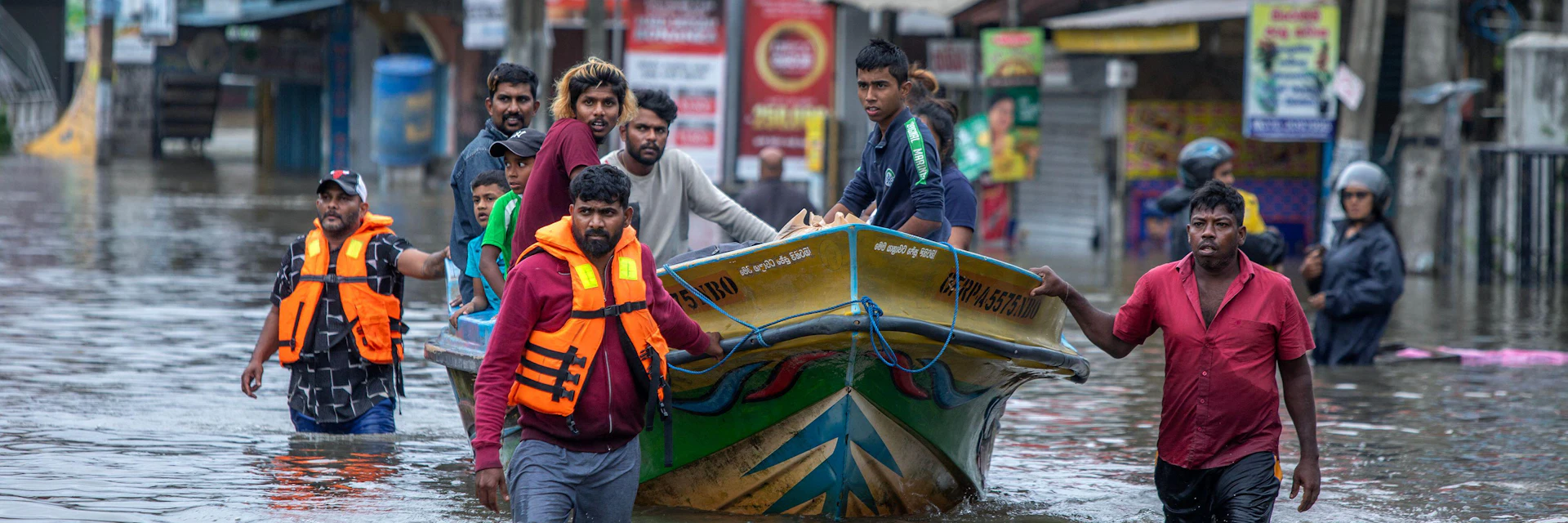
The final week of November was devastating for several South Asian countries. Communities in Sri Lanka, Indonesia and Thailand were inundated as Cyclones Ditwah and Senyar unleashed days of relentless rain. Millions were affected, more than 1,500 people lost their lives, hundreds are still missing, and damages ran into multiple millions of US dollars. Sri Lanka’s president even described it as the most challenging natural disaster the island has ever seen.
When disasters like this happen, the blame often falls on a failure in early warnings or poor preparedness. This was the case with major floods in Kerala, south India, in 2018, which devastated my hometown.
But this time, the forecasts were largely accurate; the authorities knew the storms were coming, yet the devastation was still immense.
So, if the forecasts were good enough, why were the impacts still so severe?
Weak winds, extreme rain
One emerging explanation is that these storms were not dangerous because of their winds, but because they produced unusually intense rainfall.
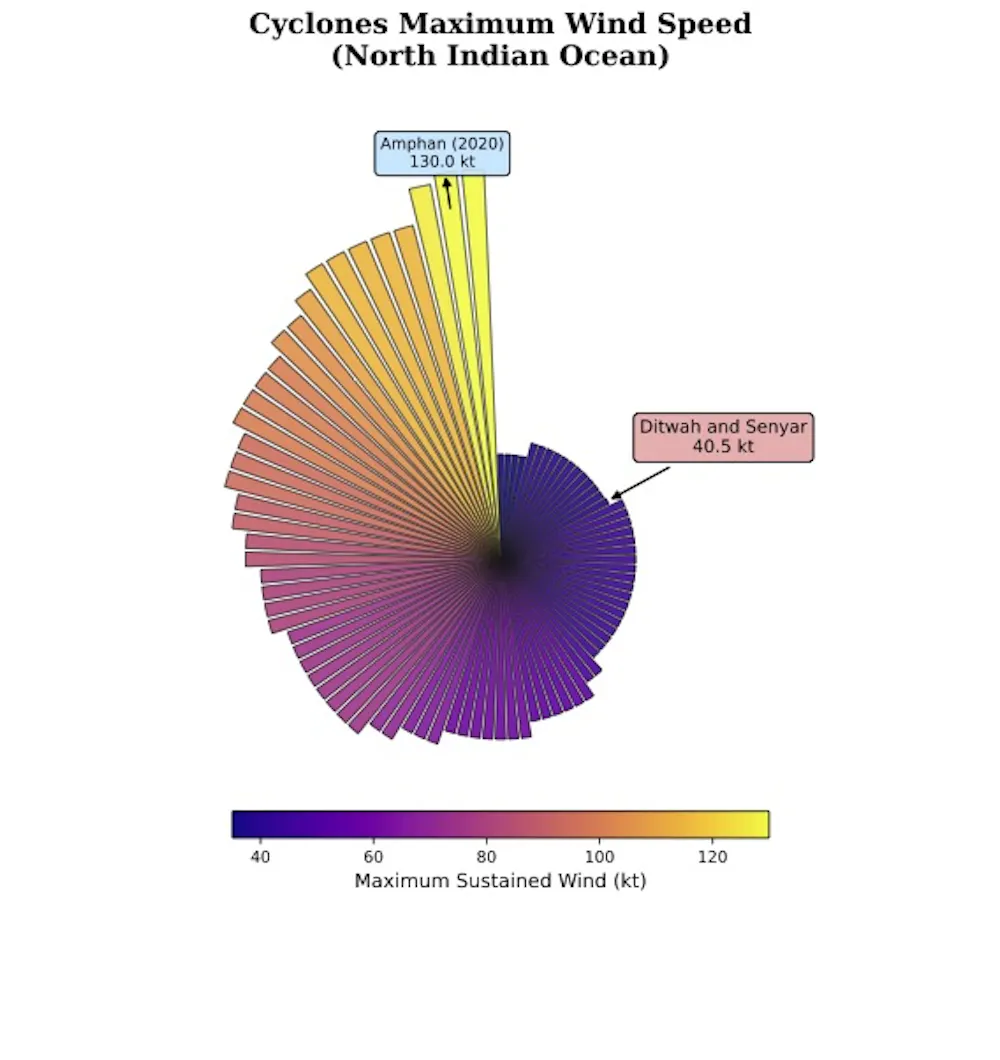
This graph of all cyclonic storms over the north Indian Ocean since 2001 shows Ditwah and Senyar weren’t particularly windy. (Wind speed measured in knots. 1 knot is about 1.15 mph or 1.85 kph) Ligin Joseph (data: IBTrACS), CC BY-SA
Consider Cyclone Ditwah. Its peak winds were around 75 km/h (47 mph). That’s windy, but nothing special. In the UK, it would be classified merely as a “gale” rather than a “storm”. It was far weaker than the 220 km/h winds of the powerful 1978 cyclone that also struck Sri Lanka. Yet Ditwah still caused massive devastation.
What explains this apparent contradiction? It’s too early to say definitively, but climate change is likely a part of the story. Even when storms are not especially strong in wind terms, the amount of rain they carry is increasing.
A warmer atmosphere holds more water
A well established meteorological rule helps explain why. For every degree of global warming, the atmosphere can hold about 7% more moisture.
As the planet warms, the air above us becomes a larger reservoir, waiting to dump more water on us. When storms form, they can tap into this expanded supply, often in extremely short bursts. Even if wind speeds are modest, the rainfall alone can be catastrophic.
The oceans matter even more
Warming oceans play an even more powerful role, as cyclones draw their energy from warm ocean waters. Satellite data from late November shows just how warm the eastern Indian Ocean was, with large areas more than 1°C above normal during Ditwah and Senyar.
In the days before the cyclones formed (20–24 November), the oceans were even warmer than usual, creating conditions that could have fuelled and intensified the rainfall. Ligin Joseph (Data: OISST; track positions are approximate), CC BY-SA
Such warm anomalies are no longer unusual. The oceans have absorbed more than 90% of the excess heat trapped by greenhouse gases, and long-term observations show a clear upward trend in ocean temperatures.
That doesn’t necessarily mean cyclones are becoming more frequent – their formation still depends on other ingredients, such as low wind shear (small differences in wind speed and direction with height) and the right atmospheric structure.
What warmer oceans do change, however, is the amount of energy available to any storm that does manage to form. When the ocean is warmer, cyclones have more fuel and evaporation increases, loading the atmosphere with moisture that can fall as intense rain once a storm develops. Even weak cyclones can therefore hold exceptional amounts of rain.
Evaporation averaged for 26–27 November. Ditwah especially travelled over warm waters supplying large amounts of moisture to the atmosphere. Ligin Joseph (Data: ERA5), CC BY-SA
The winds near the surface help this process along. As they move across the ocean, they sweep away the moisture-filled air just above the water and replace it with drier air, allowing evaporation to continue. Put together, warmer oceans, higher evaporation, and an atmosphere that can store more moisture, these factors can significantly intensify the rainfall associated with cyclones.
Coastline hugging makes flooding worse
Local geography amplified these effects. Both Ditwah and Senyar formed unusually close to land and travelled along the coastline for an extended period. This meant they stayed over warm waters long enough to continuously draw moisture, but remained close enough to land to dump that moisture as intense rainfall almost immediately.
Cyclone Ditwah, in particular, moved slowly as it approached Sri Lanka. Slow-moving storms can be especially dangerous as they repeatedly dump rain over the same area. Even if winds are weak, this combination of warm seas, coastal proximity and slow forward speed can be devastating.
A new threat
These storms suggest that climate change – especially ocean warming – is reshaping the risks posed by cyclones. The most dangerous storms may no longer simply be the ones with the strongest winds, but also the ones with the most moisture.
Forecasting systems, including new AI-powered weather models, are getting better at predicting cyclone tracks and wind speeds. Yet rainfall-driven flooding remains far harder to forecast. As oceans continue to warm, governments and disaster agencies will need to prepare for storms that may be weak in wind but extreme in rain.
These insights are based on preliminary analysis and emerging scientific understanding. More detailed peer-reviewed studies will be needed to pinpoint exactly why Ditwah and Senyar produced such extreme rainfall. But the pattern that is emerging – weak cyclones delivering outsized floods in a warming world – must not be ignored.
Donald Trump urges you to be a Climate Science denier like him. He says that he makes millions and millions for destroying the planet, Burn, Baby, Burn and Flood, Baby, Flood.Nigel Farage urges you to ignore facts and reality and be a climate science denier like him and his Deputy Richard Tice. He says that Reform UK has received £Millions and £Millions from the fossil fuel industry to promote climate denial and destroy the planet.
Original article by Roger Hallam republished from Roger Hallam. I have not asked to republish this article, expect that it will be ok.
Shymkent, Kazakhstan. Image by Raban Haaijk.
This month, the world’s elites will throw the first dice on how many millions they will have killed for their greatest of all crimes.
As of 28 April 2025, Asia is being battered by a brutal, life-threatening heatwave. Millions of people – right now – are facing unbearable temperatures. In many places it’s over 40°C. In some areas it’s approaching 46°C. In the Philippines, the heat index – the ‘feels like’ temperature – is hitting 53°C. That’s deadly.
People are collapsing in the streets. Children, the elderly, the poor – they’re the first to go. This isn’t just uncomfortable. It’s lethal. Heatstroke. Organ failure. Death in under six hours if you don’t have air conditioning – and most people don’t.
Crops are failing. Water supplies are drying up. Whole regions are becoming uninhabitable. In China, places like Zhejiang and Jiangsu have already hit record-breaking temperatures. In Bangladesh, Myanmar, Thailand – vast populations are at risk. In West Asia, where conflict and poverty already devastate lives, the heatwave is tipping people over the edge.
Let’s be absolutely clear: this is just the beginning. And it’s not a natural disaster – it’s a crime scene. A direct result of thirty years of lies, inaction, and wilful destruction by the people at the top – fossil fuel executives, politicians, and the liberal classes who let them get away with it.
This is the first phase of climate genocide. And it’s happening now.
So here we are. We’ve finally arrived.
2025 will be the second year in a row that global temperatures sit above 1.6°C. That’s not a statistic. That’s a death sentence – for millions. From this point on, every month is a roll of the dice. And if it lands on a six? The wet bulb threshold is breached – that deadly combination of heat and humidity where your body can’t cool down. People without air conditioning – the majority of humanity – die in six hours. That’s it. Game over.
Billions of people – in poor city slums, in rural villages, in places no one in power cares about – are now inside a roulette wheel of death. Waiting for their number to come up. That is what the ruling elites have created. That is what the liberal and professional classes have enabled – through cowardice, distraction, and silence. They could have stood up. They could have resisted. They chose not to. They are complicit.
The consequences? Beyond catastrophic. And if you sit back now, shrug your shoulders, and go back to your life – you are handing over the final keys. You are helping to lock in human extinction within the next ten years. If it hasn’t already been sealed.
Let’s stop pretending we don’t know what’s coming.
Do the numbers. We’re already at 1.6°C. Another 0.4°C rise is expected over the next decade. Add 0.5°C when air pollution clears and no longer cools the atmosphere. Add 0.3°C from the carbon lag – the delay between what we emit and when it shows up. Then add the collapse of forests, the melting permafrost, the methane, the wildfires.
We’re on track to blow through 3°C before 2050.
What does that mean? Ask the British insurance industry – they’ve already said it: 4 billion people dead. Half the human race. And that’s just the start. Because 3°C triggers feedbacks in the Earth system that take us past 5°C – the point where the human body, the human brain, life itself, no longer functions. That’s extinction. Everyone. Gone. Forever.
And even if there was just a 10% chance of this happening – which there isn’t, it’s now the central scenario – then to take that risk, to sit on your hands, is the greatest crime in history.
And if you still do nothing now, at this moment – then what are you?
Rev21 is hosting an online global convention this May, bringing together leading activists, writers, scientists, and changemakers to confront the realities of social and ecological collapse—and to begin designing the revolution we need. Held via Zoom with multiple talks, workshops, and breakout spaces, it’s a space to learn, connect, and collaborate on what 21st-century revolution can look like: holistic, nonviolent, and rooted in real relationships. For some, it’s a powerful networking moment; for others, it’s a first step into serious action. With solidarity pricing and an open invitation to those ready to shape the future, this isn’t just an event—it’s the beginning of a revolution.
Original article by Roger Hallam republished from Roger Hallam. I have not asked to republish this article, expect that it will be ok.
Neo-Fascist Climate Science Denier Donald Trump says Burn, Baby, Burn.Elon Musk urges you to be a Fascist like him, says that you can ignore facts and reality then.