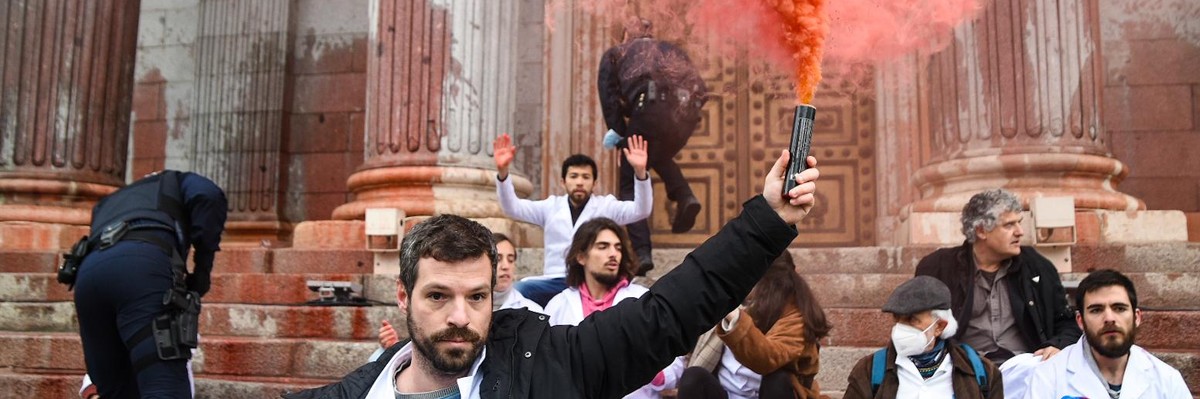
Protesters Target Dutch Microsoft Data Center for ‘Genocidal Collaboration’ With IDF

Spread the love

Original article by Brett Wilkins republished from Common Dreams under Creative Commons (CC BY-NC-ND 3.0). 
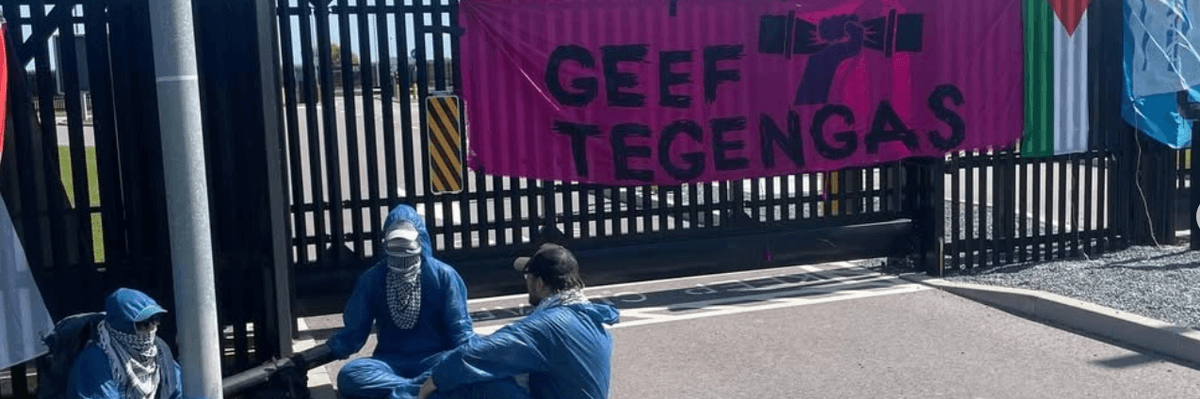
Activists with the group Geef Tegengas (Push Back) lock themselves to a pole near the entrance to Microsoft’s data center near Middenmeer, Netherlands on August 10, 2025 (Photo: Geef Tegengas/Instagram)

“Microsoft stores thousands of terabytes of surveillance data from the Israeli intelligence service Unit 8200—data that is used to oppress, imprison, and murder innocent Palestinians.”

Protesters staged a demonstration Sunday at a Microsoft data center in the Netherlands following last week’s revelation that the facility is being used by the Israel Defense Forces to plan genocidal airstrikes in Gaza and to store massive amounts of intelligence on Palestinians in the illegally occupied territories.

Members of the direct action group Geef Tegengas (Push Back) led the demonstration at Microsoft’s data center near the northwestern city of Middenmeer. Some activists scaled the roof of a building and lit flares, while others locked themselves to poles and blocked an entrance to the facility.

On its Instagram page, Geef Tegengas said it was targeting “genocide in our backyard.”

https://www.instagram.com/p/DNK-5gvIIg_/

“Microsoft stores thousands of terabytes of surveillance data from the Israeli intelligence service Unit 8200—data that is used to oppress, imprison, and murder innocent Palestinians,” the group said. “Thanks to its Azure cloud service, Microsoft plays a direct role in the genocide of the people of Gaza.”

Geef Tegengas demanded that Microsoft “remove all Israeli intelligence data” and urged employees at the facility to “lay down your work.”

The group also called on people to boycott Microsoft and support the global Boycott, Divestment, and Sanctions movement against Israel.

“We will continue to take action until this genocidal collaboration stops,” Geef Tegengas vowed.

Sunday’s demonstration followed the publication last week of a joint investigation by The Guardian+972 Magazine, and Local Call revealing that Unit 8200, the largest unit in the Israel Defense Forces (IDF), is storing 11,500 terabytes of data containing roughly 200 million hours of Palestinians’ phone call recordings on the Azure servers in the Netherlands.

According to the investigation—which involved interviews with 11 Microsoft and Israeli intelligence sources and a cache of leaked company documents—former Unit 8200 head Yossi Sariel traveled to Microsoft headquarters in Redmond, Washington in the United States in 2021 to meet CEO Satya Nadella.

Sniffing a lucrative opportunity, Nadella agreed to grant the cyberwarfare unit access to a special area of the Azure cloud platform. The project’s goal was storing “a million calls per hour.”

An intelligence source said that some of the Microsoft employees involved in the undertaking were Unit 8200 veterans, making collaboration “much easier.”

One leaked Microsoft document showed that company leaders embraced the IDF partnership as “an incredibly powerful brand moment.”

Microsoft responded to the investigation by claiming that Nadella was unaware of exactly what kind of data Unit 8200 was storing on the company’s servers.

Three Unit 8200 sources told The Guardian that Azure has facilitated IDF airstrikes on Gaza, where 674 days of U.S.-backed IDF bombing, invasion, and siege have left at least 229,000 Palestinians dead, maimed, or missing amid a worsening famine and the specter of ethnic cleansing and full Israeli occupation.

Israel’s conduct in the war is the subject of an ongoing genocide case at the International Court of Justice in The Hague, Netherlands. The International Criminal Court, also located in the Dutch city, last year issued arrest warrants for Israeli Prime Minister Benjamin Netanyahu and former Defense Minister Yoav Gallant for alleged crimes against humanity and war crimes in Gaza.

Microsoft said Monday that it has launched an investigation into how Unit 8200 is using Azure. This, after the company said in May that an internal review “found no evidence to date that Microsoft’s Azure and [artificial intelligence] technologies have been used to target or harm people in the conflict in Gaza.”

A Microsoft spokesperson said Monday that the company “takes these allegations seriously, as shown by our previous independent investigation.”

“As we receive new information, we’re committed to making sure we have a chance to validate any new data and take any needed action,” the spokesperson added.

The Guardian reported Monday that the news outlets’ investigation prompted debate last week in the Staten-Generaal, the Dutch Parliament, where Christine Teunissen of the left-wing Party for the Animals pressed the government on what it is doing to prevent data stored in the Netherlands from “being used to commit genocide” in Gaza.

Dutch Foreign Minister Caspar Veldkamp replied that he would “request further investigation.”

“If there are serious indications of criminal offenses in that information, legal proceedings can of course be initiated, and that is then up to the public prosecution service,” he said.

The Guardian/+972 Magazine/Local Call investigation follows last month’s revelation by the latter two outlets that the IDF has undertaken a “dramatic increase in the purchase of services from Google Cloud, Amazon’s AWS, and Microsoft Azure.”

Big Tech’s profiteering from Israel’s annihilation of Gaza and occupation, settler colonization, and apartheid in the West Bank has sparked numerous protests, including by employees of complicit companies. At least dozens of workers at companies including Google, Meta, and Microsoft have been fired for Palestine advocacy. Others have resigned in protest.

Hossam Nasr, a former Microsoft software engineer, was fired after organizing an October 2024 “No Azure for Apartheid” vigil for Palestinians killed by Israeli forces in Gaza.

Nasr told The Guardian after his termination that he was fired “simply because we were daring to humanize Palestinians, and simply because we were daring to say that Microsoft should not be complicit with an army that is plausibly accused of genocide.”

Original article by Brett Wilkins republished from Common Dreams under Creative Commons (CC BY-NC-ND 3.0). 
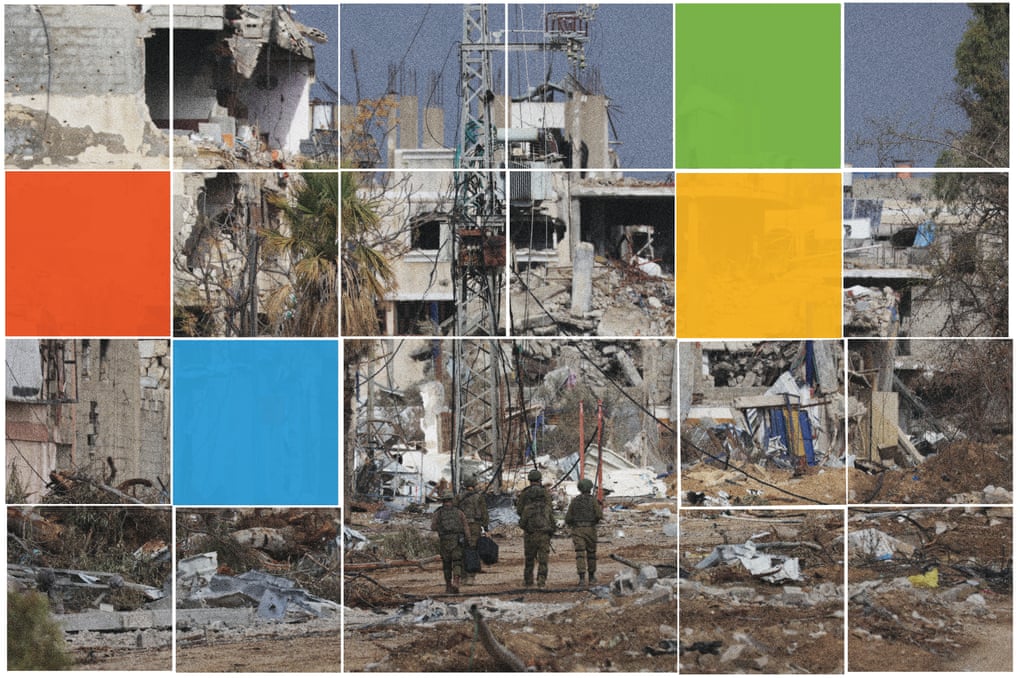
Continue ReadingProtesters Target Dutch Microsoft Data Center for ‘Genocidal Collaboration’ With IDF

Revealed: Microsoft deepened ties with Israeli military to provide tech support during Gaza war

Spread the love

https://www.theguardian.com/world/2025/jan/23/israeli-military-gaza-war-microsoft

 Illustration: Guardian Design

Leaked documents shed light on how Israel integrated the US tech giant into its war effort to meet growing demand for cloud and AI tools

Harry Davies and Yuval Abraham in JerusalemThu 23 Jan 2025 12.00 CETShare

The Israeli military’s reliance on Microsoft’s cloud technology and artificial intelligence systems surged during the most intensive phase of its bombardment of Gaza, leaked documents reveal.

The files offer an inside view of how Microsoft deepened its relationship with Israel’s defence establishment after 7 October 2023, supplying the military with greater computing and storage services and striking at least $10m in deals to provide thousands of hours of technical support.

Microsoft’s deep ties with Israel’s military are revealed in an investigation by the Guardian with the Israeli-Palestinian publication +972 Magazine and a Hebrew-language outlet, Local Call. It is based in part on documents obtained by Drop Site News, which has published its own story.

The investigation, which also draws on interviews with sources from across Israel’s defence and intelligence establishment, sheds new light on how the Israel Defense Forces (IDF) turned to major US tech companies to meet the technological demands of war.

Article continues at https://www.theguardian.com/world/2025/jan/23/israeli-military-gaza-war-microsoft

Continue ReadingRevealed: Microsoft deepened ties with Israeli military to provide tech support during Gaza war

I Went to Gaza. What I Saw Was a Holocaust

Spread the love

https://novaramedia.com/2024/10/18/i-went-to-gaza-what-i-saw-was-a-holocaust/

People attempt to extinguish a fire at the site of an Israeli strike on tents sheltering displaced people at Al-Aqsa Hospital in central Gaza, October 2024. Ramadan Abed/Reuters

Unutterable destruction.

by susan abulhawa

Editor’s note: This article was commissioned by the Guardian US as part of its Rise against fascism series, which was published in September. It was spiked by editor-in-chief Katherine Viner following a disagreement about the author’s use of the term “holocaust” to describe Israel’s actions in Gaza – the Guardian suggested she amend it to “genocide” and she refused. The context of the incident is documented in this report.

Novara Media has decided to publish the piece in full, including the term “holocaust”, following consultation with several scholars of genocide and Jewish history.

The author spells her name in lower case.

Content note: This piece contains explicit references to torture and sexual assault.

United Nations Resolution 3379 defined Zionism as “a form of racism” because at its core it is a supremacist ideology that seeks to privilege Jews at the expense, even detriment and demise, of non-Jews (the resolution passed in 1975 and was revoked in 1991 following pressure from Israel and the United States). Regardless of how one defines Zionism, it manifests, among other myriad ways, in the subjugation or displacement of indigenous Palestinians.

For the past 12 months, Israel has been implementing a long-held colonial fantasy of not only “finishing the job,” but doing so with a gleeful sadism that echos the social media posts of Tzipi Navon, Sara Netanyahu’s close advisor and office manager, who called for residents from Gaza who participated in the [7 October] massacre to be tortured live on broadcast television: “First removing the nails from the hands and feet … cut off [their] genitals and let [them] see [their testicles] fried in canola oil and [force them] to eat them … Keep the tongue to the end, so that it pleases us with its screams, the ears so that [they] can hear [their] own screams and the eyes so that [they] can see us smile.”

Polling data from Israel’s Institute for National Security Studies suggests that a majority of Jewish Israelis do not think that soldiers accused of torturing Palestinians should face criminal charges.

In a rare moment of candour, the New York Times reported UN findings of systematic torture, including sexual torture. According to the UN’s report, Israeli soldiers have allegedly kept Palestinian captives in severely overcrowded prison cells, subjected them to sleep deprivation and forced nudity, threatened them with gang-rape, and penetrated or electrocuted male and female prisoners’ genitals and anuses with electrified batons and other objects. Released Palestinian hostages and Palestinian civilians in Gaza have reported being mauled and sexually assaulted by trained dogs. A lawyer who has been granted rare access to a Palestinian captive inside an Israeli detention centre reported the activation of a fire extinguisher inside the body of a 27-year-old man through a hose inserted into his rectum.

Many of those who were kidnapped, including prominent surgeons such as Dr Adnan Al-Bursh, director of the orthopaedic department at Al-Shifa Hospital, may have died after torture. Some emerged from Israeli gulags with such trauma that they have reportedly suffered memory loss; some were unable to speak; all of them broken by unspeakable torment in Israeli captivity. And they were the lucky ones who got out.

Article continues at https://novaramedia.com/2024/10/18/i-went-to-gaza-what-i-saw-was-a-holocaust/

Discontent Deepens Among Guardian Staff Over Palestine ‘Double Standard’
Trying to find an appropriate nickname for Kamala Harris who fully supports Israel's genocide.
Trying to find an appropriate nickname for Kamala Harris who fully supports Israel’s genocide.
Continue ReadingI Went to Gaza. What I Saw Was a Holocaust

77% of Top Climate Scientists Think 2.5°C of Warming Is Coming—And They’re Horrified

Spread the love

Original article by OLIVIA ROSANE republished from Common Dreams under Creative Commons (CC BY-NC-ND 3.0).

Scientists engage in civil disobedience on the steps of the Congress of Deputies in Madrid, Spain on April 6, 2022. 
(Photo: Scientist Rebellion)

“I expect a semi-dystopian future with substantial pain and suffering for the people of the Global South,” one expert said.

Nearly 80% of top-level climate scientists expect that global temperatures will rise by at least 2.5°C by 2100, while only 6% thought the world would succeed in limiting global heating to 1.5°C above preindustrial levels, a survey published Wednesday by The Guardian revealed.

Nearly three-quarters blamed world leaders’ insufficient action on a lack of political will, while 60% said that corporate interests such as fossil fuel companies were interfering with progress.

“I expect a semi-dystopian future with substantial pain and suffering for the people of the Global South,” one South African scientist told The Guardian. “The world’s response to date is reprehensible—we live in an age of fools.”

“What blew me away was the level of personal anguish among the experts who have dedicated their lives to climate research.”

The survey was conducted by The Guardian‘s Damian Carrington, who reached out to every expert who had served as a senior author on an Intergovernmental Panel on Climate Change (IPCC) report since 2018. Out of 843 scientists whose contact information was available, 383 responded.

He then asked them how high they thought temperatures would rise by 2100: 77% predicted at least 2.5°C and nearly half predicted 3°C or more.

“What blew me away was the level of personal anguish among the experts who have dedicated their lives to climate research,” Carrington wrote on social media. “Many used words like hopeless, broken, infuriated, scared, overwhelmed.”

The 1.5°C target was agreed to as the most ambitious goal of the Paris agreement of 2015, in which world leaders pledged to keep warming to “well below” 2°C. However, policies currently in place would put the world on track for 3°C, and unconditional commitments under the Paris agreement for 2.9°C.

The survey comes on the heels of the hottest year on record, which already saw a record-breaking Canadian wildfire season as well as extreme, widespread heatwaves and deadly floods. The first four months of 2024 have also been the hottest of their respective months on record, and the year has already seen the fourth global bleaching event for coral reefs.

“They can say they don’t care, but they can’t say they didn’t know.”

“I think we are headed for major societal disruption within the next five years,” Gretta Pecl of the University of Tasmania told The Guardian. “[Authorities] will be overwhelmed by extreme event after extreme event, food production will be disrupted. I could not feel greater despair over the future.”

Scientists said that governments and companies that profit from the burning of fossil fuels had prevented action. Many also blamed global inequality and the refusal of the wealthy world to step up, both in terms of reducing their own emissions and helping climate vulnerable nations adapt.

“The tacit calculus of decision-makers, particularly in the Anglosphere—U.S., Canada, U.K., Australia—but also Russia and the major fossil fuel producers in the Middle East, is driving us into a world in which the vulnerable will suffer, while the well-heeled will hope to stay safe above the waterline,” Stephen Humphreys at the London School of Economics said.

Despite their grim predictions, many of the scientists remained committed to researching and speaking out.

“We keep doing it because we have to do it, so [the powerful] cannot say that they didn’t know,” Ruth Cerezo-Mota, who works on climate modeling at the National Autonomous University of Mexico, told The Guardian. “We know what we’re talking about. They can say they don’t care, but they can’t say they didn’t know.”

Others found hope in the climate activism and awareness of younger generations, and in the finding that each extra tenth of a degree of warming avoided protects 140 million people from extreme temperatures.

“I regularly face moments of despair and guilt of not managing to make things change more rapidly, and these feelings have become even stronger since I became a father,” said Henri Waisman of France’s Institute for Sustainable Development and International Relations. “But, in these moments, two things help me: remembering how much progress has happened since I started to work on the topic in 2005 and that every tenth of a degree matters a lot—this means it is still useful to continue the fight.”

Peter Cox of the University of Exeter added: “Climate change will not suddenly become dangerous at 1.5°C—it already is. And it will not be ‘game over’ if we pass 2°C, which we might well do.”

“I’m not despairing, I’m not giving up. I’m pissed off and more determined to fight for a better world.”

Many of the scientists who still saw a hope of keeping 1.5°C alive pinned it on the speeding rollout and falling prices of climate-friendly technologies like renewable energy and electric vehicles. Also on Wednesday, energy think thank Ember reported that 30% of global electricity came from renewables in 2023 and predicted that the year would be the “pivot” after which power sector emissions would start to fall. Experts also said that abandoning fossil fuels has many side benefits such as cleaner air and better public health. Though even the more optimistic scientists were wary about the unpredictable nature of the climate crisis.

“I am convinced that we have all the solutions needed for a 1.5°C path and that we will implement them in the coming 20 years,” Henry Neufeldt of the United Nations’ Copenhagen Climate Center told The Guardian. “But I fear that our actions might come too late and we cross one or several tipping points.”

Several scientists gave recommendations for things that people could do to move the needle on climate. Humphreys suggested “civil disobedience” while one French scientist said people should “fight for a fairer world.”

“All of humanity needs to come together and cooperate—this is a monumental opportunity to put differences aside and work together,” Louis Verchot, based at the International Center for Tropical Agriculture in Colombia, told The Guardian. “Unfortunately climate change has become a political wedge issue… I wonder how deep the crisis needs to become before we all start rowing in the same direction.”

The publication of The Guardian‘s survey prompted other climate scientists to share their thoughts.

“As many of the scientists pointed out, the uncertainty in future temperature change is not a physical science question: It is a question of the decisions people choose to make,” Texas Tech University climate scientist Katharine Hayhoe wrote on social media. “We are not experts in that; And we have little reason to feel positive about those, since we have been warning of the risks for decades.”

Aaron Thierry, a graduate researcher at the Cardiff School of Social Sciences, pointed out that The Guardian‘s results were consistent with other surveys of scientific opinion, such as one published in Nature in the lead-up to COP26, in which 60% of IPCC scientists said they expected 3°C of warming or more by 2100.

James Dyke of the University of Exeter’s Global Systems Institute argued that there was room for scientists to share more negative thoughts without succumbing to or encouraging defeatism.

“I hear the argument that we must temper these messages because we don’t want people to despair and give up. But I’m not despairing, I’m not giving up. I’m pissed off and more determined to fight for a better world,” Dyke said on social media.

NASA climate scientist Peter Kalmus shared the article with a plea to “please start listening.”

“Elected and corporate ‘leaders’ continue to prioritize their personal power and wealth at the cost of irreversible loss of essentially everything, even as this irreversible loss comes more and more into focus. I see this as literally a form of insanity,” Kalmus wrote, adding that “capitalism tends to elevate the worst among us into the seats of power.”

However, he took issue with the idea that a future of unchecked climate change would be only “semi-dystopian.”

“We’re also at risk of losing any gradual bending toward progress, and equity, and compassion, and love,” Kalmus said. “All social and cultural struggles must recognize this deep intersection with the climate struggle.”

Original article by OLIVIA ROSANE republished from Common Dreams under Creative Commons (CC BY-NC-ND 3.0).

[dizzy: It is generally accepted by knowledgeable parties that 2.5C is “locked-in” in the sense that emissions already made will cause it. We need immediate reduction in climate heating gases by abandoning fossil fuels. Politicians worldwide are neglecting this necessary action and are indeed creating a worse situation by promoting fossil fuels through widespread and generous subsidies.]

14/5/24 I’m trying to verify the “locked-in” claim that I make above. It’s not particularly supported by this report.

14/5/24 8.30 pm BST

If greenhouse gas emissions stopped but greenhouse gases stayed at a fixed level then there’d be another ~0.5-0.6°C of slow warming in the pipeline, but in reality CO₂ would fall due to natural carbon sinks once emissions stop and largely cancel out this warming.

Aerosols mask ~0.6°C of warming, but even in the unlikely scenario of their sudden elimination models show only ~0.2-0.4°C of extra warming by 2100 as a result. A gradual partial phase-out of aerosol emissions could limit this unmasking effect to ~0.1-0.2°C spread over time, and cuts in non-CO₂ greenhouse gases like methanes could entirely counteract aerosol removal, minimising its impact.

Overall this likely reduces “locked-in” warming from the climate lag and aerosols to a negligible amount on top of the current (2021) warming of ~1.2°C – in contrast to the extra ~1.4°C sometimes claimed – and any short-term warming from aerosol reductions can be reduced and compensated for by reducing other short-lived greenhouse gases like methane.

All of this is quite academic of course – politicians do not intend to address global warming and instead intend to continue trashing the planet.

Continue Reading77% of Top Climate Scientists Think 2.5°C of Warming Is Coming—And They’re Horrified