Vance Dossier Shows Not All Hacks Are Created Equal

Spread the love

Original article by Ari Paul republished from FAIR under https://creativecommons.org/licenses/by-nc-nd/3.0/

Ken Klippenstein, an independent reporter operating on Substack and an investigative alum of the Intercept, announced (Substack9/26/24) that he had been kicked off Twitter (now rebranded as X). His crime, he explained, stemmed from posting the 271-page official dossier of Republican vice presidential candidate’s J.D. Vance’s campaign vulnerabilities; the US government alleges that the information was leaked through Iranian hacking. In other words, the dossier is a part of the “foreign meddling campaign” of “enemy states.”

Klippenstein is not the first reporter to gain access to these papers (Popular Information9/9/24), but most of the reporting about this dossier has been on the intrigue revolving around Iranian hacking rather than the content itself (Daily Beast8/10/24Politico8/10/24Forbes8/11/24). Klippenstein decided it was time for the whole enchilada to see the light of day:

As far as I can tell, it hasn’t been altered, but even if it was, its contents are publicly verifiable. I’ll let it speak for itself.

“The terror regime in Iran loves the weakness and stupidity of Kamala Harris, and is terrified of the strength and resolve of President Donald J. Trump,” Steven Cheung, communications director for the Trump campaign, responded when I asked him about the hack.

If the document had been hacked by some “anonymous”-like hacker group, the news media would be all over it. I’m just not a believer of the news media as an arm of the government, doing its work combating foreign influence. Nor should it be a gatekeeper of what the public should know.

The US Office of the Director of National Intelligence said in a statement that alleged Iranian hacking (9/18/24) was “malicious cyber activity” and “the latest example of Iran’s multi-pronged approach…to stoke discord and undermine confidence in our electoral process.”

Where’s the beef?

Ken Klippenstein (Substack9/26/24) argued that the Vance dossier ” is clearly newsworthy, providing Republican Party and conservative doctrine insight into what the Trump campaign perceives to be Vance’s liabilities and weaknesses.”

The Vance report isn’t as salacious as Vance’s false and bizarre comments about Haitians eating pets (NPR9/15/24), but it does show that he has taken positions that have fractured the right, such as aid for Ukraine; the report calls him one of the “chief obstructionists” to providing assistance to the country against Russia. It dedicates several pages to Vance’s history of criticizing Trump and the MAGA movement, suggesting that his place on the ticket could divide Trump’s voting base.

On the other hand, it outlines many of his extreme right-wing stances that could alienate him with putative moderates. It says Vance “appears to have once called for slashing Social Security and Medicare,” and “is opposed to providing childcare assistance to low-income Americans.” He “supports placing restrictions on abortion access,” and states that “he does not support abortion exceptions in the case of rape.”

And for any voter who values 7-day-a-week service, Vance “appears to support laws requiring businesses to close on Sundays.” It quotes him saying: “Close the Damn Businesses on Sunday. Commercial Freedom Will Suffer. Moral Behavior Will Not, and Our Society Will Be Much the Better for It.” That might not go over well with small business owners, and any worker who depends on their Sunday shifts.

‘Took a deep breath’

The Washington Post (8/13/24) suggested that Vance dossier was different from Hillary Clinton’s hacked emails in 2016 because of “foreign state actors increasingly getting involved” in US elections.

Are the findings in the Vance dossier the story of the century? Probably not, but it’s not nothing that the Trump campaign is aware its vice presidential candidate is loaded with liabilities. There are at least a few people who find that useful information.

And the Washington Post (9/27/24) happily reported on private messages Vance sent to an anonymous individual who shared them with the newspaper that explained Vance’s flip-flopping from a Trump critic to a Trump lover. Are the private messages really more newsworthy than the dossier—or is the issue that the messages aren’t tainted by allegedly foreign fingerprints? Had that intercept of material involved an Iranian, would it have seen the light of day?

In fact, the paper (8/13/24) explained that news organizations, including the Post, were reflecting on the foreign nature of the leak when deciding how deep they should report on the content they received:

“This episode probably reflects that news organizations aren’t going to snap at any hack that comes in and is marked as ‘exclusive’ or ‘inside dope’ and publish it for the sake of publishing,” said Matt Murray, executive editor of the Post. Instead, “all of the news organizations in this case took a deep breath and paused, and thought about who was likely to be leaking the documents, what the motives of the hacker might have been, and whether this was truly newsworthy or not.”

Double standards for leaks

Politico (10/7/16) quoted a Clinton spokesperson: “Striking how quickly concern about Russia’s masterminding of illegal hacks gave way to digging through fruits of hack.” This was immediately followed by: “Indeed, here are eight more e-mail exchanges that shed light on the methods and mindset of Clinton’s allies in Brooklyn and Washington.”

There seems to be a disconnect, however, between ill-gotten information that impacts a Republican ticket and information that tarnishes a Democrat.

Think back to 2016. When “WikiLeaks released a trove of emails apparently hacked from Hillary Clinton’s campaign chairman email account, unleashing thousands of messages,” as Politico (10/7/16) reported, the outlet didn’t just merely report on the hack, it reported on the embarrassing substance of the documents. In 2024, by contrast, when Politico was given the Vance dossier, it wrote nothing about its contents, declaring that “questions surrounding the origins of the documents and how they came to our attention were more newsworthy than the material that was in those documents” (CNN8/13/24).

The New York Times and Washington Post similarly found the Clinton leaks—which were believed at the time to have been given to WikiLeaks by Russia—far more newsworthy than the Vance dossier. The Times “published at least 199 articles about the stolen DNC and Clinton campaign emails between the first leak in June 2016 and Election Day,” Popular Information (9/9/24) noted.

FAIR editor Jim Naureckas (11/24/09) has written about double standards in media, noting that information that comes to light through unethical or illegal means is played up if that information helps powerful politicians and corporations. Meanwhile, if such information obtained questionably is damaging, the media focus tends to be less on the substance, and more on whether the public should be hearing about such matters.

For example, when a private citizen accidentally overheard a cell phone conversation between House Speaker John Boehner, former Speaker Newt Gingrich and other Republican congressmembers, and made a tape that showed Gingrich violating the terms of a ethics sanction against him, news coverage focused on the illegality of taping the conversation, not on the ethics violation the tape revealed (Washington Post1/14/97New York Times1/15/97).

But when climate change deniers hacked climate scientists’ email, that produced a front-page story in the New York Times (11/20/09) scrutinizing the correspondence for any inconsistencies that could be used to bolster the deniers’ arguments.

When Cincinnati Enquirer reporter Michael Gallagher wrote a series of stories about the Chiquita fruit corporation, based in part on listening without authorization to company voicemails, the rest of the media were far more interested in Gallagher’s ethical and legal dilemmas (he was eventually sentenced to five years’ probation) rather than the bribery, fraud and worker abuse his reporting exposed.

Meet the new boss

Musk personally ordered the suspension of the account of antifascist activist Curt Loder, the Independent (1/29/23) revealed, noting that “numerous other accounts of left-leaning activists and commentators have been suspended without warning.”

There’s a certain degree of comedy in the hypocrisy of Klippenstein’s suspension. Since right-wing billionaire Elon Musk bought Twitter, he has claimed that his administration would end corporate censorship, but instead he’s implemented his own censorship agenda (Guardian1/15/24Al Jazeera8/14/24).

The Independent (1/29/23) reported that Musk “oversaw a campaign of suppression that targeted his critics upon his assumption of power at Twitter.” He

personally directed the suspension of a left-leaning activist, Chad Loder, who became known across the platform for his work helping to identify participants in the January 6 attack.

Al Jazeera (2/28/23) noted that “digital rights groups say social media giants,” including X, “have restricted [and] suspended the accounts of Palestinian journalists and activists.” Musk has likewise fulfilled censorship requests by the governments of Turkey (Ars Technica5/15/23) and India (Intercept1/24/233/28/23) officials, and is generally more open to official requests to suppress speech than Twitter‘s previous owners (El Pais5/24/23Washington Post9/25/24).

Meanwhile, Musk’s critics contend, he’s allowed the social network to be a force multiplier for the right. “Elon Musk has increasingly used the social media platform as a megaphone to amplify his political views and, lately, those of right-wing figures he’s aligned with,” AP (8/13/24) reported. (Musk is vocal about his support for former President Donald Trump’s candidacy—New York Times7/18/24.)

Twitter Antisemitism ‘Skyrocketed’ Since Elon Musk Takeover—Jewish Groups,” blasted a Newsweek headline (4/25/23). Earlier this year, Mother Jones (3/13/24) reported that Musk “has been retweeting prominent race scientist adherents…spreading misinformation about racial minorities’ intelligence and physiology to his audience of 176.3 million followers.”

‘Chilling effect on speech’

The message Ken Klippenstein got from X announcing he had been kicked off the platform.

Now Musk’s Twitter is keeping certain information out of the public view—information that just happens to damage the presidential ticket he supports. With Klippenstein having been silenced on the network, anyone claiming X is a bastion of free speech at this point is either mendacious or simply deluded.

Klippenstein (Substack9/26/24) explained that “X says that I’ve been suspended for ‘violating our rules against posting private information,’ citing a tweet linking to my story about the JD Vance dossier.” He added, though, that “I never published any private information on X.” Rather, “I linked to an article I wrote here, linking to a document of controversial provenance, one that I didn’t want to alter for that very reason.”

The journalist (Substack9/27/24) claims that his account suspension, which he reports to be permanent, is political because he did not violate the network’s code about disclosing personal information, and even if he did, he should have been given the opportunity to correct his post to become unsuspended. “So it’s not about a violation of X’s policies,” he said. “What else would you call this but politically motivated?”

Klippenstein is understandably concerned that he is now without a major social media promotional tool. “I no longer have access to the primary channel by which I disseminate primarily news (and shitposts of course) to the general public,” he said. “This chilling effect on speech is exactly why we published the Vance Dossier in its entirety.”

UPDATE: Klippenstein (Substack9/29/24) reports that his publication of the Vance dossier is being censored not only by X, but by Meta (Facebook and Instagram) and Google as well: “The platforms said that the alleged Iranian origin of the dossier — which no one is calling fake or altered — necessitated removing any links to the document.”

FAIR’s work is sustained by our generous contributors, who allow us to remain independent. Donate today to be a part of this important mission.

Original article by Ari Paul republished from FAIR under https://creativecommons.org/licenses/by-nc-nd/3.0/
Continue ReadingVance Dossier Shows Not All Hacks Are Created Equal

Billionaires Buy Governments to Avoid Paying Their Fair Share in Taxes

Spread the love

Original article by BOB LORD of Inequality.Org republished from Common Dreams under a Creative Commons Attribution-Share Alike 3.0 License.

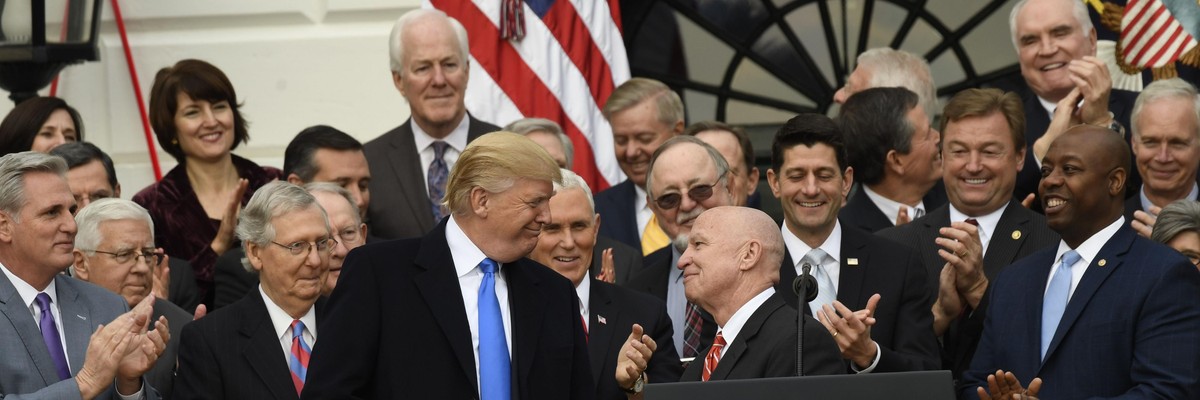
U.S. President Donald Trump smiles at House Ways and Means Committee Chairman Rep. Kevin Brady (R-Texas) after speaking about the passage of tax cut legislation at the White House in Washington, D.C. on December 20, 2017. (Photo: Saul Loeb/AFP via Getty Images)

In legislatures, the courts, and our executive offices, we have a system rigged in favor of the ultra-rich, rigged by everything from acts of Congress and judicial rulings to IRS budgets and audit policies.

By all appearances, former U.S. President Donald Trump has cut a sweet deal with a dozen or two of America’s richest billionaires: Finance his campaign and he’ll keep their federal taxes super low—or even lower them—once he’s sitting back in the White House.

How much do billionaires like this deal? This much: In April, hedge fund billionaire John Paulsen held a Palm Beach fundraiser for Trump that brought in $50.5 million. Immediately after Trump’s late May conviction on 34 felony counts in Manhattan, Timothy Mellon, the grandson of the classic plutocrat Andrew Mellon, ponied up $50 million. Miriam Adelson, the billionaire widow of Las Vegas kingpin Sheldon Adelson, appears eager to kick in as much as $100 million.

This past spring, meanwhile, billionaires Elon Musk and David Sacks reportedly held a secret dinner party for Trump, with attendees including the illustrious deep pockets Peter Thiel, Rupert Murdoch, and Michael Milken.

The rich themselves have actually become more brazen about avoiding taxes. Just try to stop us, they seem to be saying.

America’s billionaires clearly see politics as one route to ensuring they pay as little as possible at tax time. But they don’t just make their presence felt at election time. America’s rich have their thumbs firmly on the scale of all three branches of government. In legislatures, the courts, and our executive offices, we have a system rigged in favor of the ultra-rich, rigged by everything from acts of Congress and judicial rulings to IRS budgets and audit policies.

Some of this rigging we can all easily see. The dividends and long-term capital gains of the ultra-rich have for decades faced a maximum tax rate barely half the maximum rate applicable to other forms of income. And the investment income of the rich, unlike the paychecks of working people, faces no Social Security tax.

In 2017, the first year of the Trump presidency, intense lobbying efforts helped rich business owners to a special tax rate for their business income. In 2018 alone, according to ProPublica, that special rate translated into a $67 million gift to Mike Bloomberg, whose personal wealth now reportedly exceeds $100 billion.

But these glaring privileges the rich enjoy at tax time only tell part of the billionaire tax story. Other parts get precious little attention. In 2004, for instance, lawmakers in Congress enacted a penalty for the failure to disclose potentially abusive tax avoidance transactions on tax returns. The penalty on the surface looked substantial: 75% of the tax sought to be avoided. But Congress capped the penalty at $100,000, a move that turned the penalty into a minor nuisance for billionaires seeking to avoid millions of dollars in taxes.

In our current rich people-friendly tax climate, IRS staff who want to do the right thing face tough going. Recently, for example, one former IRS staffer, Michael Welu, went public with his concerns that the IRS itself has both official and unofficial policies that end up treating audited rich taxpayers much more gently than small business owners.

“I was putting butchers, bakers, and candlestick makers in jail,” Welu told the International Consortium of Investigative Journalists, “but the big stuff we really wanted to go after was being ignored.”

Welu found the upper management of the IRS division tasked with auditing the super rich—and the corporations they run—distinctly uninterested in investigating America’s richest and their “most egregious, ridiculous schemes” for avoiding taxes.

IRS officials like Michael Welu do occasionally speak out. But only tax wonks truly have any real sense of how much obscure tax code penalties and IRS audit policies favor the rich. And most of those tax wonks work for the rich.

The rich themselves have actually become more brazen about avoiding taxes. Just try to stop us, they seem to be saying.

Take the recently decided Supreme Court case, Moore v. United States. Working through an array of right-wing organizations, the conservative mover-and-shaker Leonard Leo attempted to use a challenge to an obscure one-time tax as a vehicle to preempt Congress from ever taxing the wealth or unrealized gains of the ultra-rich. Ultimately, the court decided the case without ruling on whether the rich can be taxed on their wealth or unrealized gains. But the opinions that four of the nine justices handed down made it clear that they stand prepared to do the billionaire bidding should a direct challenge to a tax on the wealth or unrealized gains of billionaires come before them.

Billionaires now have at least three Supreme Court justices firmly in their pockets. Reporting by ProPublica has revealed the massive gifts that have been flowing from Harlan Crow and other billionaires to Justice Clarence Thomas as well as the generous gifts that billionaire Paul Singer has been sending Justice Samuel Alito’s way. Justice Neil Gorsuch has had his entire career, including his appointment to the court, funded by the billionaire Philip Anschutz.

Those three justices, along with Justice Amy Coney-Barret, have now made it patently obvious they will not allow billionaires to be taxed on their unrealized gains or their wealth. Does anyone really think the billionaires won’t have the crucial, majority-making fifth vote from Justice Brett Kavanaugh when they need it?

Republican members of Congress are showing even less shame than our Supreme Court justices. Last year, these GOP lawmakers held the country hostage in negotiations to increase the country’s debt limit. Their price for agreeing to raise the debt limit, thereby avoiding a default on the country’s debt? They demanded—and won—a reduction in a scheduled IRS budget increase that would been used to increase enforcement moves against rich taxpayers.

The purported motive for this legislative hostage taking—“concern” over the federal deficit—made for an absurd justification. The proposed increase in the IRS budget would have been recovered, several times over, through increased tax collections. The IRS budget reductions the Republican lawmakers extracted will, in fact, only increase the federal deficit. But those reductions will serve a political purpose. They’ll protect the GOP’s richest patrons from tax enforcement.

The mainstream media, to no one’s surprise, did a miserable job of exposing this Republican dishonesty in the debt limit negotiations. But at one point in our recent past a courageous soul did emerge to expose the rot in our tax system. What happened? The ultra-rich and their henchmen in Congress make sure that this soul faced a punishment far more severe than any punishment ever meted out to those few rich Americans who actually get caught evading their taxes due.

That courageous soul, Charles Littlejohn, worked as an IRS contractor. He leaked tax return information related to Trump and America’s billionaires to TheNew York Times and ProPublicaProPublica used that leaked information to write over 50 stories about billionaire tax avoidance, embarrassing and angering many of our richest in the process. Two of them even brought lawsuits, one against the IRS and the other against Littlejohn’s employer.

Ultimately, Littlejohn pled guilty to one count of unauthorized tax return information disclosure, a crime that carries a recommended sentence of four to 10 months. But 25 Republican members of Congress, undoubtedly at the behest of their billionaire patrons, wrote the judge in the case and urged the harshest possible sentence of five years. The judge obliged, stating in her sentencing remarks that Littlejohn posed a graver threat to democracy than the January 6 rioters. As tax law professor Reuven Avi-Yonah has noted, Littlejohn is now serving a sentence far harsher than any imposed on rich Americans convicted of tax evasion.

Littlejohn’s extreme sentence did not reflect the one single count of unauthorized tax return information disclosure he pled guilty to. That sentence reflects his “crime” of exposing the tax avoidance of the billionaire class.

Try this thought experiment: Imagine if Littlejohn had released the return information of 1,000 or so taxpayers with modest incomes to ProPublica. Imagine that ProPublica had then publicly detailed all the tip income that servers and bartenders among these taxpayers had failed to report and all the social meals that small business owners in the sample had claimed as business expenses. If Littlejohn had then pled to one count of unauthorized disclosure, would 25 members of Congress have intervened? Would the judge have imposed a sentence over six times the maximum recommended in federal sentencing guidelines?

Doesn’t it become dangerous to society when the punishment for a crime depends on who the victim happens to be?

We are now living that danger. Our billionaires sit firmly in control. And they will do whatever it takes to make sure they never pay tax at an appropriate level—even if that means locking a human being up for a preposterously long time just to send a message.

Original article by BOB LORD of Inequality.Org republished from Common Dreams under a Creative Commons Attribution-Share Alike 3.0 License.

Continue ReadingBillionaires Buy Governments to Avoid Paying Their Fair Share in Taxes

Labour’s policy is unending poverty for the working class

Spread the love

https://morningstaronline.co.uk/article/labour’s-policy-unending-poverty-working-class

Labour has ruled out a wealth tax if it wins the next general election.

And to make it absolutely clear, shadow chancellor Rachel Reeves has emphasised that Labour would not increase the top rate of income tax.

The first of Starmer’s 10 pledges when running to succeed Jeremy Corbyn was to “increase income tax for the top 5 per cent of earners.”

In a recent study the London School of Economics wealth tax commission concluded that a one-off wealth tax was preferred over increasing taxes on work or spending.

A one-off wealth tax on millionaire couples paid at 1 per cent a year for five years, they found, would raise £260bn.

By way of contrast Reeves’s spending plans rise not even to a modest £12bn.

Labour’s latest policy reversal is the clearest sign that Starmer’s electoral strategy hinges on assuring the rich and powerful that neither their wealth or power is threatened by Labour.

This is Westminster Labour’s new philosophy of never-ending poverty for working people.

https://morningstaronline.co.uk/article/labour’s-policy-unending-poverty-working-class

Continue ReadingLabour’s policy is unending poverty for the working class