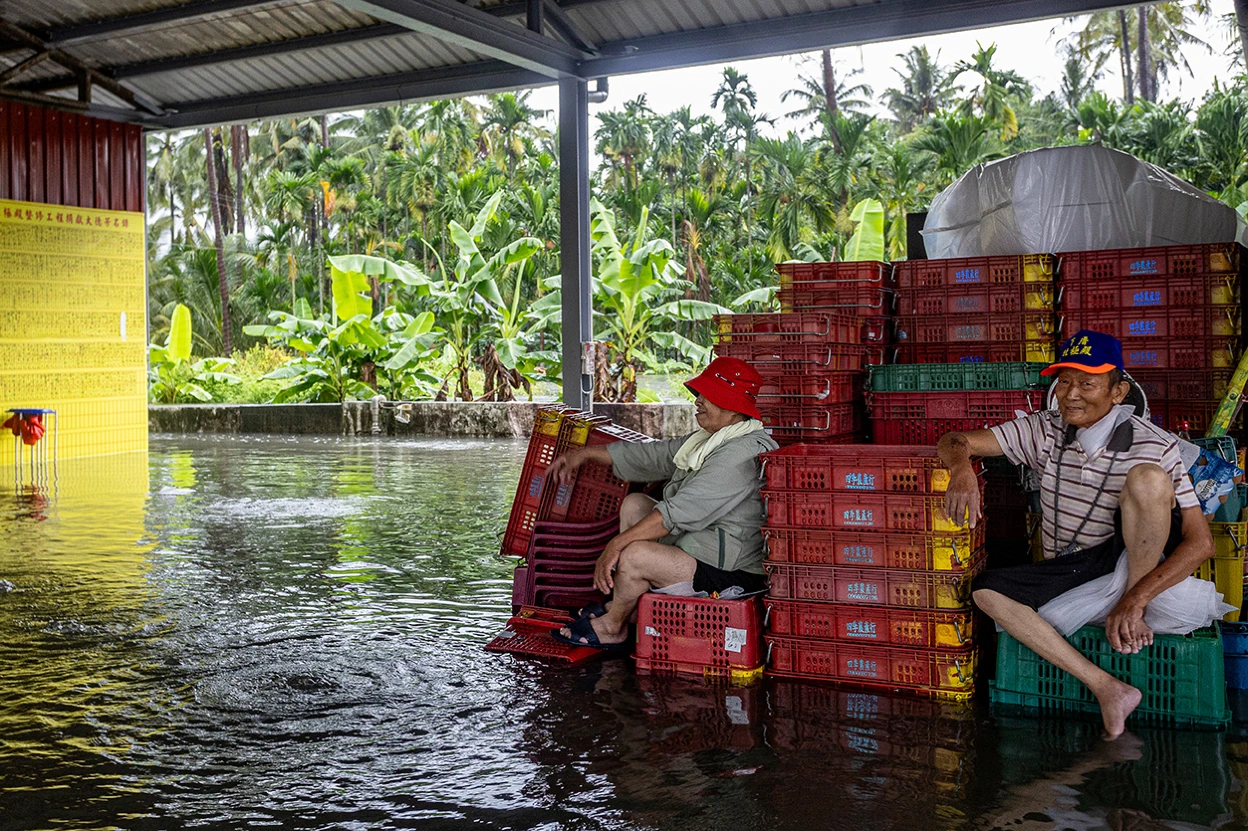
A farming storage area is flooded in Taiwan — events such as this will become more frequent in an increasingly erratic climate. Credit: Cheng Chia Huang/Getty
Increasing instability of the ocean, ice and atmosphere threatens farming, finance and society. We all need to wake up to that fact.
How we get there — how the tipping unfolds — is more important, and there is an urgent need to understand the process. This is missing from current analyses because the scales in time and space it occurs on fall between those of climate and weather. Tipping analyses focus on huge climate changes, often globally, over decades. Weather events are fast and local. But look at the interplay between the two and it’s clear that the transition between one climate state and another is not smooth but extremely volatile.
Climate tipping, therefore, will manifest as a period of increasingly dramatic weather volatility, rather than a sharp shift in average conditions. A fluctuating climate will bring swings and crashes in crop yields, flash flooding and erratic storms. It will stress economies by disrupting supply chains and amplifying insurance losses. Societies are unprepared, because weather volatility related to tipping points is absent from risk assessments.
This problem is urgent. Earth subsystems, including oceans, the cryosphere and biosphere, already seem to be destabilizing. The planet is heading for climate free fall.
Climate is destabilizing
By definition3, tipping points are reached when a series of interlinked changes amplify one another until the whole system becomes unstable and shifts uncontrollably into a different state. Loss of sea ice at the poles, for example, reduces the amount of sunlight reflected into space, further heating Earth’s surface, which then accelerates ice loss. These vicious cycles of change define a tipping point, at which the climate cannot return to its former patterns.Are we all doomed? How to cope with the daunting uncertainties of climate change
Before that point, the climate system becomes increasingly unstable. It fluctuates considerably — a rise in variability is a well-established property of such ‘non-linear dynamical systems’ approaching a critical threshold4,5. That society will face these fluctuations and that they will intensify through the tipping transition hasn’t been realized by scientists and policymakers, so far.
Earth will experience an increasingly erratic climate: more and stronger fluctuations in flows of melt water, ocean circulations and the extent of sea ice. These changes will lead to more frequent and intense extremes in temperature, precipitation and storms — leading not only to more heatwaves and droughts, but also to more cold spells and floods.
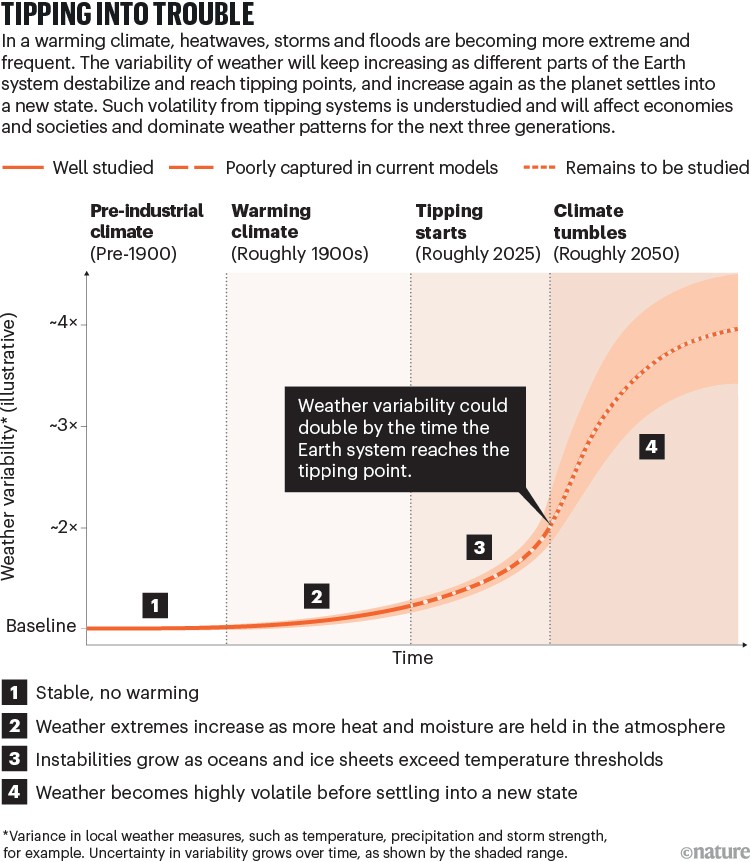
The scale of the consequences might not be obvious at first — ice sheets and ocean currents are so large that their responses to warming are relatively slow and delayed. Once a critical temperature threshold for instability is crossed, it takes time for such systems to collapse, but the collapse is inevitable (see ‘Tipping into trouble’).
Source: A. Levermann
Ice sheets in West Antarctica6 and Greenland7 have already passed their tipping temperature. Arctic sea ice will do so in a few years. For the Atlantic Ocean, scientists simply don’t know8. The period between passing the tipping temperature and reaching the tipping point is when fluctuations increase dramatically.
Research into early warning of tipping points has identified increased climate variability as a signal of reduced stability and used it to estimate the time remaining before widespread tipping begins. But variability caused by instability as a mechanism of climate impact has been widely neglected.
Modern economies are adapted to relatively stable climatic baselines. Agricultural productivity, infrastructure design, insurance pricing and financial risk management all rely not only on expected mean conditions but also on the predictability of variability.
Power-mad orange gasbag Donald Trump says Burn, Baby, Burn.Nigel Farage urges you to ignore facts and reality and be a climate science denier like him and his Deputy Richard Tice. He says that Reform UK has received £Millions and £Millions from the fossil fuel industry to promote climate denial and destroy the planet.Elon Musk urges you to be a Fascist like him, says that you can ignore facts and reality then.
United Nations • Climate change refers to long-term shifts in temperatures and weather patterns. Human activities have been the main driver of climate change, primarily due to the burning of fossil fuels like coal, oil and gas.
The 2015 Paris agreement committed countries to keeping the global temperature increase “well below 2°C”, which is widely interpreted as an average of 1.5°C over a 30-year period. The Paris agreement has not yet failed, but recent high temperatures show how close the Earth is to crossing this critical threshold.
Climate scientists have, using computer simulations, modelled pathways for halting climate change at internationally agreed limits. However, in recent years, many of the pathways that have been published involve exceeding 1.5°C for a few decades and removing enough greenhouse gas from the atmosphere to return Earth’s average temperature below the threshold again. Scientists call this “a temporary overshoot”.
If human activities were to raise the global average temperature 1.6°C above the pre-industrial average, for example, then CO₂ removal, using methods ranging from habitat restoration to mechanically capturing CO₂ from the air, would be required to return warming to below 1.5°C by 2100.
Get your news from actual experts, straight to your inbox.Sign up to our daily newsletter to receive all The Conversation UK’s latest coverage of news and research, from politics and business to the arts and sciences.
Do we really understand the consequences of “temporarily” overshooting 1.5°C? And would it even be possible to lower temperatures again?
Faith that a temporary overshoot will be safe and practicable has justified a deliberate strategy of delaying emission cuts in the short term, some scientists warn. The dangers posed by remaining above the 1.5°C limit for a period of time have received little attention by researchers like me, who study climate change.
To learn more, the UK government commissioned me and a team of 36 other scientists to examine the possible impacts.
How nature will be affected
We examined a “delayed action” scenario, in which greenhouse gas emissions remain similar for the next 15 years due to continued fossil fuel burning but then fall rapidly over a period of 20 years.
We projected that this would cause the rise in Earth’s temperature to peak at 1.9°C in 2060, before falling to 1.5°C in 2100 as greenhouse gases are removed from the atmosphere. We compared this scenario with a baseline scenario in which the global temperature does not exceed 1.5°C of warming this century.
Our Earth system model suggested that Arctic temperatures would be up to 4°C higher in 2060 compared to the baseline scenario. Arctic Sea ice loss would be much higher. Even after the global average temperature was returned to 1.5°C above pre-industrial levels, in 2100, the Arctic would remain around 1.5°C warmer compared to the baseline scenario. This suggests there are long-term and potentially irreversible consequences for the climate in overshooting 1.5°C.
As global warming approaches 2°C, warm-water corals, Arctic permafrost, Barents Sea ice and mountain glaciers could reach tipping points at which substantial and irreversible changes occur. Some scientists have concluded that the west Antarctic ice sheet may have already started melting irreversibly.
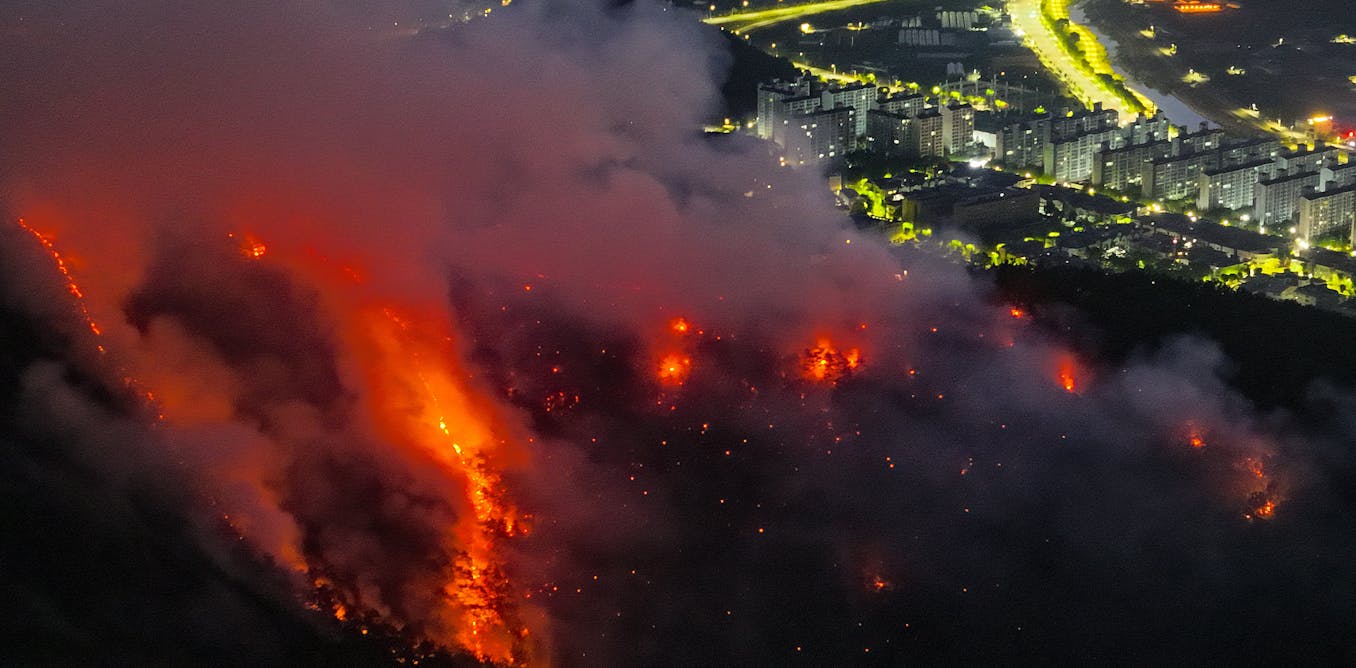
Our modelling showed that the risk of catastrophic wildfires is substantially higher during a temporary overshoot that culminates in 1.9°C of warming, particularly in regions already vulnerable to wildfires. Fires in California in early 2025 are an example of what is possible when the global temperature is higher.
Our analysis showed that the risk of species going extinct at 2°C of warming is double that at 1.5°C. Insects are most at risk because they are less able to move between regions in response to the changing climate than larger mammals and birds.
The impacts on society
Only armed conflict is considered by experts to have a greater impact on society than extreme weather. Forecasting how extreme weather will be affected by climate change is challenging. Scientists expect more intense storms, floods and droughts, but not necessarily in places that already regularly suffer these extremes.
In some places, moderate floods may reduce in size while larger, more extreme events occur more often and cause more damage. We are confident that the sea level would rise faster in a temporary overshoot scenario, and further increase the risk of flooding. We also expect more extreme floods and droughts, and for them to cause more damage to water and sanitation systems.
Floods and droughts will affect food production too. We found that impact studies have probably underestimated the crop damage that increases in extreme weather and water scarcity in key production areas during a temporary overshoot would cause.
We know that heatwaves become more frequent and intense as temperatures increase. More scarce food and water would increase the health risks of heat exposure beyond 1.5°C. It is particularly difficult to estimate the overall impact of overshooting this temperature limit when several impacts reinforce each other in this way.
In fact, most alarming of all is how uncertain much of our knowledge is.
For example, we have little confidence in estimates of how climate change will affect the economy. Some academics use models to predict how crops and other economic assets will be affected by climate change; others infer what will happen by projecting real-word economic losses to date into future warming scenarios. For 3°C of warming, estimates of the annual impact on GDP using models range from -5% to +3% each year, but up to -55% using the latter approach.
We have not managed to reconcile the differences between these methods. The highest estimates account for changes in extreme weather due to climate change, which are particularly difficult to determine.
We carried out an economic analysis using estimates of climate damage from both models and observed climate-related losses. We found that temporarily overshooting 1.5°C would reduce global GDP compared with not overshooting it, even if economic damages were lower than we expect. The economic consequences for the global economy could be profound.
So, what can we say for certain? First, that temporarily overshooting 1.5°C would be more costly to society and to the natural world than not overshooting it. Second, our projections are relatively conservative. It is likely that impacts would be worse, and possibly much worse, than we estimate.
Fundamentally, every increment of global temperature rise will worsen impacts on us and the rest of the natural world. We should aim to minimise global warming as much as possible, rather than focus on a particular target.
Orcas comment on killer apes destroying the planet by continuing to burn fossil fuels.Neo-Fascist Climate Science Denier Donald Trump says Burn, Baby, Burn.Elon Musk urges you to be a Fascist like him, says that you can ignore facts and reality then.
Rapidly phasing out fossil fuels and limiting energy consumption to tackle climate change is “a strategy doomed to fail” according to former UK prime minister Tony Blair.
In the foreword of a new report, Blair urges governments to rethink their approach to reaching net zero emissions.
Instead of policies that are seen by people as involving “financial sacrifices”, he says world leaders should deploy carbon capture and storage, including technological and nature-based approaches, to meet the rising demand for fossil fuels.
But speak to many academic experts on climate change and they will tell a very different story: that there is no strategy for addressing climate change that does not involve ending, or at least massively reducing, fossil fuel combustion.
“There is a wealth of scientific evidence demonstrating that a fossil fuel phase-out will be essential for reining in the greenhouse gas emissions driving climate change,” says Steve Pye, an associate professor of energy at UCL.
“I know because I have published some of it.”
Ed Hawkins, a climate scientist at the University of Reading, agrees.
“Rapidly reducing our reliance on fossil fuels, and not issuing new licenses to extract oil and gas, is the most effective way of minimising future climate-related disruptions,” he says.
“The sooner those with the power to shape our future recognise this, the better.”
Fossil fuels are responsible for 90% of the carbon dioxide heating the climate. The amount burned annually is still rising, and so is the rate at which the world is getting hotter. Scientists now fear we are approaching irreversible tipping points in the climate system, hence their support for an urgent replacement of fossil fuels with renewable energy.
Blair is confident that an emergency response on this scale can be avoided by absorbing CO₂ immediately after burning fossil fuels, from the smokestacks where the greenhouse gas is concentrated.
Not all of the emissions responsible for climate change would be prevented. UCL earth system scientist Mark Maslin says that natural gas, which would linger as an energy source thanks to carbon capture, still leaks from pipelines and storage vessels upstream of power plants.
Commercial applications of the technology also have a poor track record. Just two large-scale coal-fired power plants are operating with CCS worldwide – one in the US and one in Canada.
“Both have experienced consistent underperformance, recurring technical issues and ballooning costs,” Maslin says.
Blair might baulk at what he perceives to be the expense of ditching fossil fuels. But economic modelling led by Oxford University’s Andrea Bacilieri suggests his concern is misplaced. A rapid phase-out of fossil fuels could save US$30 trillion (US$1 trillion a year) by 2050 she concludes, compared with allowing power plants and factories to keep burning them with CCS.
Developing CCS will be necessary to help manage an orderly transition from fossil fuels according to Myles Allen, a professor of geosystem science at Oxford University. But it is not a substitute for undergoing that transition, he says.
“Above all, we need to make sure the availability of CCS does not encourage yet more CO₂ production.”
Keeping the public on board
Is Blair right to fret about a public backlash to lower energy use? Academics suggest multiple reasons to think otherwise if the alternative is prolonging the use of fossil fuels.
Replacing a gas boiler with a heat pump that runs on electricity, for example, can lower a household’s energy consumption without a deliberate effort. That’s because renewable appliances convert power to heat more efficiently (how much depends on how well insulated the home is).
In fact, it’s dependence on fossil fuel that is preventing many households from making this switch. The high wholesale price of gas determines the cost of electricity for UK consumers.
“Crucially, the public wants and needs the government to show clear and consistent leadership on climate change,” they say.
Meanwhile, what can corrode public acceptance of sacrifices is the high-consuming behaviour of a minority (think pop stars in rockets, as Westlake recently argued). And, arguably, the statements of powerful people like Blair.
New research even suggests the politics that Blair and many others like him favour might also play a role here. Felix Schulz (Lund University) and Christian Bretter (The University of Queensland) are social scientists who study how ideology affects personal views on climate policy.
They identified respondents in six countries (the UK, US, Germany, Brazil, South Africa and China) who shared Blair’s neoliberal worldview, which the pair define as a belief that individuals are primarily responsible for their own fortune, and need to take care of themselves – as well as an abiding faith in the free market.
“We observed a strong link between a neoliberal worldview and lack of support for the climate policies in our study,” they say.
Schulz and Bretter urge us to consider how someone’s ideology ultimately shapes their understanding of the problem and its solutions as well.
Scientists have identified more than 25 parts of the Earth’s climate system that are likely to have “tipping points” – thresholds where a small additional change in global warming will cause them to irreversibly shift into a new state.
More recent research suggests that triggering one tipping element could cause subsequent changes in other tipping elements, potentially leading to a “tipping cascade”.
However, the interactions between individual tipping elements – and the ways they might trigger each other – remain largely underexplored.
In a review study, published last year in Earth System Dynamics, we unpack the current state of scientific understanding of the interactions between individual tipping elements.
We find that scientific literature suggests the majority of interactions between tipping elements will lead to further destabilisation of the climate system.
Existing research also indicates that “tipping cascades” could occur even under current global warming projections.
Scientific understanding of individual tipping elements is continuously improving, but more research on their interactions is needed.
An emerging field
The history of tipping elements as an object of investigation is relatively short. As a result, they are only partially accounted for in current climate models.
Since then, significant progress has been made on tipping element research.
For instance, the 2023 global tipping points report – co-authored by more than 200 researchers from 90 organisations in 26 countries – recognised that five “major” tipping elements – the Greenland and West Antarctic ice sheets, the warm-water coral reefs, the North Atlantic Subpolar Gyre and global permafrost regions – are already “at risk of being crossed due to warming”.
However, tipping elements have so far largely been studied in isolation. Most research has neglected the interactions between different tipping elements which could further destabilise the climate system – and eventually even lead to tipping cascades.
Tipping cascades
Interactions between tipping elements clearly exist.
For example, we find robust evidence that an influx of freshwater into the North Atlantic caused by the disintegration of the Greenland ice sheet would destabilise the AMOC and could trigger its slowdown. (This, in turn, could result in the ocean currents moving less heat from equatorial regions to higher latitudes, leading to significant cooling in Europe.)
In worst-case cascading scenarios, the tipping of one system directly leads to the tipping of another. In less dramatic cases, it only reinforces destabilisation of other systems.
So, what additional effects are to be expected from these interactions?
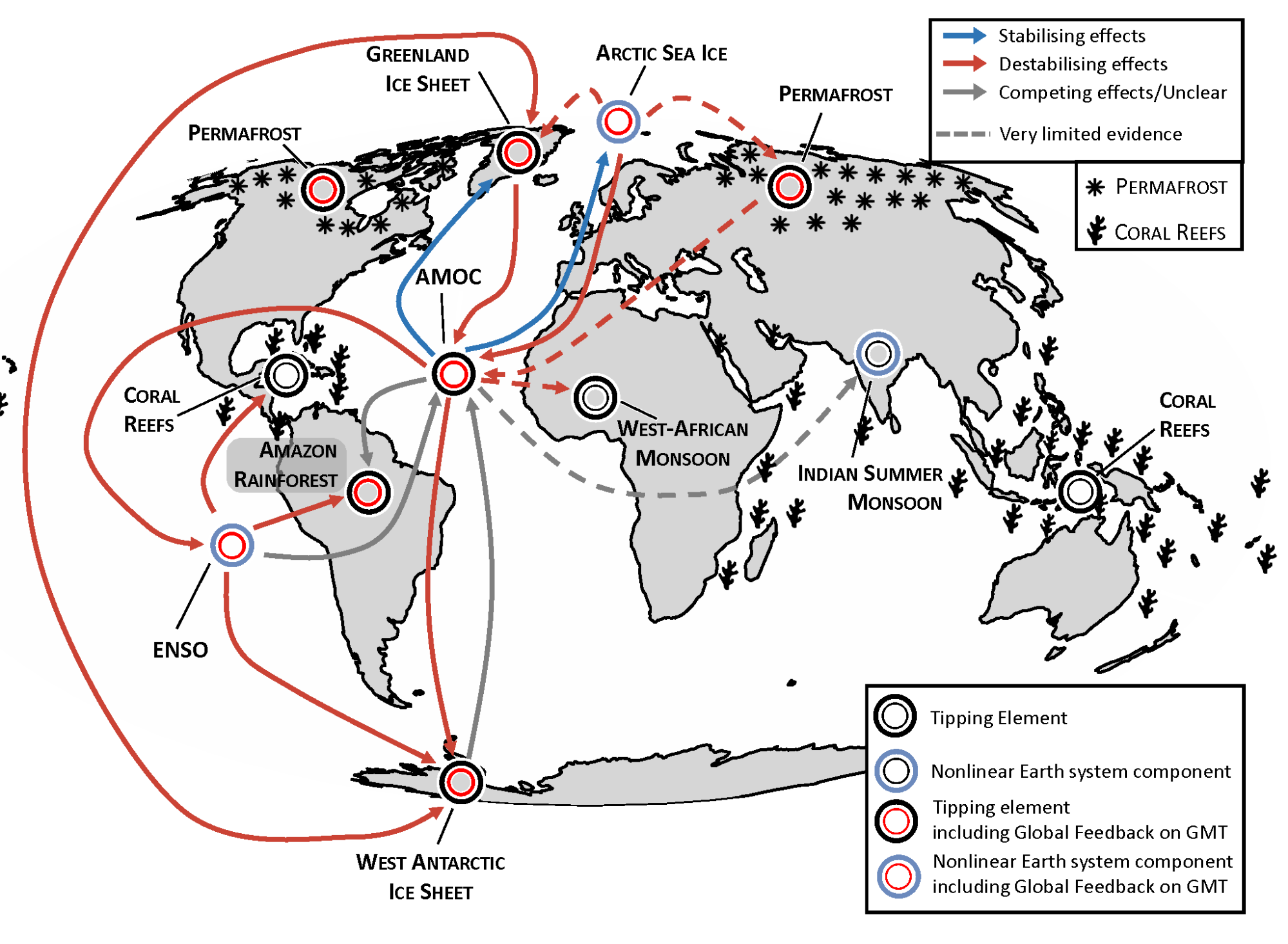
The map below shows how 13 out of 19 tipping element interactions analysed in our review study are expected to lead to further destabilisation. The arrows indicate destabilising (red), stabilising (blue) or competing (grey) effects, while the dashed lines show where there is only limited evidence for a connection.
A prominent example of a tipping point that leads to further destabilisation is the impact of changes to the AMOC. The weakening or collapse of the system of ocean currents may lead to accumulation of warm ocean water in the Southern Ocean, which could, in turn, contribute to a destabilisation of the West Antarctic ice sheet.
It has also been suggested that a weaker AMOC could promote El Niño events by increasing the temperature difference between the equator and the poles, which would strengthen trade winds. (While the El Niño-Southern Oscillation, or ENSO, is not a tipping element, it may play an important role as a propagator of disturbances.)
There are also a few examples – two out of 19 interactions – where a tipping point can help stabilise another system. For example, the weakening of AMOC could lead to an interrupted flow of warm water from equatorial to the polar Atlantic regions. This would drastically cool large parts of the polar region and could therefore stabilise the Greenland ice sheet.
Map of interactions between tipping elements. Stabilising effects are shown in blue, destabilising effects in red, and unclear effects in grey. Effects with very limited evidence are denoted by dashed lines. Credit: Wunderling et al. (2024)
A conceptual model
While scientists have gathered evidence for tipping points from observations, models and proxy data from the distant past, we still need more research to study interactions.
Our ongoing research aims to quantify the risk of tipping cascades using a conceptual computational model.
The model is “conceptual” in the sense that it is not grounded in physical or chemical processes, such as heat transfer or circulation patterns. Instead, a range of measurements – such as global average temperature, tipping temperature and temperature overshoot trajectory – serve as “modelling parameters” that can be varied to study a large range of possible scenarios.
To date, the model is limited to simulating the Amazon rainforest, the AMOC and the West Antarctic and Greenland ice sheets – tipping elements whose respective interactions are relatively well established.
However, using this model we can investigate – among other things – tipping risks under different so-called temperature “overshoot” scenarios.
This is where global warming peaks at a certain temperature level – for example, 2C – before declining to a lower long-term stabilisation temperature. (The subsequent decline is assumed to be the consequence of a global roll-out of negative-emission technologies, as assessed in several recentpublications.). The difference between the peak temperature and the long-term stabilisation temperature is the overshoot.
Evaluating millions of scenarios, our model calculates “tipping risks” for fixed combinations of a particular overshoot and stabilisation temperature.
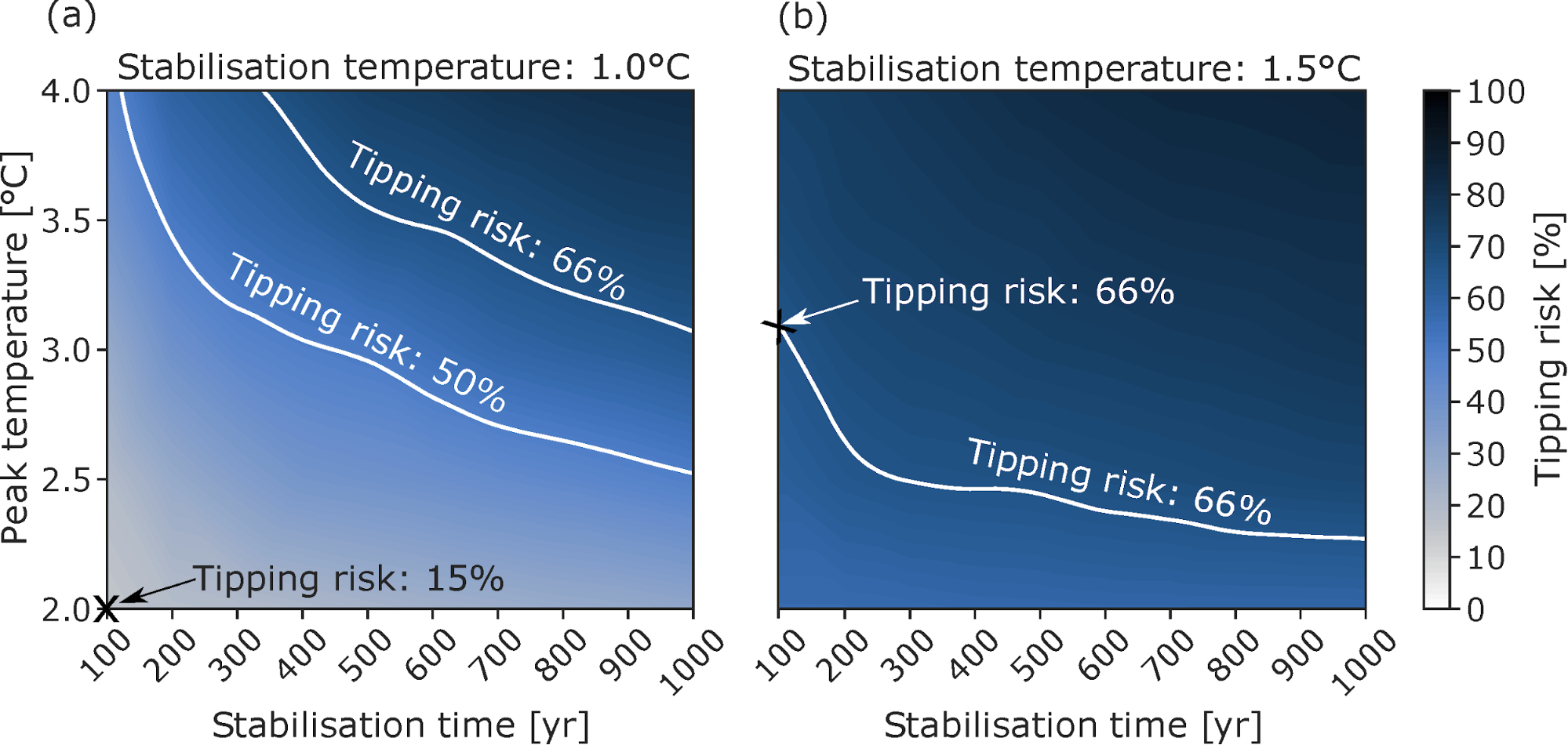
The main finding of the research is that long-term tipping risks are in the order of 15% if warming peaks at 2C and then stabilises at 1C.
In contrast, in a scenario where the peak warming reaches 3C and stabilises at 1.5C in the 22nd century, there is a 66% probability that at least one of the four modelled tipping elements would lose stability.
The figure below shows tipping risks where warming peaks at between 2C and 4C (“peak temperature” on y-axis) and takes 100-1,000 years to stabilise (“stabilisation time” on x-axis).
The figure on the left shows tipping probabilities where temperatures eventually stabilise at 1C and the figure on the right where temperatures settle at 1.5C. Darker colours represent higher tipping risks.
The figure shows how tipping risks increase with higher peak and stabilisation temperatures, as well as with longer stabilisation times.
Tipping risks under global warming overshoots for peak temperatures (between 2C and 4C) and overshoot durations (stabilisation time of 100 to 1,000 years) for stabilisation temperatures of 1C (left), and 1.5C (right). Credit: Adapted by the authors from figure 3 in Wunderling et al. (2023)
While solidly calculated and based on recent scientific literature, our results can not count as projections of future climate due to the conceptual nature of our underlying model.
Nevertheless, the findings are useful and complement findings from traditional climate models, known as General Circulation Models (GCMs).
GCMs have only started to fully address the dynamics of tipping elements and their interactions. For example, most do not yet feature fully interactive ice-sheet dynamics, nor their interactions with global oceans.
In a paper published last November, we used our conceptual model to show that neglecting interactions between the Greenland ice sheet and the AMOC can alter the expected number of tipped elements by more than a factor of two.
In addition, the high cost of running GCMs means researchers cannot run large “ensembles” of multiple model simulations to account for uncertainties in knowledge of key parameters. Our simplified conceptual model, on the other hand, can account for this uncertainty.
By drastically reducing physical complexity, we are able to compute several million – and up to a billion – ensemble members in large-scale Monte Carlo simulations.
Historical tipping events
While our results need to be confirmed by more complex Earth system models, such as GCMs, they hint at the need for scientists to examine interactions between tipping elements and potential tipping cascades more closely.
The study of abrupt climate changes of the distant and not-so-distant past is critical to convince researchers of the existence and significant impact of tipping cascades.
A potential candidate for investigation is the Eocene–Oligocene transition. This took place roughly 34m years ago and led to the formation of a continent-scale ice sheet on Antarctica which buried the region’s forests.
The transition likely involved the interaction of several tipping elements, including global deep-water formation, the Antarctic ice sheet, polar sea ice, monsoon systems and tropical forests. The monsoon-like climate of the Antarctic content at the end of the Eocene would have had to change drastically – or tip – to allow for glaciation during the transition to the Oligocene.
Since the events at that time were also linked to a major loss of mammal species, mostly in Europe, the Eocene–Oligocene transition might even have involved a climate-ecology tipping cascade.
Heinrich events, which took place in the last ice age – around 120,000 to 11,500 years ago – as well as the mid-Holocene, could also be especially revealing around what we can expect in the near future.
These events, which involved the release of icebergs into the North Atlantic, resulted in a fresh water inflow that substantially weakened the AMOC. This, in turn, led to the drying of northern Amazonia and the retreat of the rainforest. Today’s melting of the Greenland ice sheet could have similar consequences for the AMOC.
While these climate changes in the past happened through natural drivers, humans are potentially forcing these rapid changes now in the modern era through emissions of carbon dioxide, possibly on a much faster timescale.
Updated climate models
The science of interacting tipping elements and tipping cascades is in its early stages – and there is significant debate within the scientific community on the topic.
Some consider a global reorganisation of the climate system induced by tipping elements and cascades to be speculative, given that recent observations are not available and proxy data is scarce.
Additionally, there is scientific uncertainty of how tipping processes may play out across different spatial scales, as well as how to increase the resilience of tipping elements against perturbations.
Therefore, significant work is underway to investigate tipping processes in complex Earth system models. The Tipping Points Model Intercomparison Project (TIPMIP) and European Union-funded projects ClimTIP or TipESM are among a raft of such initiatives.
Although these initiatives are largely looking at tipping elements in isolation, they will also shed more light on the interactions between these important parameters of the Earth’s climate system stability.
Neo-Fascist Climate Science Denier Donald Trump says Burn, Baby, Burn.Elon Musk urges you to be a Fascist like him, says that you can ignore facts and reality then.