Nigel Farage may have landed himself in a humiliating contest with Count Binface
NIGEL FARAGE’S desperate by-election gambit has descended into farce as his Reform party was rocked by fresh funding revelations.
It emerged that the Reform boss’s £5 million donation from crypto billionaire Christopher Harborne, and other cash for the party, was referred to the National Crime Agency as suspicious.
Labour Party chair Anna Turley called the news “astonishing and deeply serious” and called on Mr Farage to “come clean and co-operate” with the agency.
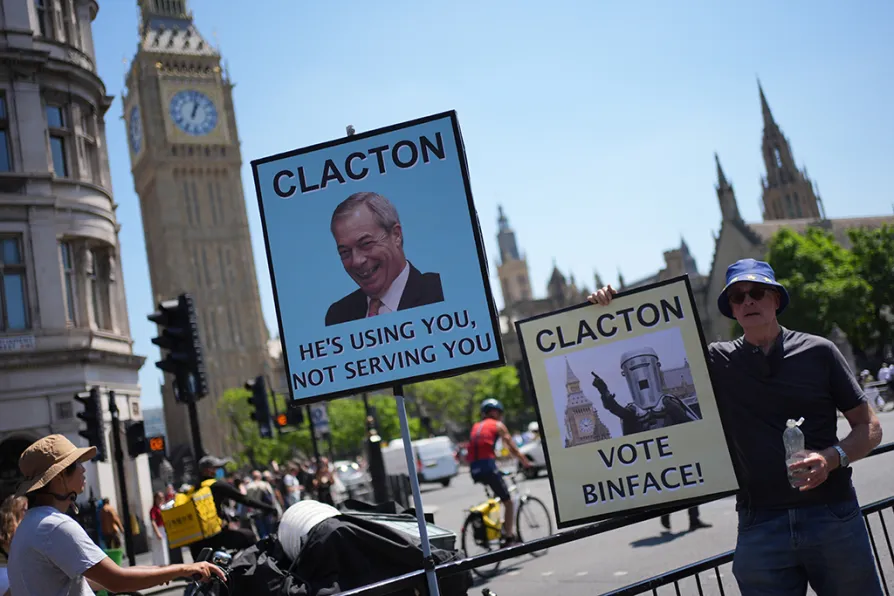
The fresh scandal about Mr Farage’s funding, first reported by the Guardian, came as he faced the prospect of a hot summer campaigning to keep his Clacton seat in the face of a challenge by Count Binface.
The perennial comedy candidate was the only confirmed opponent to Mr Farage in the by-election he provoked to regain control of a media narrative over sleaze which was gradually paralysing his political operation.
However, the Tories, Labour, Greens, Liberal Democrats and Restore parties all called Reform’s bluff by confirming that they would not stand in the by-election, describing it as a farce.
The local Green party was the last to declare its abstention, issuing a statement saying “we have no intention of helping to legitimise a by-election that appears designed not to serve local residents but to serve Nigel Farage’s personal political ambitions.
“This contest is not about the people of Clacton. It is about one politician placing himself at the centre of a media spectacle and expecting local residents to play supporting roles in a drama of his own making.”
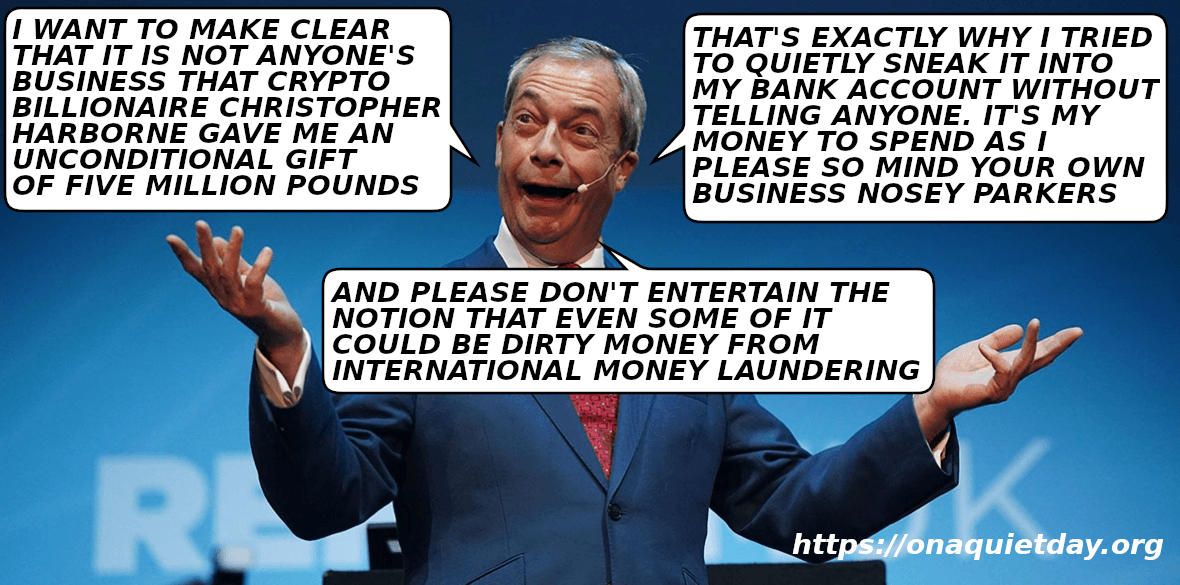
Reform 2025 Ltd’s Director Nigel Farage discusses his five million pounds gift from Crypto billionaire Christopher Harborne. He tells nosey parkers to mind their own business and suggests that you don’t entertain the notion that even some of it could be dirty money from international money laundering. FM, I’ve done it again
Then prime minister David Cameron (left) welcomes then newly-elected Newark MP Robert Jenrick to the Houses of Parliament in London, June 11, 2014
SOLOMON HUGHES finds one-time Cameron-centrist EU fans now promote vicious anti-migrant rhetoric in their bid to get attention for their ailing party
Robert Jenrick’s complaints about “not seeing another white face” in Birmingham’s Handsworth show the Tories will push racism to try to grab votes.
Jenrick’s hard right turn is creepy because this formerly “Liberal” Tory, who was so blandly Cameron-centrist-pro-EU that he was called “Robert Generic,” now uses the language of the National Front.
At Tory conference anti-migrant, anti-asylum-seeker, prejudiced and racist language was ubiquitous: Mirroring Jenrick’s manoeuvre, it spread to supposedly “liberal” Tories.
I went to a conference meeting of Tory group Bright Blue. Founded when David Cameron was leader, Bright Blue see themselves as a socially conscious liberal Tory group.
Their slogan is “Our work is about defending and improving liberal society.” Their “advisory board” has Labour figures — former ministers Margaret Hodge and John Denham and former Blair adviser John McTernan — alongside a dozen leading Tories.
This supposed liberalism evaporated over migration. They had a debate on “How Conservatism can be popular and effective again.”
Shadow home secretary Chris Philp was on the panel. Philp is pushing his anti-migrant message hard: he attacks asylum-seekers as criminals. He also attacks the much greater numbers of “legal” migrants, claiming “mass migration has certainly damaged social cohesion.”
But what Philp said for the “Bright Blue” crowd was instructive: Bright Blue wrote a list of 10 Tory objectives. Philp said this wouldn’t work, because “it is hard to get attention” for the Tories, so any list had to be reduced to two: immigration and the economy. Philp was making clear the Tories are going hard on immigration mostly to get “attention.”
Philp was joined on the panel by Jesse Norman MP, a “Bright Blue” favourite, seen as a Tory liberal. In 2022 Jesse Norman wrote a “no-confidence” letter to then PM Boris Johnson, complaining “the Rwanda policy is ugly, likely to be counterproductive and of doubtful legality.”
So did Norman object to Philp and the Tories’ plan to reinstate their policy of deporting all asylum-seekers to Rwanda, or his “ugly“ language?
No. Norman argued pushing against “immigration” was essential, saying “it’s almost a threshold condition for seriousness” for would-be Tory voters.
This is the current Tory position, across the board, from former “liberals” like Jenrick to supposedly current “liberals” like Norman — they want to hammer the anti-immigrant button, because they can’t see any other way to beat Reform.
The Tory conference was quite direct about this manoeuvre: the conference slogan was “Stronger Economy. Stronger Borders.”
They want to have a “stronger economy” — which for the Tories means more privatisation, deregulation and lower taxes, and will use their “stronger borders” message — meaning their newly supercharged anti-migrant and racist prejudices — to get it.
Those cynically adopting this hard anti-migrant persona are more sinister in some ways than lifelong bigots. They are willing to play with prejudice without principle.
If the Conservatives end up in coalition with Farage — a distinct possibility — we can’t expect the Tories to blunt Reform’s prejudices in government. Quite the opposite, they might lean into them more, and deliver them with more efficiency.
Morning Star copyright to this article is recognised.
UK Conservative Party leader Kemi ‘not a genocide’ Badenoch explains her reality that the Earth is flat, the Moon is made of cheese and that she was born from
Unicorn horn dust
Up and down the country, Jeremy Corbyn is drawing large crowds | Jeff J Mitchell/Getty Images
As Nigel Farage dominates headlines, Jeremy Corbyn is being overlooked by the media – just as he was in 2017
In May 2017, British Conservative prime minister Theresa May called a snap election three years early, despite having a comfortable majority in Parliament and having told the country she would not do so.
May was polling well and assumed it would be easy to push Jeremy Corbyn’s Labour opposition to a crushing defeat, winning an even bigger majority that would strengthen her hand in Brexit negotiations. Most pundits agreed this was the likely outcome.
But on polling day, May failed dismally. The Tories lost their majority. Corbyn, despite having faced bitter opposition from within his own party since being elected leader two years earlier, somehow managed to reach out over them to speak to a much wider public.
Something had happened to the body politic that had been missed by the media. Now, with the announcement of Corbyn and former Labour MP Zarah Sultana’s new party, a similar shift is underway – and is once again flying under the radar.
As I wrote for openDemocracy at the time, back in 2017, Corbyn was drawing large crowds across the country ahead of the election. When his rallies and meetings were held in public spaces, thousands turned up, often at short notice. If scheduled for indoor venues, these would be full to bursting, and he often had to repeat his speech to those waiting outside.
In one sense, there had already been signs of something going on below the political surface. When Corbyn first ran for the party leadership in 2015 – a contest in which he was the runaway winner – there were early indications that he was attracting considerable support from the grassroots.
A year later, strong opposition from within his own party led to a leadership challenge that he won, again achieving a hugely positive reaction at public meetings in spite of his internal critics.
History is repeating itself. Corbyn and Sultana’s new left-wing offering – not yet officially named but for now known as Your Party – may be a work in progress, but the enthusiasm with which it has been greeted is palpable.
Some 800,000 people have signed up to support the idea. If just a quarter follow through to become members when it is formally established, it may well become the UK’s largest political party by membership overnight, given the collapse in Labour membership.
The idea that a new decidedly left party could come to the fore and acquire serious political power may seem impossible, given Westminster’s First Past the Post voting system, but just look at what is happening across the UK political scene, especially in England.
It’s hard to say how many groups have sprung up across the country to form local concentrations of support for Your Party in the past four or so weeks, but it almost certainly runs into the many hundreds. In the West Yorkshire council where I live, two groups have already met, with two more due to do so in the next week, all with loose coordination yet covering the whole area of the metropolitan council.
In contrast, Labour’s practised and experienced membership bureaucracy is seeing support ebbing away. Accurate, up-to-date figures are not easy to come by, but the party reportedly had 309,000 members six months ago, down from a peak of 532,000 under Corbyn in 2019. Some constituency party treasurers are reporting recent membership losses of up to a third over the past year alone.
There are many factors involved in this decline, not least the Labour leadership maintaining a marked degree of austerity and failing to confront Nigel Farage and Reform UK head-on. But perhaps the key problem is the party’s even greater failure to confront Benjamin Netanyahu and his Israeli government over the appalling genocide they are inflicting in Gaza. This issue, probably more than any other, is leading Labour activists who would normally be at the forefront of projecting its policies to leave the party in droves.
Can Labour’s decline and Your Party’s rise, not to mention the current considerable strength of Farage and Reform UK, lead to a radical re-ordering of the political environment in England? Several things suggest it could be possible.
For a start, we’re likely three years away from a general election being called. That gives enough time for Reform’s weaknesses to show themselves.
The party is substantially trading on fear, principally of migrants, but which commonly extends to a more general ‘fear of the other’. Corbyn is particularly effective at countering this head-on with hope, which is thoroughly appealing and especially so to younger people, as can be seen in new polling showing that one in five 16 and 17-year-olds would vote for Corbyn and Sultana’s new party.
Reform is also vulnerable in its attempts to claim it is standing up for the ordinary person against a woke and distant elite. That simply doesn’t add up; given the considerable wealth floating around the Reform leadership and its funders, it is not difficult to present them as the true elite.
Finally, a serious weakness for Reform and the Tories is their Cnut-like denial of climate breakdown and their addiction to fossil carbon. The folly of that stance may well come to haunt them over the next three years, as more and more ordinary people across the UK experience floods, or wildfires, or other climate crisis-related weather phenomena.
Then there is the other side of the political scales, starting with the election this week of Zack Polanski as the Green Party leader. Polanski has not yet ruled out working with Sultana and Corbyn, and there is time for local electoral pacts to be negotiated in forthcoming elections, especially the many local elections and the Scottish and Welsh national elections taking place next May.
We also should not discount the Liberal Democrats, who have considerable geographical concentrations, north and south of the border. In Scotland, in particular, there are plenty of new, younger politicians coming through, just as there are in the Scottish National Party. Your Party is also likely to lead to the emergence of new political figures on the progressive left in the coming months, while others may decide to defect from Labour to the party.
A couple of other elements are worth watching, too. Sultana, Polanski and Corbyn are all highly committed politicians and very effective communicators. Expect to see a lot more of them, even on the legacy media.
Of them, Corbyn is key. He is not remotely a rabble-rouser, yet for the past ten years, he has maintained a formidable and dedicated network of supporters – even at very difficult times. It is very easy to dismiss what he stands for as being from the past, but perhaps it is actually from the future.
Genocide denier and Current UK Prime Minister Keir Starmer is quoted that he supports Zionism without qualification. He also confirms that UK air force support has been essential in Israel’s mass-murdering genocide. Includes URLs https://www.declassifieduk.org/keir-starmers-100-spy-flights-over-gaza-in-support-of-israel/ and https://youtu.be/O74hZCKKdpAUK Labour Party government ministers Keir Starmer, Angela Rayner and Rachel Reeves explain that they are partners complicit in Israel’s Gaza genocide. The UK has provided Israel with arms, military and air force support. They explain that they don’t do gas chambers but do do forced marches, starvation, destroy hospitals, mass-murders of journalists and healthcare workers.Nigel Farage urges you to ignore facts and reality and be a climate science denier like him. He says that Reform UK has received millions and millions from the fossil fuel industry to promote climate denial and destroy the planet.
 Nigel Farage may have landed himself in a humiliating contest with Count Binface