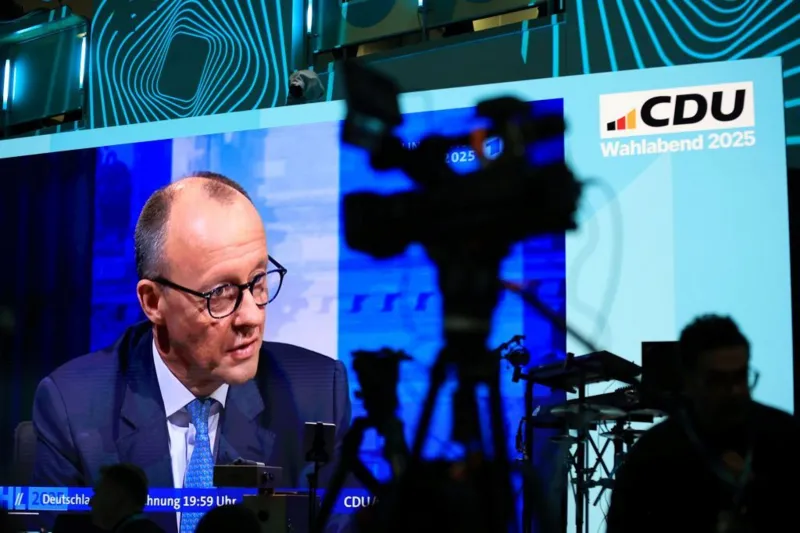
Friedrich Merz says he is eager to re-engage with international partners
Germany’s chancellor-in-waiting didn’t wait for the final results of his country’s election on Sunday to herald a new era in Europe.
Declaring the US indifferent to this continent’s fate, Friedrich Merz questioned the future of Nato and demanded Europe boost its own defences. Quickly.
This tone from the close US ally – and from Friedrich Merz who is known to be a passionate Atlanticist – would have been unimaginable even a couple of months ago.
It’s a seismic shift. That may read like hyperbole, but what we are now experiencing in terms of transatlantic relations is unprecedented in the 80 years since the end of World War Two.
Big European powers have been shocked to the core by the Trump administration, which suggests it could revoke the security guarantees to Europe in place since 1945.
“I would never have thought that I would have to say something like this in a TV show but, after Donald Trump’s remarks last week… it is clear that this government does not care much about the fate of Europe,” Friedrich Merz said during a post-election debate on Sunday.
“My absolute priority will be to strengthen Europe as quickly as possible so that, step by step, we can really achieve independence from the USA,” he added.
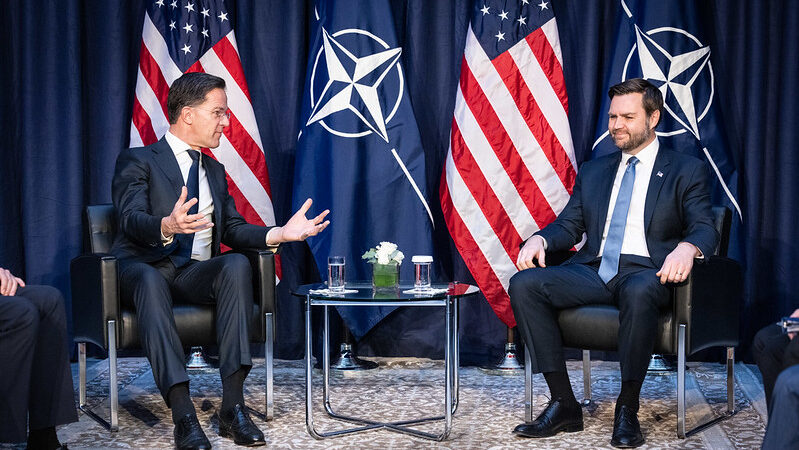
NATO Secretary General Mark Rutte meets with US Vice President JD Vance. Source: NATO/Flickr
Statements by US Vice President Vance and Defense Secretary Hegseth on the Ukraine war and transatlantic relations have left European leaders in shock
“If American democracy can survive ten years of Greta Thunberg’s scolding, you guys can survive a few months of Elon Musk,” US Vice President JD Vance told European leaders at last week’s Munich Security Conference. His remarks came during a draining week for those leaders, as Trump officials announced peace talks with Russian authorities—without European or Ukrainian involvement—while signaling they expect Europe to handle peacekeeping and being paid for their support in minerals from Ukraine.
Speeches by Vance and Defense Secretary Pete Hegseth threw European leaders into disarray, seen as not-so-subtle indications of a cooling in transatlantic relations. These interventions attacked everything from the EU’s efforts to regulate social media platforms to its approach to far-right parties in parliamentary life. In response, French President Emmanuel Macron called for an emergency summit of select regional powers on Monday, February 17 – just a day before US and Russian representatives are expected to meet in Saudi Arabia.
While Ukrainian officials and some European leaders have insisted they will not accept any deal that excludes Ukraine’s direct involvement, their stance appears to carry little weight.
At the same time, the new US administration has increased pressure on its European allies, demanding a ramping up of their defense budgets and taking on the responsibility of a potential peacekeeping mission in Ukraine. This comes as no surprise: a number of US officials, including Donald Trump himself, have said Europe does not contribute enough to NATO and essentially freeloads off the US. Vance’s speech in Munich only reaffirmed this stance, ultimately reducing high-ranking figures to tears over the apparent breakup between allies.
While the focus of European reactions to recent US statements has been on Ukraine, many leaders have admitted that more is at stake. “Yes, it is about Ukraine – but it is also about us,” European Commission President Ursula von der Leyen wrote on X. Unfortunately, the conclusion she drew going further is upsetting: “We need an urgency mindset. We need a surge in defense. And we need both of them now.”
Unlike healthcare, education, or social programs—sectors where European governments are consistently told their budgets must remain limited—military spending is expected to face no such barriers. Many European countries have already embraced the shift, with Polish officials, for example, boasting about spending close to 5% of their GDP on defense and warning of looming “wider wars” to convince other states in the region to do the same.
Despite the apparent fracture in US-Europe relations, European leaders have shown no inclination to rethink their dependence on Washington. Instead, most have done exactly what the Trump presidency wants them to do and swiftly pledged to increase military spending. Some have even already expressed willingness to deploy troops for peacekeeping in Ukraine. What remains absent from their reactions is any consideration of a future less dictated by US interests and more aligned with the needs of the people living in Europe.
Since the beginning of the war three years ago, activists have urged Europe to reject NATO’s warmongering and prioritize peace in Ukraine alongside social justice at home. Instead, the coming surge in military budgets will almost certainly coincide with cuts to public services, further fueling the rise of the far-right—a political force that Trump officials, including Vance and Elon Musk, have (more or less) openly backed during interventions in Europe. From this perspective, unlike the conservative circles who “survived ten years of ’s scolding,” Europe’s liberal elite is unlikely to emerge from its current crisis unscathed. Whether their refusal to acknowledge the failure of their anti-people policies will push the entire region into the hands of parties like Brothers of Italy and Alternative for Germany remains to be seen.
Elon Musk urges you to be a Fascist like him, says that you can ignore facts and reality then.Power-mad orange gasbag Donald Trump says Burn, Baby, Burn.