A DeSmog collage. The Institute of Economic Affairs has its headquarters on Lord North Street, Westminster. Credit: Des Blenkinsopp(CC BY-SA 2.0)
The regulator has opened a case against the Tufton Street group.
The Institute of Economic Affairs (IEA) pressure group, which campaigns against clean energy policies, is being investigated by the charities regulator.
The Good Law Project (GLP), a legal advocacy group, yesterday announced that it had been successful in forcing the Charity Commission to open a “regulatory compliance case” against the IEA.
A Charity Commission spokesperson told DeSmog: “We can confirm that, following an internal review, we have opened a regulatory compliance case to assess potential regulatory concerns about the Institute for Economic Affairs.
“Our case will examine the trustees’ management of perceptions of potential political bias, perceptions of a potential lack of transparency around funding, and perceptions that the charity may have pre-determined policy positions which would not be in keeping with its charitable purposes to advance education.”
The IEA is registered as a charity, and the regulator states that “political activity must not become the reason for the charity’s existence.”
In 2018, Greenpeace’s investigative journalism unit Unearthed revealed that the IEA had received funding from oil major BP every year since 1967. In response to the story, an IEA spokeswoman said: “It is surely uncontroversial that the IEA’s principles coincide with the interests of our donors.”
The IEA also received a £21,000 grant from U.S. oil major ExxonMobil in 2005.
However, the IEA does not publicly declare its donors, and it’s not known if the pressure group has received funding from BP or ExxonMobil in more recent years.
The IEA has extensive influence in politics and the media. It was pivotal to Liz Truss’s short-lived premiership as prime minister, and has boasted of its access to Conservative ministers and MPs.
The IEA is a prominent supporter of the continued and extended use of fossil fuels. The group has advocated for the ban to be lifted on fracking for shale gas, calling it the “moral and economic choice”. The IEA has also said that a ban on new North Sea oil and gas licences would be “madness”, has criticised the windfall tax imposed by the UK on fossil fuel firms, and said that the previous government’s commitment to “max out” the UK’s oil and gas reserves was a “welcome step”.
The IEA is part of the Tufton Street network – a cluster of libertarian think tanks and pressure groups that are in favour of more fossil fuel extraction and are opposed to state-led climate action. These groups are characterised by a lack of transparency over their sources of funding.
The Charity Commission initially rejected the GLP’s complaint about the IEA, which was lodged in March 2024 and backed by MPs from the Green Party, Liberal Democrats, and the Scottish National Party. The Charity Commission rejected the complaint after just 12 days.
However, after the GLP threatened formal legal action against the Charity Commission for failing to properly consider the evidence against the IEA, it has agreed to open a compliance case.
“We welcome this screeching u-turn from the Charity Commission who raced to clear the IEA last year,” said Good Law Project’s executive director Jolyon Maugham.
“It shouldn’t have taken the threat of legal action to force the regulator to do its job. The IEA’s activities are the polar opposite of public benefit and we’re now urging the Charity Commission to go further in its investigation.”
However, it’s unclear what action, if any, will be taken against the IEA if the regulator finds it in breach of charity rules. A previous case brought against the Global Warming Policy Foundation (GWPF) – the UK’s leading climate science denial group – didn’t lead to any meaningful sanctions against the Tufton Street group.
The GLP accused the GWPF of breaching charity law by spending hundreds of thousands of pounds on one-sided research attacking climate science, and by funding the lobbying activities of its campaign arm Net Zero Watch. However, the Charity Commission asked the GWPF to make only minor changes to its ownership structure and output.
An IEA spokesperson said: “We have received a letter from the Charity Commission and will be responding to them thoroughly in due course.”
So Kemi Badenoch, whose party has spent weeks attacking Keir Starmer for registering use of a flat from a party donor, has been secretly using the flat of another millionaire donor, currency trader and Tufton Street think-tanker to run her own campaign https://t.co/iXlS9msCIB
Badenoch being holed up in the flat of a millionaire donor, currency trader and Tufton Street think-tanker is actually depressingly predictable.
Tory leadership hopeful Kemi Badenoch has been running her leadership campaign from the home of a wealthy donor, according to Bloomberg reports.
Despite the Conservatives going on the attack over Sir Keir Starmer’s use of a London flat in the run-up to the general election, which he declared, Rishi Sunak’s potential successor has been doing precisely the same thing – and has yet to make that fact public.
Bloomberg notes that Badenoch has been running her leadership campaign from the home of Neil Record, who is the chair of the climate science denial group Net Zero Watch.
Neil is also the former chair of the Institute of Economic Affairs, a think-tank closely linked to Liz Truss that was originally based on the infamous Tufton Street.
The former business secretary, who is running for Conservative Party leader, has defended net zero U-turns and backed new fossil fuel drilling.
Conservative Party leadership hopeful Kemi Badenoch received £10,000 towards her campaign from the chair of a climate science denial group, DeSmog can reveal.
Based in 55 Tufton Street, Westminster, the GWPF is the UK’s leading climate science denial group. The GWPF’s director Benny Peiser has suggested it would be “extraordinary anyone should think there is a climate crisis”, while the group has also expressed the view that carbon dioxide has been mis-characterised as pollution, when in fact it is a “benefit to the planet”.
Its NZW arm has called for “rapid” new North Sea oil and gas exploration, and for wind and solar power to be “wound down completely”.
Badenoch received £10,000 from Record in July, according to her official register of interests, which said that the donation was “in support of my campaign for the leadership of the Conservative Party”.
The North West Essex MP has previously criticised the UK’s climate targets, calling them “arbitrary” in a 2022 interview. Badenoch has previously suggested that she would be in favour of delaying the UK’s commitment to reach net zero by 2050.
While serving as business secretary in September 2023, Badenoch also defended the decision by then prime minister Rishi Sunak to water down and delay a number of net zero policies, and argued that new fossil fuel licences were compatible with the UK’s climate targets.
“It’s no wonder that the Conservatives don’t want to act on the climate crisis when they are receiving donations from the people running groups like Net Zero Watch,” Adrian Ramsay, co-leader of the Green Party, told DeSmog.
“Just weeks on from the worst electoral defeat in their entire history, you’d hope they would be reflecting on why policies like U-turning on their climate commitments were so unpopular. Instead, it seems they are going to double down on their hostility to net zero and will remain both a threat to the planet and completely out of touch with the British public.”
Polling by More in Common and E3G during the 2024 general election period found that a majority of people in every UK constituency are worried about climate change. Some 61 percent of 2024 Conservative voters said they are worried about climate change, matched by 76 percent of Labour voters, and 65 percent of the country overall.
Last month, which saw world temperatures reach their hottest levels ever measured, Record wrote in The Telegraph that it is “debatable in detail” whether burning fossil fuels increases carbon dioxide (CO2) and causes dangerous global warming.
He went on to claim that achieving net zero by 2050 “will restrict our freedom, and is likely to be eye-wateringly expensive”, and should be replaced with the “realistic promise” for the UK not to contribute more than one percent of global emissions.
The world’s foremost climate science body, the UN’s Intergovernmental Panel on Climate Change (IPCC), has stated that CO2 “is responsible for most of global warming” since the late 19th century, which has increased the “severity and frequency of weather and climate extremes, like heatwaves, heavy rains, and drought”.
The IPCC has also warned that climate action has been delayed by “rhetoric and misinformation that undermines climate science and disregards risk and urgency”.
Record is a “life vice president” of the Institute of Economic Affairs (IEA) think tank, which he chaired until July 2023. The IEA has opposed state-led climate policies and has advocated for more fossil fuel extraction. The think tank received funding from the oil giant BP every year from 1967 to at least 2018. Record has given money to both the IEA and the GWPF.
The GWPF and the IEA are part of the Tufton Street network of think tanks and lobbying groups based in Westminster, all of which campaign for less government regulation, including on climate change.
When questioned previously about his GWPF donations, Record said: “I personally regard the continuing contribution of the GWPF to the climate change debate as very positive in assisting balance and rationality in this contentious area.”
The GWPF and the Tories
A number of other Tory MPs have also recently received donations from funders of the GWPF.
One of the early funders of the GWPF, Lord Michael Hintze, donated £18,000 to a number of Tory MPs from May to August. A hedge fund manager, Conservative peer and major party donor, Lord Hintze has said that he believes “there is climate change” caused “in part due to human activity over the past century”. However, he has said that “all sides must be heard” on the issue “to reach the right conclusion for society as a whole”.
A number of climate consensus studies conducted between 2004 and 2015 found that between 90 percent and 100 percent of experts agree that humans are responsible for climate change. A study published in 2021, which reviewed over 3,000 scientific papers, found that over 99 percent of climate science literature says that global warming is caused by human activity.
Lord Hintze’s recent donations included £2,000 to Claire Coutinho, £5,000 to Iain Duncan Smith, £2,500 to Alison Griffiths, £2,500 to Kit Malthouse, £2,000 to Andrew Murrison, £2,500 to Patrick Spencer, and £2,500 to Nick Timothy.
Former energy and net zero secretary Coutinho – who oversaw the weakening of a number of flagship climate policies – received another £2,000 from Lord Hintze in January.
Lord Hintze is one of the Conservative Party’s most prolific donors in recent years and has given more than £4 million to the party and its candidates since 2002.
Between the 2019 general election and the start of the 2024 campaign, the Conservatives received £8.4 million from fossil fuel interests, highly polluting industries, and climate science deniers.
GWPF donor Lord Jon Moynihan has also given £12,000 to a number of Tory MPs in recent months, including £5,000 to Peter Fortune, £2,000 to Mark Francois, and £5,000 to Thomas Bradley. He has now donated more than £600,000 to the Conservatives and its candidates since 2001.
Lord Moynihan gave £25,000 to the GWPF between 2018 and 2023, and has donated over £300,000 to other “free market” groups in the Tufton Street network in recent years, including the IEA.
Lord Moynihan also has substantial oil and gas investments. The peer’s register of interests shows that he holds shares worth more than £100,000 in each of the oil and gas majors BP, Shell, and TotalEnergies.
The GWPF and NZW have a number of political ties. Labour MP Graham Stringer is a director of the GWFP, having joined its board of trustees in 2015. Lord David Frost, a Tory peer and the UK’s former chief Brexit negotiator, is a trustee of the organisation alongside Telegraph columnist Allison Pearson. Former Tory MP Andrea Jenkyns, who lost her seat in July’s general election, is a director of NZW.
“The government may have changed, but it’s not clear much else has when it comes to climate crisis denialism,” Jolyon Maugham, executive director of the Good Law Project, told DeSmog. “Labour MP Graham Stringer continues to sit on the board of the GWPF and Neil Record, who chairs its subsidiary, is funding the would-be Tory leader Kemi Badenoch.”
Following a review by the Charity Commission into the GWPF’s activities and structure, the group announced that it would soon be ending its formal ownership of NZW.
All the MPs and donors mentioned in this article were approached for comment.
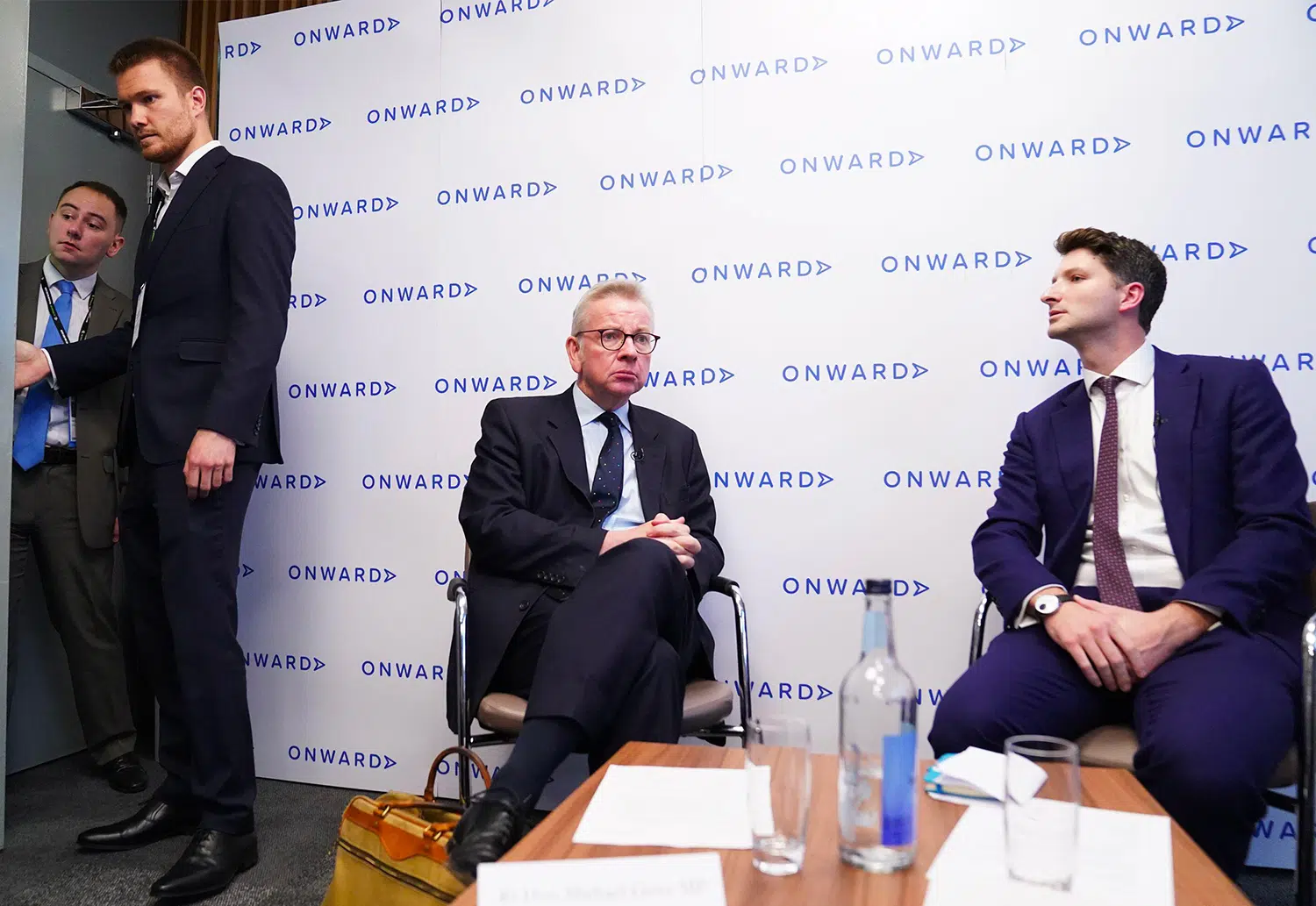
An Onward event at the 2022 Conservative Party conference featuring Cabinet minister Michael Gove. Credit: PA Images / Alamy
Ministers met with Onward, accused of being “a fossil fuel dinosaur in new clothing”, more than any other think tank last year.
An oil and gas funded group had the most registered meetings with government ministers among all think tanks last year, DeSmog can reveal.
Onward describes itself as a think tank bringing “bold and practical ideas for the centre right”. Since its launch in 2018 it has gone through a meteoric rise, quickly becoming one of Westminster’s most influential think tanks.
DeSmog analysed the meetings of every government department in 2023 and found that ministers met with the group on 17 occasions across the year, an average of well over once a month and more than any other think tank.
Onward doesn’t disclose full details of its funding but unlike many think tanks it publicly shares the list of organisations that have donated “more than £5,000 twice a year” to the group.
Its list of funders in the first half of 2023 included several oil and gas giants, including Shell, BP, and Equinor. These three companies are also listed as members of Onward’s ‘Business Network’, which is open to those who donate £12,000 a year. In exchange, Onward says that it offers its members quarterly “invitations to private roundtables with senior policymakers and opinion formers”.
Onward offers other perks to its Business Network members, including the opportunity to see its reports before they are published, though it insists that donors are precluded from influencing the contents of its publications.
In the second half of the year, Onward also received funding from Lord Michael Spencer, a Tory mega-donor and former party treasurer who holds shares in oil and gas companies.
Onward’s corporate supporters included Drax, the UK’s largest single source of CO2 emissions. Drax is the operator of a major wood pellet burning power station in Yorkshire that receives billions of pounds in government environmental subsidies despite producing millions of tonnes of carbon emissions a year while burning trees from historic woodlands.
“Onward might sound progressive, but it looks suspiciously like a fossil fuel dinosaur in new clothing,” Green Party co-leader Carla Denyer told DeSmog.
“With so much fossil fuel money oiling the wheels of Westminster it is small wonder the Tories are maxing out oil and gas licences and have granted approval for Rosebank, the largest undeveloped oilfield in the North Sea.
“It’s time to break the links between government and fossil fuel funded think tanks and engage instead in a bit of blue sky thinking.”
Onward’s meetings in 2023 included two with ministers from the Department for Energy Security and Net Zero (DESNZ), which is responsible for the government’s climate policies.
One of those meetings, held in June with Net Zero Minister Andrew Bowie, was to discuss the role of hydrogen in the transition to net zero.
Though it’s widely acknowledged that hydrogen will have a role in decarbonising some industrial processes, it has become the subject of growing controversy. Experts have warned that exaggerating the potential of the technology risks delaying climate action by distracting from the transition to renewable energies. Hydrogen is favoured by gas companies, as it is often made using natural gas and deploys existing infrastructure.
As a result, hydrogen continues to be the subject of a major lobbying effort in Westminster.
Vested interests, including oil and gas companies, have spent hundreds of thousands of pounds in recent years sponsoring political party conferences and parliamentary advocacy groups, advocating for the role of hydrogen in the clean energy transition.
UK gas infrastructure operator National Gas hosted an Onward event at the 2023 Conservative conference on the UK’s “need” for hydrogen, entitled “Gassed up”.
An Onward spokesperson said that as a not-for-profit organisation the group relies “entirely on the generosity of our network to support our research programme”, which allows the group to “routinely meet and share our research with government and shadow ministers”.
They stressed that they “do not take commissions from companies or government for specific pieces of research” giving the group “complete editorial control over our priorities and conclusions”.
Onward and Tufton Street
Onward is currently led by former Financial Times journalist Sebastian Payne, who is attempting to become a Conservative parliamentary candidate.
The think tank’s advisory board and board of directors are manned by Conservative MPs and peers, former Conservative Party treasurers, and business figures. Current Net Zero Secretary Claire Coutinho was a member of the Onward advisory board prior to her appointment to the Cabinet.
When Rishi Sunak became prime minister in October 2022, it was reported that Onward alumni had taken up several advisory posts in his government – the second highest number of any think tank. Sunak’s deputy chief of staff Will Tanner, who leads on policy, is the co-founder and former director of Onward.
Onward alumni were only outnumbered by former staff members of Policy Exchange, a right-wing think tank that formerly employed Sunak. Policy Exchange has received funding from fossil fuel giant ExxonMobil, and has been credited by Sunak for helping to draft laws that have cracked down on climate protests. DeSmog has also revealed that Shell and BP were allowed “ample opportunity” to shape a Policy Exchange report on carbon taxes that was later endorsed by Sunak’s government.
Over the last year, the prime minister has also overseen a row-back of several key climate pledges. In July, Sunak confirmed that his government planned to issue hundreds of new oil and gas licences, a move condemned by opposition MPs and charities. Oxfam’s climate policy adviser Lyndsay Walsh said the move “will send a wrecking ball through the UK’s climate commitments”.
Sunak has said his government intends to “max out” the UK’s oil and gas reserves, and has legislated to introduce annual North Sea licensing rounds. This is despite the International Energy Agency stating that new fossil fuel exploration is “incompatible” with the Paris Agreement target of limiting global heating to 1.5C.
Regulators also approved government plans for the development of the controversial Rosebank oil field, operated by Equinor, even though the project has been dubbed a “carbon bomb” by environmental law charity ClientEarth.
In September, the government scrapped a number of net zero pledges, including pushing back a ban on the sale of combustion engine vehicles, and weakening plans to phase out gas boilers.
Sunak’s predecessor Liz Truss had close ties to a number of “free market” think tanks based in and around 55 Tufton Street, Westminster. This included the Institute for Economic Affairs (IEA), a think tank that was funded by BP for at least 50 years. Former IEA director general Mark Littlewood said that Truss had spoken at IEA events more than “any other politician over the past 12 years”, and the pair have now launched the group Popular Conservatism to lobby for more libertarian policies.
DeSmog found that the IEA met with ministers on nine occasions in 2023, almost half as many as Onward.
Rishi Sunak on stopping Rosebank says that any chancellor can stop his huge 91% subsidy to build Rosebank, that Keir Starmer is as bad as him for sucking up to Murdoch and other plutocrats and that we (the plebs) need to get organised to elect MPs that will stop Rosebank.Image of InBedWithBigOil by Not Here To Be Liked + Hex Prints from Just Stop Oil’s You May Find Yourself… art auction. Featuring Rishi Sunak, Fossil Fuels and Rupert Murdoch.
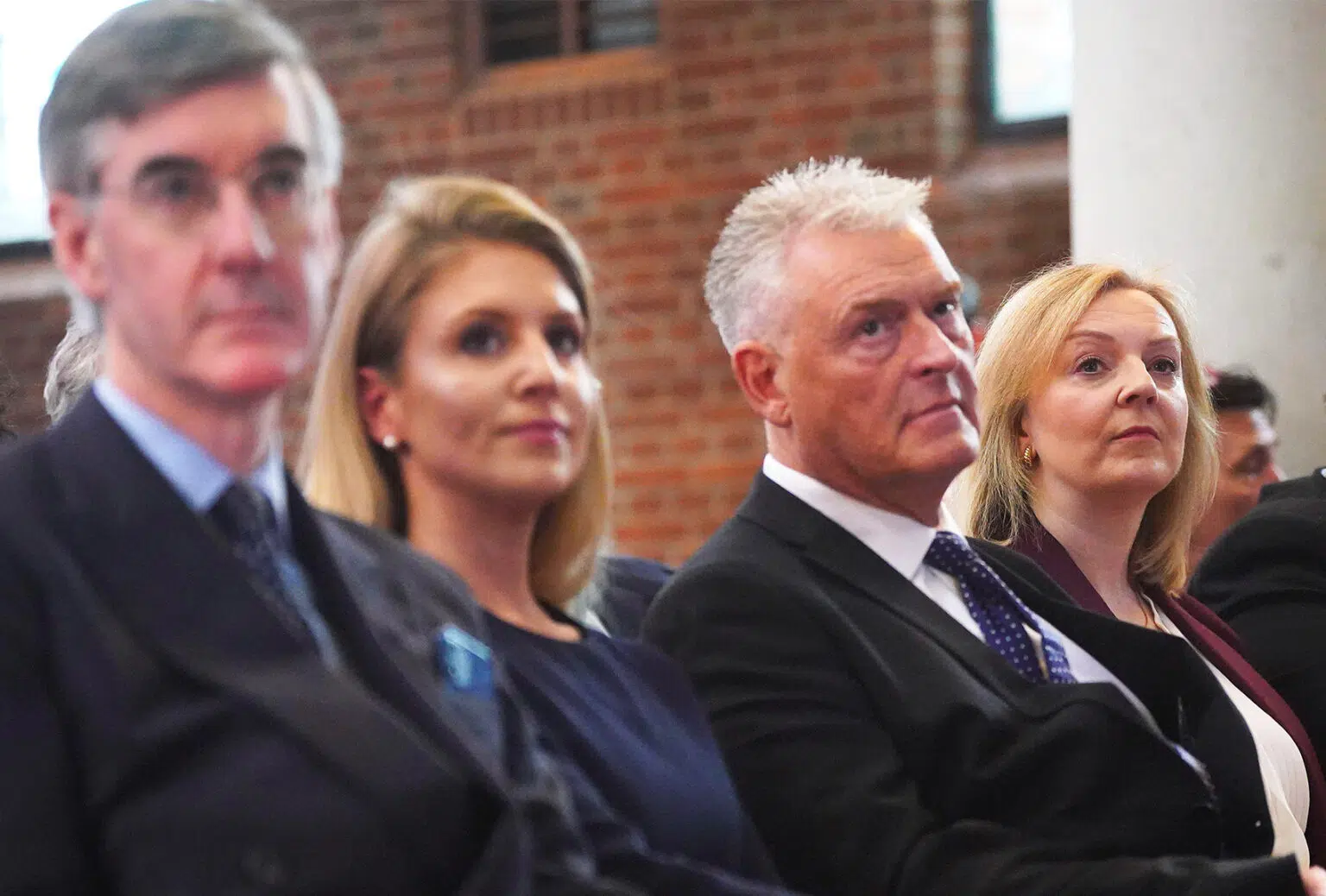
Jacob Rees-Mogg, Lee Anderson and Liz Truss at the launch of ‘Popular Conservatism’. Credit: PA Images / Alamy
The launch of Popular Conservatism saw attacks on “net zero zealots” and the Climate Change Committee.
Liz Truss’s new ‘Popular Conservatism’ faction of the Conservative Party launched today with attacks on net zero targets and environmental bodies, using the playbook established by libertarian lobby groups.
The self-styled PopCons included politicians critical of climate policies and science, including Lord Frost, who is a director of the climate science denial Global Warming Policy Foundation, as well as Conservative MP Lee Anderson and Reform party president Nigel Farage.
PopCon director Mark Littlewood is the outgoing managing director of the Institute of Economic Affairs (IEA), an influential free market think tank that has talked up its access to government.
The IEA received funding from oil company BP every year from 1967 to 2018, according to an Unearthed investigation confirmed by the IEA. Both IEA and BP have declined to say if this funding continues, when asked by DeSmog.
A branded leaflet handed out at the event, under the heading “what we stand for”, stated: “End net zero zealotry and promote energy pragmatism to provide both security of supply and low prices”.
The leaflet also named the Climate Change Committee (CCC), the government’s independent advisory body on hitting its climate targets, as one of the institutions which “stand in the way of meaningful reform”.
Littlewood’s speech criticised the UK’s net zero target, complaining about “the Climate Change Committee, pronouncing on our progress to the eye-wateringly [sic] expensive and almost certainly unachievable aim of being carbon net zero”.
Lee Anderson, former deputy chair of the Conservative Party, repeatedly attacked net zero in his speech, which he claimed “never comes up on the doorstep” aside from when it is brought up by “the odd weirdo”.
Anderson said: “if we became net zero tomorrow, this country… it wouldn’t make a blind bit of difference to the earth’s atmosphere”, pointing to the higher emissions produced by other countries.
Anderson argued that net zero would cost voters money, calling for an “opt-in, opt-out” approach to what he called “green levies” on energy bills, adding: “Not one politician can put their hand on their hearts and tell you how much it’s [net zero] going to cost.”
The CCC has estimated the cost of net zero at less than one percent of GDP, while the Office for Budget Responsibility has said that “the costs of failing to get climate change under control would be much larger than those of bringing emissions down to net zero”.
Liz Truss used her speech to say: “If we look at the net zero zealots that Lee has just been talking about, the need for cheaper energy is being drowned out by some very active campaigners.” She claimed voters “don’t like the net zero policies which are making energy more expensive”.
The International Monetary Fund found in September 2022 that the energy crisis was hitting UK households harder than any country in western Europe, due to the UK’s reliance on gas for heating homes.
Tufton Street Links
Politicians fronting the PopCon group have a history of working with anti-green think tanks and supporting more fossil fuel extraction.
Truss (who went to the University of Oxford with Littlewood) has extensive ties to the IEA, which is part of the Tufton Street network – a cluster of libertarian pressure groups and think tanks that oppose state-led climate action.
In 2022, Truss’s campaign for Tory leader was run by Ruth Porter, a former communications director at the IEA. Once in 10 Downing Street, Truss hired Porter as her senior special advisor, and has since appointed her to the House of Lords. A number of former Tufton Street figures were appointed to government advisory roles during Truss’s short-lived tenure in Downing Street.
The IEA publicly supported Truss’s ‘mini-budget’, which caused economic chaos by promising large tax cuts without explaining how they would be funded. While in office, Truss lifted the UK’s ban on fracking for shale gas, a policy advocated by the IEA. (The policy was ditched by her successor Rishi Sunak.)
The IEA has consistently opposed UK government climate policies, preferring “market solutions”. In October 2022, IEA executive Andy Mayer said the government should “get rid of” its net zero target, which he called a “very hard left, socialist, central-planning model”.
During her 2022 leadership campaign, Truss received £5,000 from Lord Vinson, one of the few known funders of the Tufton Street-based Global Warming Policy Foundation (GWPF), the UK’s main climate science denial group.
Rees-Mogg also has a long record of opposing climate policies. Earlier this month he said: “the current headlong rush to net zero risks impoverishing the nation to no global benefit on emissions”.
The UK government’s legally-binding target to cut carbon dioxide emissions to net zero by 2050 is part of international efforts to keep global warming below 1.5C.
As Business and Energy Secretary in 2022, Rees-Mogg supported overturning the UK’s ban on fracking, and said “we have to stop demonising oil and gas” in a meeting with the UAE’s state investment company.
He also receives around £29,000 per month to host a show on right-wing broadcaster GB News. A DeSmog investigation last year found one in three GB News hosts spread climate science denial on air in 2022, while more than half attacked net zero policies. The channel‘s co-owner, Paul Marshall, has £1.8 billion invested in fossil fuels via his investment fund Marshall Wace.
Science Denial
Several figures with ties to climate science denial turned out for the PopCon launch. They included Lord Frost, a trustee of the GWPF who last year said global warming could be “beneficial”, along with Dame Andrea Jenkyns, who sits on the board of the GWPF’s campaign arm, Net Zero Watch.
The IEA and GWPF have both received funding from Neil Record, a Conservative donor who was IEA chairman until July 2023 and remains chair of Net Zero Watch. Record has donated thousands to Tory MP Steve Baker, an IEA ally and former GWPF trustee who has claimed much climate science is “contestable” and “propagandised”.
The PopCon launch was also attended by GB News host Nigel Farage, honorary president of right-wing party Reform UK, which campaigns to “scrap net zero”. Last year the party received £135,000 from donors who spread climate denial or had fossil fuel interests. Reform leader Richard Tice has claimed that “CO2 isn’t poison; it’s plant food”.
Farage posed for a photo at the PopCon event with Lois Perry, director of climate denial group CAR26, who is running for leader of UKIP and last month said she does not believe in human-caused climate change.
Addressing the audience Truss made a series of bizarre attacks on the Left, taking aim at “wokeism” and said the Tories had failed to “take on the left-wing extremists”.
“Wokeism seems to be on the curriculum,” said Truss. “There is confusion about basic biological facts, like what is a woman.
“Look at the net zero zealots, if you listen to the Today programme, I don’t recommend it, you’ll hear demands for more public spending.”
Truss went on to warn that the left were “on the march and actively organising”.
“These people have repurposed themselves, they don’t believe they are socialist or communists anymore. They say they’re environmentalists, they say they’re in favour of helping people across all communities, they are in favour of supporting LGBT people or groups of ethnic minorities.
“So they no longer admit that they are collectivists but that is what their ideology is about.”
She went on to claim that anti-capitalists were being “pandered to” by the Government and that Conservative values were being eroded and said it was “only through Conservative values that we can give the British people what they want”, however fell short on saying what this was exactly.
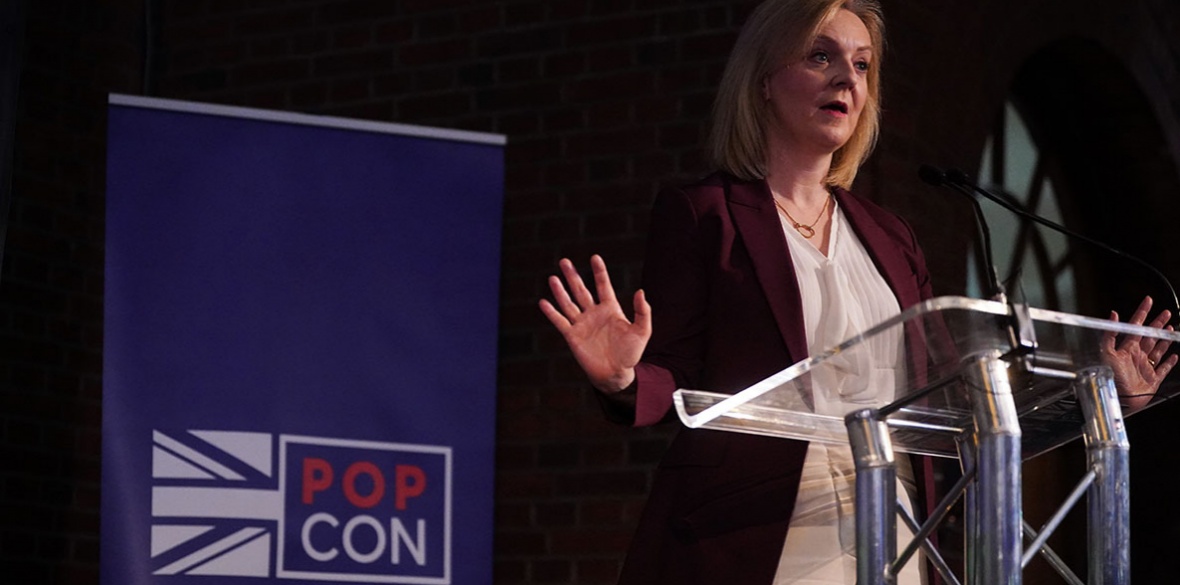
Former prime minister Liz Truss during the launch of the Popular Conservatism movement at the Emmanuel Centre in central London, in a bid to rally right-wing Tory MPs ahead of a general election this year, February 6, 2024
…
Running through a list of enemies almost longer than her catastrophic time in Downing Street, Ms Truss nevertheless claimed that Britain was “full of secret Conservatives — people who agree with us but don’t want to admit it,” while the Tory party had been appeasing “left-wing extremists.”
Painting a picture of a world on the edge of socialism, the former prime minister, best known for crashing the economy in a matter of days, asserted that “the left have been on the march.”
“They have been on the march in our institutions, they have been on the march in our corporate world, they are on the march globally,” she claimed.
Taking on this menace and “changing the system itself” will require “resilience and bravery,” Ms Truss added.
Unfortunately, rather than resilience and bravery, she had to hand only Lee Anderson and Jacob Rees-Mogg, former frontbenchers taking a break from their present gigs on GB News.