Palestinians Describe ‘Hell’ in Gaza’s So-Called ‘Humanitarian Zone’

Spread the love

Original article by JULIA CONLEY republished from Common Dreams under Creative Commons (CC BY-NC-ND 3.0). 
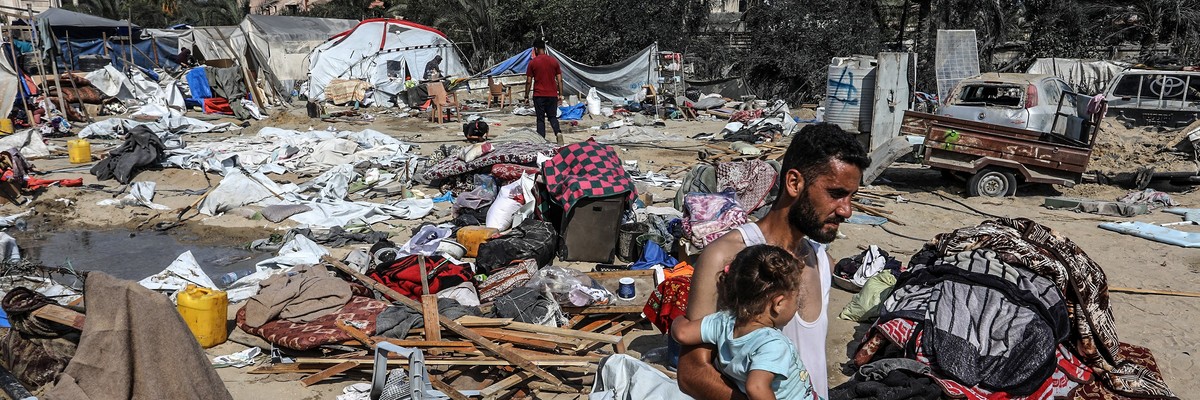
A view of destruction in the al-Mawasi area after an Israeli attack in Khan Younis in the southern Gaza Strip on July 14, 2024. (Photo: Abed Rahim Khatib/Anadolu via Getty Images

“We live in an area that is considered humanitarian and is supposed to be safe, but it is not,” one woman said. “There is no safe place for us or our children.”

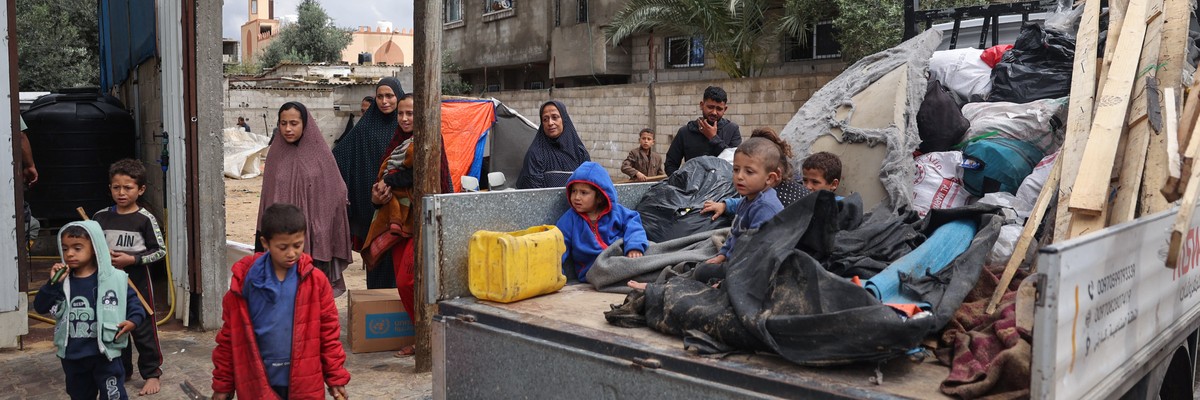
Palestinians living in the so-called “humanitarian zone” designated by Israel described extreme and worsening overcrowding on Tuesday, saying that as the Israel Defense Forces has repeatedly struck the area in recent months, displaced people living there have been left feeling they “could die any minute.”

A 37-year-old mother of four, Nisreen Joudeh, told The New York Times that al-Mawasi, a stretch of coastal land to which hundreds of thousands of people from other parts of Gaza have evacuated under Israeli orders, “is no longer a safe area.”

With materials for tents now costing hundreds of dollars instead of an average of $50 as they did before Israel began bombarding Gaza and blocking humanitarian aid last October, families now commonly share the tents that have been erected along the sandy shore area.

“A tent that used to accommodate four to seven people now houses 15 to 17 people from two or more families,” a man named Karel Mohammed told the Times, and overcrowding has intensified in recent weeks as Israel forcibly displaced tens of thousands more Palestinians and ordered them to al-Mawasi.

People face “scorching heat” with very few trees to provide shade, and have access to only “primitive bathrooms,” according to Mohammed.

With Israel continuing to block large amounts of humanitarian aid—actions that United Nations experts last month said have pushed Gaza into famine—Mohammed said there is “no drinkable water, no healthy food” in al-Mawasi.

“The truth is that this area is anything but humanitarian,” said Mohammed. “Our life in these camps is like hell.”

The Times‘ dispatch from al-Mawasi came a day after the United Nations Children’s Fund (UNICEF) reported that the “lack of clean water” and the destruction of Gaza’s sanitation and sewage treatment systems” have caused a surge in diseases including diarrhea and skin disorders across Gaza.

Mona al-Farra, another Palestinian who is sheltering in al-Mawasi in a tent crowded with nine other family members, said skin rashes among children have particularly become rampant due to a lack of clean water and medicine.

“We live in an area that is considered humanitarian and is supposed to be safe, but it is not,” she told the Times, adding that her family frequently hears airstrikes nearby. “There is no safe place for us or our children.”

Last month, at least 90 Palestinians were killed in a bombing within al-Mawasi, which the IDF said had targeted Hamas commander Muhammed Deif.

The so-called humanitarian zone covers 18 square miles, according to the U.N., or nearly 13% of the Gaza Strip. The IDF adjusted the area’s borders last month, shrinking it by about one-fifth.

Doctors Without Borders, also known as Medecins Sans Frontieres (MSF), shared on social media on Monday drawings that had been made by children in a mental health clinic in al-Mawasi, with the artwork exemplifying the “complete psychological destruction” among Gaza’s youngest residents that a report warned of earlier this year.

“Even though the wounds are invisible, the drawings provide a glimpse into what these children have witnessed. It is beyond words,” said Samuel Johann, an emergency coordinator for MSF. “I cannot express what I feel, seeing what these children have experienced, through their eyes and the reality they are facing.”

“Today,” he said, “I heard a Palestinian colleague describe the human suffering of the war as such: ‘Only the dead have been spared this suffering.'”

Original article by JULIA CONLEY republished from Common Dreams under Creative Commons (CC BY-NC-ND 3.0). 
Continue ReadingPalestinians Describe ‘Hell’ in Gaza’s So-Called ‘Humanitarian Zone’

‘Unlawful and Catastrophic’: IDF Begins Forced Evacuation of Rafah

Spread the love

Original article by JAKE JOHNSON republished from Common Dreams under Creative Commons (CC BY-NC-ND 3.0). 
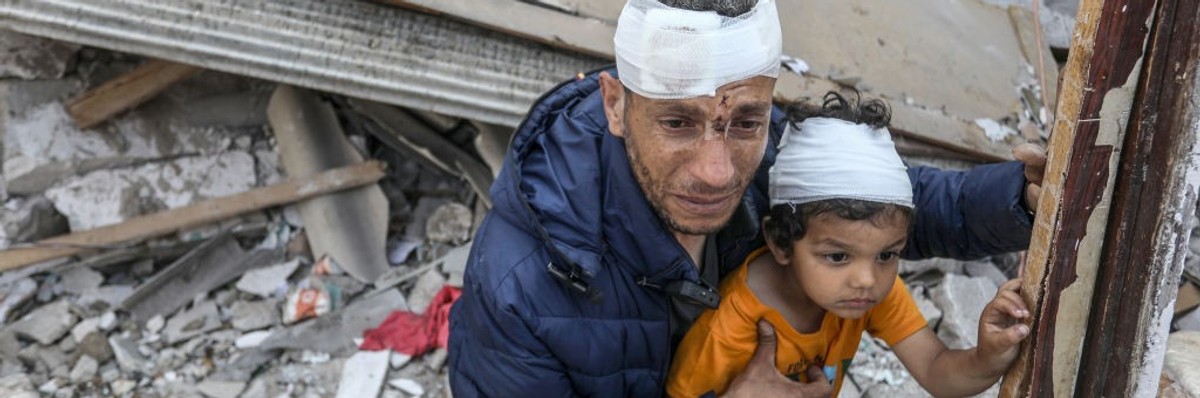
Displaced Palestinians in Rafah in the southern Gaza Strip gather their belongings following an evacuation order by the Israeli military on May 6, 2024. (Photo: AFP via Getty Images)

The head of one humanitarian group called the Israeli military’s directives “a serious violation of international law.”

Israel’s army on Monday ordered roughly 100,000 people living in eastern Rafah to evacuate ahead of an imminent military assault on the area, terrifying families who have been forcibly displaced to the southern Gaza city in recent months and intensifying warnings of a bloodbath.

The Israel Defense Forces (IDF) dropped leaflets over Rafah ordering some of its 1.4 million residents to move to a strip along Gaza’s coast, a signal that a long-feared ground assault on the overcrowded city is set to begin in the face of vocal opposition from the international community and humanitarian organizations.

The U.S., Israel’s top arms supplier, has said it would oppose a Rafah assault without a credible plan to evacuate civilians from the city. Humanitarian groups and analysts have said such a plan is impossible because there is no genuinely safe place for Gazans to go. Israeli forces have repeatedly attacked so-called “safe zones” and designated routes Palestinians have used to flee in compliance with past IDF orders.

“Israel’s military offensive in Rafah could lead to the deadliest phase of this conflict, inflicting horrific suffering on approximately 1.4 million displaced civilians in the area,” said Jan Egeland, secretary-general of the Norwegian Refugee Council. “The relocation orders issued by Israel today to thousands of Gazans, directing them to move to Al-Mawasi, are beyond alarming. The area is already overstretched and devoid of vital services. It lacks the capacity to house the number of people currently seeking refuge in Rafah, with no assurances of safety, proper accommodation, or return once hostilities end for those forced to relocate.”

“The absence of these fundamental guarantees of safety and return, as required by international humanitarian law, qualifies Israel’s relocation directives as forcible transfer, amounting to a serious violation of international law,” Egeland said. “Any Israeli military operation in Rafah—which has become the largest cluster of displacement camps in the world—will cause potential mass atrocities.”

“If large-scale military operations start, not only will children be at risk from the violence, but also from chaos and panic, and at a time where their physical and mental states are already weakened.”

Israel reportedly notified the U.S. of the evacuation orders overnight, and CIA Director William Burns is set to arrive in Israel on Monday to discuss the operation in Rafah, a city along Gaza’s border with Egypt that has become a critical point of entry for humanitarian aid. The new evacuation orders, expected to be just the first round of directives, include Rafah’s largest medical facility.

The United Nations Relief and Works Agency for Palestine Refugees in the Near East (UNRWA), the main relief agency in Gaza, said in response to the IDF’s orders that it would not leave Rafah.

“An Israeli offensive in Rafah would mean more civilian suffering and deaths. The consequences would be devastating for 1.4 million people,” the organization wrote in a social media post. “UNRWA is not evacuating: The agency will maintain a presence in Rafah as long as possible and will continue providing lifesaving aid to people.”

The far-right Israeli government, led by Prime Minister Benjamin Netanyahu, has been threatening a ground invasion of Rafah for months, characterizing the city as Hamas’ last major stronghold. Avichay Adraee, an IDF lieutenant colonel, said Monday that the Israeli military would use “extreme force” in the evacuation areas and warned that “anyone who is close to terrorist organizations puts his life and the life of his family at risk.”

According to the United Nations Children’s Fund (UNICEF), around 600,000 children are currently sheltering in the city, including many who have been displaced multiple times since Israel’s assault began in October following a Hamas-led attack.

“More than 200 days of war have taken an unimaginable toll on the lives of children,” Catherine Russell, UNICEF’s executive director, said Monday. “Rafah is now a city of children, who have nowhere safe to go in Gaza. If large-scale military operations start, not only will children be at risk from the violence, but also from chaos and panic, and at a time where their physical and mental states are already weakened.”

Omar Shakir, Israel and Palestine director at Human Rights Watch, called the IDF’s evacuation push in Rafah “unlawful and catastrophic.”

“There’s nowhere safe to go in Gaza,” Shakir added. “The international community should act to prevent further atrocities.”

The IDF began issuing its evacuation orders in Rafah a day after the Netanyahu government voted to shut down Al Jazeera‘s operations in the country, a brazen attack on press freedom.

“The fact that Israel banned Al Jazeera hours before beginning its assault on Rafah is not a coincidence,” said author and Middle East analyst Assal Rad. “After everything we’ve seen in the last seven months, imagine what they’ll do when they think no one is watching.”

Original article by JAKE JOHNSON republished from Common Dreams under Creative Commons (CC BY-NC-ND 3.0). 
Israeli Plan To Evacuate Rafah By Force Sparks Warnings Of ‘Ethnic Cleansing’

Continue Reading‘Unlawful and Catastrophic’: IDF Begins Forced Evacuation of Rafah

UN Warns Israeli Ground Invasion Rafah Will Lead to ‘Slaughter of Civilians’

Spread the love

Original article by BRETT WILKINS republished from Common Dreams under Creative Commons (CC BY-NC-ND 3.0). 
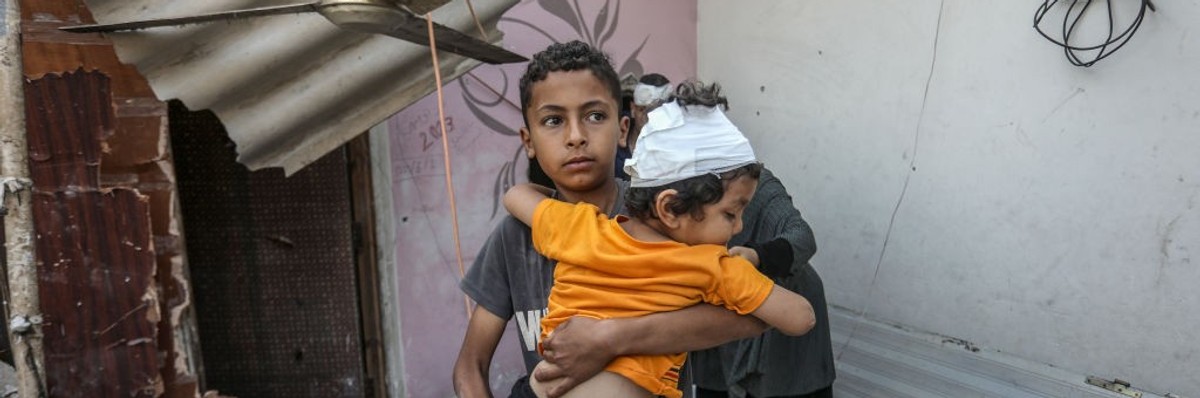
Palestinians wounded in Israeli attacks on Rafah attempt to collect belongings from bombed-out homes on May 1, 2024 in the southern Gaza city. 
(Photo: Abed Rahim Khatib/Anadolu via Getty Images)

“The simplest truth is that a ground operation in Rafah will be nothing short of a tragedy beyond words,” said a top U.N. aid official. “No humanitarian plan can counter that.”

The United Nations’ humanitarian aid agency warned Friday that an Israeli ground invasion of Rafah would put hundreds of thousands of Palestinians “at imminent risk of death.”

“Any ground operation would mean more suffering and death” for the approximately 1.5 million Palestinians—including around 1.2 million people forcibly displaced from other areas of the embattled enclave—sheltering in Gaza’s southernmost city, U.N. Office for the Coordination of Humanitarian Affairs (OCHA) spokesperson Jens Laerke told reporters in Geneva on Friday.

“The hundreds of thousands of people who are there would be at imminent risk of death if there is an assault,” he added, warning of not only “a slaughter of civilians, but also at the same time an incredible blow to the humanitarian operation in the entire strip, because it is run primarily out of Rafah.”

According to PoliticoIsrael has shared with the U.S. government its plan to move the civilian population out of Rafah ahead of a looming ground assault the Wall Street Journal reported earlier on Friday could begin next week.

Conditions in Rafah are already dire. The city—which was home to fewer than 300,000 people before the war—is now one of the most densely populated places on the planet. Hundreds of thousands of refugees are crowded together in tents and other makeshift shelters. Water and other necessities are in desperately short supply. According to James Elder, the global spokesperson for the United Nations Children’s Fund (UNICEF), there is approximately one toilet for every 850 people in Rafah and one shower for every 3,500 people.

“Try to imagine, as a teenage girl, or elderly man, or pregnant woman, queueing for an entire day just to have a shower,” Elder wrote for The Guardian this week.

There are nearly 600,000 children in Rafah, nearly all of whom are “injured, sick, malnourished, traumatized, or living with disabilities,” UNICEF executive director Catherine Russell said Wednesday.

Dr. Rik Peeperkorn, who represents the U.N. World Health Organization in the illegally occupied Palestinian territories, on Friday called contingency response plans for a Rafah invasion a “Band-Aid” solution.

“It will absolutely not prevent the expected substantial additional mortality and morbidity caused by a military operation,” he stressed.

Israel’s 210-day assault on Gaza in retaliation for the October 7 attacks has already killed at least 34,622 Palestinians—a large majority of them civilian men, women, and children—while wounding more than 77,800 others, according to Palestinian and international officials. At least 11,000 other Gazans are missing and presumed dead and buried beneath the rubble of the more than 370,000 homes and other buildings destroyed or damaged during the war.

That means around 5% of Gazans have been killed or wounded during Israel’s onslaught, the U.N. Development Program and the U.N. Economic Commission for Western Asia said in a report published Wednesday. The agencies called this an “unprecedented” level of casualties in modern warfare and said it would take until at least 2040 to restore all the homes destroyed or damaged during the war.

As many as 90% of Gaza’s 2.3 million people have also been forcibly displaced by Israeli forces, who despite a January International Court of Justice (ICJ) order to prevent genocidal acts continue to block adequate humanitarian aid from reaching the starving people of Gaza.

Despite pleas and protestations from world leaders including U.S. President Joe Biden, Israeli Prime Minister Benjamin Netanyahu has vowed to invade Rafah to “eliminate Hamas’ battalions there.”

Earlier this week, far-right Israeli Finance Minister Bezalel Smotrich called for the “total annihilation” of Gaza, specifically mentioning Rafah. The South Africa-led case against Israel at the ICJ has centered similar statements of intent to destroy Palestinians—which are key to proving the crime of genocide—made by Israeli officials since October.

Meanwhile, Israeli forces have ramped up aerial attacks on Rafah in what is likely preparation for a ground invasion. Palestinian and international media reported Friday that an overnight Israeli airstrike on a home killed at least eight people, mostly children.

“After almost seven months of brutal hostilities that have killed tens of thousands of people and maimed tens of thousands more, Gaza is bracing for even more suffering and misery,” U.N. Under-Secretary-General for Humanitarian Affairs and Emergency Relief Coordinator Martin Griffiths said earlier this week.

“The world has been appealing to the Israeli authorities for weeks to spare Rafah, but a ground operation there is on the immediate horizon,” he continued. “For the hundreds of thousands of people who have fled to Gaza’s southernmost point to escape disease, famine, mass graves, and direct fighting, a ground invasion would spell even more trauma and death.”

“The simplest truth is that a ground operation in Rafah will be nothing short of a tragedy beyond words,” Griffiths added. “No humanitarian plan can counter that. The rest is detail.”

U.S. officials have also privately sounded the alarm over the likely consequences of an Israeli invasion of Rafah.

In March, according to a leaked cable obtained by The Intercept, members of the Bureau for Humanitarian Assistance at the U.S. Agency for International Development warned the State Department that a Rafah invasion “could result in catastrophic humanitarian consequences, including mass civilian casualties, extensive population displacement, and the collapse of the existing humanitarian response.”

Original article by BRETT WILKINS republished from Common Dreams under Creative Commons (CC BY-NC-ND 3.0). 

Continue ReadingUN Warns Israeli Ground Invasion Rafah Will Lead to ‘Slaughter of Civilians’

Nearly All 600,000 Kids in Rafah ‘Injured, Sick, Malnourished,’ Says UNICEF

Spread the love

Original article by JESSICA CORBETT republished from Common Dreams under Creative Commons (CC BY-NC-ND 3.0). 

Palestinians, including children, collect remaining belongings from the rubble of destroyed houses after Israeli attacks on May 1, 2024 in Rafah, Gaza.
 (Photo: Abed Rahim Khatib/Anadolu via Getty Images)

A full-scale Israeli assault on the crowded southern Gaza city “would bring catastrophe on top of catastrophe for children.”

“The children in Gaza need a cease-fire.”

That’s how Catherine Russell, executive director of the United Nations Children’s Fund (UNICEF), concluded a brief video Wednesday about the harrowing conditions across the Gaza Strip, particularly in Rafah, where about 1.5 million of the besieged enclave’s 2.3 million residents have sought refuge from Israel’s devastating assault.

The video was released nearly seven months into Israel’s retaliation for the Hamas-led October 7 attack—which has killed at least 34,596 Palestinians in Gaza, wounded another 77,816, and left thousands more missing—and as a full-scale Israeli assault of Rafah looms.

The war has already taken “an unimaginable toll,” and a major military operation against the crowded southern Gaza city “would bring catastrophe on top of catastrophe for children,” Russell warned. “Nearly all of the some 600,000 children now crammed into Rafah are either injured, sick, malnourished, traumatized, or living with disabilities.”

“Many have been displaced multiple times and lost homes, parents, and loved ones,” the UNICEF chief noted. “There is nowhere safe to go in Gaza. Homes throughout the Gaza Strip lie in ruin. Roads are destroyed and the ground littered with unexploded ordnances.”

“Rafah is also the main hub for the humanitarian response, which includes UNICEF, and the city has some of the last functioning healthcare facilities,” she explained.

Israeli forces launched at least 435 attacks on health facilities or personnel during the first six months of the war, and just 10 of the enclave’s 36 hospitals remain partially functional, according to the World Health Organization. As Common Dreams reported Wednesday, thousands of Palestinian child amputees are struggling to recover due to the destruction of Gaza’s healthcare system.

“UNICEF continues to call for the protection of all women and children in Rafah and throughout the Gaza Strip—and the protection of the infrastructure, services, and humanitarian aid they rely on,” said Russell. “We repeat our calls for the unconditional release of all hostages in Gaza who need to be home with their children and families. The violence must end.”

The agency’s five core demands for Gaza are:

  1. An immediate and long-lasting humanitarian cease-fire;
  2. Safe and unrestricted humanitarian access;
  3. The immediate, safe, and unconditional release of all abducted children, and an end to any grave violations against all children;
  4. Respect and protection for civilian infrastructure; and
  5. Allow patients with urgent medical cases to safely access critical health services or leave.

As Russell called for peace in video form, James Elder, UNICEF’s global spokesperson, penned a Wednesday opinion piece for The Guardian following his recent trips to Gaza. He began with a startling anecdote:

The war against Gaza’s children is forcing many to close their eyes. Nine-year-old Mohamed’s eyes were forced shut, first by the bandages that covered a gaping hole in the back of his head, and second by the coma caused by the blast that hit his family home. He is nine. Sorry, he was nine. Mohamed is now dead.

“From looming famine to soaring death tolls, the latest fear is the much-threatened offensive in Rafah in southern Gaza,” he wrote. “Can it get any worse? It always seems to.”

“Rafah will implode if it is targeted militarily,” Elder stressed. “Water is in desperately short supply, not just for drinking but sanitation. In Rafah there is approximately one toilet for every 850 people. The situation is four times worse for showers. That is, around one shower for every 3,500 people. Try to imagine, as a teenage girl, or elderly man, or pregnant woman, queueing for an entire day just to have a shower.”

On October 31, just weeks after the start of what the International Court of Justice has since determined is Israel’s plausibly genocidal assault, UNICEF called Gaza a “graveyard” for children.

“Can it get any worse? It always seems to.”

“Last month I saw new graveyards in Rafah being constructed. And filled,” wrote Elder. “Every day the war brings more violent death and destruction. In my 20 years with the United Nations, I have never seen devastation like that I saw in the Gaza Strip cities of Khan Younis and Gaza City. And now we are told to expect the same via an incursion in Rafah.”

Elder recalled that “in the north of the territory, close to where a UNICEF vehicle came under fire last month, a woman clutched my hand and pleaded, over and over, that the world send food, water, and medicine. I will never forget how, as I felt her grasp, I tried to explain we were trying, and she continued to plead.”

“Why? Because she assumed the world did not know what was happening in Gaza. Because if the world knew, how could they possibly let this happen?” he continued. “How, indeed. The world has certainly been warned about Rafah. It remains to be seen how many eyes stay, or are forced, shut.”

Original article by JESSICA CORBETT republished from Common Dreams under Creative Commons (CC BY-NC-ND 3.0). 

Continue ReadingNearly All 600,000 Kids in Rafah ‘Injured, Sick, Malnourished,’ Says UNICEF

Australia Restores UNRWA Funding as Israel Kills Aid Workers, Starving Gazans

Spread the love

Original article by BRETT WILKINS republished from Common Dreams under Creative Commons (CC BY-NC-ND 3.0). 

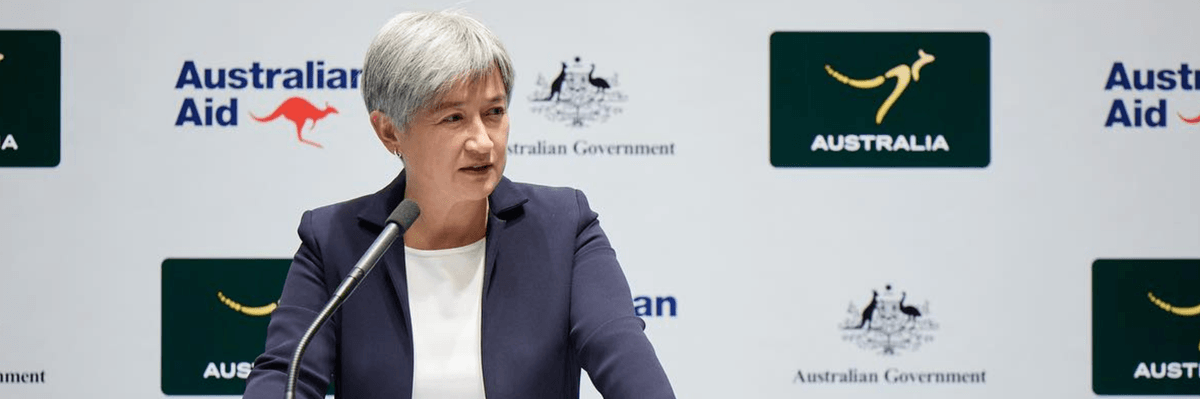
Australian Foreign Minister Penny Wong speaks in Canberra on August 8, 2023. (Photo: Penny Wong/Facebook)

“Restoring UNRWA funding is the bare minimum,” said one Australian Green senator. “The Labor government must publicly pressure Israel to allow aid into all parts of Gaza.”

Australia said Friday that it would reinstate funding for the United Nations United Relief and Works Agency for Palestine Refugees in the Near East, which has lost hundreds of millions of dollars in international financing due to unsubstantiated Israeli claims that UNRWA staff participated in the October 7 Hamas-led attacks on Israel.

“The best available current advice from agencies and the Australian government lawyers is that UNRWA is not a terrorist organization,” Australian Foreign Minister Penny Wong said in Adelaide while announcing a new funding package for the agency, which works to aid Palestinians forcibly displaced during the Nakba, or “catastrophe” through which the modern state of Israel was established in 1948, as well as their descendants.

In addition to restoring $6 million in UNRWA funding, Wong said Australia would contribute another $2 million to the United Nations Children’s Fund and would deploy a C-17 Globemaster transport plane to assist humanitarian airdrops over Gaza.

Sen. Mehreen Faruqi of New South Wales and the Australian Greens welcomed the shift, asserting that “restoring UNRWA funding is the bare minimum” Australia should do.

“The Labor government must publicly pressure Israel to allow aid into all parts of Gaza,” Faruqi stressed. “Starvation is a weapon of war, and Israel is blocking aid to reach the people of Gaza in brazen contravention of the [International Court of Justice’s] ruling” ordering Israel to prevent genocidal acts.

“I hope this is the start of the Labor government breaking away from their unquestioning and immoral support for Israel,” the senator added.

Simon Birmingham, leader of the center-right Liberal opposition in the Senate, said his party does not support the Labor government of Prime Minister Anthony Albanese “acting without and ahead of the United States in terms of decisions around this funding.”

Following Israeli claims—reportedly extracted from Palestinian prisoners in an interrogation regime rife with torture and abuse—that 12 of the more than 13,000 UNRWA workers in Gaza were involved in the October 7 attack, Australia and nine other nations including the United States cut off funding to the largest humanitarian aid organization operating in the besieged coastal enclave.

UNRWA subsequently terminated nine employees in response to the unfounded Israeli claims, without any evidence to support their firing. UNRWA Commissioner-General Philippe Lazzarini later called the move an act of “reverse due process.”

The European Union and nations including Canada and Sweden have also reinstated funding for UNRWA, which Lazzarini said “is facing a deliberate and concerted campaign to undermine its operations.” The agency has been struggling to provide shelter, aid, and other lifesaving services to Gazans facing not only Israeli bombs and bullets but also a genocidal siege and blockade that are starving Palestinians to death.

Australia’s decision came as Israeli attacks on aid convoys, food distribution centers, and desperate, starving Palestinians in Gaza continued. On Thursday, Israeli forces killed at least 20 people and wounded more than 150 others as they awaited delivery of humanitarian aid at the Kuwait Roundabout in Gaza City. The previous day, a UNRWA staffer was among five people killed and more than 20 wounded in an attack on a food distribution center in Rafah, Gaza’s southernmost city. Israeli officials claimed the slain man was a Hamas commander.

According to UNRWA, at least 165 of the agency’s staff members have been killed since October 7. Over 150 UNRWA facilities have been attacked by Israeli forces, while more than 400 Palestinians have been slain while seeking shelter under the United Nations flag.

UNRWA also says its workers have been tortured by Israeli troops trying to force them to falsely confess to participating in the October 7 attacks.

Gaza officials said earlier this week that at least 400 Palestinians seeking humanitarian aid have been killed by Israeli forces since the February 29 “Flour Massacre,” in which at least 118 people were killed and more than 760 others wounded while waiting for an aid convoy in Gaza City.

More than 112,000 Palestinians have been killed or wounded in Gaza since October 7, including people missing and presumed dead and buried beneath the rubble of the strip’s hundreds of thousands of bombed-out buildings. The majority of the dead are women and children. Around 90% of Gaza’s 2.3 million people have been forcibly displaced. Disease and starvation are rampant, and a growing number of Palestinians—mostly children but also elders and other vulnerable people—are starving to death.

After 161 days of near-constant slaughter, there is still no cease-fire in sight.

Original article by BRETT WILKINS republished from Common Dreams under Creative Commons (CC BY-NC-ND 3.0). 

Continue ReadingAustralia Restores UNRWA Funding as Israel Kills Aid Workers, Starving Gazans