This work by Middle East Monitor is licensed under a Creative Commons Attribution-NonCommercial-ShareAlike 4.0 International License.
Israeli forces demolish a two-storey Palestinian-owned building, claiming it lacked a permit, during a military raid in the city of Nablus, located in the West Bank on February 17, 2026. [Issam Rimawi – Anadolu Agency]
The United Nations has warned of “ethnic cleansing” committed by Israel in the occupied West Bank, citing the displacement of more than 36,000 Palestinians over the past year.
In a report released on Tuesday, the Office of the UN High Commissioner for Human Rights said the scale of displacement represents “forced displacement on an unprecedented scale”, raising concerns about a coordinated policy of mass transfer.
The report stated that the developments suggest efforts aimed at permanent displacement of Palestinians from parts of the occupied territories.
It also documented a sharp rise in Israeli settler violence, recording 1,732 attacks causing injuries or property damage in the past 12 months, compared with 1,400 incidents in the previous period.
According to the report, these attacks have included intimidation, destruction of homes, and damage to agricultural land, contributing to worsening living conditions for Palestinian communities.
The UN described the violence as “coordinated, strategic and widespread”, adding that it often occurs with near-total impunity. It also stated that Israeli authorities play a “pivotal role” in enabling or facilitating such actions.
The report highlighted a significant escalation during the olive harvest season in October, when 42 attacks injured 131 Palestinians, including women and children — the highest monthly toll recorded since 2006.
It added that increasing restrictions on farmers’ access to their land, alongside the involvement of armed settlers and soldiers, have made the most recent harvest season the worst in decades.
The UN called on Israeli authorities to immediately halt settlement expansion and take steps to prevent further displacement and violence, warning that continued developments could further destabilise the situation in the occupied West Bank.
This work by Middle East Monitor is licensed under a Creative Commons Attribution-NonCommercial-ShareAlike 4.0 International License.
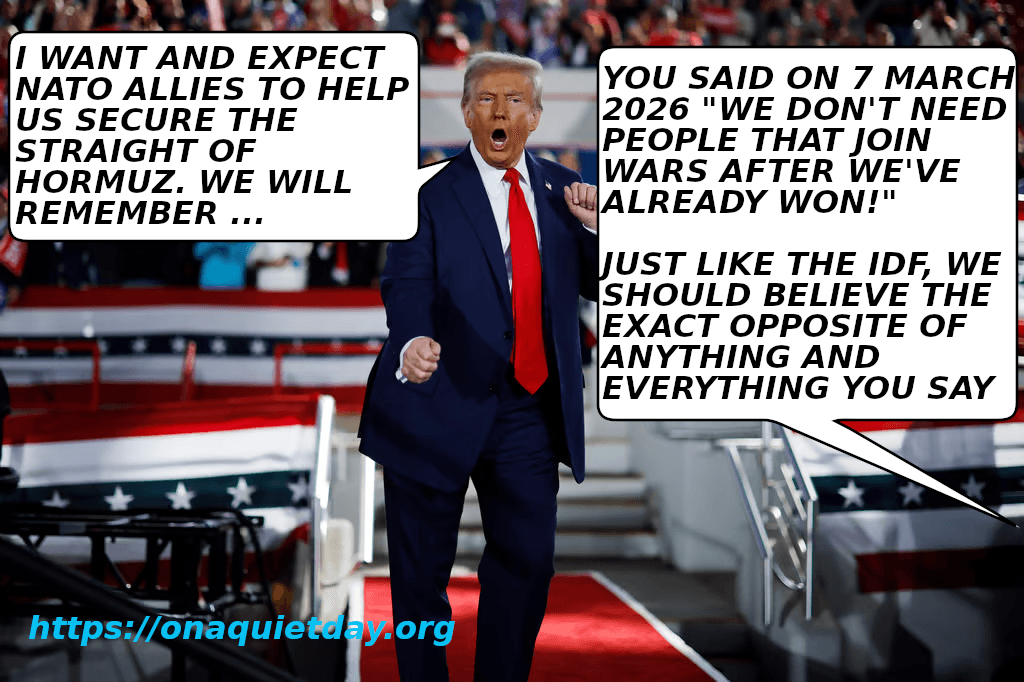
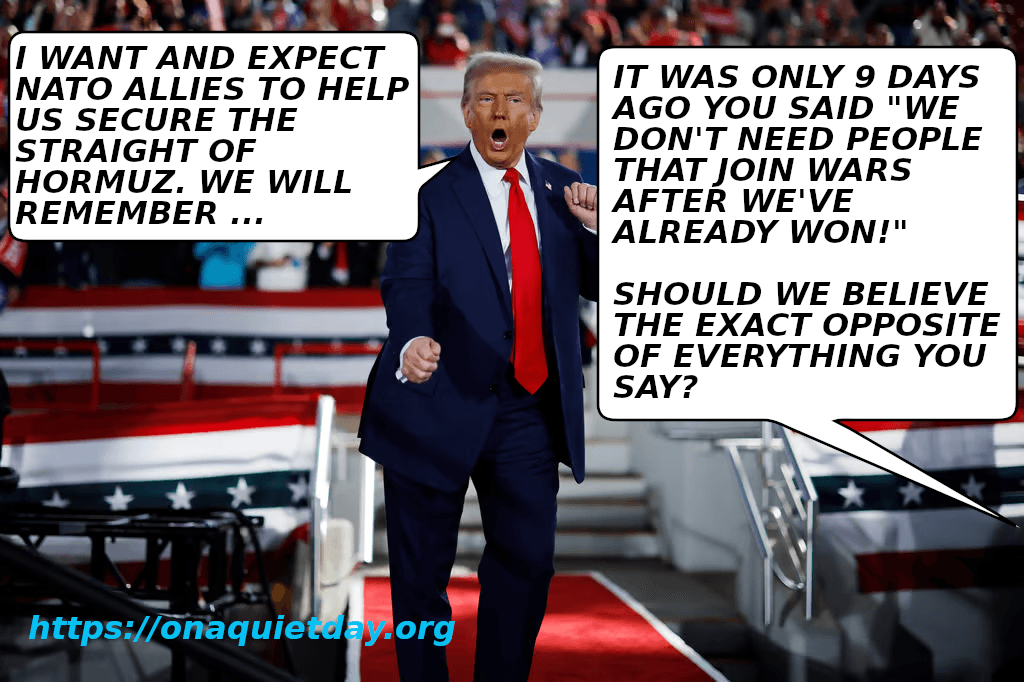
Orcas discuss Genocide-supporting and complicit Zionists. Donald Trump, Keith Starmer, David Lammy, Rachel Reeves, Angela Rayner and Wes Streeting are acknowledged as evil genocide-complicit and supporting cnuts.Donald Trump sings and dances, says that it’s fun to kill everyone … https://www.youtube.com/shorts/cNKBW5LLMlsDonald Trump calls for help from NATO allies in securing the Straight of Hormuz despite saying only 9 days ago that they don’t need people to join wars after they’ve already won. https://www.bbc.com/news/articles/c9dn3j04lydo
United Nations Secretary-General António Guterres holds a press briefing outlining his priorities for 2026 at the United Nations headquarters in New York, United States, on January 29, 2026. (Photo by Selcuk Acar/Anadolu via Getty Images)
As the world’s largest economy, the US provided nearly a quarter of the UN’s funding. That is, until earlier this month, when Trump stripped hundreds of millions of dollars from dozens of treaties.
Weeks after President Donald Trump withdrew the US from dozens of United Nations organizations, the UN’s chief warns that the UN is at risk of an “imminent financial collapse.”
“The crisis is deepening, threatening program delivery and risking financial collapse. And the situation will deteriorate further in the near future,” UN Secretary-General António Guterres wrote in a letter to ambassadors dated January 28, according to a Friday report from Reuters.
While he did not reference the United States explicitly, Guterres called out the fact that “decisions not to honor assessed contributions that finance a significant share of the approved regular budget have now been formally announced,” which almost certainly referenced Trump’s pullout from at least 66 international treaties earlier this month, including 31 within the UN system.
With the stroke of a pen, Trump reneged on the US commitment to the UN Framework Convention on Climate Change, which it has been part of for more than 30 years. He also took the US out of the UN International Law Commission, the UN Democracy Fund, UN Oceans, UN Women, and dozens of other global bodies, deeming them “contrary to the interests of the United States.”
As the world’s largest economy, the US was the largest source of funding for the UN, providing 22% of its regular and peacekeeping budgets as of 2025—about $820 million per year.
The largest single financial cut as a result of the US pullout was the termination of dozens of grants worth approximately $377 million for the UN Population Fund, which focuses on family planning and preventing maternal mortality and sexual violence in developing nations. The organization is estimated to have prevented 39,000 maternal deaths and 18 million unwanted pregnancies in 2024, according to an annual report.
Warning that cash could run out by July, Guterres said, “Either all member states honor their obligations to pay in full and on time–or member states must fundamentally overhaul our financial rules to prevent an imminent financial collapse.”
Elon Musk urges you to be a Fascist like him, says that you can ignore facts and reality then.Donald Fuhrump says that Amerikkka doesn’t bother with crimes or charges anymore, not being 100% Amerikkkan and opposing his real estate intentions is enough.Orcas discuss how Trump was re-elected and him being an obviously insane, xenophobic Fascist.
This work by Middle East Monitor is licensed under a Creative Commons Attribution-NonCommercial-ShareAlike 4.0 International License.
Palestinians, including children, wait with pots to receive hot meals distributed by charity organizations, as people struggle with hunger due to the Israeli food blockade at Nuseirat refugee camp in Deir al-Balah, Gaza, on October 15, 2025. [Moiz Salhi/Anadolu via Getty Images]
The United Nations has confirmed that it has received a message from Israel stating that the number of aid trucks allowed into Gaza will be reduced by half. This reduction affects the previously promised 600 trucks set to be allowed passage following the ceasefire.
UN Deputy Spokesperson Farhan Haq said at a press conference on Tuesday that Israel’s Coordinator of Government Activities in the Territories (COGAT) had informed the UN in a letter that the number of humanitarian aid trucks heading to Gaza would be cut by 50 per cent. According to the message, the decision was made on the grounds that Hamas has not yet returned the bodies of Israeli captives.
“We are aware of the message sent by Israel’s COGAT,” Haq said.
He added that the United Nations wants as much aid as possible to reach Gaza, stating: “We call on all parties to abide by their commitments, including the return of the bodies of deceased prisoners, and to implement the remaining provisions of the ceasefire agreement, most notably ensuring the flow of humanitarian aid to civilians in the Gaza Strip.”
US media outlets earlier reported that Israel had informed the UN of its intention to cut the agreed number of daily aid trucks entering Gaza under the ceasefire terms from 600 to 300, citing Hamas’s failure to promptly return the bodies of all Israeli captives believed to be trapped under the rubble.
This work by Middle East Monitor is licensed under a Creative Commons Attribution-NonCommercial-ShareAlike 4.0 International License.
Keir Starmer objects to criticism of the IDF. He asks how could anyone object to them starving people to death, forced marches like the Nazis did, bombing Gaza’s hospitals and universities, mass-murdering journalists, healthworkers and starving people queuing for food, killing and raping prisoners and murdering children. He calls for people to stop obstructing his genocide for Israel.Genocide denier and Current UK Prime Minister Keir Starmer is quoted that he supports Zionism without qualification. He also confirms that UK air force support has been essential in Israel’s mass-murdering genocide. Includes URLs https://www.declassifieduk.org/keir-starmers-100-spy-flights-over-gaza-in-support-of-israel/ and https://youtu.be/O74hZCKKdpAGenocide denying UK Foreign Secretary David Lammy says that UK is suspending 30 of 350 arms licences to Israel. He also confirms the UK government’s support for Israel’s Gaza genocide and the UK government and military’s active participation in genocide.
This work by Middle East Monitor is licensed under a Creative Commons Attribution-NonCommercial-ShareAlike 4.0 International License.
Gustavo Petro, Colombia’s president, during the United Nations General Assembly (UNGA) in New York, US, on Tuesday, Sept. 23, 2025. [Photographer: Michael Nagle/Bloomberg via Getty Images]
In one of the most daring and controversial political interventions to echo through the halls of the United Nations in decades, Colombian President Gustavo Petro, in his address to the UN General Assembly on 23 September 2025, called for the creation of an international army that transcends the traditional balance of power and whose first mission would be the liberation of Palestine from Israeli occupation and the cessation of the ongoing genocide in Gaza.
The speech drew widespread global attention, opening the door to a complex debate on the future of the international order, the limits of international law, and the possibility of a fundamental transformation toward a new architecture of international relations that moves beyond bipolarity and the centrality of U.S. power.
Petro: The end of words and the beginning of action
In his speech, President Gustavo Petro sharply criticised the current international order, asserting that a world dominated by a single power and complicit in genocide cannot credibly claim to defend democracy or human rights. He emphasised that statements and declarations are no longer sufficient amid the mass killings in Gaza, calling for the creation of an international armed force composed of states that reject genocide, tasked with protecting threatened populations and enforcing international justice. Petro declared: “We need a strong army of nations that do not accept genocide… We must gather weapons and armies. We must liberate Palestine.”
Invoking Simón Bolívar, he added: “We are tired of words… It is time for the sword of liberty or death.”
In later remarks posted on X (formerly Twitter), Petro announced plans to submit a draft resolution to the UN General Assembly to establish a “global army for justice,” with its first mission focused on liberating Palestine,” marking a dramatic call for action over [sic]
Petro’s proposal marks a significant shift in international political discourse. Since the UN’s founding in 1945, international forces have primarily focused on post-conflict peacekeeping, operating under limited mandates and with Security Council approval. Petro, however, envisions a force designed not to maintain the status quo but to actively change it, intervening militarily to prevent genocide and end occupation. This transition from neutrality to action challenges core principles of international law, including state sovereignty and non-intervention, while contesting the Security Council’s monopoly, particularly its five permanent members, over the authorised use of force. Petro suggested that such a force could be established through the General Assembly, referencing the 1950 “Uniting for Peace” resolution, when the Assembly bypassed a deadlocked Security Council to authorize military intervention in Korea, setting a precedent for acting when conventional mechanisms fail.
Enormous political and legal obstacles
Despite Petro’s bold proposal, formidable obstacles make its near-term realization highly unlikely. The UN’s legal framework restricts the use of force to the Security Council, where the US holds veto power and would never allow the creation of a force that could act against Israel, its key Middle Eastern ally. Geopolitical realities also hinder the formation of a global coalition outside the Western security umbrella. Even countries critical of Israeli policies, including EU members and Global South states, may resist joining a force that risks direct confrontation with Israel or the U.S Additionally, there is a significant lack of collective political will: while smaller and medium-sized states often use strong rhetoric, turning such words into military action demands a consensus that is currently absent. Past struggles to reform the Security Council or establish war crimes tribunals underscore how difficult it is to translate ambitious ideas into action within today’s entrenched power structures.
The significance and timing of Petro’s speech
Despite significant practical obstacles, Petro’s speech carries profound symbolic and political weight in shaping global discourse on Palestine and the international order. He reframes the Palestinian issue from a mere “conflict” to an act of “genocide,” shifting the debate from political negotiation to one centered on liberation and international justice. His references to “Bolívar’s sword” and an “army of justice” seek to place Palestine at the core of a broader struggle against double standards and for global legitimacy.
Moreover, Petro’s call sparks renewed debate on reforming the United Nations. Beyond advocating for a force dedicated to Palestine, he highlights the failure of the current system to prevent genocides in Rwanda, Syria, Myanmar, and now Gaza. The proposed army thus symbolizes a deeper demand for rebuilding the international order on fairer, more pluralistic foundations.
Finally, the speech underscores a shift within the Global South. From Colombia to South Africa and Brazil, states on the geopolitical periphery are increasingly using the UN stage to challenge the Global North’s dominance and redefine concepts of legitimacy. Petro’s message aligns with this momentum, adding new strategic depth to the Palestinian cause within emerging international alliances.
President Petro’s speech comes at a critical moment, as Gaza endures one of the most brutal Israeli military campaigns since the Nakba. UN agencies and human rights organizations, including OCHA, Oxfam, and Human Rights Watch, report the killing of tens of thousands of civilians and the widespread destruction of vital infrastructure, including hospitals, schools, and relief centers. The UN has also documented the deaths of hundreds of humanitarian workers, in what international organizations describe as the largest targeting of the humanitarian sector in modern conflict.
In this context, Petro’s speech becomes more than a theoretical proposal, it is a cry against a world that remains silent in the face of genocide. His call to form an “army of justice” is, at its core, an expression of the failure of the international system to fulfill its most fundamental duty: protecting civilians and enforcing international law.
And while the idea may be unattainable at present, it exposes the glaring gap between the UN’s rhetoric and its reality, opening the door to rethinking the mechanisms of collective international action.
Conclusion
President Petro’s project to form an international army to liberate Palestine may seem, in the realpolitik balance, a utopian dream difficult to achieve amid current power dynamics. Yet, in the realm of symbolic and strategic politics, it reflects a profound shift in how international justice, Palestine, and the global order itself are conceived.
The speech will not change the world tomorrow, but it could mark a turning point in a longer trajectory toward reshaping international institutions so that they are capable of confronting genocide and injustice. And just as Simón Bolívar’s words once ignited the liberation of entire continents, President Petro’s speech may, even if only in the long run, be the spark that drives the world to contemplate a global army for justice, one whose first mission would begin in Gaza, if Gaza, as we know it, still exists.
The views expressed in this article belong to the author and do not necessarily reflect the editorial policy of Middle East Monitor.
Genocide denier and Current UK Prime Minister Keir Starmer is quoted that he supports Zionism without qualification. He also confirms that UK air force support has been essential in Israel’s mass-murdering genocide. Includes URLs https://www.declassifieduk.org/keir-starmers-100-spy-flights-over-gaza-in-support-of-israel/ and https://youtu.be/O74hZCKKdpAKeir Starmer objects to criticism of the IDF. He asks how could anyone object to them starving people to death, forced marches like the Nazis did, bombing Gaza’s hospitals and universities, mass-murdering journalists, healthworkers and starving people queuing for food, killing and raping prisoners and murdering children. He calls for people to stop obstructing his genocide for Israel.Vote Labour for Genocide.
This work by Middle East Monitor is licensed under a Creative Commons Attribution-NonCommercial-ShareAlike 4.0 International License.
Relatives and loved ones of Palestinians, who lost their lives in an Israeli attack on the ez-Zeytun neighborhood, mourn the deceased as the bodies are being taken to El Ehli Baptist Hospital for funeral in eastern Gaza City, Gaza on August 6, 2025. [Khames Alrefi – Anadolu Agency]
The United Nations said on Thursday it opposes expanding the Israeli offensive in the Gaza Strip.
Farhan Haq, Deputy Spokesman for the UN Secretary-General, said in New York: “We stand firmly against any escalation of the conflict. It’s already been extremely ruinous.”
He noted that the fighting has already claimed “more than 60,000 people” over nearly two years of war.
Haq warned of “the prospect of huge levels of humanitarian suffering, including potential starvations that could worsen if the conflict gets worse.”
His remarks came as Israel’s security cabinet convened later that day to discuss further steps in the Gaza war.
Israeli Prime Minister Benjamin Netanyahu reiterated his support for the full occupation of Gaza, despite opposition from military leaders, amid concerns that intensifying the fighting could endanger the remaining hostages held by Hamas.