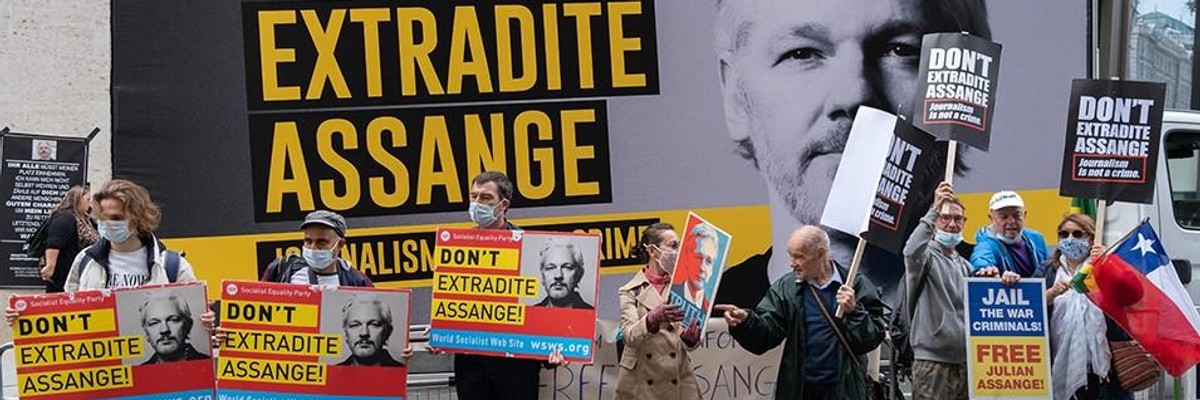
Original article by BRETT WILKINS republished from Common Dreams under Creative Commons (CC BY-NC-ND 3.0).
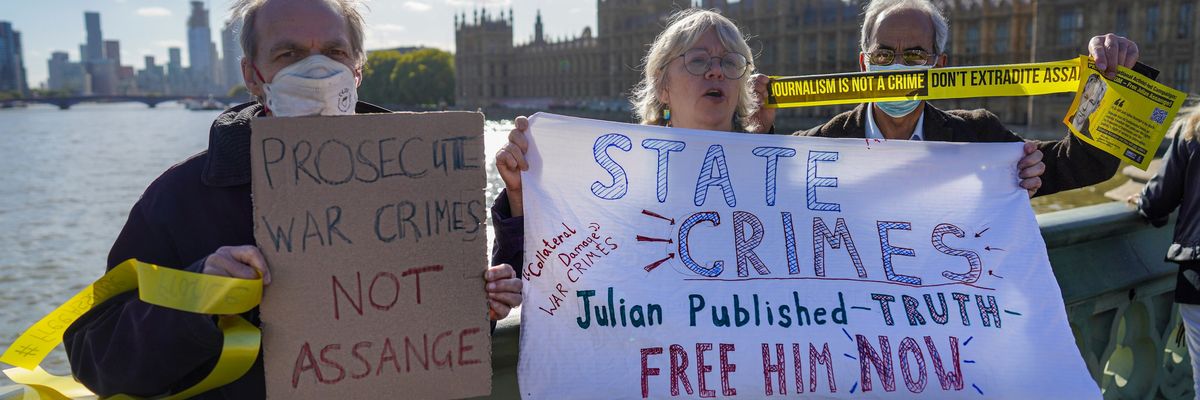
“The risk to publishers and investigative journalists around the world hangs in the balance. Should Julian Assange be sent to the U.S. and prosecuted there, global media freedoms will be on trial, too.”
Amnesty International on Tuesday renewed its call for the U.S. government to drop charges against jailed WikiLeaks publisher Julian Assange, whose final hearing before the United Kingdom’s High Court regarding his extradition to the United States is fast approaching.
Assange’s February 20-21 hearing before the High Court will determine whether the Australian journalist—who has been imprisoned in London’s Belmarsh Prison since April 2019—has exhausted all of his U.K. appeals and will be extradited to the United States, where he has been charged with violating the 1917 Espionage Act and the Computer Fraud and Abuse Act for publishing classified U.S. military documents and files on WikiLeaks over a decade ago.
“The risk to publishers and investigative journalists around the world hangs in the balance. Should Julian Assange be sent to the U.S. and prosecuted there, global media freedoms will be on trial, too,” said Julia Hall, Amnesty International’s expert on counterterrorism and criminal justice in Europe.
“Assange will suffer personally from these politically motivated charges and the worldwide media community will be on notice that they too are not safe,” Hall added. “The public’s right to information about what their governments are doing in their name will be profoundly undermined. The U.S. must drop the charges under the Espionage Act against Assange and bring an end to his arbitrary detention in the U.K.”
Among the materials published by WikiLeaks are the Afghanistan and Iraq war logs, which revealed U.S. and coalition war crimes, many of them leaked by American whistleblower Chelsea Manning. Perhaps the most infamous of the leaks is the so-called “Collateral Murder” video, which shows U.S. Army attack helicopter crews laughing as they gunned down a group of Iraqi civilians that included journalists and children.
While the soldiers and commanders implicated in the materials published by WikiLeaks have largely enjoyed impunity, Manning served seven years in prison before her sentence was commuted by outgoing U.S. President Barack Obama in 2017. Meanwhile, Assange faces up to 175 years behind bars if found guilty of all charges against him.
According to the United Nations Working Group on Arbitrary Detention, Assange has been arbitrarily deprived of his freedom since he was arrested in December 2010. Since then he has been held under house arrest, confined for seven years in the Ecuadorean Embassy in London while he was protected by the administration of former Ecuadorean President Rafael Correa, and jailed in Belmarsh.
In 2019, Nils Melzer, then the U.N. special rapporteur on torture, said Assange was showing “all symptoms typical for prolonged exposure to psychological torture.”
In a development related to Assange’s case, a federal judge earlier this month sentenced Joshua Schulte of New York to 40 years in prison in part for giving WikiLeaks “Vault 7,” a series of documents detailing the CIA’s surveillance and cyberwarfare activities and capabilities.
On Monday, the CIA—which during the Trump administration mulled assassinating Assange—invoked its state secrets privilege in a bid to block a lawsuit by the publisher’s attorneys. The suit alleges that CIA operatives “blatantly violated” the rights of lawyers and journalists visiting Assange in the Ecuadorean Embassy in London by conducting unconstitutional searches and seizures of their electronic devices.
Acclaimed U.S. film director Oliver Stone released a video over the weekend to draw attention to protests on “Day X”—what Assange supporters are calling his upcoming hearing—and Assange’s continued “illegal detention.”
“The world needs to be reminded, and so does Julian,” said Stone. “He’s one of us. He’s more than that, he is the collective us. If he goes down a part of each one of us goes down.”
In New York City, activist and political satirist Randy Credico, host of “Julian Assange: Countdown to Freedom”on WBAI radio and the Progressive Radio Network, will be co-piloting billboard trucks with “Free Assange” messages until the London hearing, according toCounterPunch.
Meanwhile in France, Russian artist Andrei Molodkin is attracting global attention for threatening to destroy a collection of works by artists including Picasso, Rembrandt, and Andy Warhol that he has amassed if Assange—who suffers from a host of health issues—dies in prison.
Original article by BRETT WILKINS republished from Common Dreams under Creative Commons (CC BY-NC-ND 3.0).
- ‘Freedom For Assange And Journalism Are At Stake’: Belmarsh Tribunal Comes To DC ›
- US Lawmakers Implore DOJ To Drop ‘Unprecedented’ Charges Against Julian Assange ›
- Press Freedoms Under ‘Grave Threat’ As British Court Rules Assange Can Be Extradited To US ›
- ‘Journalism Is Not A Crime’: Outrage As Judge Approves Assange Extradition To US ›
- After UK Rejects Appeal, Press Freedom Groups Say Biden Must Drop Assange Extradition Push ›
- ‘A Chilling Message To Journalists The World Over’: UK Approves Assange Extradition To US ›
- US Lawmakers Renew Call For Biden To Drop Charges Against Julian Assange ›