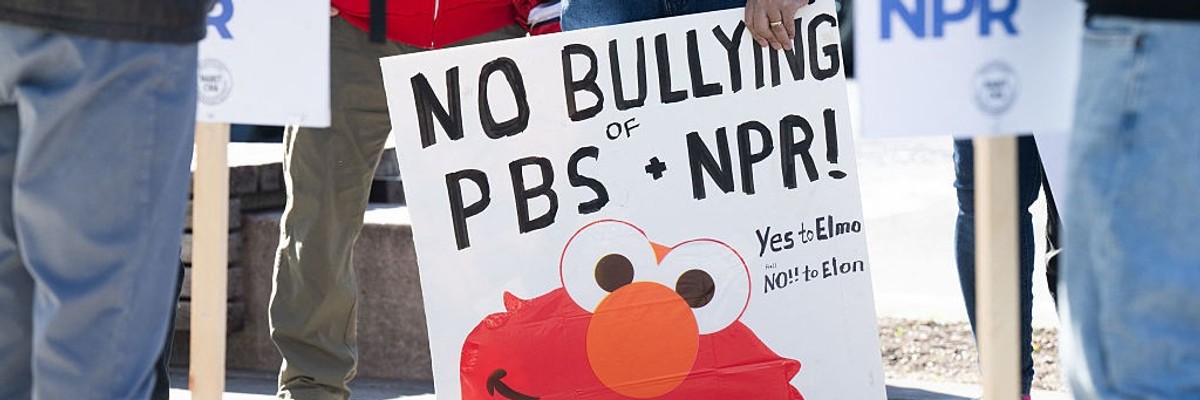
People participate in a rally to call on Congress to protect funding for US public broadcasters, Public Broadcasting Service (PBS) and National Public Radio (NPR), outside the NPR headquarters in Washington, DC, on March 26, 2025. (Photo by Saul Loeb / AFP via Getty Images)
Anything representing the idea that the state could in any way contribute to the greater good is horrific and must be crushed.
The Trump Administration has announced its intention to withdraw over $1 billion in funding for the Corporation for Public Broadcasting (CPB), the organization that supports public broadcasting in the United States in the form of the Public Broadcasting Service (PBS) and National Public Radio (NPR).
Although federal funding makes up only a small portion of the overall budgets for these organizations—a combination of private donations, corporate sponsorship, state financing makes up a larger part—the funding is vital for public television and radio in smaller local markets where public or corporate support is difficult to obtain. The cuts would likely kill off those smaller stations and weaken those in larger markets.
In effect, the last traces of public media would disappear from large sections of the United States, leaving them entirely in the hands of corporate media.
This attack on U.S. public media is perhaps the least surprising news imaginable. When I was interviewed last month here in Sweden after Trump effectively shut down Voice of America (VOA), I was asked what could be next on the Republican media agenda. I didn’t hesitate in my response: next would be the de-funding of the nation’s public broadcasting system. To me, it wasn’t a question of if…but when.
In its classic form, public service broadcasting of the type we have here in Europe treats the inhabitants of the country not as potential consumers, but as actual citizens.
The threat to kill public broadcasting in the U.S. is not the same as the killing of Voice of America. Through stations such as Radio Free Europe, VOA had always had been the mouthpiece of the U.S. state. It was part of global U.S. soft power, promoting the nation’s foreign policy and economic interests. It was anything but objective, independent journalism.
PBS and NPR, on the other hand, are something entirely different. They represent an alternative model for how media in the U.S. could be…or, at least, could have been. Created in 1967 under President Lyndon Johnson, and decades after private media giants ABC, NBC, and CBS had been allowed to take near-complete control over U.S. broadcasting, the Corporation for Public Broadcasting was meant to provide U.S. citizens with a non-commercial media alternative.
Unlike their European counterparts, however, which began as well-financed monopolies in the 1920s and 1930s, U.S. public media were born weak. They were never meant to challenge the power of U.S. corporate media.
For the past half century, U.S. public broadcasting has existed at the margins of the national media ecosystem, producing high-quality educational programming and decent news that attracted a predominantly well-educated, urban audience. Low levels of federal funding meant that U.S. public broadcasting, again unlike European counterparts such as Sweden’s SVT or the UK’s BBC, was forced to take money from corporations in order to survive. When I lived in the U.S., PBS took so much “sponsorship” money from oil companies such as ExxonMobil that it was jokingly referred to as the “Petroleum Broadcasting System.”
So, why kill off the last remnants of a media system that attracts only a tiny fraction of the U.S. audience and gets the majority of its financing from non-government sources?
Simple. Because of what it represents.
The Trump administration and its oligarchy of advisors have as their central goal to destroy or undermine any and all institutions in U.S. society that either suggest an alternative to private, corporate control or provide a counter-argument to the myth that the “free market” is the best option for structuring U.S. society: from education to health care to media. The very idea that the state could in any way contribute to the greater good is horrific and must be crushed.
In its classic form, public service broadcasting of the type we have here in Europe treats the inhabitants of the country not as potential consumers, but as actual citizens. In modern societies, absolutely soaked in the logic of consumption, there needs to be at least a few spaces where your value is seen as inherent and not related to how much disposable income you have.
Here in Sweden, for example, that includes not just public broadcasting, but things like universal healthcare and university education. The logic is simple: being informed, being healthy and being educated should not be privileges restricted to those who can afford it. And, a well-informed, healthy and well-educated society benefits everyone.
Public broadcasting in the U.S. is in need of serious reform. And, public broadcasting in Europe isn’t perfect. But, despite their various flaws, their value can be found not only in what they produce in terms of content, but in what they tell people about how society can be structured. That working alternatives exist and can co-exist. That it’s possible to have a free market, but at the same time recognize there are some elements of society too important to be left to the mercies of corporations, billionaires, and profit margins.
For people like Trump and Musk, these non-commercial spaces of citizenship are viruses eating away at profits. But they aren’t the virus.
Neo-Fascist Climate Science Denier Donald Trump says Burn, Baby, Burn.Elon Musk urges you to be a Fascist like him, says that you can ignore facts and reality then.
CECOT prison in El Salvador. Photo: Nayib Bukele/X
The alliance between Trump’s expanding deportation campaign and Salvadoran President Bukele’s carceral authoritarianism has major implications for human rights and the future of democracy.
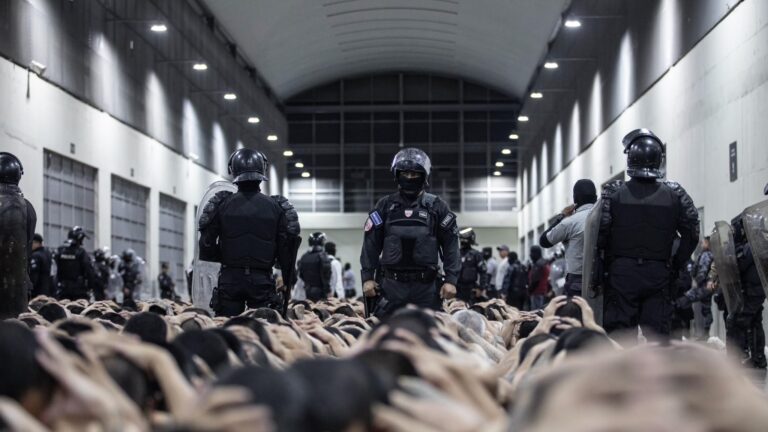
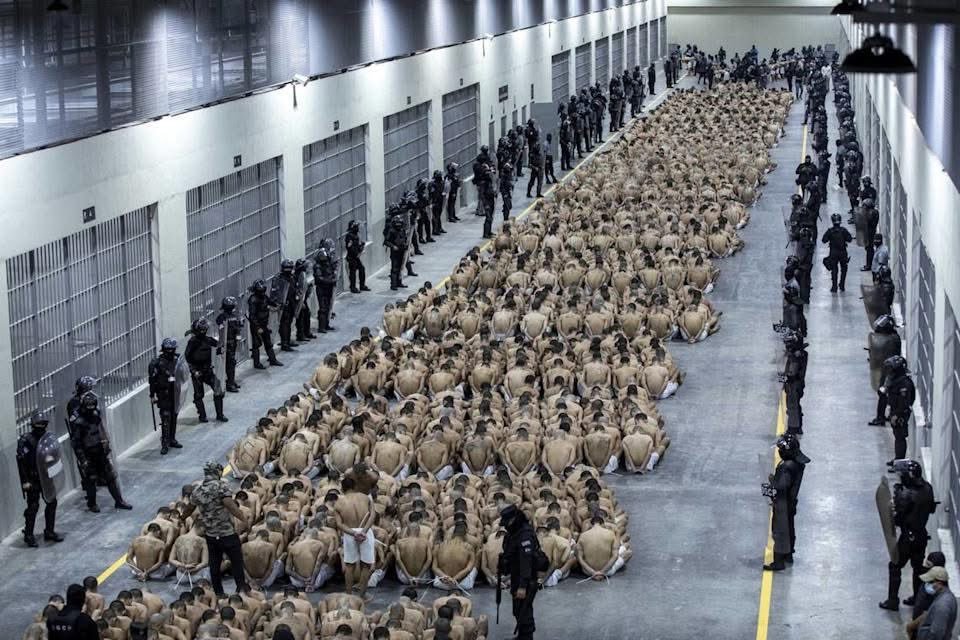
In February 2023, the Salvadoran government released drone footage of thousands of shirtless men with shaved heads, shackled and crouched in tight formation, being herded into a newly built prison called the Center for the Confinement of Terrorism – CECOT.
The high-tech mega-prison was constructed at breakneck speed under the rule of President Nayib Bukele as he declared victory in the so-called “war on gangs” in the country.
Known as the largest prison in the world, CECOT can hold up to 40,000 people. However, plans to expand the mega-prison to double its current capacity (80,000) are already underway, with the US expected to “send enough to fill it,” as reported by the Wall Street Journal.
From state of emergency to state of exception
The year before CECOT’s inauguration, President Nayib Bukele declared a “state of emergency,” suspending constitutional rights like due process, legal defense, and freedom of assembly, and allowing measures like mass arrests, and indefinite pretrial detention.
“CECOT is nothing more than an extermination prison for the poor,” says Marisel Ramírez, a member of the Popular Resistance and Rebellion Bloc, a coalition of Salvadoran trade unions, civil society groups, and political organizations. “The regime invests in mega-prisons instead of health, education, or structural reforms.”
Today, El Salvador’s detention rate has outpaced that of the United States – the former world leader in incarceration by far. 1 in every 57 Salvadorans is now incarcerated, triple the rate of the US.
In March 2025, various human rights organizations in El Salvador, such as Human Rights Institute of the Central American University (IDHUCA); Foundation for the Study and Application of the Law (FESPAD); Passionist Social Service, among others, produced a report compiling documented cases of mistreatment, torture, and the inhumane conditions of detainees over the three years of the “state of exception.” Their findings include:
85,000+ people have been detained by the state during this period
6,889 cases of human rights violations have been filed by human rights organizations
52% of detainees are 19–30 year-old men
265–375 deaths in state custody have been verified by different data agencies
Their report demands the repeal of the “state of exception,” reparations for the families and victims of human rights violations, and independent investigations of all human rights abuses.
Welcome to CECOT
Many of CECOT’s prisoners are denied due process. Visitation is prohibited. Communication with family, friends, and even lawyers is prohibited. Inmates are also completely stripped of privacy. Cells are packed with up to 80 people for 23.5 hours a day. They share metal bunks and an open toilet, under constant surveillance by prison guards. There is no form of education or recreation offered at the facility. Letters and reading material are prohibited. And there are no reports of any inmates being released. CBS News reported El Salvador’s justice minister saying, “the only way out is in a coffin.”
In fact, Google Earth images and videos have recently circulated social media showing a CECOT courtyard that appears to be stained with blood.
CECOT has become a symbol of a global trend towards militarization, mass incarceration, and political repression under the guise of “domestic security.” As Trump’s offshore detention of migrants in CECOT shines an international spotlight on Bukele’s policies, urgent questions are arising:
How far will the US go in utilizing Bukele’s repressive infrastructure for its own agenda?
How did a self-described “dictator” rise to power in El Salvador?
How are communities in El Salvador responding?
CECOT. Photo: CECOT/X
The US – Bukele alliance
While CECOT was built for domestic repression and incarceration, it is now a site of international collaboration between extreme-right-wing governments. Bukele’s prison has been openly endorsed – and now directly funded – by the US government.
On March 15, in an unprecedented move, the Trump administration deported roughly 250 Venezuelan migrants to CECOT prison in El Salvador, ignoring a federal judge’s order to halt the deportations. Invoking the Alien Enemies Act (AEA) of 1798 against Venezuelan nationals accused of being part of the gang Tren de Aragua, Trump attempted to pave a “legal” pathway for his policy of mass deportations. Yet a report from CBS News claims that the majority of those deported have no criminal record in the US, and human rights and advocacy groups have rejected any legal basis for Trump’s use of the AEA.
One of the deportees, a Maryland resident and union worker named Kilmar Abrego Garcia, has become a central figure in the broader legal and political crisis surrounding Trump and Bukele’s authoritarian alliance.
The case of Kilmar Abrego Garcia
Kilmar was born in El Salvador and holds protected status in the US, where he has lived for over 14 years. The Trump administration admitted he was deported in error and the Supreme Court has ordered the US government to facilitate his return. Nevertheless, Trump has defied the order, and Bukele refuses to release Abrego. Recently, Trump has accused Abrego of being part of the Salvadoran gang, MS-13, without evidence or due process.
Since the day CECOT was inaugurated, the government has used social media to promote positive ideas about the prison and Bukele’s iron-grip approach. Far-right politicians and YouTube influencers are regularly welcomed to tour CECOT, posing in front of groups of detainees for their online audiences. However, Maryland Senator Chris Van Hollen was denied entry to the facility on April 16, when he traveled to El Salvador to advocate for Kilmar’s release.
In the late hours of April 17, the senator was finally able to meet with Abrego off-site from the prison. Kilmar’s wife credited the growing movement for justice for this small win in a statement released by the advocacy group CASA:
“Now I know that my husband is alive…Thank you to everyone, including Senator Van Hollen, my CASA family, all our Union’s, faith leaders and community for continuing this fight for my family to be reunited.”
In a press conference held on April 18 in Dulles International Airport, the Maryland Senator told reporters that the Maryland father is not being held at CECOT but is still being illegally detained in a different Salvadoran prison. “The reason they relented is pretty clear — they were feeling the pressure,” said the senator.
The USD 6 million deal behind CECOT
The use of El Salvador’s prison system to detain migrants with no clear end in sight has faced heavy criticism, especially in the wake of the mistaken deportation and detention of Abrego Garcia.
During his visit to El Salvador, US Senator Van Hollen raised this same question to Vice President Félix Ulloa regarding Abrego Garcia, who said that the Trump administration is paying El Salvador to keep migrants like him at CECOT.
The Trump administration has reportedly agreed to pay El Salvador USD 6 million to house hundreds of migrants deported from the US for up to a year. In Van Hollen’s press conference on April 18, he told reporters that the deal between Trump and Bukele may be for as much as USD 15 million.
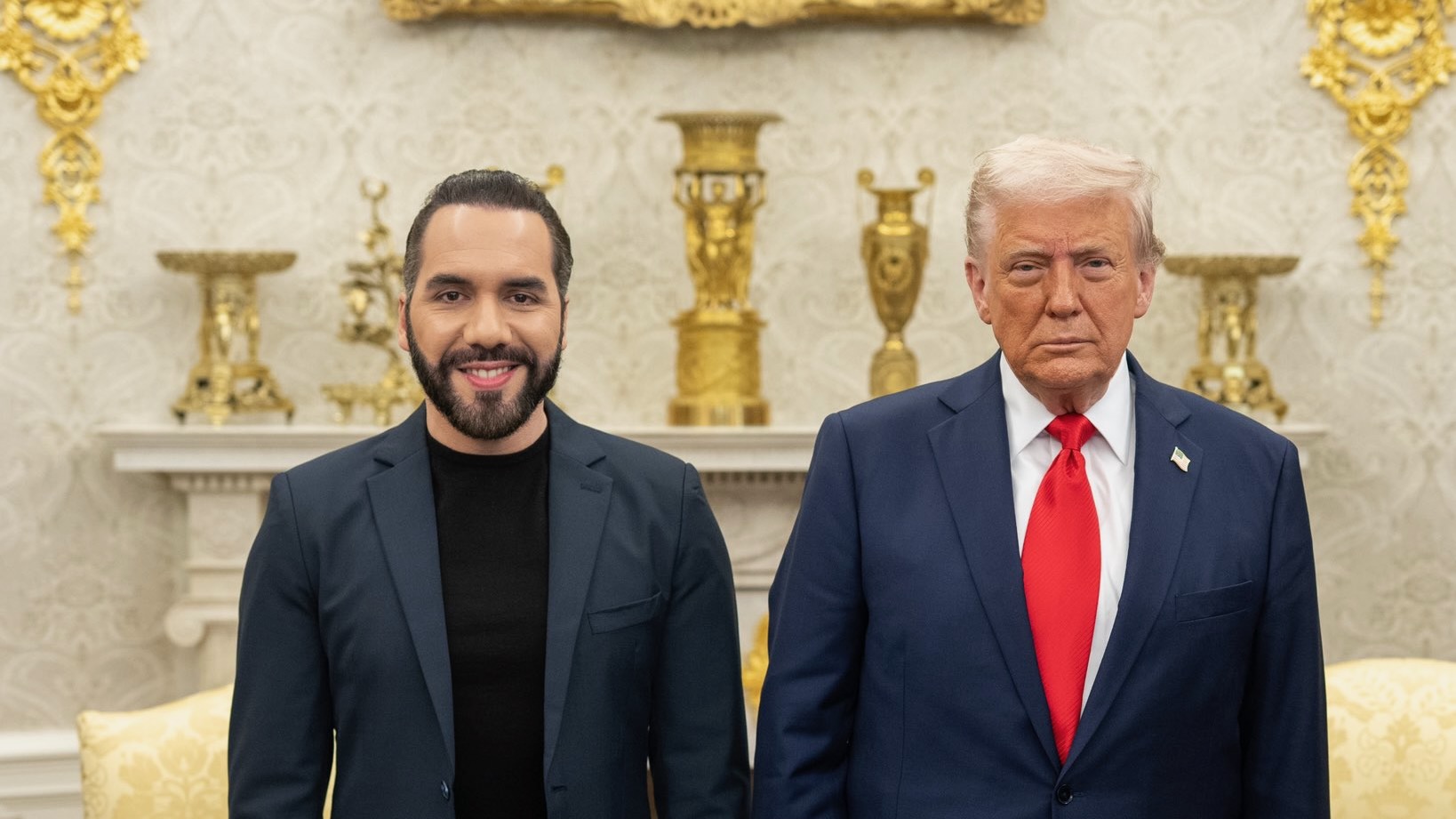
Salvadoran President Nayib Bukele and US President Donald Trump at the White House on April 14. Photo: White House/X
“Homegrowns are next”
However, migrants are not the only ones being targeted for deportation to CECOT. During Bukele’s White House visit on April 14, Trump was recorded saying he wants to send US citizens to CECOT too. The “homegrown criminals” are next. “You’ve got to build about five more places,” he said. To which Bukele responded, “we’ve got space.”
Legal experts and human rights organizations have asserted that the offshore detention of US citizens is illegal, but Trump confirmed “We are looking into it, and we want to do it.”
The US – Bukele alliance represents a convergence in the growing international authoritarian trend. But this alliance didn’t emerge overnight. It is the result of a deliberate political project that Bukele has been advancing for years. But to understand how the country got to this point, we have to look back at how Bukele transformed El Salvador into, as he calls it, a dictatorship.
The world’s “coolest dictator”
For years, El Salvador faced one of the highest homicide rates in the world, driven by the extortion practices of gangs, like MS-13 and Barrio 18. Communities were often caught in the crossfire, with widespread insecurity and little trust in state institutions to protect them. Bukele rose to power promising an end to the violence, using harsh anti-gang rhetoric and militarization to gain popular support amid a climate of fear and frustration.
However, according to organizers with the Popular Resistance and Rebellion Bloc, Bukele’s security policy is based on a pact with the gangs – not a war on them. They explain that while the president claims there are 80,000 gang members and terrorists in prison, the National Civil Police only reports the seizure of 4,000 weapons, 20,000 cell phones, and USD 4 million. There have been no arrests of top gang leaders, nor have those who have committed crimes in the US been extradited to that country.
Movement leaders describe Bukele’s rise as one of clear authoritarianism – cloaked in anti-gang rhetoric, backed by the US, and enforced through mass repression. He enjoys popular support “because people perceive improved security, and he has imposed the idea that traditional parties were corrupt and waged a war that led to tragedies.”
Activists also assert that eliminating the left in the country as a political option has been a deliberate goal of Bukele’s “business clan.” They say Bukele has specifically targeted the FMLN, a former guerilla group that led the armed struggle against US-backed dictatorship in the 1980s, and later helped secure key democratic reforms through the Peace Accords.
“The FMLN is a victim of a smear campaign by the regime…whose influence in the state and society has significantly diminished. After governing for 10 years, the FMLN has no presence in the Legislative Assembly and no longer governs any mayoralties,” reads a statement by the Bloc.
Here is a brief timeline of the Bukele’s rise to power from the perspective of movements on the ground:
2019 – Bukele elected president
Breaking with the two dominant parties (ARENA and FMLN), he formed the party Nuevas Ideas, and presented himself as a young, social media savvy reformist.
2020 – Bukele storms Legislative Assembly with military
Flanked by heavily armed soldiers and police, Bukele enters the Legislative Assembly to pressure lawmakers to approve a USD 109 million loan, in order to further militarize his police and soldiers for the “war on gangs.”
International human rights groups condemn the action, while activists draw connections to El Salvador’s history of military dictatorships.
Replacing judges in the Constitutional Court with loyalists, and removing the Attorney General, Bukele gains unchecked control over all three branches of government.
El Salvador becomes the only country in the world to adopt Bitcoin as a legal tender, despite mass protests.
Bukele’s new court rules that presidential reelection is now legal, ignoring a constitutional ban. Bukele announces his intent to run for reelection in 2024.
Critics argue that a major part of Bukele’s propaganda is the idea that he’s “changing the country,” using symbolic gestures, minor public projects, and some changes to the state like reducing the number of provincial and municipal governments.
2022 – “State of emergency” declared
Following a spike in homicides, Bukele declares a “state of emergency,” suspending constitutional rights, and launching a so-called “war on gangs.”
Mass arrests without warrants begin. Many are detained without evidence or due process. Organizers call the state of emergency a “mechanism of social containment.” They report popular leaders being targeted, generating fear and limiting popular protests.
2023 – CECOT prison unveiled
The 40,000 person-capacity mega-prison is inaugurated with a propaganda blitz displaying prisoners in dehumanizing ways.
Bitcoin investment loses over 50% of its value, costing El Salvador hundreds of millions.
The Bukele family, which owns 12 large companies, monopolizes public procurement and appropriates state resources. The public procurement law is practically repealed, limiting public access to details about government spending and contracts.
2024 – Bukele wins reelection
Despite a constitutional ban on reelection, Bukele runs for president and wins. He is backed by his courts and military, amid a climate of fear and mass imprisonment justified by “domestic security” rhetoric.
The US government supports his illegal reelection.
Political opposition in government has been practically eliminated. 55/60 representatives are from Bukele’s party, NI. 43/44 mayoralities are controlled by NI and its allies. The majority of the population rejects the FMLN and even the traditional, non-governing right parties.
Bukele reverses a landmark ban on metal mining, sparking a nationwide protest movement.
Today, Bukele’s “state of exception” continues indefinitely. Reports of torture, disappearances, and political arrests grow. People’s movements for the freedom of political prisoners, and against the “state of exception” continue to build, the most important of these is the Popular Resistance and Rebellion Bloc.
Meanwhile, the Salvadoran President is promoting himself worldwide as a model far-right leader and enjoying a lucrative alliance with the US government.
Salvadoran resistance
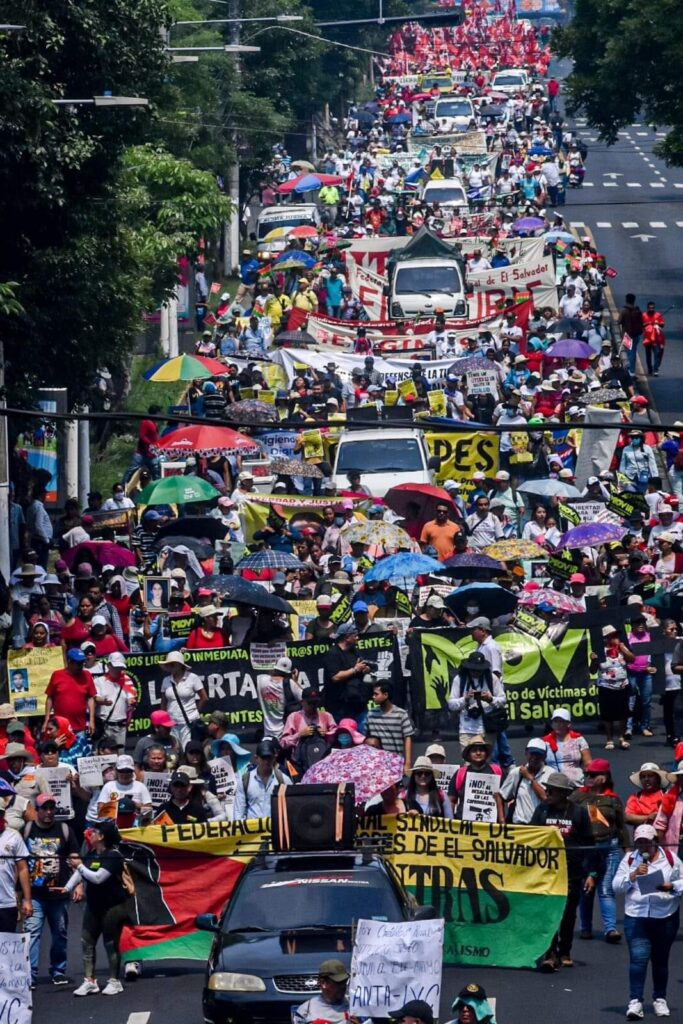
Dozens of organizations march on May 1, 2024. Photo: Bloque de Resistencia y Rebeldía Popular
The Popular Resistance and Rebellion Bloc is an organization of 35 social organizations from various sectors of society: students, women, peasants, unions, professionals, and more.
Marisel Ramírez, a member and organizer with the Bloc, told Peoples Dispatch: “These organizations came together in January 2021 to denounce the major setbacks we have suffered since the Bukele business clan took office, and to demand an end to the government’s repressive policies.”
Explaining the Bloc’s strategies and tactics, Marisel said that “the organizations that belong to the bloc act according to their own demands, highlighting the serious human rights violations committed under the state of emergency.”
She outlined several fronts of their struggle:
1. Movement of Victims of the State of Emergency (MOVIR)
Families of the detainees mobilize their communities and protest the arbitrary arrests, demanding justice and freedom for their loved ones.
2. Salvadoran Student Force
Students are consistently fighting back against the arrests of university students under the state of exception.
3. Feminist Resistance
Women are organizing and mobilizing around the economic, emotional, and familial impacts of the arbitrary arrests of innocent people, as well as the abuse of power by the military and police.
These forces, Marisel said, “demand ‘sexual favors’ in exchange for ‘benefits’ – not taking people away, expediting judicial processes, and access to personal hygiene products.”
4. The Confederation of Salvadoran Agrarian Reform Federations (CONFRAS)
Mobilizes peasants and farm workers and denounces the shortage of agricultural labor caused by the high migration triggered by the state of exception.
Despite Bukele’s iron-grip approach and mass incarceration campaign, resistance in El Salvador is growing – led by families of the detained and disappeared, student organizers, feminist collectives, and peasant unions who refuse to be silenced. Their struggle aims to demonstrate that CECOT is not just a prison – it is a weapon of political power aimed at the poor and fueled by international complicity.
What’s becoming increasingly clear is that the US is seeking to expand its deportation machine and outsource incarceration and repression to third countries like El Salvador. As these transnational policies develop, urgent questions remain: How far will Trump go in bulldozing any legal barriers to utilizing this repressive model? Will US citizens begin facing deportation and detention in CECOT? How will the people in the US respond to this deepening authoritarian alliance?
Neo-Fascist Climate Science Denier Donald Trump says Burn, Baby, Burn.Elon Musk urges you to be a Fascist like him, says that you can ignore facts and reality then.Image of the original Fascists Mussolini and Hitler
Jennifer Vasquez Sura, a U.S. citizen and the wife of Kilmar Abrego Garcia, who was mistakenly deported to El Salvador, speaks to the media before she enters federal court on April 15, 2025 in Greenbelt, Maryland. (Photo: Tasos Katopodis/Getty Images)
“There will be no tolerance for gamesmanship or grandstanding,” the judge said. “Cancel vacations, cancel other appointments… I expect all hands on deck.”
As White House Press Secretary Karoline Leavitt on Tuesday had a “full-blown meltdown” after a reporter asked about the Maryland man wrongly deported to a prison in his native El Salvador, U.S. District Judge Paula Xinis launched an inquiry into the Trump administration’s refusal to seek the return of Kilmar Abrego Garcia to the United States.
The Trump administration has previously admitted in court that Abrego Garcia was mistakenly sent to the notorious Terrorism Confinement Center (CECOT)—despite an immigration judge’s 2019 order barring his deportation to El Salvador—due to an administrative error. Xinis ordered the administration to facilitate his release, a decision unanimously affirmed last week by the U.S. Supreme Court.
However, Abrego Garcia remained imprisoned as the U.S. Department of Justice (DOJ) argued in a Sunday filing that Xinis has “no authority” to compel the administration to bring him home, and as President Donald Trump on Monday welcomed Salvadoran President Nayib Bukele to the White House. Their meeting was followed by a Tuesday court hearing.
According to NBC News: “Attorneys for Abrego Garcia had asked that the administration be found in contempt of court over its inaction. The judge said she wants to review the evidence the administration submits, which is expected to include sworn depositions, before ruling on the matter.”
During the hearing, Drew Ensign of the DOJ told Xinis—who was appointed to the District of Maryland by former President Barack Obama—that if Abrego Garcia “appears at a port of entry or U.S. Embassy we will facilitate his return.”
Meanwhile, the judge called out the administration, saying: “What the record shows is that nothing has been done. Nothing. I asked for reports from individuals with direct knowledge, and I’ve gotten very little information of any value.”
“We’re going to move. There will be no tolerance for gamesmanship or grandstanding,” Xinis continued. “There are no business hours while we do this… Cancel vacations, cancel other appointments. I’m usually pretty good about things like that in my court, but not this time. So, I expect all hands on deck.”
NEW: Judge Xinis authorizes up to 15 interrogatories, 15 document requests, depositions from all govt declarants (Cerna, Katz, Kozak, and Mazzara) and up to two others to assess what the govt has done to "facilitate" Kilmar Abrego Garcia's release storage.courtlistener.com/recap/gov.us…
At the White House on Tuesday, a reporter asked Leavitt who is responsible for Abrego Garcia and where he is going to end up. The press secretary responded by sharing unfounded allegations that he is a “terrorist” and member of the gang MS-13, and said that “deporting him back to El Salvador was always going to be the end result.”
Leavitt also used Bukele’s framing from the Oval Office event, when he suggested that returning the Maryland resident would mean smuggling a terrorist into the country. In addition to Abrego Garcia, the Trump administration has sent 238 Venezuelan migrants to CECOT, and the president on Monday expressed interest in sending “homegrown” American prisoners there.
“This is what mass deportation looks like,” Vanessa Cárdenas, executive director of the advocacy group America’s Voice, said in a Tuesday statement. “The concept of stripping citizenship from U.S. citizens and sending them to El Salvador prisons without due process is the stuff of nightmares and undemocratic regimes, yet here we are.”
“It’s hard to overstate what the stakes are for our democracy and core American principles given what we’re seeing and what the administration is now floating as the next steps in their larger deportation agenda,” Cárdenas added. “And it’s time Americans of all political perspectives stand up and speak out in opposition.”
Some Democrats in Congress have blasted the Trump administration’s anti-immigrant agenda and are part of the battle to bring Abrego Garcia home—including U.S. Sen. Chris Van Hollen of Maryland, who is aiming to travel to El Salvador if the deported man is not swiftly returned to his state. Multiple Democratic members of the House of Representatives have signaled that they plan to join the trip.
Power-mad Neo-Fascist orange gasbag Donald Trump says Burn, Baby, Burn.Elon Musk urges you to be a Fascist like him, says that you can ignore facts and reality then.
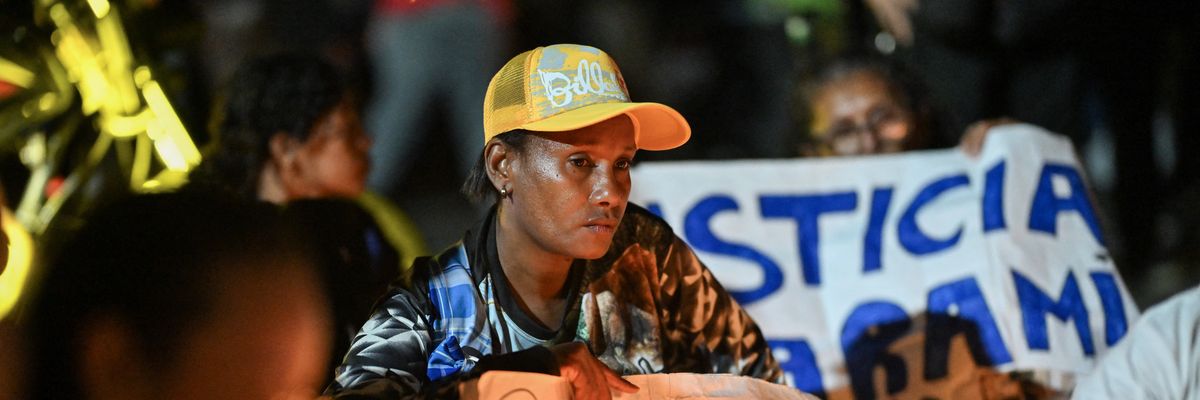
Relatives of Venezuelan migrants deported from the U.S. to a maximum security prison in El Salvador attend a vigil in front of El Salvador embassy in Caracas, Venezuela on April 2, 2025. (Photo: Juan Barreto / AFP via Getty Images)
“The cruelty of the U.S. and Salvadoran governments has put these people outside the protection of the law and caused immense pain to their families,” said one human rights advocate.
Human Rights Watch on Friday accused the governments of the United States and El Salvador of “a grave violation of international human rights law” over the deportation more than 230 Venezuelan nationals by the Trump administration to a megaprison in El Salvador last month.
The actions taken against the deportees constitute both enforced disappearances and arbitrary detention, according to a statement from the group released Friday.
The governments of the United States and El Salvador have subjected more than 200 Venezuelan nationals to enforced disappearances and arbitrary detention.
“The cruelty of the U.S. and Salvadoran governments has put these people outside the protection of the law and caused immense pain to their families,” said Juanita Goebertus, Americas director at Human Rights Watch.
The group said that since their removal, the Venezuelans “have been held incommunicado” and that the United States and Salvadoran officials have not released a list of the people who were removed, though CBS News last month published a list of names the outlet obtained.
The administration invoked the Alien Enemies Act, a rarely used law that gives the president broad authority to detain or deport non-citizens during times of war, to justify dozens of the deportations—triggering a fierce legal battle.
The Trump administration invoked the Alien Enemies Act in response to an alleged “invasion” by “Tren de Aragua,” a Venezuelan gang, but the government has produced scant evidence that the people removed had ties to Tren de Aragua. One hundred and one of the deportees were removed under regular immigration procedures.
According to Human Rights Watch, the Salvadoran government has failed to offer a legal basis for detaining the Venezuelan deportees and has not indicated when or whether they will be released.
“It appears that their detention is wholly arbitrary and potentially indefinite; a grave violation of El Salvador’s human rights obligations,” the group said.
Enforced disappearance, according to Human Rights Watch, is when officials deprive someone of their liberty and then conceal the fate or whereabouts of the disappeared person. The violation is “especially serious” because it means they are outside the protection of the law.
The group is calling on U.S. authorities to publicly identify the Venezuelans who were removed to El Salvador and is urging the Salvadoran government to “confirm their current whereabouts, disclose whether there is any legal basis for their detention, and allow them contact with the outside world.”
The statement from Human Rights Watch also detailed the struggle that family members of the deported individuals have faced getting information about them.
The group has interviewed 40 relatives of people “apparently” removed to El Salvador, and all of them told Human Rights Watch that U.S. immigration authorities initially informed their relatives, who were in U.S. immigration detention, that they would be sent to Venezuela. They were not told they would be sent to El Salvador.
“Nobody should be forced to piece together bits of information from the media or to read into the authorities’ silence to find out where their relatives are being held,” Goebertus said. “Salvadoran authorities should urgently disclose the names and locations of all detainees transferred from the US, and allow them to contact their families.”
In addition to the Venezuelans who were deported in March, the Trump administration also deported a smaller number of Salvadoran nationals. U.S. Immigration and Customs Enforcement has admitted that one of the men sent to El Salvador was deported in “error.” On Thursday, the Supreme Court instructed the Trump administration to take steps to retrieve the man it had wrongly deported.
Neo-Fascist Climate Science Denier Donald Trump says Burn, Baby, Burn.Elon Musk urges you to be a Fascist like him, says that you can ignore facts and reality then.
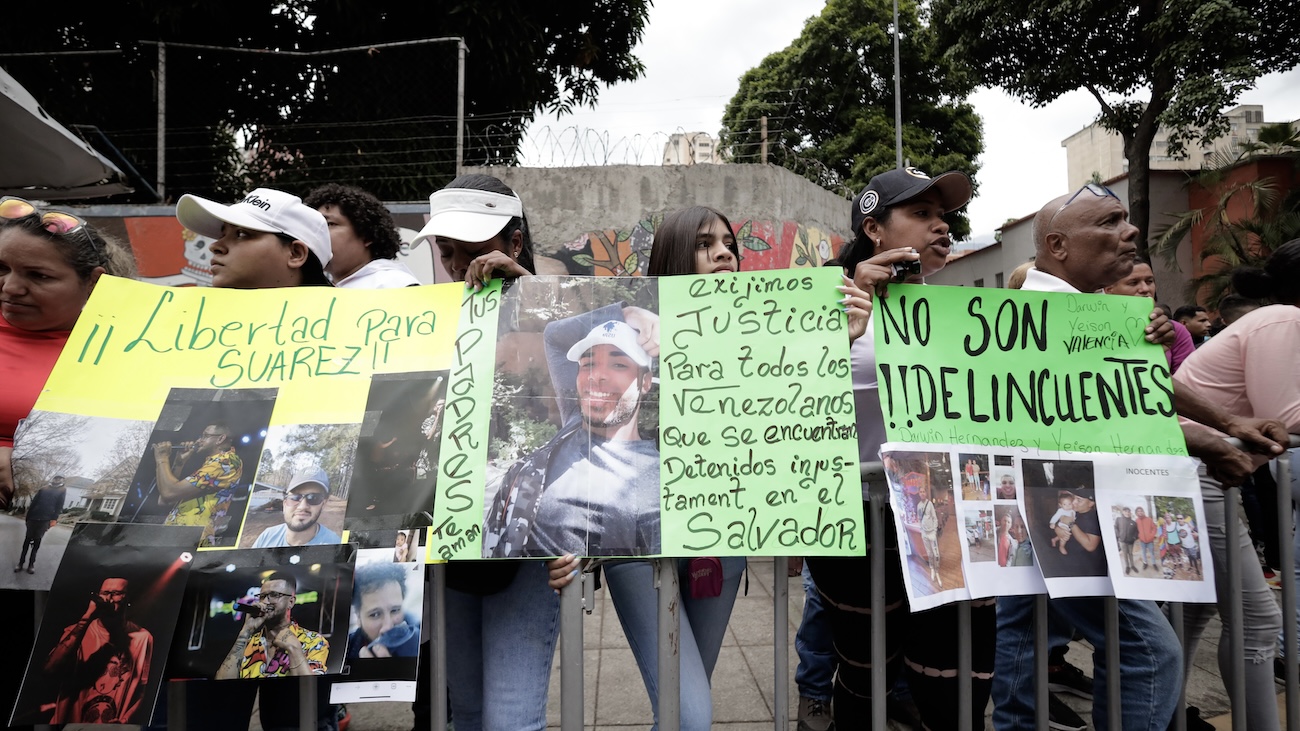
Venezuelans rally against deportations. Photo: Francisco Trias
The Venezuelan government has promised that it will “fight until it frees all its compatriots” who have been imprisoned and deported without evidence thanks to an 18th-century US law.
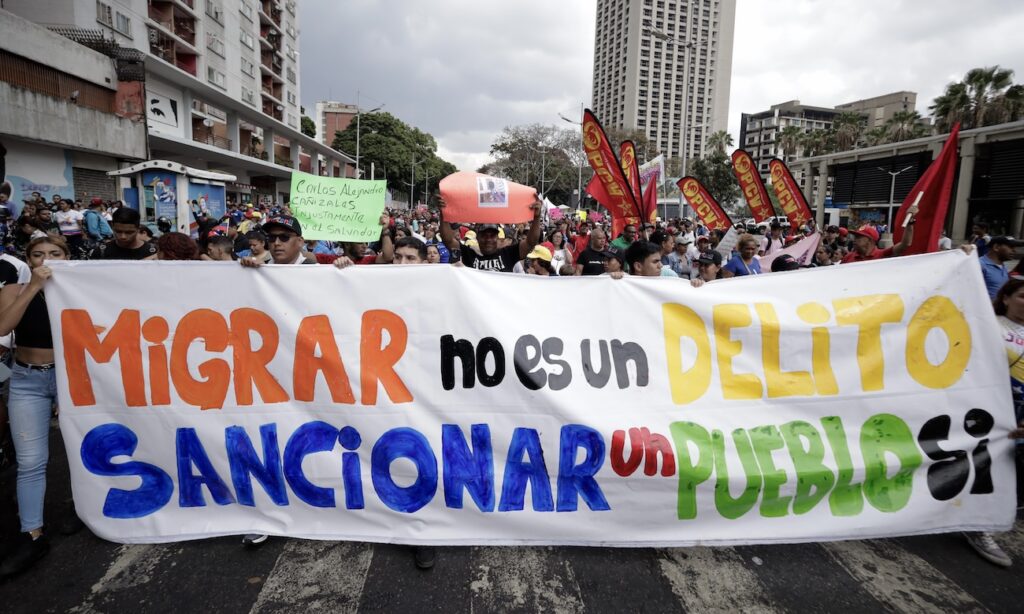
Thousands of Venezuelans rallied in Caracas on Tuesday, March 18, to protest the deportation of Venezuelan migrants from the United States to a high security prison in El Salvador. Family members of the deported migrants addressed Venezuelan officials and fellow citizens to demand the immediate return of their loved ones, with many insisting that their relatives are not criminals or members of the infamous Tren de Aragua as Donald Trump claims.
The mobilization occurred days after the deportation of over 200 migrants to El Salvador in one of the most controversial acts by the administration of Donald Trump during his two months in office. In January, shortly after Trump’s swearing in, Salvadoran President Nayib Bukele had offered up his country’s prisons to take in deported migrants or even the US’ national incarcerated population. It appears that this discussion advanced, and El Salvador, like several other countries in the region, will now provide detention centers for deported migrants, with no clarity of the criteria for who gets sent, how long they stay there, and under what jurisdiction they are. According to the US government, the Venezuelan migrants deported on Saturday all belong to the criminal group called Tren de Aragua (Aragua Train).
The Trump administration has yet to show evidence to back up its accusation.
“It is a massive violation of human rights,” says the Venezuelan government.
For its part, the Venezuelan government has condemned the US-Salvadoran decision as a violation of human rights. Jorge Rodríguez, president of Venezuela’s National Assembly, said in a press conference, “How do the Dantesque images we saw [of the deported Venezuelan migrants] differ from those of the Warsaw ghetto? How does Mr. Bukele’s barbarity when he said that he had bought slave labor differ from the memory of forced labor in the concentration camps of Auschwitz?”
In this sense, the Venezuelan government informed the families of the detainees that it would do everything possible to repatriate the migrants that were deported and now are being indefinitely held in a high security prison in El Salvador with no due process.
In addition, the Secretary of the Interior, Diosdado Cabello questioned the Trump administration’s assertion that the Venezuelans who were deported were part of the “Tren de Aragua” criminal gang. In this regard, Cabello said, “It is a lie that those [deported] to El Salvador are from the Tren de Aragua.”
Maduro accuses Bukele of exercising fascist tactics against Venezuelan migrants
For his part, Venezuelan President Nicolás Maduro publicly rebuked Bukele for the treatment Venezuelans have received in El Salvador, and accused his government of fascist practices: “Are you going to protect this cruelty, this injustice, without [the detainees having] the right to any [judicial process], of creating concentration camps and putting noble working migrants in jails without a [due] trial, without having committed crimes in El Salvador, without having any sentence issued by a court in El Salvador? Is this legal, is this fair, Nayib Bukele?”
In addition, Maduro denounced the treatment suffered by the Venezuelan deportees: “They put them in handcuffs by hands and legs without telling them where they were going, and when they arrived in El Salvador, they made them get off the plane beating them with sticks and clubs; they humiliated them, threw them on the floor, shaved their hair. Is that called justice? Is that called international law? Is that called human rights? That is called fascism, Nazism, and Venezuela is ready and willing to denounce this massive violation of human rights against the hard-working and noble migrants in the United States!”
Migration is not a crime, sanctioning a people is. Photo: Francisco Trias
An 18th-century law to imprison migrants
According to the US Executive, its decision is based on an 18th-century law (1789) called the “Alien Enemies Act,” which states that the President of the nation has the power to order the detention and expulsion of foreign citizens from countries with which the United States is at war.
The bicentennial law was passed during the administration of John Adams, during a potential war with France, to prevent espionage and sabotage by foreigners in the United States. This law was applied again in 1812 during the war between the United States and the United Kingdom, and during the two world wars, during which US authorities imprisoned tens of thousands of foreigners in concentration camps for several years.
The law permits the imprisonment and deportation of foreign nationals without proper defense or normal judicial process, expediting the process under the pretext of national security.
Trump claimed that the law could be applied today because the Tren de Aragua is “perpetrating, attempting, and threatening a predatory invasion or incursion against US territory.” However, a judge in the District of Columbia named James Boasberg stated that there was no legal justification for enforcing the law, and asked that it be stayed. However, in another unprecedented move, Trump ignored the judge and did not reverse the action, allowing for the deportation of hundreds of Venezuelans to Salvadoran territory.
ALBA Movimientos rejects the deportation and imprisonment of Venezuelan migrants
In a statement, the Social Movements of ALBA, a platform of social movements in Latin America and the Caribbean, condemned Trump and Bukele’s decision as a violation of international law and human rights, and called it a kidnapping of migrants.
“This constitutes a barbaric action, demonstrative of the fascist, racist and defiant character of the basic human rights conventions, by the government of Donald Trump, who invoking a law of 1798 (three centuries ago) attributes to himself the power to kidnap, deport and imprison people only for being Venezuelans and the presumption of belonging to the ‘Tren de Aragua’, without any evidence and the right to defense,” states the communiqué.
“One of the most serious consequences of the application of this law is the criminalization of migration and in particular of Venezuelan migration, giving rise to the possibility that any Venezuelan migrant over the age of 14 could be qualified as an ‘invader’, ‘enemy of the US’ or ‘terrorist’ member of the so-called ‘Tren de Aragua’ and immediately could be deprived of his freedom, confiscating his goods, bank accounts and any kind of belongings.”
Finally, the communiqué demands the unity of the peoples of the world to stop this type of action that could have dangerous consequences for world peace, while supporting the actions of Maduro’s government in its crusade to repatriate the detained migrants:
“These dangerous expressions of neo-fascism that the global right wing under Trump’s leadership are wanting to naturalize and intensify, besieging countries, generating migration, promoting armed groups and then using those same groups to justify policies of criminalization against migrants and to top it off there are countries that commodify this imprisonment.”
“We therefore call for an international campaign to repudiate and denounce this dangerous escalation of criminalization of migration and the Venezuelan people. We accompany and support the actions of the Venezuelan Government before international organizations to rescue the kidnapped Venezuelan citizens and to take the necessary actions within the framework of public international law to prevent this neo-Nazi policy from continuing or spreading.”
Donald Fuhrump says that Amerikkka doesn’t bother with crimes or charges anymore, not being 100% Amerikkkan and opposing his real estate intentions is enough.Elon Musk urges you to be a Fascist like him, says that you can ignore facts and reality then.