Scientists Warn ‘Garbage’ Models Underestimate Risk of Economic Collapse From Climate Crisis

Spread the love

Original article by Jessica Corbett republished from Common Dreams under Creative Commons (CC BY-NC-ND 3.0). 

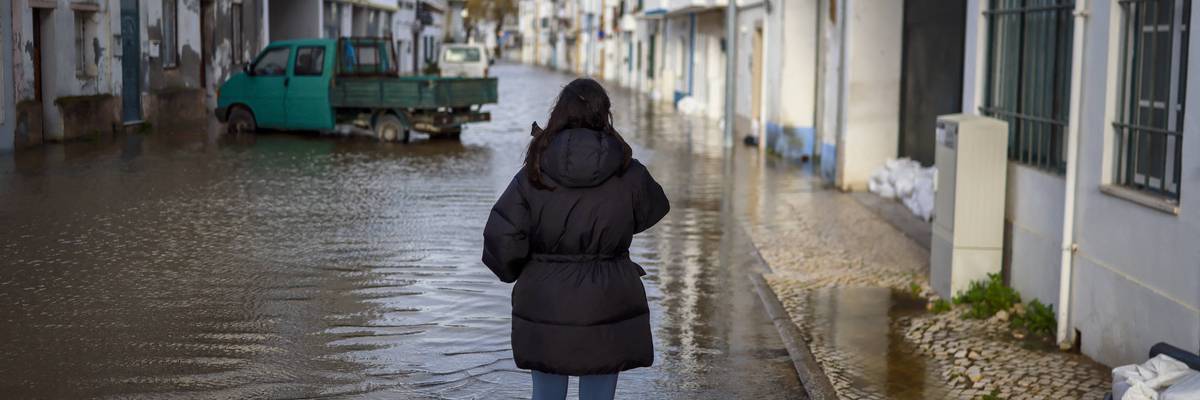
A woman observes floodwaters from the Sado River covering a street in Alcacer do Sal, Portugal, amid Storm Leonardo on February 5, 2026. (Photo by Patricia de Melo Moreira/AFP via Getty Images)

Current models “assume the future will behave like the past, even as we push the climate system into uncharted territory,” said the lead author of a new report that’s based on input from dozens of experts.

In a report published Thursday, UK experts highlighted the “growing gap between real-world climate risk and the economic analysis used to guide policy, supervision, and investment,” while also warning that because the “window for preventing catastrophic warming” is narrowing, ambitious action “cannot await perfected models.”

Various scientific institutions concur that 2025 was among the hottest years on record—and the ongoing failure of governments across the globe, particularly the Trump administration, to enact policies that would significantly cut planet-heating emissions from fossil fuels is pushing the Paris Agreement’s 1.5°C and 2°C goals for this century further out of reach.

RECOMMENDED…

Pam Bondi Attends Confirmation Hearing To Be Attorney General

Calls to Impeach Bondi Mount After Nude Photos of Possible Victims Released in Epstein Files

Immigration Detainees Held At Texas Facility

US Military Helping Trump to Build Massive Network of ‘Concentration Camps,’ Navy Contract Reveals

The new report from the University of Exeter and the think tank Carbon Tracker Initiative, titled Recalibrating Climate Risk, incorporates the expert opinions of 68 climate scientists from Australia, Austria, Canada, China, France, Germany, the Netherlands, Norway, SpainSweden, the United Kingdom, and the United States.

“Our expert elicitation reveals a fundamental disconnect: Climate scientists understand that beyond 2°C, we’re not dealing with manageable economic adjustments,” said Jesse Abrams, lead author and senior impact fellow at Exeter’s Green Futures Solutions, in a statement.

“The climate scientists we surveyed were unambiguous,” he explained. “Current economic models systematically underestimate climate damages because they can’t capture what matters most—the cascading failures, threshold effects, and compounding shocks that define climate risk in a warmer world and could undermine the very foundations of economic growth.”

Abrams said that “for financial institutions and policymakers relying on these models, this isn’t a technical problem—it’s a fundamental misreading of the risks we face, which current models miss entirely because they assume the future will behave like the past, even as we push the climate system into uncharted territory.”

https://embed.bsky.app/embed/did:plc:iqdm2serzk75y6iufoei6xko/app.bsky.feed.post/3me3osxundc2a?id=8027327466248629&ref_url=https%253A%252F%252Fwww.commondreams.org%252Fnews%252Fclimate-and-economy&colorMode=system

Communities around the world are already contending with devastating droughts, fires, and storms—and, as another report from researchers at Exeter and the UK’s Institute and Faculty of Actuaries (IFOA) pointed out last month, “above 1.5°C, we enter the danger zone where multiple climate tipping points may be triggered, such as the collapse of ice sheets in Greenland and Antarcticapermafrost melt, Amazon dieback, and changes in ocean circulation.”

The IFOA report “warned that when cascading and systemic risks are taken into account, warming of 2°C by 2050 could result in a 25% hit to projected GDP, rising to a halving of projected economic growth between 2070 and 2090,” BusinessGreen editor-in-chief James Murray reported Thursday. “Similarly, a report from consultancy Boston Consulting Group calculated a third of the global economic output could be lost under a scenario where temperatures reach 3°C above preindustrial levels by 2100.”

“The studies stand in stark contrast to some mainstream economic models that have suggested warming of 2°C or more will only reduce projected economic growth by a few percentage points—analyses that have been seized upon by opponents of climate action to argue that decarbonization policies can be dropped or delayed,” Murray noted.

Abrams told the Guardian that some current economic models “are saying we’ll have a 10% GDP loss at between 3°C and 4°C, but the physical climate scientists are saying the economy and society will cease to function as we know it. That’s a big mismatch.”

https://embed.bsky.app/embed/did:plc:6hzfdhu5ruogfnpe6lpxyzwh/app.bsky.feed.post/3me4e5t55mk2q?id=8379828271862539&ref_url=https%253A%252F%252Fwww.commondreams.org%252Fnews%252Fclimate-and-economy&colorMode=system

Laurie Laybourn, a Carbon Tracker board member and executive director of Strategic Climate Risks Initiative, cited another recent report that provides a bleak picture of the current moment and what lies ahead.

“As the UK government’s landmark security assessment of ecosystem collapse showed last week, we are currently living through a paradigm shift in the speed, scale, and severity of risks driven by the climate-nature crisis,” she said. “Yet, beyond this report, there has not been a corresponding paradigm shift in how regulators and government as a whole assess these risks.”

“Instead, they’re routinely underestimated if not missed entirely, meaning many regulations and government action are dangerously out of touch with reality,” she continued. “This threatens disaster when that reality catches up with us. So, it’s critical that policymakers change course, providing clear signals and guidance to markets that these risks should be priced accordingly, rather than downplayed.”

And, as the experts emphasized Thursday, it’s not just policymakers—investors are also still relying on “flawed economic advice,” said Carbon Tracker founder and CEO Mark Campanale. The result is “widespread complacency… with many investors viewing climate scenario analysis as a tick-box disclosure exercise.”

“Until the gap between scientists and economists’ expectations of future climate damages is closed and government bodies act to ensure the integrity of advice upon which investment decisions are made,” he added, “financial institutions will continue to chronically underprice climate risks—meaning that pension funds and taxpayers will remain dangerously exposed.”

Hetal Patel, head of sustainable investment research at Phoenix Group, the UK’s largest and retirement and savings business, said that her firm “supports the report’s call for a more robust and coordinated approach to climate‑risk modeling. Underestimating physical risk doesn’t just distort financial analysis and investment decisions, it underplays the real‑world consequences that will ultimately affect customer outcomes and society as a whole.”

The new report stresses that addressing the “fundamental disconnect between what climate scientists understand about climate impacts and how these impacts are represented in economic models” would require “research investments spanning years,” but rather than simply waiting for better modeling, decision-makers “must proceed on the basis of precautionary risk management, physical climate science, and observed impacts.”

Original article by Jessica Corbett republished from Common Dreams under Creative Commons (CC BY-NC-ND 3.0). 

Donald Trump urges you to be a Climate Science denier like him. He says that he makes millions and millions for destroying the planet, Burn, Baby, Burn and Flood, Baby, Flood.
Nigel Farage urges you to ignore facts and reality and be a climate science denier like him and his Deputy Richard Tice. He says that Reform UK has received £Millions and £Millions from the fossil fuel industry to promote climate denial and destroy the planet.
Elon Musk urges you to be a Fascist like him, says that you can ignore facts and reality then.
Continue ReadingScientists Warn ‘Garbage’ Models Underestimate Risk of Economic Collapse From Climate Crisis

Actuaries and Scientists Warn Climate Shocks Risk ‘Planetary Insolvency’

Spread the love

Original article by Jessica Corbett republished from Common Dreams under Creative Commons (CC BY-NC-ND 3.0). Published Jan 16, 2025

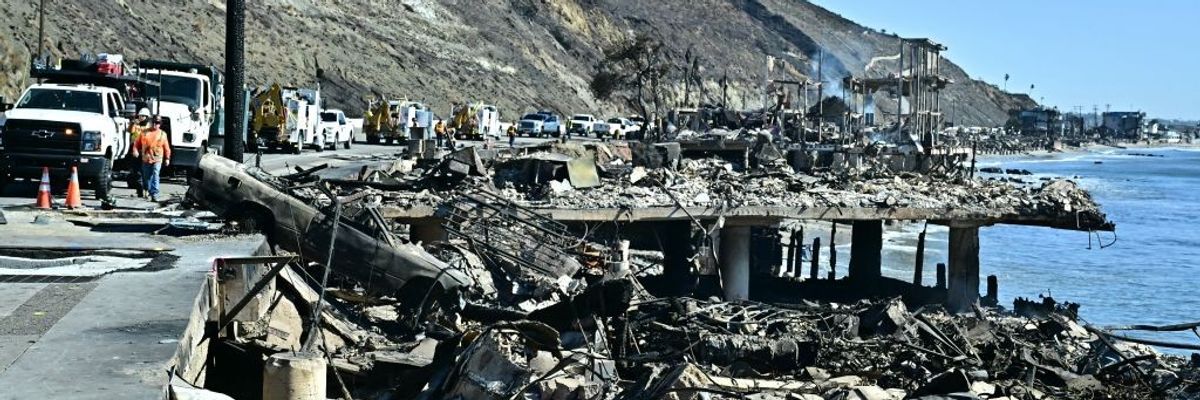
Gas company employees work in Malibu, California, after the Palisades Fire destroyed beach homes on January 12, 2025. (Photo: Frederic J. Brown/AFP via Getty Images)

A new report “shows a 50% GDP contraction between 2070 and 2090 unless an alternative course is chartered,” said the lead author.

U.K. actuaries and University of Exeter climate scientists on Thursday warned that “the risk of planetary insolvency looms unless we act decisively” and urged policymakers to “implement realistic and effective approaches to global risk management.”

Actuaries have developed techniques that “underpin the functioning of the global pension market with $55 trillion of assets, and the global insurance market, collecting $8 trillion of premiums annually, to help us manage risk,” Tim Lenton, University of Exeter’s climate change and Earth system science chair, noted in the foreword of a report released Thursday.

Planetary Solvency—Finding Our Balance With Nature is the fourth report for which the Institute and Faculty of Actuaries (IFoA) has collaborated with climate scientists. In financial terms, solvency is the ability of people or companies to pay their long-term debts. Co-authors of one of the previous publications coined the phrase planetary solvency, “setting out the idea that financial risk management techniques could be adapted to help society manage climate change and other risks.”

Three IFoA leaders—Kalpana Shah, Paul Sweeting, and Kartina Tahir Thomson—explained in their introduction to the latest report how “planetary solvency applies these techniques to the Earth system,” writing:

The essentials that support our society and economy all flow from the Earth system, commodities such as food, water, energy, and raw materials. The Earth system regulates the climate and provides a breathable atmosphere, it is the foundation that underpins our society and economy. Planetary solvency assesses the Earth system’s ability to continue supporting us, informed by planetary boundaries, tipping points in the Earth system, and other scientific discoveries to assess risks to this foundation—and thus to our society and the economy.

Our illustrative assessment of planetary solvency in this report shows a more fundamental, policy-led change of direction is required. Our current market-led approach to mitigating climate and nature risks is not delivering. There is an increasing risk of severe societal disruption (planetary insolvency), as our economic system drives further global warming and nature degradation.

“Impacts are already severe with unprecedented fires, floods, heatwaves, storms, and droughts,” the document points out, emphasizing that human activity—particularly burning fossil fuels—drives climate change and biodiversity loss. “If unchecked they could become catastrophic, including loss of capacity to grow major staple crops, multimeter sea-level rise, altered climate patterns, and a further acceleration of global warming.”

The report was released as wildfires ravage California and shortly after scientific bodies around the world concluded that 2024 was the hottest year on record and the first in which the average global temperature exceeded a key goal of the Paris agreement: 1.5°C above preindustrial levels. In the United States, experts identified 27 disasters with losses exceeding $1 billion.

“We risk triggering tipping points such as Greenland ice sheet melt, coral reef loss, Amazon forest dieback, and major ocean current disruption,” the new publication warns, adding that “tipping points can trigger each other,” and if multiple are triggered, “there may be a point of no return, after which it may be impossible to stabilize the climate.”

Food system shocks and more frequent and devastating disasters increase the risk of mass mortality for humanity—including due to hunger and infectious diseases—along with mass migration and conflict, the report highlights.

“Climate change risk assessment methodologies understate economic impact, as they often exclude many of the most severe risks that are expected and do not recognize there is a risk of ruin,” the document stresses. “They are precisely wrong, rather than being roughly right.”

Specifically, lead author and IFoA council member Sandy Trust said in a statement, “widely used but deeply flawed assessments of the economic impact of climate change show a negligible impact” on gross domestic product (GDP).

However, Trust continued, “the risk-led methodology, set out in the report, shows a 50% GDP contraction between 2070 and 2090 unless an alternative course is chartered.”

To mitigate the risk of planetary insolvency, the co-authors called on policymakers around the world to implement independent, annual assessments; set limits and thresholds that respect the planet’s boundaries; enhance governance structures to support planetary solvency; and “enhance policymaker understanding of ecological interdependencies, tipping points, and systemic risks so they understand why these changes are needed.”

They also underscored the need to limit global warming and avoid triggering tipping points with actions such as accelerating decarbonization, removing greenhouse gases from the atmosphere, restoring damaged ecosystems, and building resilience.

“You can’t have an economy without a society, and a society needs somewhere to live,” said Trust. “Nature is our foundation… Threats to the stability of this foundation are risks to future human prosperity which we must take action to avoid.”

Original article by Jessica Corbett republished from Common Dreams under Creative Commons (CC BY-NC-ND 3.0).

Orcas discuss Donald Trump and the killer apes' concept of democracy. Front Orca warns that Trump is crashing his country's economy and that everything he does he does for the fantastically wealthy.
Orcas discuss Donald Trump and the killer apes’ concept of democracy. Front Orca warns that Trump is crashing his country’s economy and that everything he does he does for the fantastically wealthy.
Neo-Fascist Climate Science Denier Donald Trump says Burn, Baby, Burn.
Elon Musk urges you to be a Fascist like him, says that you can ignore facts and reality then.

Continue ReadingActuaries and Scientists Warn Climate Shocks Risk ‘Planetary Insolvency’

Student paints University of Exeter during graduation ceremony

Spread the love
Just Stop Oil activist Eddie Whittingham protests at University of Exeter graduation ceremony.
Just Stop Oil activist Eddie Whittingham arrested following protest at University of Exeter graduation ceremony.

A Just Stop Oil activist has disrupted his graduation ceremony at the University of Exeter as a call for students to take action against the UK Government’s plans to licence new oil and gas projects.

At 1:15pm, Eddie Whittingham, 25, was tackled by security as he sprayed a university courtyard orange with a paint-loaded fire extinguisher, while his graduating cohort looked on. Shortly beforehand he had received his BA in Philosophy, Politics, and Economics. He was arrested at the scene.

Eddie is known for high-profile Just Stop Oil actions, including the interruption of the World Snooker Championship in April 2023, where he climbed a snooker table at The Crucible Theatre and released orange-coloured powder.

Speaking before his action today, he said:

“My name’s Eddie, I’m 25 years old and I’m about to disrupt my own graduation ceremony. Exactly 3 months ago, I disrupted the snooker world championship. I’m taking these actions because our government has failed young people like me.”

“They have failed to cut greenhouse gas emissions in line with science. They have failed to prepare us for the inevitable disruption that they have caused. They’re driving our society towards collapse by continuing to allow new oil, gas and coal. This is a violation of the advice of the International Energy Agency, the United Nations and thousands and thousands of climate scientists all around the world, who have been warning us for years: new fossil fuels means death.”

“As a result, 1 billion people may be displaced from their homes by 2030. That’s 7 years away. We face a future of mass-starvation and unimaginable suffering, including here in the UK. And all of this is happening so a small handful of extremely rich people can carry on getting even richer.”

“Universities, rather than preparing young people for this inevitable disruption, are instead upholding a status quo that is going to kill millions, if not billions of people. That’s why I’m calling on students everywhere to join us in resistance against this criminal government.”

“What use is a university degree if you can’t feed yourself? What use is an “education” if society is collapsing around you? Each one of us has a choice: die quietly or get into resistance. It’s now or never.”

Also arrested was Kostja Junglas, 27, a PhD student at Oxford University. They were tackled by University of Exeter security for attempting to hold up a banner to the crowd of graduates.

In 2022, the University of Exeter began a new partnership with Shell Oil, building on decades of collaboration between the university and the company. The stated aim of the project is ‘Carbon Sequestration’, a speculative technology that would allow Shell to continue producing fossil fuels whilst reducing their carbon emissions. However, experts that don’t stand to gain from Shell profits have declared carbon sequestration unviable: “Many international bodies and national government are relying on carbon capture in the fossil fuel sector to get to net zero, and it simply won’t work,” according to Bruce Robertson, the author of an Institute for Energy Economics and Financial Analysis report on the topic. Students are campaigning for the university to cut ties with Shell under the name ‘Shell Out’.

The first week of July 2023 is believed to have been the hottest in the history of humanity, according to the European Union’s Copernicus Climate Change Service. The highest temperature in recorded history has been set repeatedly in the last few weeks, and this pattern is expected to continue. “We are in uncharted territory and we can expect more records to fall as El Niño develops further and these impacts will extend into 2024,” said Christopher Hewitt, World Meteorological Organisation director of climate services, adding “This is worrying news.”  The impacts of this climate crisis are already devastating, and will only multiply in the short term.

Since the Just Stop Oil campaign launched on 14th February 2022, there have been 2,200 arrests and 138 people have spent time in prison, many without trial. Just Stop Oil supporters Morgan Trowland and Marcus Decker are serving three year prison sentences for resisting new oil, gas and coal.

Just Stop Oil is calling on everyone to get off the sidelines and join in civil resistance against new oil, gas and coal.

juststopoil.org/students juststopoil.org

Continue ReadingStudent paints University of Exeter during graduation ceremony