The Asian Katra cargo ship (top left) arrives in Havana Bay in Havana, Cuba, May 18, 2026
A SHIP laden with humanitarian aid from the governments of Mexico and Uruguay has arrived in Cuba to help ease the effects of the illegal US blockade.
The cargo of the ship, which sailed from a Mexican port, includes personal hygiene items and 1,700 tons of grains, powdered milk and other food, according to a statement published by Cuban media.
Food Industry Minister Alberto Lopez Diaz said the items had arrived “at a time of great economic hardship, exacerbated by the tightening of the blockade imposed on our country by the US government.”
The US has been ratcheting up pressure as it seeks an indictment against Cuba’s former president Raul Castro over his alleged role in the 1996 downing of four planes operated by Miami-based exile group Brothers to the Rescue.
Donald Trump sings and dances, says that it’s fun to kill everyone …Orcas discuss Donald Trump and the killer apes’ concept of democracy. Front Orca warns that Trump is crashing his country’s economy and that everything he does he does for the fantastically wealthy.
This work by Middle East Monitor is licensed under a Creative Commons Attribution-NonCommercial-ShareAlike 4.0 International License.
Spanish Prime Minister Pedro Sanchez holds a press conference following the European Union (EU) Leaders’ Summit in Brussels, Belgium, on October 23, 2025. [Dursun Aydemir – Anadolu Agency]
Spanish Prime Minister Pedro Sanchez said on Monday that the territorial unity of Ukraine, the Gaza Strip and Venezuela is not open to negotiation.
In a post on the X platform, Sanchez said that “respect for the sovereignty of all states and their territorial integrity is a non-negotiable principle, from Ukraine to Gaza, including Venezuela”.
Commenting on remarks by US President Donald Trump, who described Greenland as having a strong strategic position and said the United States needs it for national security reasons, Sanchez expressed his rejection of those statements.
He added that Spain “will always remain actively committed to the United Nations and will be in full solidarity with Denmark and the people of Greenland”.
On Sunday, Spain, Brazil, Colombia, Mexico, Uruguay and Chile said in a joint statement that they “reject unilateral US military operations” in Venezuelan territory.
The statement, distributed by the Spanish authorities, said: “We express our deep concern about what is happening in Venezuela and our rejection of unilateral military actions carried out on Venezuelan territory.” Such actions had violated the “basic principles of international law, in particular the prohibition of the use of force and respect for territorial sovereignty established in the United Nations Charter.”
This work by Middle East Monitor is licensed under a Creative Commons Attribution-NonCommercial-ShareAlike 4.0 International License.
Elon Musk urges you to be a Fascist like him, says that you can ignore facts and reality then.Donald Fuhrump says that Amerikkka doesn’t bother with crimes or charges anymore, not being 100% Amerikkkan and opposing his real estate intentions is enough.Orcas discuss how Trump was re-elected and him being an obviously insane, xenophobic Fascist.
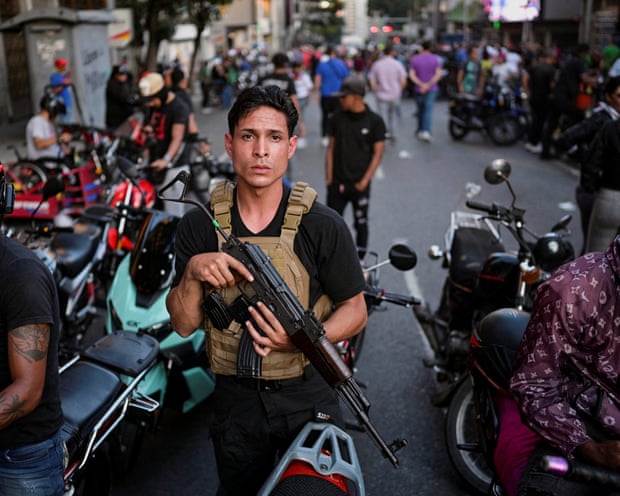
A member of the militia group known as “Colectivos” takes part in a march calling for release of Venezuela’s President Nicolas Maduro, after he and his wife Cilia Flores were captured following U.S. strikes on Venezuela, in Caracas, Venezuela. Photograph: Gaby Oráa/Reuters
“Uncertainty,” said Griselda Guzmán, a 68-year-old pensioner, fighting back tears as she lined up outside a grocery store with her husband to stock up on supplies in case the coming days brought yet more drama.
“Anger,” said Sauriany, a 23-year-old administrative worker from Venezuela’s state-owned electricity company as she queued outside a supermarket on the other side of town with her 24-year-old partner, Leandro.
Leandro voiced shock as the couple waited in a 100-person queue to buy flour, milk and butter alongside a quartet of nuns. “W ho could have imagined that his would happen? That right at the start of the year they’d bomb our country while everyone was asleep?” he asked.
“If I thought it would improve the country I’d welcome it,” Leandro added, as shoppers were allowed into the overcrowded supermarket in small groups. “But I don’t believe this will happen. If they wanted peace, this isn’t the way to achieve it.”
Similarly confused sentiments could be heard all over Caracas on Sunday as its 3 million citizens came to terms with the traumatic nocturnal blitz on their city – a move the governments of Spain, Brazil, Chile, Colombia, Mexico and Uruguay warned set “an extremely dangerous precedent for peace and regional security”.
“It’s all so distressing,” said Gabriel Vásquez, a 29-year-old video-maker, recalling how he had been woken by the sound of a “gigantic” explosion at about 2am on Saturday and how his community in central Caracas was plunged into darkness as aircraft circled overhead.
“I thought that any time my house could get bombed too,” said Vásquez, whose neighbourhood was still in the dark on Sunday. “We have no water, no electricity, no phone reception – nothing,” he complained.
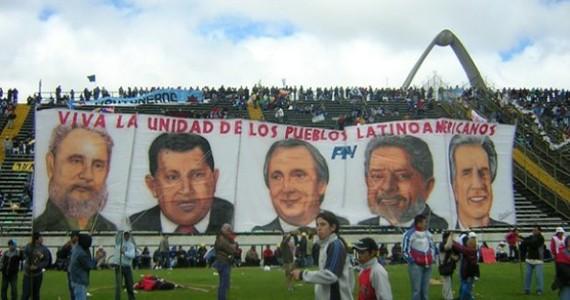
In 2005, in the city of Mar del Plata, the presidents of the brother countries of the Americas, Lula da Silva, Hugo Chávez, Evo Morales, and Néstor Kirchner stood firm against the United States. Photo: X
The meeting in Mar del Plata paid tribute to the moment when several Latin American presidents defeated the US attempt to establish a regional free trade agreement.
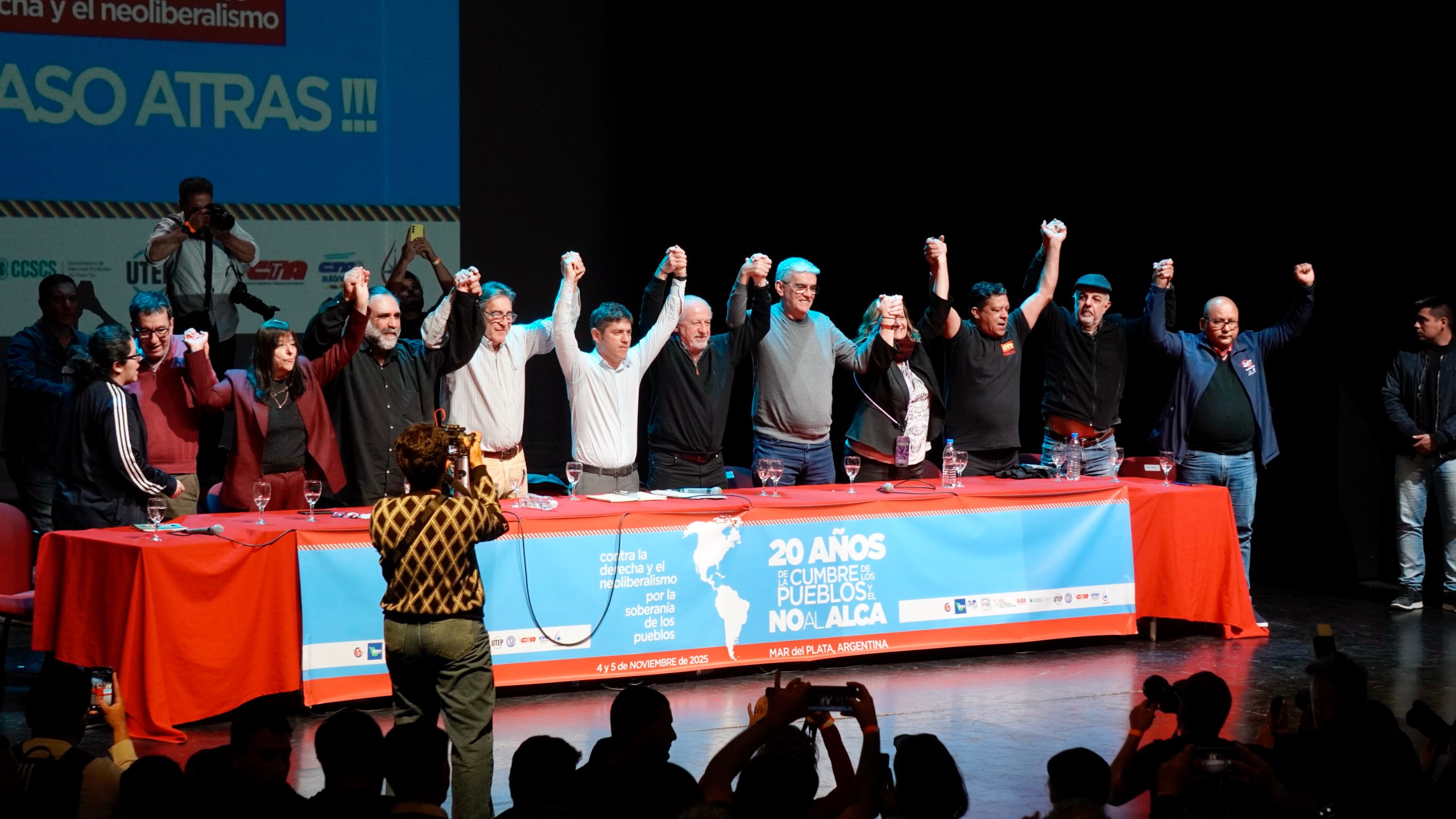
In the same place where the regional free trade project was “buried” two decades ago, 150 delegates from various social movements in Brazil, Uruguay, Bolivia, Cuba, Mexico, Portugal, Haiti, Palestine, Chile, Nicaragua, Peru, and Paraguay gathered to reaffirm the anti-imperialist spirit that led to the regional rejection of the FTAA project, they say.
“The world faces greater levels of inequality, injustice, and authoritarianism, with a growing concentration of financial and technological power that deepens poverty and limits the autonomy of countries in the Global South,” the delegates said in the event’s final declaration.
The meeting was also attended by the governor of Buenos Aires, Axel Kicillof, who stated that the rejection of the FTAA in 2005 was a “new declaration of independence” for Latin American countries. “The rejection of the FTAA was a victory for Latin American sovereignty, voiced by a group of presidents with enormous courage, represented in our country by Néstor Kirchner. Twenty years after that historic milestone, we have a responsibility to continue building unity, because there is no possibility of development for our countries outside the framework of regional integration. We cannot afford not to have a project on behalf of our people, because Argentina and the countries of Latin America are not anyone’s backyard,” Kicillof wrote in X.
Delegates from dozens of Latin American countries reaffirm the anti-imperialist spirit of the “No to the FTAA” summit in 2005.
For his part, the Secretary of Foreign Affairs of the Argentine Workers’ Central Union (CTA), Adolfo Aguirre, stated: “In this very place, in front of the President of the United States, George W. Bush, and before the eyes of the whole world, our peoples, workers, together with leaders such as Néstor Kirchner, Hugo Chávez, and Luiz Inácio Lula da Silva, marked a turning point. We said no to surrender, no to dependence, no to the model that wanted to turn our America into the backyard of economic power.”
Twenty years ago, the anti-imperialist slogan was born
Twenty years ago in Argentina, several political leaders from the Latin American left gathered at a People’s Summit, whose fundamental slogan was the rejection of the Free Trade Area of the Americas (FTAA), an initiative promoted, among others, by the George W. Bush administration. The FTAA sought to significantly reduce customs barriers between American countries.
According to popular and left-wing forces in Latin America and the Caribbean, the agreement would have promoted a regional market in which the United States would have had an enormous advantage over other countries and which, in the long run, would have led to the destruction of the still immature regional industry to benefit the interests of large US companies.
However, the economic and geopolitical project did not prosper due to fierce and coordinated opposition from several Latin American presidents, including Néstor Kirchner (Argentina), Hugo Chávez (Venezuela), and Luiz Inácio Lula da Silva (Brazil), among others. The political maneuver took place in Mar del Plata, during the Summit of the Americas, where Bush and his entourage suffered a severe setback. Thus, the proposal that had been in the works and planned since 1994 in Miami and was definitively defeated.
The Summit of the Americas is considered by several experts to be a turning point in the geopolitical relations of the American continent. New progressive and pro-sovereignty processes joined those of Argentina, Brazil, and Venezuela, giving rise to an attempt at regional integration that to this day is pushed by progressivism and boycotted by Washington’s neoliberal allies.
While the summit was taking place, thousands of people from left-wing and progressive movements and political parties gathered at a parallel conference with the slogan “No to the FTAA,” which was eventually attended by several political leaders. Among them, Hugo Chávez made a statement in his speech that would go down in history: “ALCA (FTAA in Spanish), al carajo! (FTAA, go to hell!)”.
A historic event
The region has undoubtedly changed its political composition. The seemingly unstoppable rise of progressive governments is now fragmented due to the emergence of new right-wing and neoliberal projects, such as those of Javier Milei in Argentina and Daniel Noboa in Ecuador, and the recent victory of the Bolivian right after more than 20 years of left-wing governments, among others.
However, in several countries, progressivism managed to regain government, as in the case of Lula da Silva himself, or managed to remain in power, as in the case of the United Socialist Party of Venezuela. Also, in other countries such as Colombia with Gustavo Petro and Mexico with Andrés Manuel López Obrador and Claudia Sheinbaum, progressive governments took office for the first time in their recent history.
In this sense, the dispute over governments in Latin America remains open, and much of the structure of that dispute can be found in what happened in Mar del Plata 20 years ago, where one regional project was buried and another was established, for almost a decade, as the model for regional integration around a position that, although it had its clear limits, always declared itself sovereign and independent.
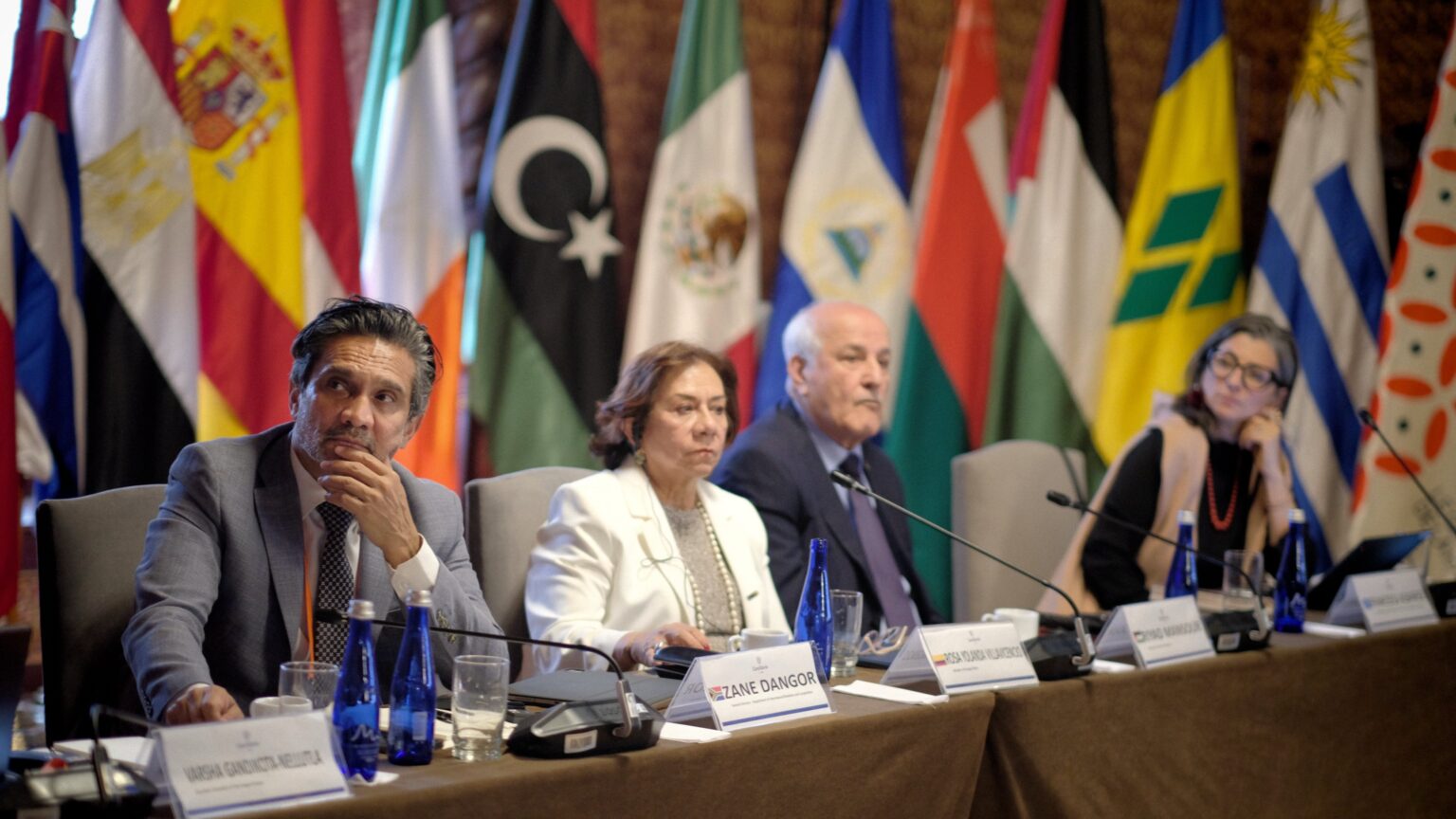
Hague Group Summit in Bogotá, Colombia. Photo: Abby Martin
In the final document, the signatory countries commit, among other things, to cease arms trade with Israel, review public contracts with that country, and seek accountability for war crimes.
Countries of the Global South have expressed their solidarity with the Palestinian people at the Emergency Ministerial Conference on Palestine organized by The Hague Group, which took place on July 15 and 16 in Bogotá, Colombia. The multilateral meeting was attended by representatives from Algeria, Bangladesh, Botswana, Brazil, Chile, China, Djibouti, Egypt, Slovenia, Spain, Honduras, Indonesia, Iraq, Ireland, Lebanon, Libya, Malaysia, Mexico, Namibia, Nicaragua, Norway, Oman, Pakistan, Palestine, Qatar, Saint Vincent and the Grenadines, South Africa, Turkey, Uruguay, and Venezuela.
Regarding the meeting, Colombia’s deputy secretary of state, Mauricio Jaramillo, said: “This conference is being convened by the Hague Group, but it is not an exclusive meeting of this group. Given the urgency of what is happening in the occupied territories, especially in Gaza, where today, for example, we have passed the threshold of 58,000 fatalities, we must commit ourselves to action.”
The conference, which was organized by the governments of Colombia and South Africa and attended by 30 countries, agreed that: “The era of impunity must end – and that international law must be enforced without fear or favor through immediate domestic policies and legislation – along with a unified call for an immediate ceasefire.”
The agreements
According to an official press release, the meeting laid out several measures to stop the genocide in Gaza:
Prevent the provision or transfer of arms, munitions, military fuel, related military equipment, and dual-use items to Israel.
Prevent the transit, docking, and servicing of vessels at any port … in all cases where there is a clear risk of the vessel being used to carry arms, munitions, military fuel, related military equipment, and dual-use items to Israel.
Prevent the carriage of arms, munitions, military fuel, related military equipment, and dual-use items to Israel on vessels bearing our flag … and ensure full accountability, including de-flagging, for non-compliance with this prohibition.
Commence an urgent review of all public contracts to prevent public institutions and funds from supporting Israel’s illegal occupation of the Palestinian Territory and entrenching its unlawful presence.
Comply with obligations to ensure accountability for the most serious crimes under international law, through robust, impartial, and independent investigations and prosecutions at national or international levels, to ensure justice for all victims and the prevention of future crimes.
Support universal jurisdiction mandates, as and where applicable in national legal frameworks and judiciaries, to ensure justice for victims of international crimes committed in the Occupied Palestinian Territory.
Although 30 countries attended the meeting, only 12 countries committed to immediately complying with the agreements outlined in the final declaration: Bolivia, Cuba, Colombia, Indonesia, Iraq, Libya, Malaysia, Namibia, Nicaragua, Oman, Saint Vincent and the Grenadines, and South Africa. The others expected to join them by September 20, 2025 – the date of the 80th UN General Assembly. The group will also be consulting various other states on an ongoing basis for participation in the measures against Israel.
Colombia’s President Gustavo Petro stated: “We came to Bogotá to make history — and we did … Together, we have begun the work of ending the era of impunity. These measures show that we will no longer allow international law to be treated as optional, or Palestinian life as disposable.”
“What we have achieved here is a collective affirmation that no state is above the law … The Hague Group was born to advance international law in an era of impunity. The measures adopted in Bogotá show that we are serious — and that coordinated state action is possible,” said South African Secretary of State Ronald Lamola.
The final agreement is historic as it is the first multilateral agreement that seeks to influence the Israeli government’s actions in its offensive against Gaza. In this sense, it is the first time that several countries have challenged the apparent immunity of the Israeli state in its actions in Gaza, which could have unpredictable diplomatic repercussions. It could also become the starting point for other countries to demand an end to the violence in Palestine jointly.

 The Asian Katra cargo ship (top left) arrives in Havana Bay in Havana, Cuba, May 18, 2026