US military assets worth billions damaged or lost in Iran war: Report

Spread the love

This work by Middle East Monitor is licensed under a Creative Commons Attribution-NonCommercial-ShareAlike 4.0 International License.

A view of US military refueling aircraft at Ben Gurion Airport as the US-Israel attacks on Iran continue and retaliatory actions from Iran against Israel, primarily are ongoing in the capital Tel Aviv, Israel, on March 22, 2026. [Nir Keidar – Anadolu Agency]

Billions of dollars in US military equipment have been damaged or destroyed since the start of the US-Israeli war on Iran, mostly due to Iranian missile and drone attacks, according to a Wall Street Journal report published on Friday, Anadolu reports.

Losses in the first three weeks of the conflict are estimated at $1.4 billion to $2.9 billion, Elaine McCusker, a former Pentagon budget official now at the American Enterprise Institute, told the newspaper.

Among the incidents cited, three F-15E fighter jets were mistakenly shot down by a Kuwaiti aircraft on March 1, while an F-35 stealth jet made an emergency landing on March 16 after reportedly coming under fire. Iran claims it targeted the aircraft, according to the report.

A midair collision between two KC-135 refueling planes over Iraq also killed six crew members. Five more KC-135s were damaged in an Iranian missile strike on Prince Sultan Air Base in Saudi Arabia and are undergoing repairs.

More than a dozen MQ-9 Reaper drones have been lost, including several shot down by missiles and others destroyed on the ground. Iranian strikes also damaged aircraft and radar systems at US bases in Saudi Arabia, Qatar, and Jordan.

A fire broke out on the aircraft carrier USS Gerald R. Ford on March 12; the ship is now undergoing repairs at Souda Bay, Greece, according to the US Navy.

The Pentagon plans to replace some of the damaged systems through a proposed $200 billion supplemental spending request.

Anadolu could not independently verify the reported losses.

Regional tensions escalated after Feb. 28, when the US and Israel launched a joint offensive on Iran, killing more than 1,340 people. Iran has retaliated with drone and missile strikes targeting Israel and Gulf countries hosting US military assets.

So far, 13 US service members have been killed and roughly 290 others injured since the operations began.

READ: Israeli gov’t ‘sending army into multi-front war without strategy,’ says opposition leader

Keir Starmer explains that UK is participating defensively in Trump and Israel's criminal war for Israel's genocidal expansion in Iran and states that he supports Zionism "without qualification". Keir Starmer said "I said it loud and clear – and meant it – that I support Zionism without qualification.” here: https://www.jewishnews.co.uk/keir-starmer-interview-i-will-work-to-eradicate-antisemitism-from-day-one/
Keir Starmer explains that UK is participating defensively in Trump and Israel’s criminal war for Israel’s genocidal expansion in Iran and states that he supports Zionism “without qualification”. Keir Starmer said “I said it loud and clear – and meant it – that I support Zionism without qualification.” here: https://www.jewishnews.co.uk/keir-starmer-interview-i-will-work-to-eradicate-antisemitism-from-day-one/
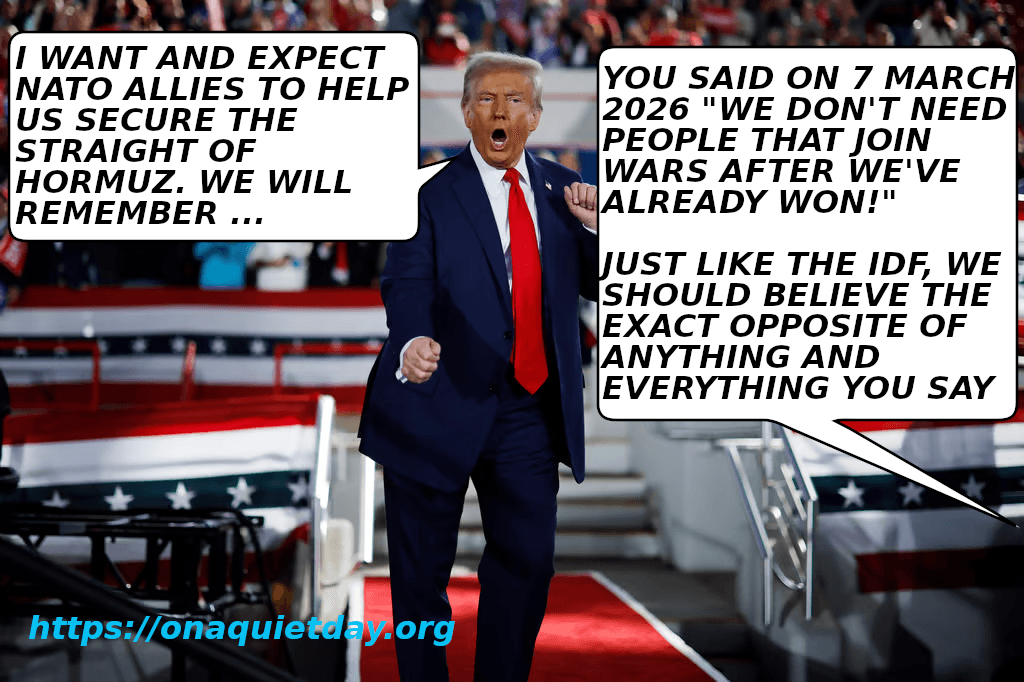
Donald Trump calls for help from NATO allies in securing the Straight of Hormuz despite saying on 7 March 2026 that they don't need people to join wars after they've already won.
Donald Trump calls for help from NATO allies in securing the Straight of Hormuz despite saying on 7 March 2026 that they don’t need people to join wars after they’ve already won.
Climate science denier Donald Trump confirms that he knows nothing about democracy and that more liquid gold is being secured according to his policy of global privateering.

Continue ReadingUS military assets worth billions damaged or lost in Iran war: Report

Between invasion and diplomacy: Trump’s options with Venezuela

Spread the love

Original article by Pablo Meriguet republished from peoples dispatch under a Creative Commons Attribution-ShareAlike 4.0 (CC BY-SA) license.

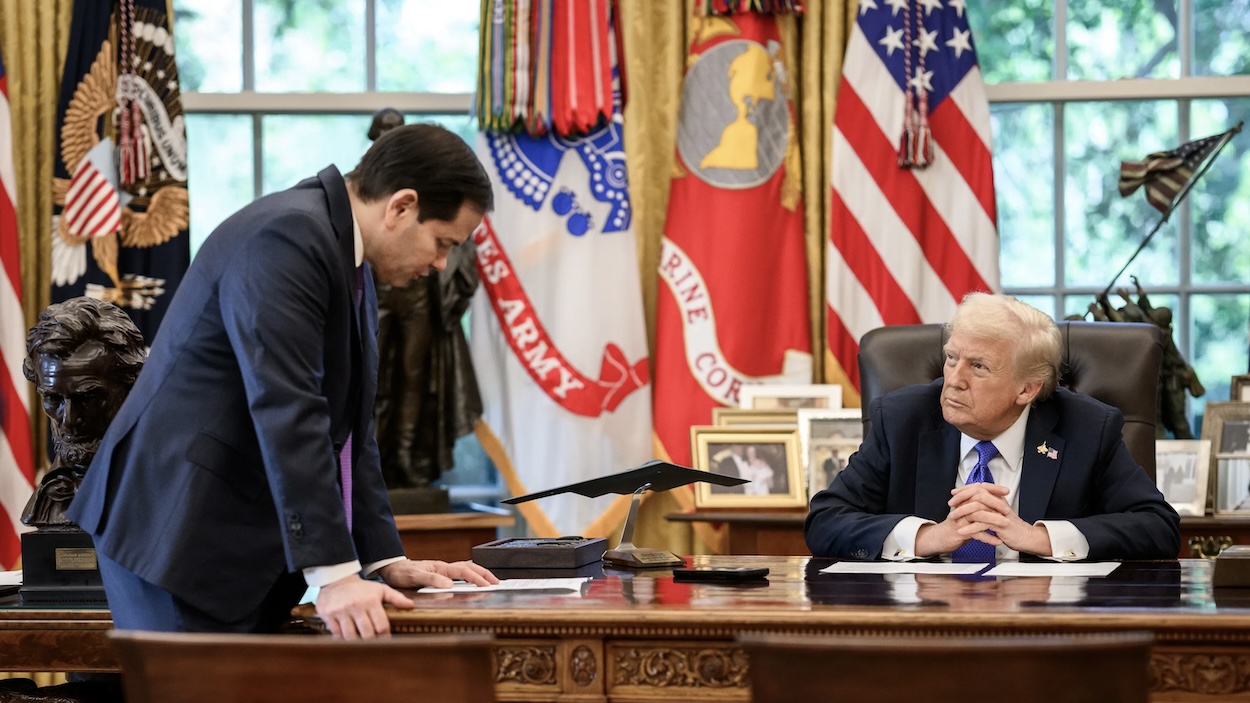
US President Donald Trump and US Secretary of State Marco Rubio in the Oval Office. Photo: The White House

While Trump increases military pressure in the Caribbean Sea, he hasn’t ruled out the possibility of resuming talks with Caracas. Meanwhile, Maduro supports the diplomatic route and rejects the possibility of war

At a press conference on November 17, US President Donald Trump stated that he does not rule out using his armed forces in Venezuela. This military buildup has involved the Pentagon deploying thousands of soldiers to the Caribbean Sea and to countries collaborating with Washington in the so-called Southern Spear military operation. Most recently, the USS Gerald R. Ford, the largest aircraft carrier in the United States, arrived in the Caribbean to, according to the Pentagon, “combat transnational threats”.

The Trump administration claims that a large amount of the drugs entering the United States comes from Venezuela, whose government is allegedly part of a criminal structure called the “Cartel of the Suns”.

Caracas has flatly denied these accusations and claimed that they are part of a justification to overthrow the Venezuelan government (which controls the world’s largest oil reserves) and thus force a change of direction in the country that is aligned with Washington’s economic and geopolitical interests.

Washington insists on its accusations

On November 16, the US State Department announced that it will designate the Cartel of the Suns (Cartel de los Soles) a foreign terrorist organization. Defense Secretary Marco Rubio stated: “The Cartel of the Suns, along with other designated foreign terrorist organizations, including the Aragua Train and the Sinaloa Cartel, are responsible for terrorist violence throughout the hemisphere, as well as drug trafficking to the United States and Europe.”

According to US authorities, this designation gives the US military carte blanche to attack the assets and infrastructure of what they consider to be part of the Cartel de los Soles, despite the fact that a large number of international law experts argue that this is not sufficient to legally justify an attack outside its borders.

Despite these warnings, the Trump administration has already launched attacks on small boats in the Caribbean Sea that, according to Washington, were carrying drugs to the United States, although no reliable evidence has yet been presented to prove this. Dozens of deaths have been reported so far.

Read More: From Palestine to Venezuela: The US is behind the door

The big question arising from the recent military and administrative maneuvers by the United States is whether Washington will dare to attack Venezuelan territory on the grounds that it is an attack to destroy a terrorist organization. For the moment, Trump has moved forward with these measures, although he has been cautious in stating that the attack will take place.

Trump says he will speak with Maduro soon

While the Trump administration increases pressure on Venezuela, even authorizing covert actions in the Caribbean country according to the New York Times, it also claims that there may be an open channel of communication with Caracas.

This was seemingly confirmed at the November 17 press conference, when, in response to questions from reporters about possible communication with Maduro, Trump said, “At some point, I will talk to him.”

Maduro’s response

In response to these statements, the Venezuelan president reacted by saying that the conversation should take place: “Only through diplomacy can differences be resolved … Anyone who wants to talk to Venezuela will talk face to face, but the Venezuelan people cannot be allowed to be massacred.”

Maduro warned that one of the consequences of a possible military invasion of Venezuela would be the loss of legitimacy of the Trump administration: “A war against Venezuela would be the political end of his leadership and his name. [Some people are trying to push Trump to] make the most serious mistake of his entire life.” He also said that public opinion in the United States is increasingly rejecting a possible military intervention in South America.

For now, Washington wants to maintain all options available when negotiating with Maduro’s government, whether through military or diplomatic means. Thus, Trump is deploying his military and intelligence assets in South America while keeping the lines of communication open with Maduro. For its part, the Venezuelan government is betting on diplomacy while preparing for a possible military invasion that would seek to end more than 25 years of Chavista rule, although such an operation could have unforeseen effects in the region, even for Washington.

Original article by Pablo Meriguet republished from peoples dispatch under a Creative Commons Attribution-ShareAlike 4.0 (CC BY-SA) license.

Donald Fuhrump says that Amerikkka doesn't bother with crimes or charges anymore, not being 100% Amerikkkan and opposing his real estate intentions is enough.
Donald Fuhrump says that Amerikkka doesn’t bother with crimes or charges anymore, not being 100% Amerikkkan and opposing his real estate intentions is enough.
Orcas discuss how Trump was re-elected and him being an obviously insane, xenophobic Fascist.

Continue ReadingBetween invasion and diplomacy: Trump’s options with Venezuela

Venezuela Mobilizes Military as US Aircraft Carrier Approaches

Spread the love

Original article by Julia Conley republished from Common Dreams under a Creative Commons (CC BY-NC-ND 3.0).

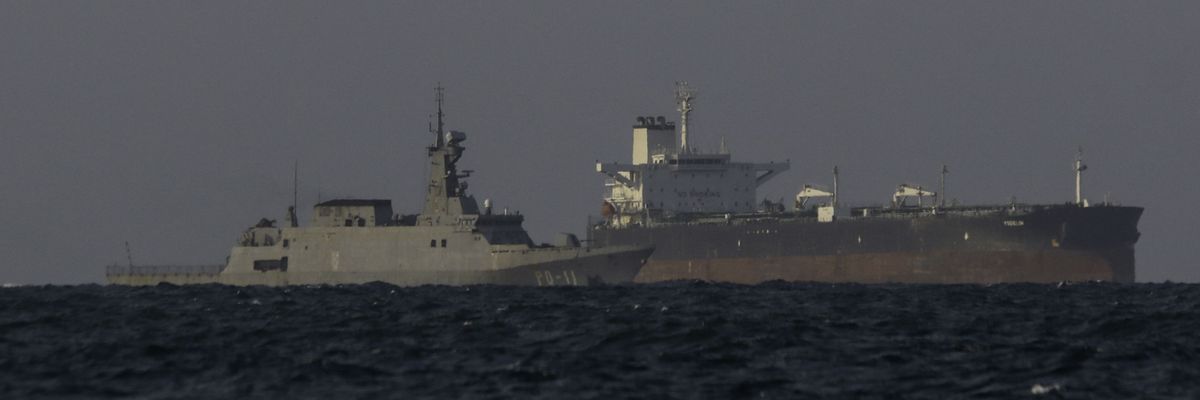
A Venezuelan navy patrol boat escorts Panamanian flagged crude oil tanker Yoselin near the El Palito refinery in Puerto Cabello, Venezuela on November 11, 2025. (Photo by Juan Carlos Hernandez/AFP via Getty Images)

“The only reason to move it there is to use it against Venezuela,” said one policy expert of the deployment of the USS Gerald R. Ford.

White House officials have sought to walk back President Donald Trump’s repeated threats against Venezuela in recent days—even as the Department of Defense has continue to strike boats in the Caribbean and eastern Pacific—but officials in the South American country on Tuesday took the arrival of a US aircraft carrier in the region seriously despite the administration’s claims that it won’t target Venezuela directly.

As the USS Gerald R. Ford entered waters near Latin America, accompanied by three warships, Defense Minister Vladimir Padrino López said Venezuela’s entire military arsenal had been placed on “full operational readiness,” with President Nicolás Maduro ordering the deployment of nearly 200,000 soldiers.

The government also approved the “massive deployment of ground, aerial, naval, riverine, and missile forces,” López announced.

Venezuela’s military deployment comes weeks after US Defense Secretary Pete Hegseth ordered the Ford to relocate from Europe to Latin America following several military strikes on boats in the Caribbean and Pacific that the Trump administration has claimed are meant to stop drug trafficking out of Venezuela—despite the fact that US intelligence agencies and United Nations experts agree that the country plays virtually no role in the trafficking of fentanyl, the top cause of drug overdoses in the US.

At least 76 people have been killed in the strikes so far, and the Associated Press reported last week that the victims have included an out-of-work bus driver and a struggling fisherman—people who in some cases had turned to helping drug traffickers transport cocaine across the Caribbean, but were hardly the high-level “narco-terrorists” that Hegseth and Trump have insisted they’ve killed in the region.

With the carrier strike group entering the Caribbean region, the US now has about 15,000 troops in the area where tensions have escalated since the boat strikes began in September.

Mark Cancian, a senior defense adviser at the Center for Strategic and International Studies, told the Washington Post that Venezuelan officials had good reason to mobilize forces.

“The only reason to move it there is to use it against Venezuela,” Cancian said of the Ford deployment. “The shot clock has started because this is not an asset they can just keep there indefinitely. They have to use it or move it.”

Since beginning the boat bombings, Trump has signaled the US attacks could move to Venezuela directly, with the Wall Street Journal reporting late last month that the administration was preparing to target “ports and airports controlled by the military that are allegedly used to traffic drugs, including naval facilities and airstrips.”

Trump also authorized Central Intelligence Agency operations last month, falsely claiming the country has “emptied” its prisons into the US and again asserting that “we have a lot of drugs coming in from Venezuela.”

Democratic senators have introduced two war powers resolutions aimed at stopping the US from striking inside Venezuela and at halting the boat-bombing campaign—but Republicans have voted them down after administration officials assured the caucus that the White House was not currently planning to attack Venezuela.

Maduro said last month that Trump’s actions in the region in recent months amount to attempts at “regime change,” adding that “if Venezuela did not possess oil, gas, gold, fertile land, and water, the imperialists wouldn’t even look at our country.”

Trump himself said publicly in 2023 that if he had won the 2020 presidential election, “we would have taken [Venezuela] over, we would have gotten all that oil.”

On Tuesday, both the United Kingdom and Colombia announced that they were halting intelligence sharing with the US in the region, saying that working with the US as it attacks small vessels in the Caribbean could make the countries complicit in violations of international law.

“All levels of law enforcement intelligence are ordered to suspend communications and other agreements with US security agencies,” Colombian President Gustavo Petro said. “This measure will remain in place as long as missile attacks on boats in the Caribbean continue. The fight against drugs must be subordinate to the human rights of the Caribbean people.”

Original article by Julia Conley republished from Common Dreams under a Creative Commons (CC BY-NC-ND 3.0).

Donald Fuhrump says that Amerikkka doesn't bother with crimes or charges anymore, not being 100% Amerikkkan and opposing his real estate intentions is enough.
Donald Fuhrump says that Amerikkka doesn’t bother with crimes or charges anymore, not being 100% Amerikkkan and opposing his real estate intentions is enough.
Continue ReadingVenezuela Mobilizes Military as US Aircraft Carrier Approaches