Eighty years on: Remembering the defeat of fascism – or witnessing its return?

Spread the love

Original article by Biljana Vankovska republished from peoples dispatch under a Creative Commons Attribution-ShareAlike 4.0 (CC BY-SA) license.
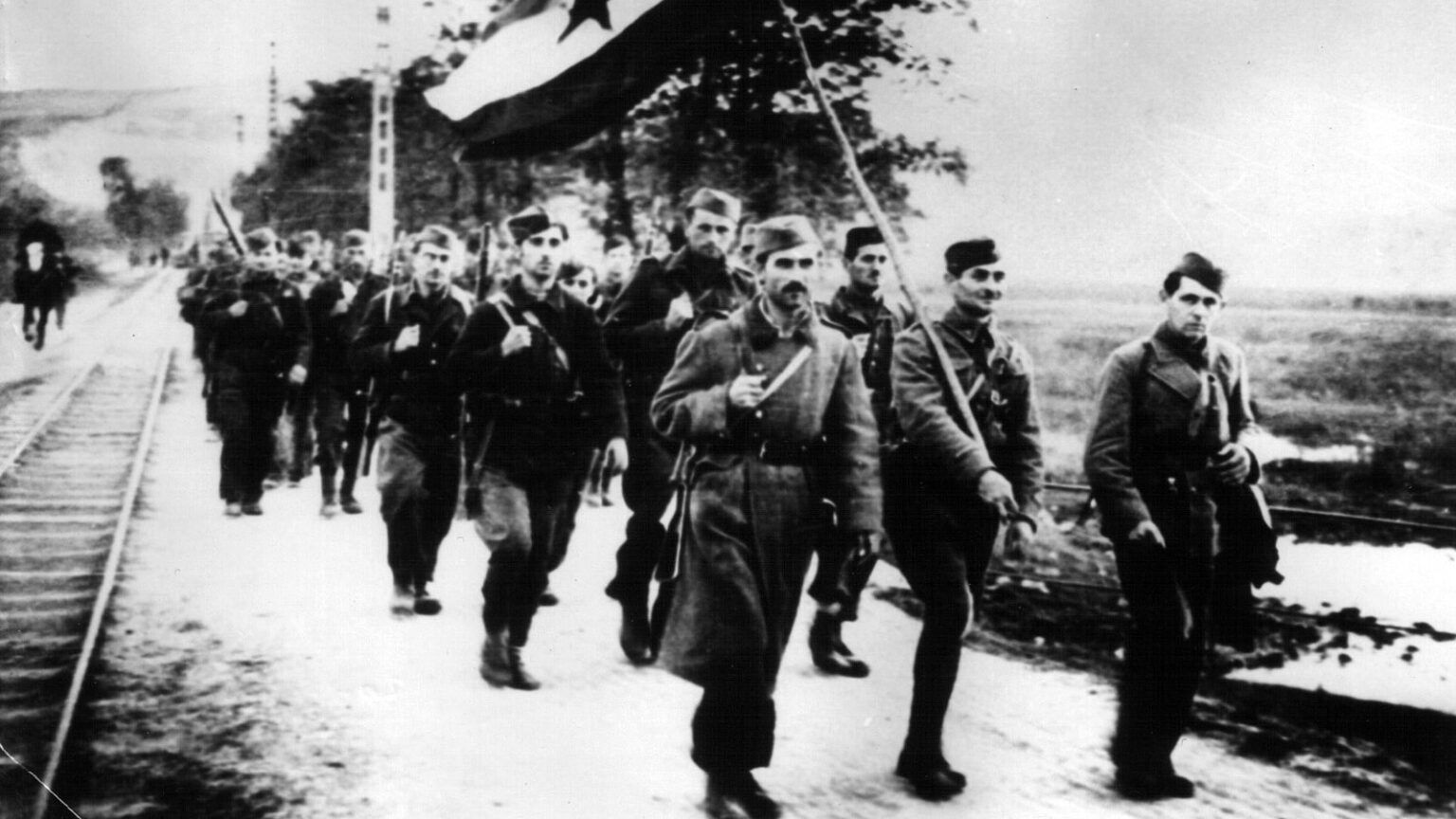
Entrance of the 7th Vojvodina Brigade of Yugoslav partisans in liberated Novi Sad, 23 October 1944. Photo: Wikimedia Commons

Neo-fascism merely adapted, disguised, and reshaped itself according to the times. In some states, we now see historical revisionism – and even glorification of local fascist or Nazi collaborators.

As we approach a major anniversary – 80 years since the defeat of fascism – a strange silence hangs over my country, Macedonia, and the broader region we now call the territory of former Yugoslavia. National authorities have been under sustained external (Western) pressure for years: May 9 must no longer be associated with the victory over fascism. Year after year, in both public memory and the education system, May 9 has been rebranded as Europe Day.

Older generations still remember, but what do younger ones know about Yugoslavia’s enormous human sacrifice, second only to the USSR, in the struggle against Evil? Almost nothing. We, the older ones, might suffer from the absence of dementia – we stubbornly remember the times when our fathers and grandfathers gave their lives for ideals that today’s youth barely even hear about.

This imposed forgetfulness on younger generations, however, goes so far that TV segments show young people unable to answer the simple question: Who was Josip Broz Tito? In Macedonia, more and more students know nothing about October 11, 1941, the Day of the Macedonian Uprising against fascism. Yet they excel in competitions where they display near-perfect knowledge of Europe. The irony is painful: the roots of patriotism and links to the most glorious moments of our not-so-distant past are not only being severed but portrayed as harmful.

A mythical and quasi-religious connection is being nurtured toward a mirage called Europe – meaning, of course, the European Union – which is idealized as a promised land, waiting with open arms. But this is no coincidence. Through its entire state-building apparatus, the EU seeks to rewrite history and implant it in the minds of new generations. In that version of history, any connection to the brutal colonial past is erased. More importantly, a veil is drawn over the fact that Europe’s imperial ambitions led to two world wars. The Second World War, whose anniversary we now mark quietly – even clandestinely, behind the EU’s back – was the anticlimax of capitalism, its degeneration into Nazism and fascism. This was not merely the result of individuals like Hitler or Mussolini, but of structural conditions that emerged from the womb of the post-World War I capitalist crisis.

The EU, falsely presenting itself as the embodiment of “Europe”, has been busy remodeling its image – until the start of the special military operation in Ukraine, it even tried to portray itself as a normative power, winning hearts and minds through soft power. It was even awarded the Nobel Peace Prize for past deeds. Yet its present and future seem to signal the revival of the very seed of evil it once claimed to oppose. The latest deep cycle of capitalist crisis first resulted in a divorce from democratic principles, but now it does not hide its hyper-imperialist and militaristic aspirations – for the sake of “self-defense” from an imagined Russian threat. Colloquially, many of us use the new word “Rusophrenia”: a belief that Russia is about to collapse and to take over the world at the same time. This term describes well the irrational view of Russia that is now entrenched in Western public opinion. It helps legitimize the new wave of militarization, even at the expense of the social well-being of Western citizens.

The rehabilitation of fascism began with its erasure from memory. Then came the glorification of the Euromaidan in Ukraine – the so-called pro-European revolution of 2014. A strange amnesia is spreading through the so-called Western world. As said, May 9 was kidnapped, and with it, textbooks, symbolic acts, and commemorations were gradually stripped of any connection to the true military victors of World War II: the Red Army and the Soviet people, who sacrificed more than 27 million lives. (Yugoslavs sacrificed more than a million people.)

It was the Soviets who liberated Berlin – twice. The final time, it was done by Mikhail Gorbachev, at a cost that Russia continues to pay today. Even the UN Secretary-General now avoids naming the Red Army soldiers who freed prisoners from the most notorious concentration camps.

It is Moscow and its allies who now stand as the only ones acting in the spirit of Orwell’s assertion that “in a time of universal deceit, telling the truth is a revolutionary act”. That truth will ring out loudly during the parade and major celebration on Red Square.

What is happening in what used to be Yugoslavia? In countries where generations were raised on narratives of brotherhood and unity, on the heroism of partisans who fought on the right side of history? First came the erosion of sovereignty and the right to self-determination. As the new religion – NATO and the EU are the only alternative and always right – was internalized, governments began distancing themselves from that part of our history. They turned instead to ancient glories or to painting a glowing future in union with the West.

To be red, to be a partisan, to be anti-fascist – gradually became suspicious, even dangerous. Our government now prides itself on alliances with the West (though it’s increasingly unclear – whose West? America’s or Europe’s?), and in distancing itself from those we once fought alongside. Former occupiers are now called “administrators”. Busts of partisans gather dust.

Anti-fascism has become uncomfortable to display – lest our Western allies recognize themselves in the mirror. So, silence prevails. Europe, the EU, is still celebrated – even as it re-militarizes, tramples basic values and human rights, and tacitly supports genocidal regimes. Confusion reigns over what to celebrate, what to remember, and why. Because, in an Orwellian world, war is peace, and peace is war.

Commemoration and historical memory matter. But just as vital is the ability to see, with eyes wide open, that the serpent’s egg still lives – and could hatch again into what millions across the world gave their lives to defeat eighty years ago. The bitter truth is that fascism was never fully defeated – except on the battlefield in 1945. Social scientists know well that the roots of fascism cannot be destroyed by arms alone. Neo-fascism merely adapted, disguised, and reshaped itself according to the times. In some states, we now see historical revisionism – and even glorification of local fascist or Nazi collaborators.

That is why the Russian initiative at the United Nations is significant. On 17 December 2024, during the 79th session of the UN General Assembly, the Russian Federation proposed a resolutionCombating glorification of Nazism, neo-Nazism and other practices that contribute to fueling contemporary forms of racism, racial discrimination, xenophobia and related intolerance. It was co-sponsored by 39 states from various regions. At last, it received 119 votes in favor, while 53 voted against. Regrettably, my country was among the latter – even though its very right to self-determination and statehood within Yugoslavia was born of the anti-fascist struggle. Perhaps for global politics, it is even more telling to examine who else voted against the resolution: Ukraine, the US, the UK, Germany, Italy, Belgium, Norway, the Netherlands, Finland, Sweden, Japan, Canada… Look at the new geopolitical map of the world, and it all becomes self-evident and telling.

According to some sources, Soviet Marshal Georgy Zhukov said, “We have liberated Europe from fascism, but they will never forgive us for it.”

They haven’t, as we now clearly see.

Biljana Vankovska is a professor of political science and international relations at Ss. Cyril and Methodius University in Skopje, a member of the Transnational Foundation of Peace and Future Research (TFF) in Lund, Sweden, and the most influential public intellectual in Macedonia.

This text was originally published by the Valdai Club and reproduced by Globetrotter.

Original article by Biljana Vankovska republished from peoples dispatch under a Creative Commons Attribution-ShareAlike 4.0 (CC BY-SA) license.

Publication should be regarded as worthy of debate rather that endorsement of the views of the author by the https://onaquietday.org blog.
Continue ReadingEighty years on: Remembering the defeat of fascism – or witnessing its return?

European leaders rewrite WWII history on Auschwitz liberation anniversary

Spread the love

Original article by Ana Vračar republished from peoples’ dispatch under a Creative Commons Attribution-ShareAlike 4.0 (CC BY-SA) license.

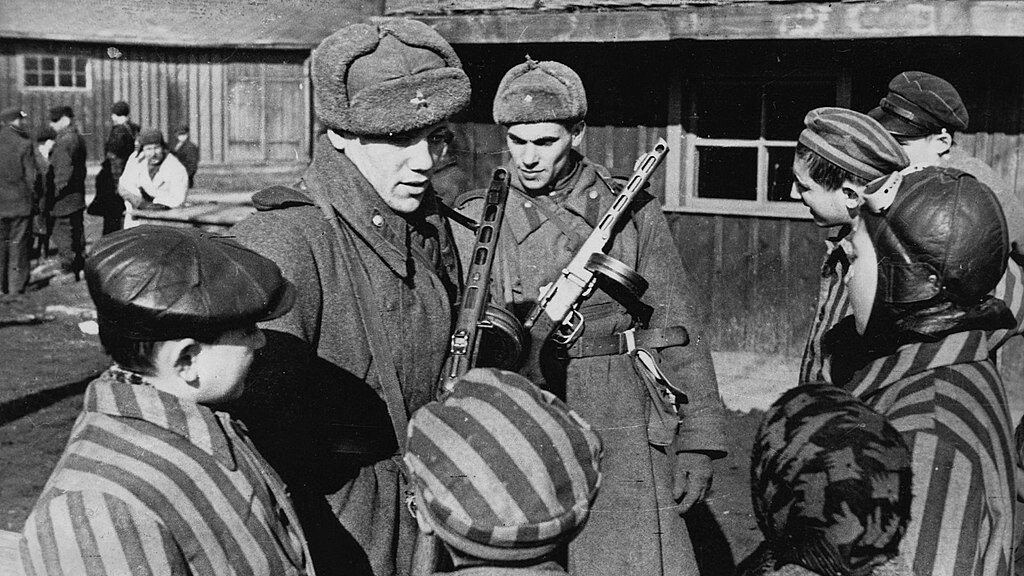
Red Army soldiers with prisoners of Nazi concentration camp, 1945. Source: Wikimedia Commons

As European leaders gathered at Auschwitz to commemorate 80 years since its liberation, they upheld a revisionist narrative that downplays the role of the Red Army in defeating Nazism

On January 27, 1945, soldiers of the Soviet Red Army liberated Auschwitz, the Nazi concentration camp where over one million people—overwhelmingly Jews—were murdered. Eighty years later, European leaders gathered in Poland, now home to the Auschwitz memorial, to hear survivor testimonies and reaffirm the commitment to ensuring such atrocities never happen again.

Yet this year’s commemoration came with a blazing omission. Despite the USSR’s vital role in defeating Nazi Germany and its allies—at the cost of over 20 million Soviets’ lives—there were no representatives of the Russian Federation at Auschwitz. In its pursuit of punishing Russia for the war in Ukraine, the European Union (EU) has virtually erased the Red Army’s contributions from the narrative. Leaders like Ursula von der Leyen and Giorgia Meloni issued statements of remembrance while avoiding any mention of the USSR. Only left politicians dared to talk about the full picture in their messages on the day of remembrance.

Read more: Zagreb’s anti-fascist flame: a decade of liberation celebrations and resistance

These events have to be read as part of a broad revisionist trend spreading through Europe, in which far-right parties, such as Meloni’s Brothers of Italy and France’s National Rally, are using anti-communist tropes to rewrite history. This trend has taken root among mainstream parties as well. Just days before Holocaust remembrance day, the European Parliament adopted a resolution condemning Russia for “exploiting the narrative of the ‘liberation of Europe from Nazism.’” The text of the resolution also criticized the restoration of Lenin’s monuments in Ukraine and called for a “pan-European” memorial for “victims of the 20th century totalitarian regimes,” a vocabulary that aims to equate fascism and communism.

In what can only be described as a severe case of historical amnesia, the parliamentaries proposed a ban on “both Nazi and Soviet communist symbols” across the EU. As some have pointed out, implementing such a ban would complicate commemorations like the one on Monday, given the prominence of Soviet uniforms in archival photographs of liberation.

While the EU is entertaining itself with erasing communism’s role in defeating Nazism in World War II, it seems to have learned extremely little from the Holocaust itself. The first phase of a ceasefire in Gaza had not even begun when Polish authorities announced they would allow Israeli Prime Minister Benjamin Netanyahu to attend the Auschwitz commemoration—despite an International Criminal Court warrant for his arrest on war crimes charges. Though Netanyahu ended up not attending himself, the mere possibility highlights Europe’s willingness to overlook crimes against humanity if committed by its current allies.

“Laying claim to the memory of one genocide in order to justify another genocide is morally and politically unacceptable,” historian Enzo Traverso said in a recent interview with Jacobin, commenting on Europe’s reactions to the genocide in Gaza. “The memory of Auschwitz should be mobilized to impede new genocides, not to justify them.”

Read more: Elon Musk and AfD’s Alice Weidel’s align ahead of elections in Germany

By refusing to acknowledge the full history of Nazism’s defeat in 1945—especially the contributions of the Red Army and communist movements—Europe only fuels the rise of the far-right. Parties like Alternative for Germany (AfD), National Rally and Brothers of Italy may avoid explicit antisemitism in their platforms, but their policies thrive on the same hatred and violence that drove the Holocaust. As these parties gain electoral ground, the slogan “Never again is now” is becoming increasingly difficult to believe.

Original article by Ana Vračar republished from peoples’ dispatch under a Creative Commons Attribution-ShareAlike 4.0 (CC BY-SA) license.

Continue ReadingEuropean leaders rewrite WWII history on Auschwitz liberation anniversary

The black, and Red, contribution to Nazi defeat must never be forgotten

Spread the love

Original article at https://morningstaronline.co.uk/article/victory-over-nazis-was-black-and-red

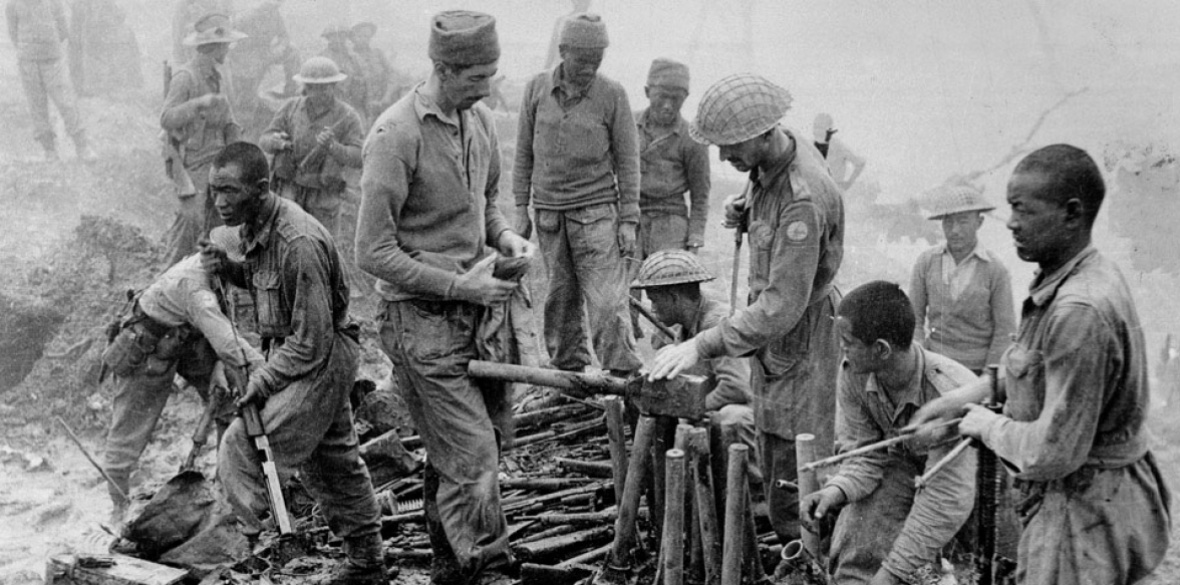
A photograph from the battle of Kohima, in north-east India, during World War II

We have long struggled for black and Asian Allied soldiers to be properly acknowledged in Europe’s commemorations — but now a worse travesty is upon us, as Russia’s crucial role is purged from the record, writes ROGER McKENZIE

President Putin took part in the commemoration of the 60th D-Day anniversary in 2004 and again, 10 years later, for the 70th anniversary — but he was not invited to this one.

The USSR, of which Russia was a key part, lost around 25 million people in the fight against Nazi Germany. But even this until recently undisputed fact is now under challenge.

In fact, the Red Army caused 80 per cent of all WWII German military losses and themselves lost 30 times more people than Britain, France and the US combined.

The Red Army’s defeat of the Nazis at Stalingrad is cited by many experts as being the decisive turning point in World War II. Between 150,000 and 250,000 Germans are estimated to have died at Stalingrad.

For Nazis, Stalingrad was not the battle that exacted the highest death toll, but the psychological impact of the battle was immense and was decisive in winning the war. It occupied and depleted massive Nazi resources which paved the way for the eventual Allied victory.

Over half a million Soviet soldiers and civilians died in the Battle of Stalingrad, among them numerous civilians. But that clearly was not enough to be invited.

Ukraine’s President Volodymyr Zelensky, on the other hand, was in attendance — as he always seems to be at pretty much anything. I now expect to see Zelensky at any event where a photo opportunity exists but the fact that he is invited to a commemoration of an event about the defeat of the Nazis is particularly insulting given the number of Nazis in his own forces and his applause in Canada last year for a veteran of a Waffen SS brigade that fought in Ukraine.

But the Russians are not the only ones that have been deliberately written out of history. The role of black people of African or Asian descent has continually been discarded.


More than 134,000 travelled from other colonies, including some 10,000 from the Caribbean to help defeat the Nazis. Only when casualties began to mount during the war were black people enlisted to join the fighting or become part of the Merchant Navy.

But there was no suspension in the standing orders of racism. Caribbean men joining the Merchant Navy were paid around one-third of the wages that white sailors were paid.

Around two and a half million fighters came from India to support the war effort. About the same time as the D-Day landing Indian, Gurkha and African soldiers fought the historic but little talked about — at least in Britain or the US — battles in Kohima, in north-east India.

These battles fought alongside British soldiers were among some of the toughest in the war and helped to turn the tide against the Japanese. Not for nothing did many of the troops who fought in battles in India and what is now Myanmar during the war call themselves “the Forgotten Army.”

I think they are probably wrong. I don’t think they were forgotten. I believe they were ignored because much of the fighting was carried out by black people. The Battle of Kohima and Imphal was the bloodiest of World War II in India, and it cost Japan many of its most elite fighters.

None of this seems to matter though to those that continue to hide the contribution made by people of African and Asian origin to the victory over the Nazis. We know the erasure of the role of the Red Army in World War II is being carried out for a different purpose.

The leaders of the Western powers can’t bring themselves to acknowledge the massive sacrifice of the Soviet people lest it demonstrate the skill and bravery of its soldiers and the refusal to be defeated by the seemingly invincible Nazis.

It is also part of the inexorable lurch towards a conflict with Russia as Nato ramps up the warmongering rhetoric that could lead to World War III and the catastrophic nuclear destruction of the planet.

Western powers seem far more willing to associate themselves with the Nazis surrounding the leadership of Ukraine and to hobnob with the likes of fascist-inspired Italian leader Giorgia Meloni.

I wonder how fast they will move for a photo opportunity should the far-right Marine Le Pen win the National Assembly election later this month or the next French presidential vote.

They say that history is written by the winners. Well, it seems not all the winners count. This means we must all call out the continued drive to rewrite history.

Original article at https://morningstaronline.co.uk/article/victory-over-nazis-was-black-and-red

Continue ReadingThe black, and Red, contribution to Nazi defeat must never be forgotten