US Opinion Is Shifting on Palestine; Can Political Leaders Shift With It?

Spread the love

Original article by Ramzy Baroud republished from Common Dreams under Creative Commons (CC BY-NC-ND 3.0). 
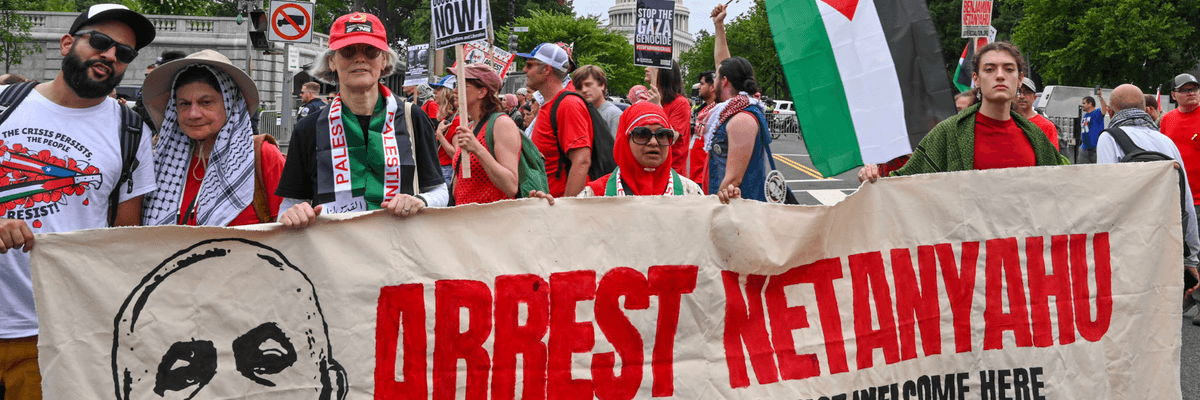
Pro-Palestine protesters hold a banner calling for the arrest of Israeli Prime Minister Benjamin Netanyahu during a July 24, 2024 demonstration in Washington, D.C. (Photo: Joe Piette/flickr/cc)

Growing support for Palestine means that more U.S. voters will base their future political decisions on how the U.S. engages with Israel and its disregard for Palestinian rights.

It is crucial for any American administration to recognize that, regardless of political agendas, the views of the American public regarding the situation in Palestine and Israel are undergoing a significant shift. A critical mass of opinion is rapidly forming, and this change is becoming undeniable.

Paradoxically, while Islamophobia continues to rise across the U.S., sentiments supporting Palestinians and opposing Israeli occupation are steadily increasing.

In theory, this means that the pro-Israeli media’s success in linking Israel’s actions against the Palestinian people to the so-called “war on terror”—a narrative that has demonized Islam and Muslims for many years—is faltering.

Palestine may not be the sole measure by which the Trump administration will be judged, nor the only factor shaping future voting patterns. Yet, it is undoubtedly a crucial test.

Americans are increasingly viewing the situation in Palestine as a human rights issue, and one that is deeply relevant to domestic politics. A recent Gallup poll underscores this shift.

The poll, released on March 6, was conducted between February 3 and 16. It found that American support for Israel is at its lowest point in 25 years, while sympathy for Palestinians has reached its highest level. Having 46% of Americans supporting Israel and 33% supporting Palestinians would have seemed inconceivable in the past, when the plight of Palestine and its people was largely overlooked by the general public.

Even more remarkable is that this shift continues to gain momentum, despite the fact that mainstream media and American politicians have been more biased than ever, promoting a dehumanizing discourse of Palestinians and unprecedented, uncritical support for Israel.

While the growing shift in favor of Palestine—particularly the genocide in Gaza, which played a role in influencing political outcomes in several states during the last presidential election—had gone largely unnoticed by the Biden administration, it’s clear that the dissatisfaction with the government’s position remains unchanged.

The previous administration approved significant military aid to Israel, topping $17.9 billion in the first year alone, enabling its genocidal war in Gaza, resulting in over 160,000 casualties over a span of 15 months.

Yet, this blatant disregard for Palestinian lives and rights persisted under the new administration of President Donald Trump, who appointed some of the most staunchly anti-Palestinian, pro-Israel figures to key positions in his government.

Trump did this despite making repeated, though often contradictory, promises to end the war and resolve the Israeli-Palestinian conflict.

Instead, the U.S. president approved the release of a shipment of heavy MK-84 bombs and passed a nearly $3 billion arms sale to Israel.

Trump also introduced a new U.S. policy that solely focused on “taking ownership” of Gaza and displacing its population. Although this position was inconsistently articulated, Trump ultimately, on March 14, seemed to reverse it altogether. This left many wondering whether U.S. foreign policy was truly independent or simply a reflection of Israel’s influence and its Washington lobby.

Unlike Biden, whose support for Israel has been consistent, Trump’s stance has been confusing and contradictory. The U.S. news portal Axios reported on March 5 that talks between the U.S., led by Adam Boehler, and Hamas had taken place in Doha. In an interview with CNN four days later, Boehler made the striking statement that U.S. and Israeli foreign policies should be seen as separate. “We’re the United States. We’re not an agent of Israel,” he said.

However, as analysts began mulling over this unprecedented language, it was soon revealed that Boehler was removed from his position, and the traditional, unwavering support for Israel quickly returned.

As U.S. policymakers continue to swing between their unwavering commitment to Israel and the “America first” rhetoric, they must keep in mind the following.

First, the American public is increasingly aware of events in Palestine, so masking Israel’s violations of Palestinian rights under the guise of “Israel’s right to defend itself” no longer suffices.

Second, U.S. and Israeli interests are not identical: The U.S. seeks geopolitical dominance followed by stabilization and so-called “containment,” while Israel thrives on provocations, destabilization, and long-lasting conflicts.

Third, Palestine has become a domestic issue in the U.S., and the debate on Palestine and Israel is no longer one-sided. Growing support for Palestine means that more U.S. voters will base their future political decisions on how the U.S. engages with Israel and its disregard for Palestinian rights.

Fourth, crackdowns on dissent, arrests of activists, and funding cuts will only deepen the polarization around this issue, rather than fostering an open, informed, and productive debate about a matter of great importance to millions of Americans. Such actions are quickly eroding the reputation of the U.S. as a democratic state and undermining confidence in its commitment to a peaceful resolution of the conflict.

Palestine may not be the sole measure by which the Trump administration will be judged, nor the only factor shaping future voting patterns. Yet, it is undoubtedly a crucial test. If the contradictions persist, and the U.S. continues to provide unwavering military support for Israel, Palestine could become the defining issue that contributes to the unraveling of U.S. foreign policy, not only in the Middle East but around the world.

It is not too late for this trajectory to shift, or for some degree of balance to emerge. The lives of millions are at stake.

Original article by Ramzy Baroud republished from Common Dreams under Creative Commons (CC BY-NC-ND 3.0). 

Neo-Fascist Climate Science Denier Donald Trump says Burn, Baby, Burn.
Elon Musk urges you to be a Fascist like him, says that you can ignore facts and reality then.
Continue ReadingUS Opinion Is Shifting on Palestine; Can Political Leaders Shift With It?

Ministers warned to stop the rush to ‘political suicide’

Spread the love

https://morningstaronline.co.uk/article/ministers-warned-to-stop-the-rush-to-political-suicide

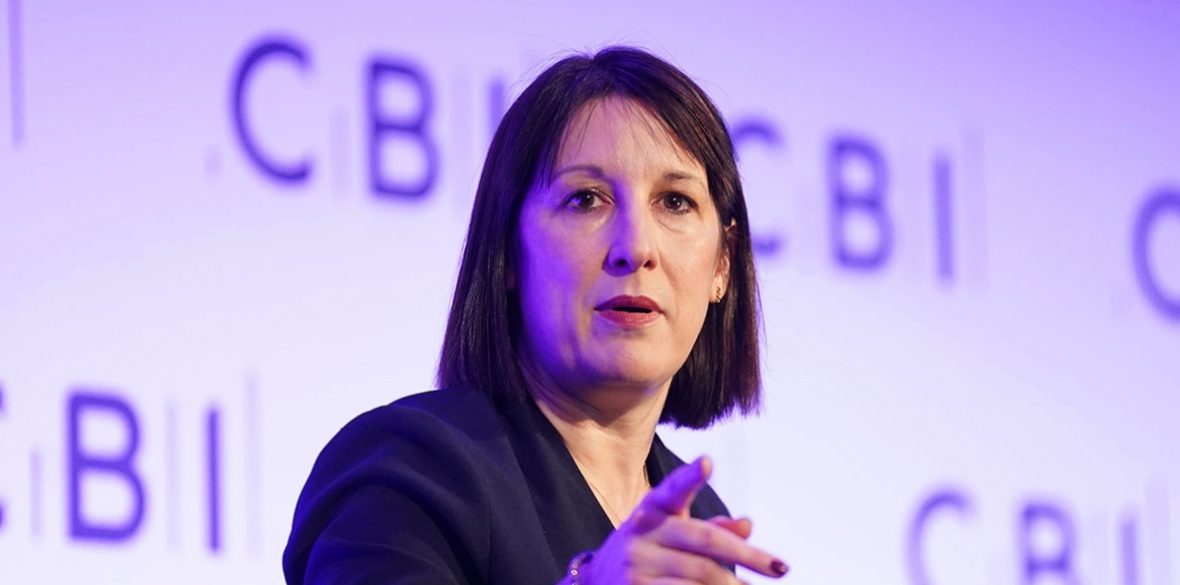
Chancellor of the Exchequer Rachel Reeves at the Confederation of British Industry (CBI) conference at the QEII Centre, London, November 25, 2024

Leading left MP and former shadow chancellor John McDonnell issued the warning to Rachel Reeves as the Chancellor returned from her China trip to confront the bond market crisis.

Mr McDonnell, presently suspended from the Labour whip for opposing the cruel two-child benefit cap, told BBC radio: “There is obviously a problem.

“There’s turbulence in the international markets, and we’ve just got to see those through.

“You don’t turn to cuts, certainly, because not only will that be politically suicidal, that would undermine the political support upon which Labour got elected.

“In addition to that, you would be taking demand out of the economy, and you would be looking at turning a crisis into a recession.

“So I think you just have to see through the turbulence in the markets.”

Mr McDonnell also reminded the government that voters matter more than markets.

https://morningstaronline.co.uk/article/ministers-warned-to-stop-the-rush-to-political-suicide

Continue ReadingMinisters warned to stop the rush to ‘political suicide’

Labour’s Otherworldly Manifesto

Spread the love
Zionist Keir Starmes is quoted "I support Zionism without qualification." He's asked whether that means that he supports Zionism under all circumstances, whatever Zionists do.
Zionist Keir Starmes is quoted “I support Zionism without qualification.” He’s asked whether that means that he supports Zionism under all circumstances, whatever Zionists do.

https://www.rosalux.de/en/news/id/52233/labours-otherworldly-manifesto

Keir Starmer’s party is set to win by a landslide, but its ambitions are simultaneously unrealistic and uninspiring

AUTHOR: Keir Milburn

“Stability is Change!” This seemingly paradoxical, almost Orwellian statement is the principal slogan of the Labour Party’s current parliamentary election campaign. Labour leader Keir Starmer used the slogan at the party’s manifesto launch, and it provides a key prism for understanding the manifesto and its weaknesses.

There is little doubt that the UK electorate is in the mood for change. The widespread, off-stated consensus in the country is that nothing works. The National Health Service is so chronically underfunded that doctor’s appointments are difficult to get and long waiting lists proliferate. The trains are shockingly expensive but utterly unreliable.

The list could go on and on, but the image most frequently used to sum up the situation comes from the failure of the privatized water services. A lack of investment in infrastructure accompanied by the looting of those companies for huge shareholder dividend payouts has led to the near constant release of untreated sewage into the UK’s river system. It flows from there onto our beaches. The British are quite literally swimming in shit!

These problems are identified quite clearly in the Labour Party manifesto, but the diagnosis of their causes and therefore their solutions proves much less convincing. Labour may have a plan to win in July, but how it will govern in the interests of its voters is anybody’s guess.

The totality of Labour’s spending pledges amounts to just 0.2 percent of GDP, smaller even than the Conservative pledges of 0.8 percent and dwarfed by the previous two Labour manifestos, which promised 2.1 percent and 3.2 percent respectively. Even the pro-market Institute for Fiscal Studies called Labour’s plans “tiny, going on trivial”.

These policies do not point to stability, not least because they do not address the 18 billion pounds of government spending cuts that the Conservatives have already baked into the government budget going forward. The effects of implementing such cuts on government services — which have already suffered so badly under 14 years of severe austerity — makes it hard to imagine that Labour will stick to this commitment. It seems likely that money will be found to prevent the worst of these cuts through technical changes in accounting between the government and the notionally independent Bank of England.

Beyond this paddling, however, the need for investment in the UK is huge. Both public and private investment in the country has collapsed since 2008. It has the lowest business investment in the G7 and ranks just twenty-eighth out of the 31 OECD countries. In the face of this, Labour, hamstrung by self-imposed fiscal rules on bringing down government debt and pledges not to raise the main forms of taxation, are promising so little investment that their plans seem unbelievable.

Until last February, Labour was promising to immediately strengthen workers’ rights through a New Deal for Workers, and to spend 28 billion pounds per year to decarbonize the economy through its Green Prosperity Plan. The Labour Party’s current openness to corporate funding and lobbying, including the imposition of over 30 parliamentary candidates with corporate lobbying backgrounds, has led to a dramatic watering down of these pledges. The Green Prosperity Plan has been reduced to just 3.5 billion pounds, but the form that spending will take reveals another logic or worldview which may come to the fore as crises mount.

The word “securonomics”, an ugly portmanteau favoured by shadow chancellor Rachel Reeves, makes an appearance in the manifesto, introducing the idea that public investment should support and de-risk private investment in strategically key sectors. The chief vehicle for this will be a National Wealth Fund “capitalised with £7.3 billion over the course of the next parliament”. What precisely this will look like has yet to be determined, but The National Wealth Fund “will have a target of attracting three pounds of private investment for every one pound of public investment”. This is an explicit return to and acceleration of the kind of public-private partnerships that lost legitimacy in the UK during the fallout from the disastrous Public Finance Initiative under New Labour.

Recommended article at https://www.rosalux.de/en/news/id/52233/labours-otherworldly-manifesto

Continue ReadingLabour’s Otherworldly Manifesto

Support for Israel’s War on Gaza Plummeting Among Key Biden Voters: Poll

Spread the love

Original article by JAKE JOHNSON republished from Common Dreams under Creative Commons (CC BY-NC-ND 3.0). 

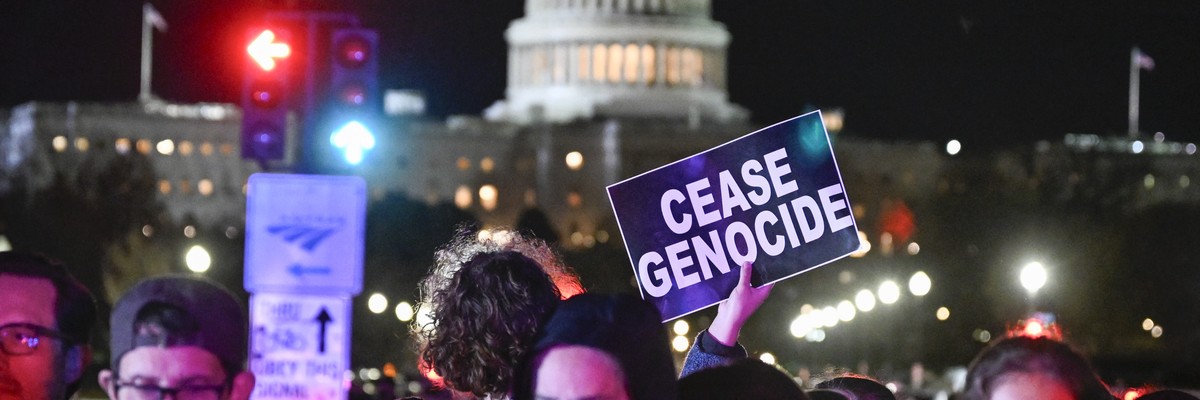
Hundreds of demonstrators demanding an immediate cease-fire in the Gaza Strip march in Washington D.C. on March 7, 2024. 
(Photo: Celal Gunes/Anadolu via Getty Images)

“Given these numbers,” said one progressive campaigner, “I don’t know how President Biden can reconcile his stalwart support for Israel with the clear preference that his core constituents have for an end to this war.”

A Gallup survey released Wednesday shows that U.S. public support for Israel’s military assault on Gaza has plummeted since November, with the decline particularly sharp among Democratic voters whom President Joe Biden will need to turn out to win reelection against presumptive GOP nominee Donald Trump.

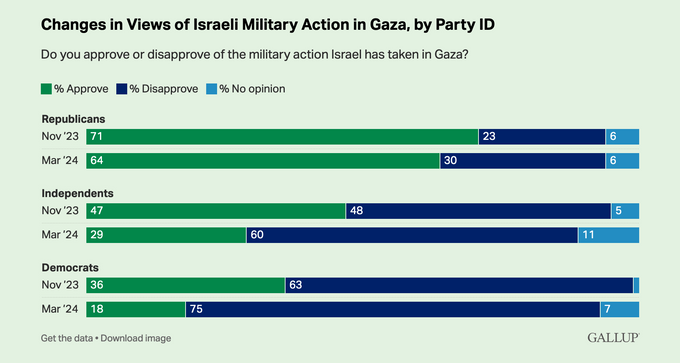
Just 18% of Democratic voters currently approve of “the military action Israel has taken in Gaza” and 75% disapprove, according to the new poll, which was conducted between March 1-20. In November, 36% of Democratic respondents expressed approval of Israel’s war and 63% disapproved.

“The crosstabs are even more striking—nearly two-thirds of people under 54, people of color, and women disapprove of the military action in Gaza,” Sam Rosenthal, political director of the progressive advocacy group RootsAction, told Common Dreams in response to the new poll. “That is effectively the Democratic Party’s base.”

“Given these numbers,” Rosenthal added, “I don’t know how President Biden can reconcile his stalwart support for Israel with the clear preference that his core constituents have for an end to this war.”

Overall, Gallup found that 55% of the American public—including 60% of Independents and 30% of Republicans—disapproves of Israel’s military campaign in the Gaza Strip, up from 45% in November. Just 36% of the U.S. public approves, down from 50% four months ago.

“Biden is risking his second term and our democracy by continuing to support the kind of violence and cruelty that is being perpetrated in Gaza right now.”

Observers noted that Gallup’s new poll was conducted after the Israeli military’s February 29 massacre of Palestinians seeking food aid. Since October, according to one human rights monitor, Israeli forces have killed more than 560 people waiting for humanitarian aid, the delivery of which Israel’s government has intentionally hindered—fueling the spread of famine across the territory.

The Biden administration has backed Israel’s assault from the beginning, providing the Netanyahu government with billions of dollars worth of weapons and diplomatic cover despite widespread and growing protests at home and abroad. Gallup’s survey found that 74% of U.S. adults say they are following developments in Gaza “closely.”

Political analyst Yousef Munayyer wrote on social media that “Biden’s policy of continued support for Israel’s war on Gaza is in line with the views of the right-wing Republicans,” noting that 64% of GOP voters still approve of the Israeli assault—down slightly from 71% in November.

“Just to emphasize how extreme his position is and out of line with his voters,” he added, “more Republicans disapprove of the war than Democrats who approve.”

Growing Democratic opposition to Israel’s military action in Gaza has fueled grassroots campaigns across the country urging voters to mark “uncommitted” on their Democratic primary ballots to pressure Biden to change course ahead of the general election against Trump, who has voiced support for Israel’s devastating assault on Gaza.

“Uncommitted” campaigns won 11 Democratic National Convention (DNC) delegates in Minnesota and two in both Michigan and Washington state.

“Biden is risking his second term and our democracy by continuing to support the kind of violence and cruelty that is being perpetrated in Gaza right now,” Faheem Khan, president of the American Muslim Advancement Council and a lead organizer of Uncommitted WA, said earlier this week.

Rosenthal of RootsAction told Common Dreams on Wednesday that the U.S. decision to abstain and allow the U.N. Security Council to pass a cease-fire resolution earlier this week was “a step in the right direction, and a clear indication that domestic pressure from campaigns like Listen to Michigan and other uncommitted voting efforts is working.”

“However, actual policy towards Israel has changed very little,” said Rosenthal. “Biden is still clamoring for more military aid to be sent, and the U.S. still largely supports Israel’s line, i.e., that military operations in Gaza are solely aimed at rooting out Hamas. What is manifestly obvious to the rest of the world, that Israel is committed to the wanton destruction of the Gaza Strip, is somehow escaping the administration’s notice.”

“President Biden should decide quickly whether he wants to continue to uphold policy that is increasingly associated with the opposition party,” Rosenthal added.

Original article by JAKE JOHNSON republished from Common Dreams under Creative Commons (CC BY-NC-ND 3.0). 

Another State Department Official Resigns Over Biden Gaza Policy

Democratic Insider Rips ‘Shocking’ US Claim That Israel Is Following International Law

US Under Fire for Downplaying Security Council Resolution as ‘Nonbinding’

Continue ReadingSupport for Israel’s War on Gaza Plummeting Among Key Biden Voters: Poll