‘A Moment of Reckoning’: 4,000+ May Day Demonstrations Across US

Spread the love

Article by Stephen Prager republished from Common Dreams under Creative Commons (CC BY-NC-ND 3.0).
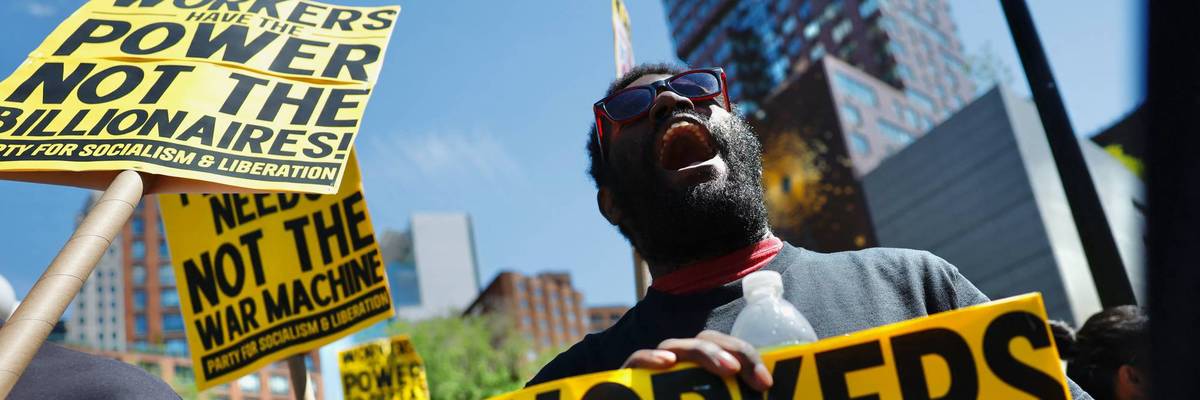
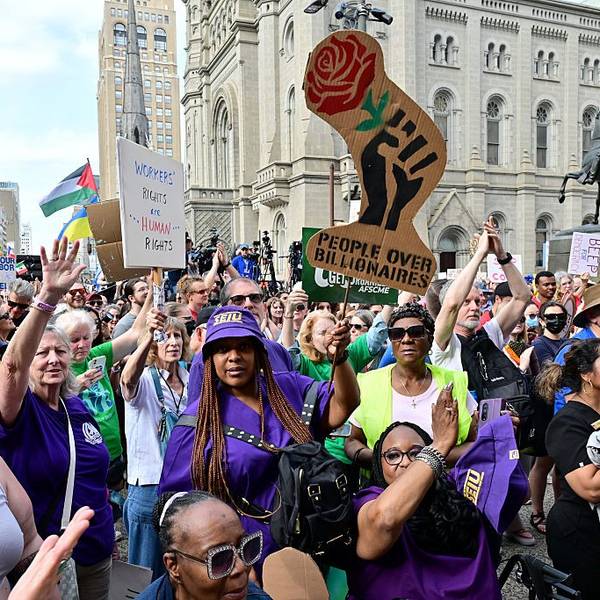
Demonstrators attend a May Day rally marking International Workers’ Day in New York, on May 1, 2026. (Photo by Kena Betancur/AFP via Getty Images)

“During the ‘No Kings’ demonstrations, we showed what we’re against. May Day is the day we’re making clear what we are fighting for,” said one organizer.

In thousands of locations across the United Statesworkers and students are taking off from work and school and swearing off shopping on Friday as part of a national May Day protest.

May Day Strong, a coalition of activist groups and unions organizing the events, said more than 4,000 actions, from marches to pickets to displays of peaceful civil disobedience, were underway.

RECOMMENDED…
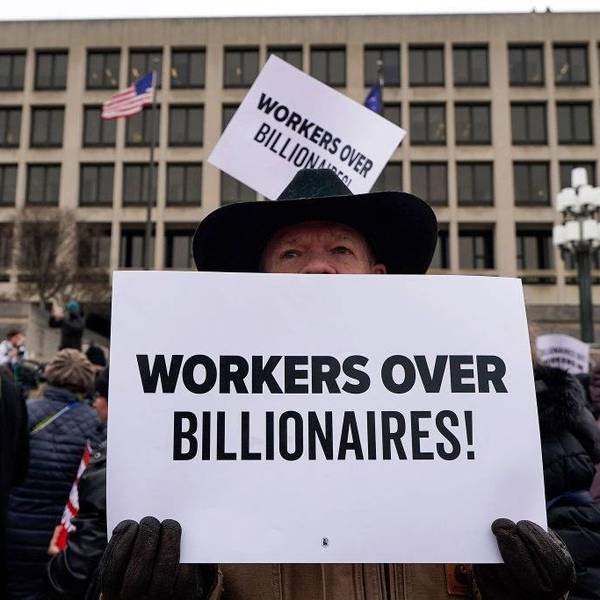
'Workers Over Billionaires': Over 3,000 Events Planned for May Day Across US
‘Workers Over Billionaires’: Over 3,000 Events Planned for May Day Across US

Nationwide May Day Strong Rally - Workers Stand Up to Billionaires- Philadelphia

US Working Class Mobilizes Ahead of Nationwide ‘May Day Strong’ Rallies

It is yet another nationwide display of coordinated resistance to the Trump administration’s agenda, including its war in Iran and its use of US Immigration and Customs Enforcement (ICE) to attack immigrant communities, issues that were at the forefront of March’s “No Kings” protests.

Six young protesters with the Sunrise Movement were taken into custody after blocking a bridge in Minneapolis in what they said was an act of “nonviolent noncooperation” to “stand up to the war in Iran and against ICE terrorizing our neighbors and our cities.”

Dozens more Sunrise protesters in Portland held a sit-in in the lobby of a Hilton hotel that was housing top officials with the Department of Homeland Security, leading to eight arrests.

“It’s May 1st, it’s workers’ day,” one of the protesters was recorded saying while being led away by police. “Don’t forget that you have power.”

In New York, over 100 activists lined up outside every entrance to the New York Stock Exchange in downtown Manhattan, banging drums and chanting “No ICE, no war!” where they were met by a flood of cops.

In the spirit of May Day, a global day of solidarity among workers, Sulma Arias, the executive director of the social justice organization People’s Action, said Friday’s “Workers Over Billionaires” protests are just as much about confronting injustices as about building an alternative.

“During the ‘No Kings’ demonstrations, we showed what we’re against. May Day is the day we’re making clear what we are fighting for,” Arias said. “We are for affordable housing for low-income people. We are for free healthcare for all. We are for utility laws that ensure every home stays warm in the winter and cool in the summer at costs that a person on a fixed income can afford. We are for the right to a fair and equal vote for Americans from every race and in every state. May Day is our day to assert and defend our rights.”

“They want us afraid. They want us divided. But on May 1, we refuse.”

Despite claims by President Donald Trump that the US is entering an economic “golden age” under his leadership, a Gallup poll released this week found that 55% of Americans said their finances were getting worse, the highest number ever recorded in more than 20 years of polling, and even higher than in the doldrums of the Great Recession.

A coalition of labor unions across several major cities, including Philadelphia, Chicago, and Los Angeles, has coordinated what has been called an “economic blackout,” which includes avoiding buying from private sector retailers.

“When we say ‘workers over billionaires,’ ‘billionaires’ is not just this amorphous figure, right? They’re real people,” said Jana Korn, the chief of staff for the Philadelphia Council AFL-CIO, in an interview with The Real News Network. “In Philadelphia, we’re kind of a poor city. We don’t have that many billionaires, but we have one. The CEO of Comcast is the only billionaire that lives in the city.”

“So why should we, as a city, accept that they take and take from us? And then with that money, what do they do? They donate to Trump’s ballroom project,” she continued. “People in Philadelphia are struggling… Our transportation system barely works. We’re at risk of having 17 schools close down this year.”

Some labor organizers have described economic boycotts, undertaken as part of prior mass protest movements against the second Trump administration, as an act of building strength for something larger, such as a future general strike.

“I think really for us in the labor movement,” Korn said, “[the boycott is] about how do we build the capacity to really disrupt, to strike when necessary, to shut things down when we have to. And that’s something that we have not been called to do as a labor movement in a very long time.”

Other unions have used May Day to confront their own employers directly. In New Orleans, hundreds of nurses at University Medical Center announced that they were beginning a five-day strike after attempting to negotiate a contract for more than two years.

In New York City, Amazon workers unionized with the Teamsters assembled on the steps of the public library before marching to Amazon’s corporate offices to demand the company cut its contracts with ICE, which has used its cloud computing services to target immigrants, including some Amazon workers and contractors.

Matt Multari, who has worked as an Amazon driver for a year and a half, told Mother Jones that he joined the protest to “demand the one thing that’s worth fighting for in this life: respect.”

Masih Fouladi, executive director of the California Immigrant Policy Center, said, “May Day is a moment of reckoning.”

“Immigrant communities—from farmworkers in our fields to nurses in our hospitals, from refugees fleeing war to families who have built their lives here for generations—are under siege,” she said. “They want us afraid. They want us divided. But on May 1, we refuse.”

“Workers and immigrants—documented and undocumented, native-born and newly arrived,” she said, “will stand together in the streets because we know the truth: there is no workers’ rights without immigrant rights, and there is no justice for working people here while our tax dollars fund devastation abroad.”

Article by Stephen Prager republished from Common Dreams under Creative Commons (CC BY-NC-ND 3.0).

Orcas discuss how Trump was re-elected and him being an obviously insane, xenophobic Fascist.
Donald Trump warns against following the Onaquietday.org blog, says that he's heard that she's a which with a black cat and a dangerous kitchen.
Donald Trump warns against following the Onaquietday.org blog, says that he’s heard that she’s a which with a black cat and a dangerous kitchen.

Continue Reading‘A Moment of Reckoning’: 4,000+ May Day Demonstrations Across US

Will voters turn against Donald Trump in the US midterms? What we know so far

Spread the love

Richard Hargy, Queen’s University Belfast

The US is bracing for another cycle of elections, with November’s midterms determining the scope of Donald Trump’s power in the final two years of his presidency. All seats in the House of Representatives will be contested, as will one-third of the Senate.

Trump’s Republican party currently controls both branches of Congress. However, polls are indicating a swing to the Democrats that would see them retake the House. A current RealClear generic congressional vote poll, in which people are asked whether they will vote for Democrats or Republicans for Congress, gives the Democrats a five percentage point lead over the Republicans at 47.4% to 42%.

One major variable that is likely to affect the outcome of November’s elections is the war in Iran. Some Republican political operatives believe the conflict and its repercussions, namely the increased cost of living, could prove fatal to their party’s hopes of securing a slim retention of the House.

A March poll by the Pew Research Center revealed 61% of Americans disapproved of Trump’s handling of the conflict. One voting demographic of particular concern for Republicans is people aged 18 to 29. An Economist/YouGov poll also from March showed that 63% of these people opposed the war.

Men within this age bracket were an important factor in Trump’s 2024 election victory. Philip Wang, political reporter for Time magazine, argued in an article on April 8 that this “same voting bloc … is showing far less interest in voting in the midterms”.

William A. Galston, a senior fellow at the Brookings Institution, has asserted that the affordability issue is affecting Trump’s standing. He has also stated that, for a majority of Americans, the president’s “priorities do not align with theirs”. A recent survey conducted by American non-profit Consumer Action for a Strong Economy revealed that voters’ most pressing concern was the price of groceries, with the cost of healthcare coming second.

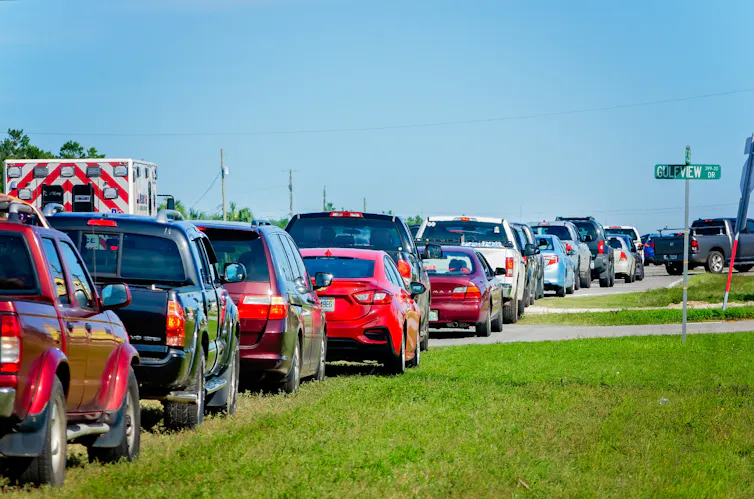
A queue of cars on a road in Florida.
Three weeks into the Iran war, petrol prices had surged to an average of US$4 a gallon. Carmen K. Sisson / Shutterstock

Over the past year, both parties have also engaged in redistricting efforts designed to increase their respective chances of controlling the House. In a number of mainly – though not exclusively – Republican controlled states, legislators have redrawn congressional maps in an attempt to secure more seats.

The redistricting war has come down to two final states: Democratic-led Virginia and Republican-dominated Florida. On April 21, voters in Virginia will decide the fate of proposed new congressional boundaries heavily favouring Democrats. Florida’s legislature will vote days later on a revised Republican-leaning electoral map.

However, there are growing concerns in both political camps about these votes and their impact on the result of the midterms. Florida Republicans fear Trump’s low approval ratings could cost them redrawn districts, while Democrats are encountering tepid backing from their supporters for their aggressive redistricting in Virginia.

Growing Democrat momentum

There have already been significant election results in recent weeks that have shed light on the trajectory of the upcoming midterms. In Republican-led Texas, a fascinating race is shaping up between both parties for a Senate seat. The last time a Democrat won here was in 1988.

In primary elections in March, Democratic voters chose state representative James Talarico as their candidate for November’s election. Republicans are yet to confirm theirs, with incumbent Senator John Cornyn facing Texas attorney-general Ken Paxton in a run-off election in May.

Primary voting numbers in Texas are encouraging for Democrats. For the first time in six years, more of its supporters cast early vote ballots in a March primary than Republicans. Democrats also saw a major shift in Latino voters to their side, a voting bloc that had swung to Trump in record numbers in 2024.

According to analysis by American broadcaster NPR: “In the ten most populous counties in Texas that are also at least 50% Latino, votes in the Democratic primary increased by an average of 128%.” The same analysis concluded that, in those same counties, the Republican primary saw an average drop in votes of 4.8%.

Then, in early April, liberal judge Chris Taylor won a seat on the state of Wisconsin’s supreme court. She secured 60.1% of the vote to her conservative opponent’s 39.8%. Taylor’s statewide vote is an impressive 21 percentage points higher than Democratic presidential candidate Kamala Harris’s vote share was in the state in 2024.

Also in early April, an election took place in Georgia to fill the congressional seat vacated by former Trump ally Marjorie Taylor Greene. Greene, who has publicly broken with Trump over his handling of the Epstein files, won in 2024 by almost 29 percentage points. Her replacement, Clay Fuller, held the seat for the Republican party by a much narrower margin of just 12 percentage points.

The forecasts for November’s midterm elections are moving in the Democrats direction, especially for taking control of the House. But there is some reason for hope among Republicans.

Figures from CBS News and CNN/SSRS show that at the same point in 2006 and 2018 – also midterm election years where a Republican president was in office – Democrats were ahead on party favourability by 18 points and 12 points respectively. At this stage in 2026, the data reveals Republicans are actually sitting with a five-point favourability lead.

Seven months out from November’s midterms, Democrats have momentum on their side as well as a Republican president whose poll ratings are plummeting. The most likely outcome is that the Democrats will emerge with control of at least one branch of Congress.

Richard Hargy, Visiting Research Fellow in International Studies, Queen’s University Belfast

This article is republished from The Conversation under a Creative Commons license. Read the original article.

Continue ReadingWill voters turn against Donald Trump in the US midterms? What we know so far