London PR firm rewrites Wikipedia for governments and billionaires

Spread the love

Original article by Claire Wilmot republished from TBIJ under a Creative Commons Attribution-NonCommercial-NoDerivs 3.0 Unported License.

Founded by Keir Starmer’s comms chief, Portland helps rich clients ‘protect their reputation’ – with a shady, off-the-books service

Twenty-five years after it was founded, Wikipedia stands as an unrivalled achievement. Not only is it the single largest collection of information in human history, it has also built a stellar reputation for reliability in a digital world awash with lies and deception.

For this reason, new AI tools have begun to carry the site’s contents far and wide. Chatbots and AI-generated search summaries – which are rapidly transforming the way people get their information – both use Wikipedia as a key source.

Now, we can reveal Wikipedia has been subject to shady, paid-for edits ordered by partners at an elite London PR firm with links to Downing Street. And the clients who benefitted from this “wikilaundering” are some of the world’s richest and most powerful people.

The firm in question is Portland Communications, whose founder Tim Allan is now the director of communications for Keir Starmer. And it has been busted once already for this practice, which is in breach of the British PR professionals’ code of conduct.

But after the firm was exposed, former employees told us, it simply started hiring middlemen instead. As one of them put it: “No one said, ‘We should stop doing this.’ The question was how we could keep doing it without getting caught.”

Portland’s subcontractors have polished the public image of Qatar by burying references to critical reporting ahead of the 2022 World Cup, according to the firm’s insiders. They have also obscured mentions of a major terrorist-financing case involving Qatari businessmen; scrubbed evidence that a billion-dollar Gates-funded project failed in its mission; and promoted one side of Libya’s post-Gaddafi government over the other.

Often, however, their changes were more subtle: burying bad press under descriptions of a client’s philanthropic work or swapping out critical news references with something more positive.

How Wikipedia works

– Hide

Anyone can edit Wikipedia. You don’t even need to set up an account. But all editors must abide by rules put in place to protect it from manipulation. Automated scripts scan the site for suspicious edits, and a critical mass of contributors and volunteer editors work to add and refine its contents. Wikipedia’s terms of use prohibit paid contributions without disclosure and it has other policies on neutrality, sourcing and conflicts of interest.

The site’s reputation as a dependable and objective information source is well earned. A 2019 study in the journal Nature showed that the most politically contentious articles on Wikipedia also tended to be pretty balanced. To put it simply: it is hard to publish misinformation on Wikipedia.

“Small Wikipedia edits punch above their weight,” explained Alberto Fittarelli, a senior researcher at the University of Toronto’s Citizen Lab. “Professionals who try to manipulate the platform know that small, incremental changes are likely to stick for longer. These kinds of edits make narratives seem credible precisely because they are hardly noticeable. Once that enters the information stream, it becomes really hard to claw it back.”

With the rich and powerful ever more eager for their pages to cast them in the best possible light, the demand for Wikipedia editing has never been higher. And that demand is being met by a thriving cottage industry of illicit editors.

Portland declined to comment on any of our findings.

The man at the centre

Radek Kotlarek, a web consultant who lives on the Welsh coast, is an unremarkable-looking man with friendly features and a bushy beard. Like many in his field, Kotlarek’s expertise lies in SEO – search engine optimisation – and the company he founded, Web3 Consulting, was fairly low-profile until it was dissolved last year. His only real excursion into public life was in 2021, when he was arrested for breaking lockdown rules by taking his wife and son out for an ice cream.

But we can reveal that Kotlarek was in fact a key figure in Portland’s secret wikilaundering business. He specialises in “black hat” Wikipedia editing: pay-for-play changes that violate both the website’s rules and the British PR professional association’s guidelines for ethical conduct. According to seven Portland insiders we spoke to, Kotlarek’s services were used by partners at the firm for about a decade.

Radek Kotlarek is at the heart of Portland’s outsourced wikilaundering operation

All PR sources have signed strict non-disclosure agreements that come with serious consequences if breached. As a result, the 14 industry insiders who spoke to us for this story have been kept anonymous. But because there is a public record of every Wikipedia edit, we were able to corroborate some of their stories by examining the changes made to certain pages at certain times.

Our analysis led us to a network of 26 “sockpuppets” – multiple accounts orchestrated by a single person – that was eventually banned from Wikipedia under suspicion of paid editing. We linked that network to Web3 Consulting, Kotlarek’s company.

Kolarek did not respond to multiple requests for comment during our reporting of this story.

Portland hasn’t always outsourced this work. Until the early 2010s, it did its wikilaundering in-house. According to former employees, the firm’s partners would dispatch junior staff around London and New York, instructing them to move from cafe to cafe and edit clients’ pages from different computers. (One telltale sign of wikilaundering is persistent edits from a common IP address. Doing it on the move was a form of disguise.)

But in 2011, the firm was caught trying to remove a reference to domestic violence on the page for Stella Artois. The scandal prompted the Chartered Institute of Public Relations (CIPR), the UK’s PR professional association, to proscribe paid editing as a form of “digital dark arts” – actions it describes as breaches of conduct. The CIPR is a voluntary members-based association to which Portland has not signed up.

https://frontend.poool.fr/engage/56TXL-DGRM7-IPY34-9YVAW/67b3726b9f79a3dc6ea9504c

After this episode, Portland began outsourcing Wikipedia edits to bring the firm a degree of plausible deniability if it was caught, ex-employees told us. And Kotlarek’s company took on some of the work.

While wikilaundering was not something provided openly by Portland, Kotlarek’s services were a loosely kept secret at the firm. If a client “had a Wikipedia problem”, there were certain partners who could bring him on board, said one ex-employee.

Because of Wikipedia’s many volunteer editors and stringent sourcing practices, the influence operations that target it must be subtler and more sophisticated than those aimed at other platforms. Web3’s techniques fit that bill: its network of sockpuppets used multiple accounts that adopted different personas to make edits look more authentic – at least to the untrained eye.

“Influence operators are attracted to Wikipedia because it is a means of shaping perceptions in large populations,” said Alberto Fittarelli.

“While people are increasingly sceptical of the content they see on social media, Wikipedia remains a point of reference for many. That’s why it is attractive to bad actors trying to manipulate it, and why the danger is real.”

The Qatar contract

In December 2010, the tiny Gulf state of Qatar became the centre of huge international attention when it was chosen as the shock host for the 2022 World Cup. Almost immediately, the country’s human rights record began to draw intense scrutiny. And as stadium construction projects got underway, reports began to emerge detailing the deaths of migrant workers.

Construction workers building Lusail stadium, Doha, ahead of the Qatar World CupMatthew Ashton / AMA / Getty

With its reputation in the spotlight, Qatar turned to Portland. In 2013, the firm was handed a lucrative contract with the country, its remit covering “government affairs through to nation branding”.

According to six former Portland employees involved in some of this work between 2013 and 2024, Wikipedia edits were a common request from the Qataris. They said Portland hired subcontractors to target pages detailing Qatar’s human rights record, particularly around stadium-building, with pages of prominent politicians also targeted.

TBIJ’s analysis confirms several networks of accounts editing pages to raise the prominence of positive coverage of Qatar, as well as hedging negative press or burying it under more favourable material. Many of these changes – some of which Wikipedia editors flagged as suspicious in separate investigations – were performed by accounts outside of the Web3 network.

Wikipedia reaches into AI and distributes information throughout the internet

Stephen Harrison, journalist

Other edits by the Web3 network focussed on the country’s business interests, including the removal of references to a case in which two Qatari billionaires were sued in the British high court for allegedly channelling funds to Jabhat al-Nusra, a Syrian terrorist group. The case appears to have collapsed in July 2024 after claimants withdrew some claims (lawyers told the Guardian that their clients had been intimidated by Qatari state operatives). But in October 2019, Web3’s network erased all mentions of the case from the page of the men’s business.

Three Wikipedia editors told us that in general, if a case is subject to media coverage as this one was, it should not be deleted.

And earlier this year, Portland’s Qatar contract became the subject of a lawsuit against the firm. In April, Portland and its parent company Omnicom were sued by more than 100 victims of World Cup construction projects, who allege the PR firms helped Qatar hide its human rights record such that they aided human trafficking. They are seeking damages.

‘Constantly putting out fires’

Kotlarek’s network got through plenty of work, but it wasn’t able to stay under the radar forever. In 2020, Wikipedia editors began investigating suspicious changes performed by a network – which we later linked to Web3 – and blocked a handful of accounts. The site’s volunteer investigators busted the entire network in 2024, according to open-source Wikipedia records.

But by that time, the network had been active for almost a decade and had been able to make some considerable changes to the public record.

On the page for the Alliance for a Green Revolution in Africa (AGRA), a billion-dollar initiative from the Gates Foundation – both known Portland clients – Kotlarek’s sockpuppets had changed various key details. First, they changed the date by which the project had aimed to reach its goal of doubling the revenue of 30 million farmers, from 2020 to 2021.

A month later, a different account also run by Web3 restructured the page and deleted the “Evaluation” section entirely. It also removed a reference to a Tufts University study showing that the project had failed to meet its own objectives.

How Kotlarek’s network changed the goals of the AGRA project …

… and deleted its Evaluation section altogether

Another raft of changes centred around political fallout in Libya. During the civil war following the fall of Muammar Gaddafi’s government in 2011, the assets controlled by the country’s sovereign wealth fund were frozen by the UN to prevent them being plundered. Portland was reported to be representing one side of the disputed government, which three Portland sources familiar with the contract confirmed to us.

One of the original accounts in Kotlarek’s network was pushing narratives favourable to the Tripoli-based government over its Malta-based opposition throughout 2016, during a period of intense fighting in which all sides were accused of committing atrocities.

AGRA confirmed to us that it had hired Portland but said it has “no knowledge of, nor any association with, Web3 Consulting”. It said it is committed to transparency and its policies prohibit any actions that violate the terms of service of external platforms.

The Gates Foundation, the Qatar government and the Libyan sovereign wealth fund did not respond to our requests for comment.

The blocking of Kotlarek’s network hasn’t stopped the practice more widely. Indeed, new networks have since emerged that also spend a lot of time editing pages of Portland clients. And Portland employees told us the demand for wikilaundering is only likely to increase.

Stephen Harrison, a journalist who has covered Wikipedia extensively, said: “It is incredibly important that the facts are represented accurately because Wikipedia reaches into AI and distributes information throughout the internet.”

What’s more, AI-generated summaries are drawing traffic away from the site, which its editors fear could diminish that critical mass of volunteers keeping the platform safe. Investigating and blocking these networks, an exercise in constantly putting out fires, takes time and energy.

“The sock puppet investigators are real heroes,” said Harrison “But [their] investigations are not going to stop this kind of thing. I think there also needs to be more legal action.”

A spokesperson for the Wikimedia Foundation said that it had resources to investigate and take action against firms that violate its policies, though couldn’t share details of specific cases.

“We are committed to protecting the integrity and reputation of Wikipedia, which is built from the contributions of millions of volunteers over nearly 25 years.”

Reporter: Claire Wilmot
Big Tech editor: James Clayton
Deputy editor: Katie Mark
Editor: Franz Wild
Production editor: Alex Hess
Fact
 checker: Ero Partsakoulaki

TBIJ has a number of funders, a full list of which can be found here. None of our funders have any influence over editorial decisions or output.

Original article by Claire Wilmot republished from TBIJ under a Creative Commons Attribution-NonCommercial-NoDerivs 3.0 Unported License.
Continue ReadingLondon PR firm rewrites Wikipedia for governments and billionaires

In Grok we don’t trust: academics assess Elon Musk’s AI-powered encyclopedia

Spread the love

https://www.theguardian.com/technology/2025/nov/03/grokipedia-academics-assess-elon-musk-ai-powered-encyclopedia

Users have found that Grokipedia lifts large chunks from Wikipedia, contains numerous factual errors and promotes Musk’s favoured rightwing talking points. Photograph: Algi Febri Sugita/Zuma Press Wire/Shutterstock

From publishing falsehoods to pushing far-right ideology, Grokipedia gives chatroom comments equal status to research

The eminent British historian Sir Richard Evans produced three expert witness reports for the libel trial involving the Holocaust denier David Irving, studied for a doctorate under the supervision of Theodore Zeldin, succeeded David Cannadine as Regius professor of history at Cambridge (a post endowed by Henry VIII) and supervised theses on Bismarck’s social policy.

That was some of what you could learn from Grokipedia, the AI-powered encyclopedia launched last week by the world’s richest person, Elon Musk. The problem was, as Prof Evans discovered when he logged on to check his own entry, all these facts were false.

It was part of a choppy start for humanity’s latest attempt to corral the sum of human knowledge or, as Musk put it, create a compendium of “the truth, the whole truth and nothing but the truth” – all revealed through the magic of his Grok artificial intelligence model.

When the multibillionaire switched on Grokipedia on Tuesday, he said it was “better than Wikipedia”, or “Wokepedia” as his supporters call it, reflecting a view that the dominant online encyclopedia often reflects leftwing talking points. One post on X caught the triumphant mood among Musk’s fans: “Elon just killed Wikipedia. Good riddance.”

But users found Grokipedia lifted large chunks from the website it intended to usurp, contained numerous factual errors and seemed to promote Musk’s favoured rightwing talking points. In between posts on X promoting his creation, Musk this week declared “civil war in Britain is inevitable”, called for the English “to ally with the hard men” such as the far-right agitator Tommy Robinson, and said only the far-right AfD party could “save Germany”.

Musk was so enamoured of his AI-encyclopedia he said he planned to one day etch the “comprehensive collection of all knowledge” into a stable oxide and “place copies … in orbit, the moon and Mars to preserve it for the future”.

Original article at https://www.theguardian.com/technology/2025/nov/03/grokipedia-academics-assess-elon-musk-ai-powered-encyclopedia

Elon Musk urges you to be a Fascist like him, says that you can ignore facts and reality then.
Donald Trump urges you to be a Climate Science denier like him. He says that he makes millions and millions for destroying the planet, Burn, Baby, Burn and Flood, Baby, Flood.
Nigel Farage urges you to ignore facts and reality and be a climate science denier like him and his Deputy Richard Tice. He says that Reform UK has received £Millions and £Millions from the fossil fuel industry to promote climate denial and destroy the planet.

Continue ReadingIn Grok we don’t trust: academics assess Elon Musk’s AI-powered encyclopedia

Climate Crisis Reality Check (2)

Spread the love
The Paris Agreement 2015 is the latest international treaty on climate change.
  
Quoted from wikipedia 
 
...
The Paris Agreement's long-term temperature goal is to keep the rise in mean global temperature to well below 2 °C (3.6 °F) above pre-industrial levels, and preferably limit the increase to 1.5 °C (2.7 °F), recognizing that this would substantially reduce the effects of climate change. Emissions should be reduced as soon as possible and reach net-zero by the middle of the 21st century.[3] To stay below 1.5 °C of global warming, emissions need to be cut by roughly 50% by 2030. This is an aggregate of each country's nationally determined contributions. 
...
According to the 2020 United Nations Environment Programme (UNEP), with the current climate commitments of the Paris Agreement, global mean temperatures will likely rise by more than 3 °C by the end of the 21st century.
...
Countries determine themselves what contributions they should make to achieve the aims of the treaty. As such, these plans are called nationally determined contributions (NDCs).
...
In 2021, a study using a probabilistic model concluded that the rates of emissions reductions would have to increase by 80% beyond NDCs to likely meet the 2 °C upper target of the Paris Agreement, that the probabilities of major emitters meeting their NDCs without such an increase is very low. It estimated that with current trends the probability of staying below 2 °C of warming is 5% – and 26% if NDCs were met and continued post-2030 by all signatories.
...

The message from the above quotations is
1. The Paris Agreement is an attempt to limit climate change effects by keeping global mean (average) temperatures below 1.5C or 2C.
2. We are likely looking at global temperature rises between 2C and over 3C by the end of the century. 


We are currently at 1.1 or 1.2C global mean temperature above pre-industrial levels. There are extreme climate events now never mind at 1.5, 2 or over 3C. 

2022 saw record-breaking heat in UK while there were heatwaves and vast wildfires in North America, record-breaking temperatures and huge wildfires across France and Western Europe, huge drought followed by severe flooding in Pakistan, repeated flooding in Eastern Australia and currently East Africa is suffering the worst drought in decades.  

We are in a climate crisis at 1.2C. The crisis is now. 

The main cause of global warming is the use of fossil fuels. The best response to the climate crisis is to stop the use of fossil fuels as much as we possibly can and to transition to renewable sources of energy instead. This would also involve a programme of insulation to reduce the use of fossil fuels. 

Politicians worldwide are neglecting to address the climate crisis in any meaningful way. The protest group Just Stop Oil is calling for no new development of fossil fuels. Grant Shapps, UK's Secretary of State for Business, Energy and Industrial Strategy is so totally out of touch that he's not even familiar with Just Stop Oil's objectives: “I’ve no issue with people arguing for lower levels of petrol, gas or whatever other thing they want to campaign for usage, that is fine, that is one thing. But don’t go disrupting other people’s lives - it’s unacceptable, it’s illegal!”, the Business Secretary said.  

Young people particularly should get active opposing climate destruction because it's fekking their futures and otherwise they're just going to keep on getting totally disregarded, shat on. Extreme weather events at 1.2C are so serious, 3C may well lead to extinction and next to nothing is being done to prevent it.

Some links - try searching for your own e.g. extreme weather events 2022
https://en.wikipedia.org/wiki/Paris_Agreement
Met Office: Unprecedented extreme heatwave (UK), July 2022
Analysis: Africa’s unreported extreme weather in 2022 and climate change
Over 20,000 died in western Europe’s summer heatwaves, figures show

16/12/22 Climate Reality Check 2021


Continue ReadingClimate Crisis Reality Check (2)

WARNING: Graphic Image. Paris attacks 13 November 2015

Spread the love

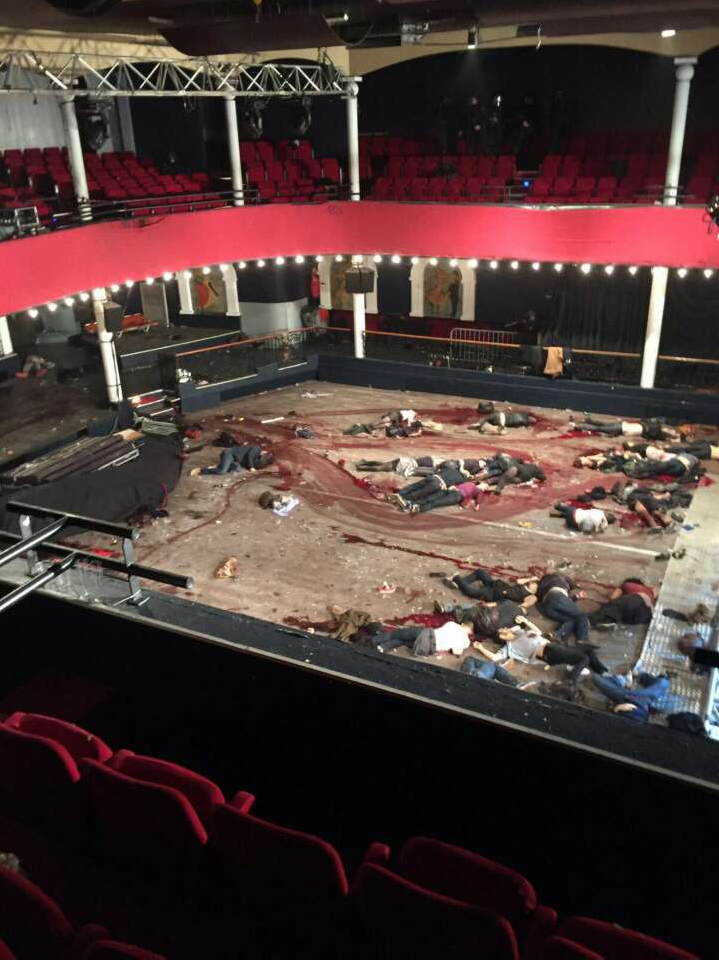
WARNING: Graphic Image. For me it was that photo. That was enough. The claim was that it was carefully considered / planned. So would Daesh make a sacrifice to the devil? I have experience of this. Those numbers in the image. Daesh would do that? Hands up? Looks like a different dialect.

Image of Bataclan theatre following Paris attacks 13 November 2015

ed: a certain dialect. I’ve not ever taken any vows.

ed: J’accuse les NeoCons.

9.15 20/11/15: Who don’t have beards? French culture is anti-stubble – even tramps are clean-shaven FFS. To not have beards is a cultural giveaway. 11.10 21/11/15. This is probably incorrect. They may have had small beards or stubble.

24/11/15 10.15 am

Paris attack witness says black Mercedes pulled up and shooters fired rifles from the hip

Witness describes Paris attackers as clean-shaven, muscular, like soldiers or mercenaries, driving a black Mercedes car.

“He was white, clean shaven and had dark hair neatly trimmed.”

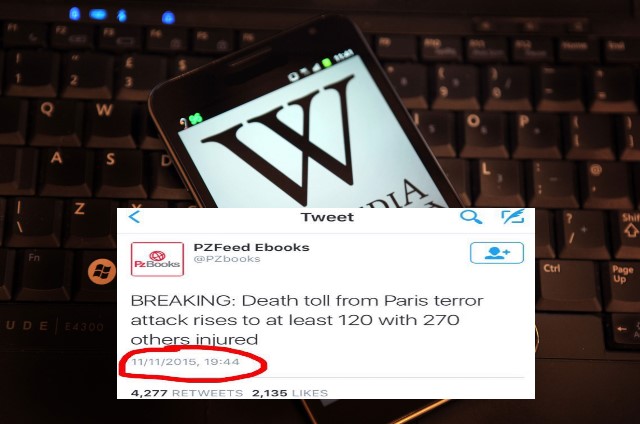
Paris Attack Reported on WIKIPEDIA and TWITTER before it happened

Paris attacks reported at wikipedia and twitter before they happenedThat title is a little misleading. The Wikipedia reports are extremely detailed very soon after the events with one incident reported before it had happened. The twitter report was over two days before the Paris attacks.

The 23:18 version includes discussions of the hostage-taking, complete with an approximate number of hostages involved (60), as well as detailed accounts of events at several locations. It even has a detailed bibliography. How could your average Wikipedia author have done this incredible piece of work and in less than two hours? Obviously this was not your average Wikipedia author.

You’re invited to read this early version of the Wikipedia article, which appears at the bottom of this post.

Revisions were subsequently made to the article. But the storyline it established, which is undoubtedly why it was written in the first place and gotten into Wikipedia so quickly, did not change through any of those revisions. It’s the storyline that the article is designed to make stick in the public mind.

As yet (00:41 PM CET), the newspapers are reporting simply bullet lists of events which they’re aware of only very sketchily. But Wikipedia has extensive coverage. within a couple of hours. That just did not sit with me and I continued to investigate.

Secret Warfare: Operation Gladio and NATO’s Stay-Behind Armies

Synopsis of the Book

Chapter One: A terrorist attack in Italy

This chapter describes the discovery of the secret stay-behind army “Gladio” in Italy. The chapter takes the reader back to the Peteano terrorist attack of 31 May 1972. In that year an anonymous phone call after the attack suggested that the left-wing terrorist organization “Red Brigades” had carried out the atrocity, and for many years Italy believed that the crime had been carried out by the political left. Yet in 1984 Italian judge Felice Casson reopened the Peteano case after having discovered large-scale manipulations. The chapter describes how Casson during his investigations discovered the Italian secret stay-behind army “Gladio” hidden within the military secret service and how it had linked up with right-wing terrorist Vincenzo Vinciguerra who confessed to having carried out the Peteano terrorist attack. The chapter focuses on the agitated Italian public debate that followed when Vinciguerra exposed the so called “strategy of tension” through which members of the secret stay-behind armies and the military secret services had manipulated the public through terrorism. The secret armies supplied right wing terrorists with explosives to carry out terrorist attacks on the Italian population who were thereafter blamed on the communist party and the political left in general in order to discredit the political opponent. “The terrorist line was followed by camouflaged people, people belonging to the security apparatus, or those linked to the state apparatus through rapport or collaboration”, Vincenzo Vinciguerra testified. Right-wing organisations across Western Europe “were being mobilised into the battle as part of an anti-communist strategy originating not with organisations deviant from the institutions of power, but from the state itself, and specifically from within the ambit of the state’s relations within the Atlantic Alliance.

Chapter Four: The secret war in the United Kingdom

The chapter takes the reader back to World War Two when British Prime Minister Winston Churchill ordered that under the label “Special Operations Executive” (SOE) a secret army had to be created “to set Europe ablaze”. SOE operated behind enemy lines, and following World War Two the British were widely recognised as the leading experts in secret warfare. The chapter describes how the British foreign secret service MI6 together with the British Special Forces “Special Air Service” (SAS) and the CIA during the Cold War set up and trained the secret stay-behind armies in Western Europe. Among those trained by the SAS ranged Decimo Garau, an instructor at the Italian Gladio base Centro Addestramento Guastatori (CAG) on Capo Marargiu in Sardinia

26/11/15 22.50 Comments are very welcome. There is a comments policy that it needs to be relevant and non-commercial. You are welcome to disagree or take issue. The vast majority of comments to this blog are commercial spam that get caught by Akismet. If you have something to say it will be published although I don’t check that often.

16/11/15 23.00 UK Prime Minister David Cameron is currently banging the drum to have UK military bomb – allegedly IS/ISIS/Daesh in Syria. I am opposed to that for a few reasons; 1. There is not a clear objective

2. Despite what DC says innocent people are clearly going to be killed and injured

3. The situation is hugely complex and I don’t see that UK can or should contribute anything to resolving it

4. I suspect that Cameron is following the NeoCon objective of getting rid of al Assad for greater NeoCon objectives. ed: i.e. bombing who?

later ed: You shouldn’t rush into things in an emotional state. You need to consider things rationally. There’s a real danger that people are manipulated through their emotions.


Continue ReadingWARNING: Graphic Image. Paris attacks 13 November 2015