ARGENTINA’S far-right President Javier Milei has cut more than 63,000 public-sector jobs since coming to power two years ago, it was reported on Monday.
The structural adjustment programme put in place by Mr Milei between December 2023 and December 2025 slashed 63,234 public-sector jobs, according to the Centre for Political Economy of Argentina (Cepa).
A report by the organisation said the cuts of 18.4 per cent amounted to almost 80 jobs lost per day.
Director Heran Letcher described the cuts “as the deepest in recent decades.”
…
Mr Milei’s administration has prioritised the reduction of public spending, shrinking the state and the so-called liberalisation of the Argentinian economy.
The president promised to carry out these cuts to secure financial support from the US government and bodies such as the World Bank and the International Monetary Fund.
Observers have warned that the cuts directly affect the operational capacity of the state and the provision of public services, as well as adding to rising unemployment and growing poverty across Argentina.
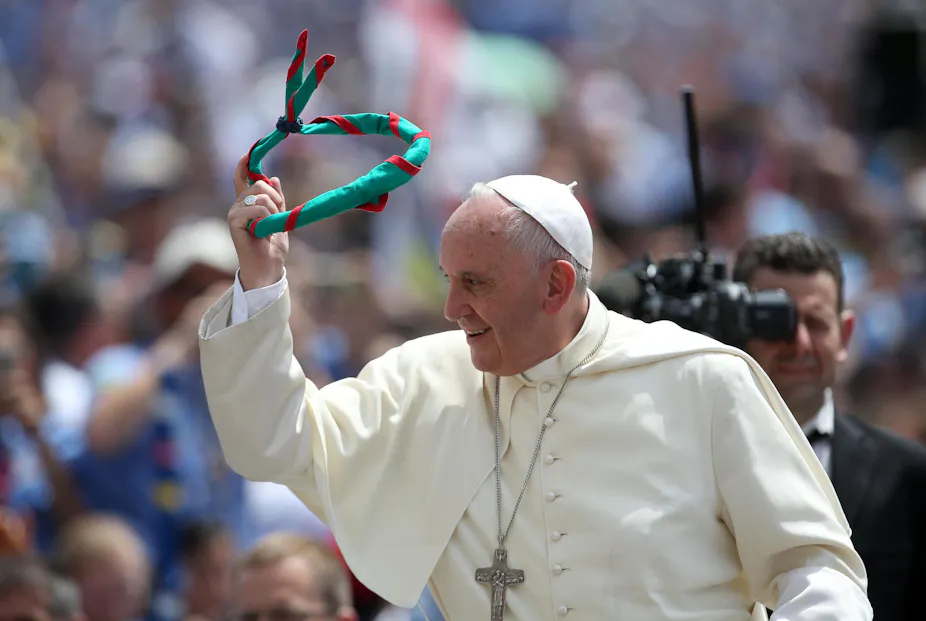
What makes Pope Francis and his 183-page encyclical so radical isn’t just his call to urgently tackle climate change. It’s the fact he openly and unashamedly goes against the grain of dominant social, economic and environment policies.
While the Argentina-born pope is a very humble person whose vision is of a “poor church for the poor”, he seems increasingly determined to play a central role on the world stage. Untainted by the realities of government and the greed of big business, he is perhaps the only major figure who can legitimately confront the world’s economic and political elites in the way he has.
However his radical message potentially puts him on a confrontation course with global powerbrokers and leaders of national governments, international institutions and multinational corporations.
The backlash has begun even before the encyclical has been officially published. US presidential candidate Jeb Bush, a Catholic, feels the pope should stay out of the climate debate, joining other Republicans, fossil fuel lobbyists and climate denier think-tanks in seeking to discredit Pope Francis’s intervention.
What makes the pope so radical?
There are several meanings of the word “radical” that can be applied to the Pope and in particular his forthcoming encyclical.
First, radical can be understood as going back to the roots (from Latin radix, root). The majority of Catholics live in the Global South; in Latin America and sub-Saharan Africa. Francis is the first pope from the Global South, and naming himself in honour of Saint Francis of Assisi, “a man of poverty and peace who loved nature and animals”, signalled to the world a commitment to going back to the roots of human existence.
The pope knows the plight of the majority world. Before he became Archbishop of Buenos Aires, he was a priest in the vast, poor neighbourhoods, the villas miserias or slums, of Argentina’s capital.
Improving the lives of slum dwellers and addressing climate change is, for Pope Francis, one and the same thing. Both require tackling the structural, root causes of inequality, injustice, poverty and environmental degradation.
Even as the quality of available water is constantly diminishing, in some places there is a growing tendency, despite its scarcity, to privatize this resource, turning it into a commodity subject to the laws of the market. Yet access to safe drink- able water is a basic and universal human right, since it is essential to human survival and, as such, is a condition for the exercise of other human rights. (p. 23)
This stands in stark contrast to, for example, Peter Brabeck-Letmathe, the chairman of Nestlé, the world’s largest food and bottled water company, who thinks water is a normal commodity with a market value, and not a human right. Nestlé is far from unusual. Its stance is backed up by the official water privatisation policies of the World Bank, IMF and other international institutions.
In fact, the encyclical is a radical – for a pope and international leader, unprecedented – attack on the logic of the market and consumerism, which has been expanded into all spheres of life.
The document states:
Since the market tends to promote extreme consumerism in an effort to sell its products, people can easily get caught up in a whirlwind of needless buying and spending. Compulsive consumerism … leads people to believe that they are free as long as they have the supposed freedom to consume. But those really free are the minority who wield economic and financial power. (p. 149-150)
The pope rejects market fundamentalism, instead arguing that “the market alone does not ensure human development and social inclusion.”
The strategy of buying and selling “carbon credits” can lead to a new form of speculation which would not help reduce the emission of polluting gases worldwide. This system seems to provide a quick and easy solution under the guise of a certain commitment to the environment, but in no way does it allow for the radical change which present circumstances require. Rather, it may simply become a ploy which permits maintaining the excessive consumption of some countries and sectors. (p. 126)
The pope’s right. The same criticisms of carbon markets have been made by myself and others.
Climate change is a global problem with grave implications: environmental, social, economic, political and for the distribution of goods. It represents one of the principal challenges facing humanity in our day. (p. 20)
While the pope is not a politician – or maybe precisely because he is not one – he commands high moral and ethical authority that goes beyond traditional partisan lines. His encyclical speaks truth to power, and he might be the only person with both the clout and the desire to meaningfully deliver a message like this:
Many of those who possess more resources and economic or political power seem mostly to be concerned with masking the problems or concealing their symptoms, simply making efforts to reduce some of the negative impacts of climate change. However, many of these symptoms indicate that such effects will continue to worsen if we continue with current models of production and consumption. There is an urgent need to develop policies so that, in the next few years, the emission of carbon dioxide and other highly polluting gases can be drastically reduced, for example, substituting for fossil fuels and developing sources of renewable energy. (p. 21)
The bosses of Shell, ExxonMobil and other fossil fuel companies will not like this message, as it threatens their fundamental business model, and it also stands in contrast to the underwhelming ambitions of the G7 leaders who recently pledged to phase out fossil fuels only by 2100.
The time for bold, radical action on the environment as well as poverty eradication has come. This seems to be Pope Francis’ message: “The same mindset which stands in the way of making radical decisions to reverse the trend of global warming also stands in the way of achieving the goal of eliminating poverty.” (p. 128)
We need to think beyond the current, taken-for-granted logic that believes only markets and consumerism can solve the world’s social and environmental problems. The pope himself believes the situation is so grave that only a new, “true world political authority” will be able to address these problems.
This article was updated on 18 June to include quotes from the final encyclical rather than the earlier draft leaked to L’Espresso magazine.
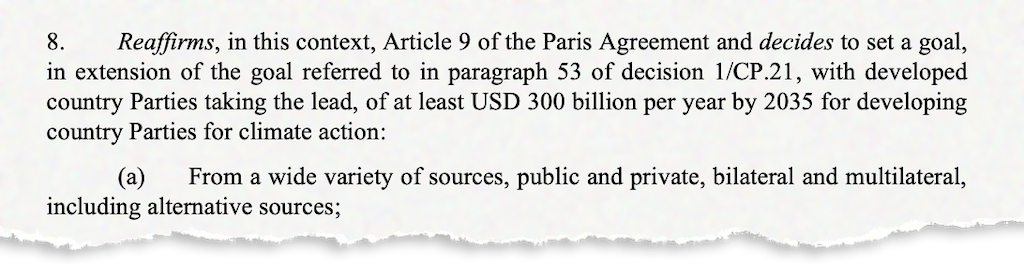
At COP29 in Baku, developed-country parties such as the EU, the US and Japan agreed to help raise “at least” $300bn a year by 2035 for climate action in developing countries.
The goal was welcomed by global-north leaders and presented as a “tripling” of the previous target for international climate finance.
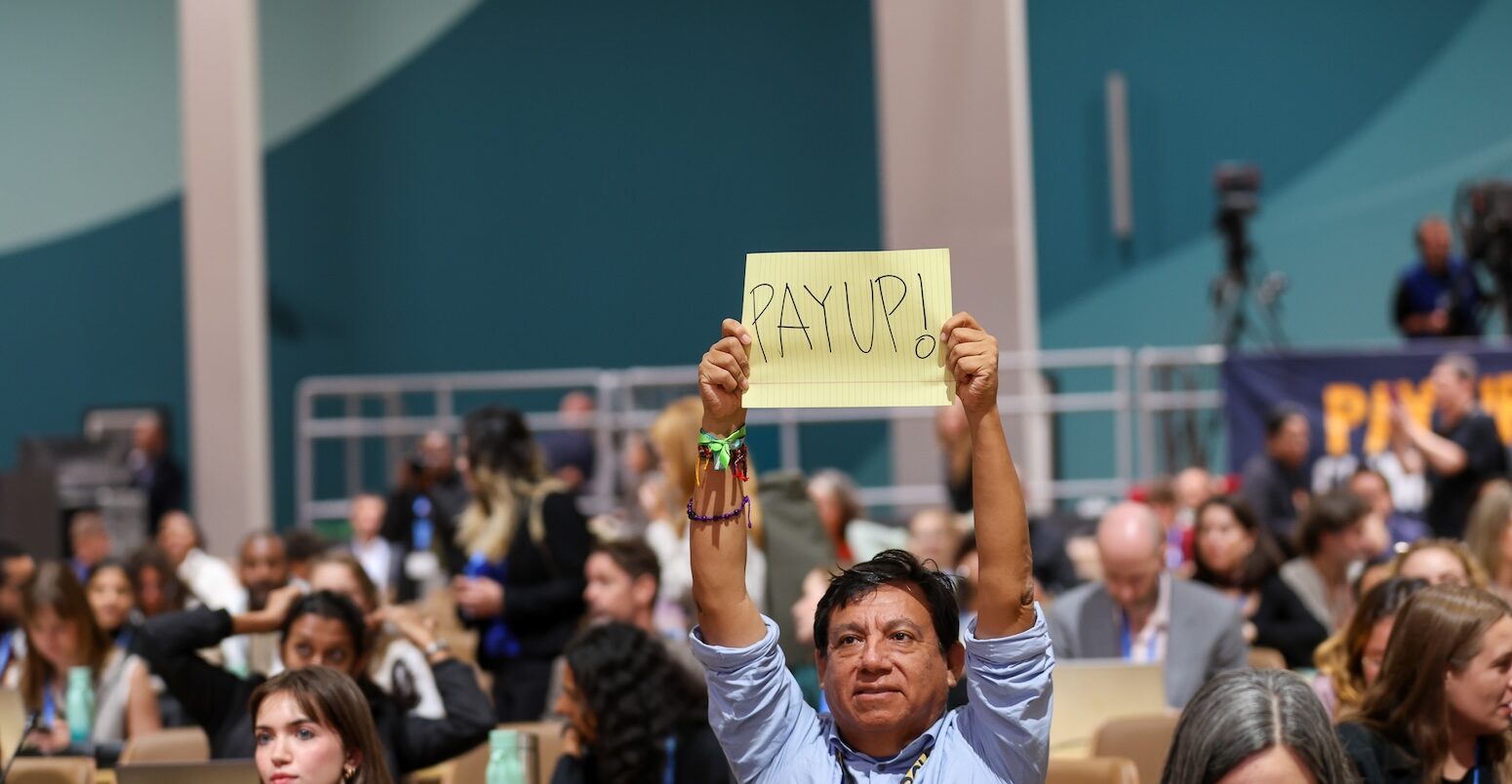
Yet it faced a strong backlash from many developing countries, with some branding it a “joke” and “betrayal”.
Closer analysis of the goal and climate-finance data helps to explain this response.
Analysts have shown that the target is achievable with virtually “no additional budgetary effort” from developed countries, beyond already-committed increases.
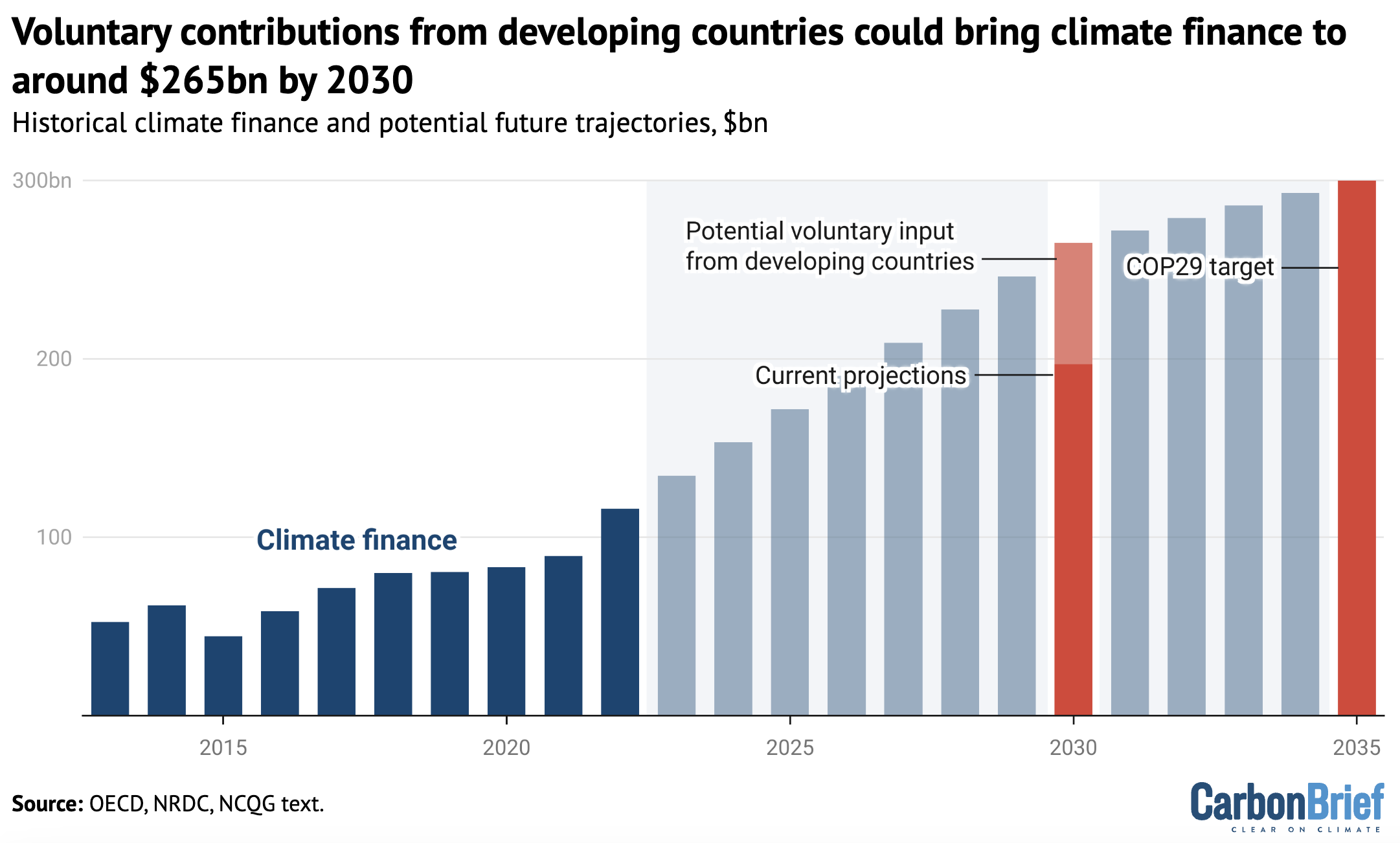
Counting money already being distributed by emerging economies such as China – as “encouraged” under the new goal – could bring the total to $265bn by 2030. This could mean the target is well on its way to being met by that date, with minimal extra effort.
Moreover, as activists and academics have noted, the $300bn target does not account for inflation. When this is factored in, its “real” value could shrink by around a quarter.
The new target has emerged against a backdrop of financial strain and political uncertainty in developed countries.
At the same time, developing countries have stressed that they need climate finance to reach the “trillions of dollars” needed to cut emissions and protect themselves from climate change.
This article looks at three ways in which the $300bn goal could be met with little extra financial effort by developed countries – and provide fewer benefits for developing countries than the figure suggests.
1. Much of the goal will be met with ‘no additional effort’
The $300bn climate-finance target agreed at COP29 in Baku will be met with finance from a “wide variety of sources”, largely coming from developed countries.
This part of the “new collective quantified goal” (NCQG) for climate finance is likely to be made up of public finance provided directly by governments, as well as money from MDBs, specialised climate funds and private finance “mobilised” by public investments.
The wording of the $300bn goal frames it as an extension of the $100bn target. This was the amount that developed countries agreed in 2009 to raise for developing countries annually by 2020 – a goal that was extended through to 2025 by the Paris Agreement.
Beyond the central goal of $300bn, the NCQG also includes a much broader “aspirational” target of $1.3tn a year in climate finance by 2035.
However, this is harder to assess, as the text of the deal is vague about who will be responsible for raising the funds, which could include various sources that are beyond the jurisdiction of the UN climate process.
Developed countries and MDBs had already committed to raising their climate-finance contributions before a deal was struck at COP29, as noted in a joint analysis by the Natural Resources Defense Council (NRDC), ODI, Germanwatch and ECCO.
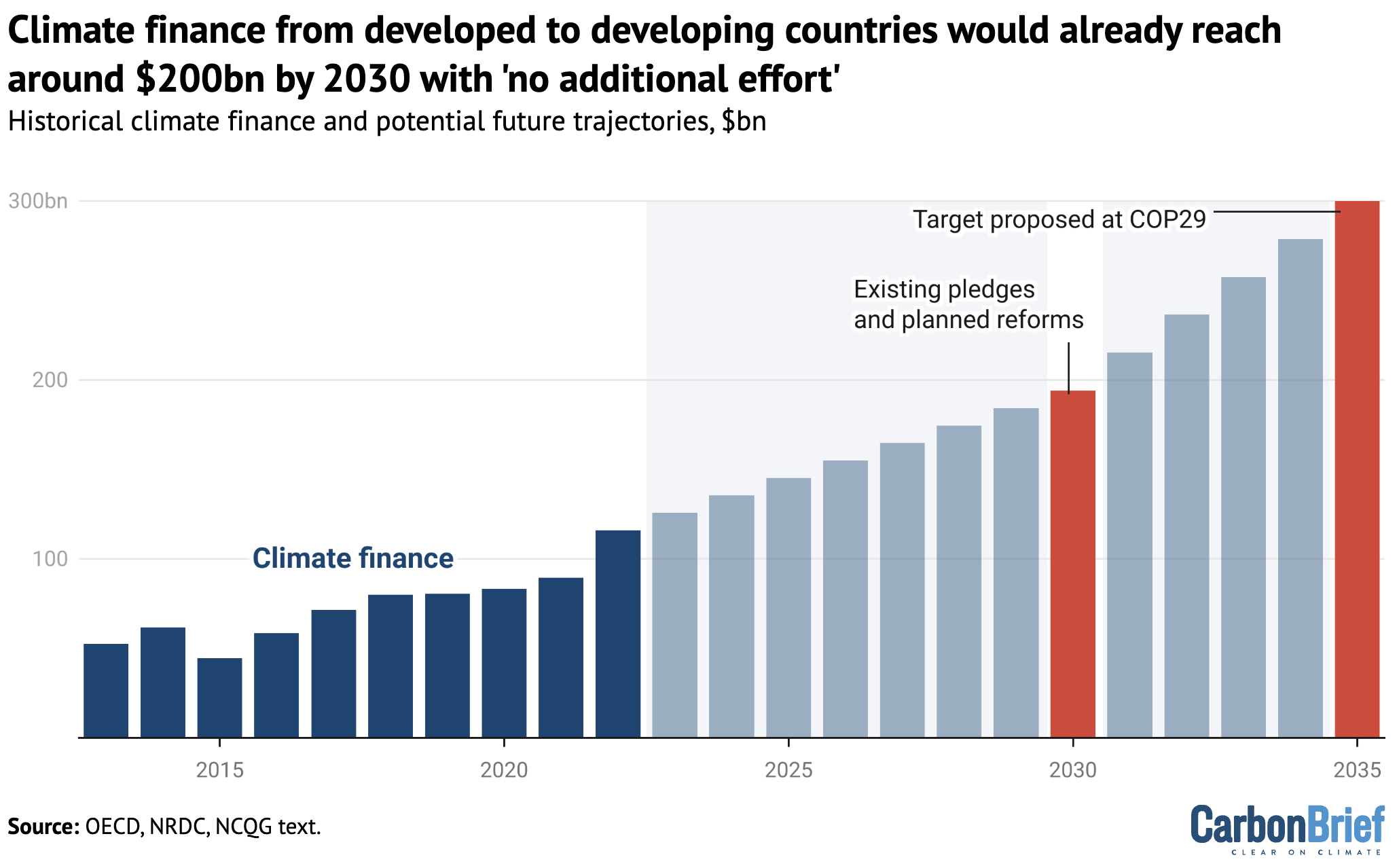
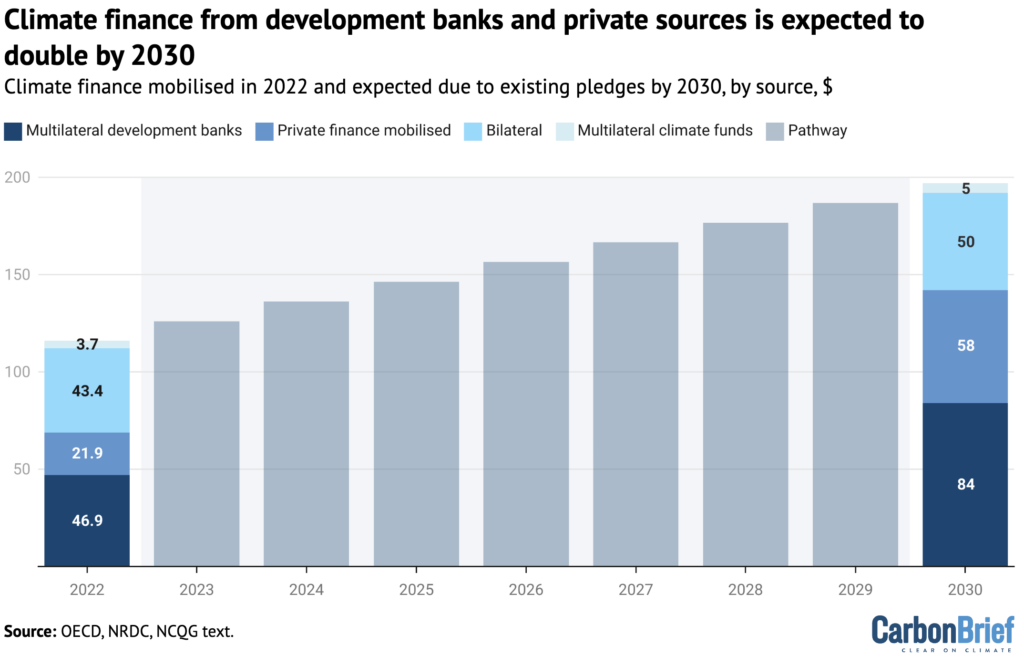
The collective impact of these pre-existing commitments can be seen below, with climate finance from developed countries set to increase from $115.9bn in 2022 – the most recent year for which data is available – to $197bn in 2030. This can be seen in the chart below, which does not account for inflation. (See: Inflation wipes out much of the increase in climate finance.)
Estimated climate finance in 2030, based on funds that have already been pledged, and target set at COP29 for 2035 (red). Dark blue bars show historical climate finance recorded by the Organisation for Economic Co-operation and Development (OECD), 2013-2022 (grey). The light blue bars indicate an estimated trajectory to reach the 2030 and 2035 levels. These figures do not account for inflation. Source: OECD, NRDC, NCQG text.
The expected increase between 2022 and 2030 comes from a few different sources.
The analysts calculated that climate finance distributed “bilaterally” – as grants or loans via overseas aid and other public funding – was already expected to increase $6.6bn annually by 2025, based on existing pledges, bringing the total to $50bn. (The chart above assumes that bilateral finance remains at this level up to 2030.)
They also estimated that existing pledges and reforms at specialised climate funds, such as the Green Climate Fund and Climate Investment Funds, would add another $1.3bn per year by 2030. This would bring their contribution to $5bn.
The biggest increase that was already locked in before the COP29 deal was a pledge by MDBs – which provide 40% of existing climate finance – to increase their contributions further.
A joint statement by the World Bank, the Asian Development Bank and others in the first week of COP29 committed to raising $120bn of climate finance per year by 2030 for low- and middle-income countries. Of this, $84bn can be attributed to developed countries, based on their shareholdings in these banks.
On top of this, the climate-finance analysts estimated that $58bn of private finance would be mobilised by these bilateral and multilateral contributions in 2030 – up from $21.9bn in 2022.
The chart below shows the estimated breakdown, by source, of climate finance in 2030, compared to 2022.
Historical climate finance in 2022 and estimated climate finance in 2020, by source. Source: OECD, NRDC, NCQG text.
These expected increases over the course of this decade mean that with “no additional efforts”, beyond what had already been agreed prior to COP29, developed countries would have been on a trajectory to reach around $200bn per year by 2030, and $250bn per year by 2035. (The latter was the first numerical target proposed by developed countries at COP29, which was, ultimately, negotiated upwards to $300bn on the final day.)
NRDC climate-finance expert Joe Thwaites, one of the researchers who undertook the Natural Resources Defense Council’s (NDRC) analysis, tells Carbon Brief that bilateral funding directly from governments is the “big constraint” in climate finance. COP29 came just after the re-election in the US of climate-sceptic Donald Trump and many European countries have cut their aid budgets. Thwaites says:
“The MDBs are growing and doing all kinds of reforms and getting bigger and better, but the bilaterals are what are politically very stuck.”
Moreover, the COP29 climate-finance deal contains no pledge by developed countries to provide a set amount of public, bilateral finance, despite strong pressure from developing countries to include such a goal.
Following COP29, Thwaites released updated modelling to calculate different ways of reaching the $300bn target. He wrote:
“What is clear is that $300bn by 2035 is eminently achievable, with little to no additional budgetary effort required from developed countries, let alone other contributors, to meet the goal.”
2. Developing-country contributions could cover part of the goal
Unlike the earlier $100bn target, contributions from developing countries could count towards the new climate finance goal.
Only developed countries are obliged to provide climate finance to developing countries under the Paris Agreement. But the NCQG outcome says that developing countries can “voluntarily” declare any climate-related funds they contribute, if they choose to do so.
This allowed negotiators at COP29 to skirt the controversial issue of formally expanding the list of official donors that are required to help with financial aid.
Developed countries had previously been pushing to enlist relatively wealthy developing nations, such as China and the Gulf states, to share the financial burden.
Several countries described since the early 1990s as “developing” under the UN’s climate convention are known to already make large, climate-related financial contributions to other developing countries. Examples include China’s Belt and Road initiativesupporting clean-energy expansion and South Korea’s contributions to the GCF.
In fact, at COP29 China announced for the first time that it had “provided and mobilised” more than $24.5bn for climate projects in developing countries since 2017 – confirming that its contributions are comparable with those of many developed countries.
This roughly aligns with calculations by research groups that have placed China’s annual climate finance at around $4bn a year.
Both developed and developing countries pay money into MDBs. As well as “encouraging” developing countries to voluntarily contribute directly to climate finance, the NCQG outcome also specifies that these countries could start counting the share of climate-related money paid out of MDBs that can be traced back to their inputs.
Roughly, 30% of the banks’ “outflows” can be attributed to developing countries in this way.
Counting the developing-country share of the projected increase in climate finance from MDBs by 2030 would add an extra $36bn to the global total, plus an extra $20bn of private finance mobilised by the funds.
It is not possible to say for sure how much climate finance new contributors such as China will choose to officially declare.
However, the chart below shows an estimate based on an “illustrative scenario”, by NRDC and others, of bilateral finance and multilateral climate funds, combined with expected MDB outflows and the associated private finance that this would mobilise. This could bring total annual climate finance up to $265bn by 2030.
Potential voluntary contributions of climate finance by developing countries, including bilateral finance, contributions to multilateral funds, outflows from MDBs allocated to developing countries and private finance mobilised by developing country contributions to MDBs (lighter red), on top of estimated climate finance from developed countries in 2030 (red). The second red bar indicates the NCQG climate-finance target agreed for 2035 at COP29. The light blue bars indicate an estimated trajectory to reach the 2030 and 2035 levels. These figures do not account for inflation. Source: OECD, NRDC, NCQG text.
Some observers at COP29 said they hoped that officially counting developing-country contributions towards UN “climate finance” targets would enable parties, such as the EU, to set more ambitious goals.
However, Michai Robertson, lead finance negotiator for the Alliance of Small Island States (AOSIS), dismissed this as an “accounting trick”, because these funds are already being provided.
Li Shuo, head of the China climate hub at the Asia Society Policy Institute (ASPI), tells Carbon Brief that the NCQG outcome could bring more attention to China’s climate-related aid and lead to “stronger and better climate support from Beijing”. However, he notes that this is in the context of a low-ambition global target that is a “far cry” from what is needed:
“I take this as a classic example of geopolitical competition weakening environmental ambition, namely, the geopolitical desire of including China as a donor without corresponding desire of developed countries to contribute more limited the overall scale of climate finance.”
3. Inflation wipes out much of the increase in climate finance
One issue that has surfaced in the wake of COP29 is the impact of inflation. Campaigners have noted that the failure to factor this into the 2035 climate-finance target means that, by the time it is met, the true value of the money pledged will be far lower than it is today.
In an article highlighting this issue, the Guardian reported that the $300bn goal was, therefore, “not the tripling of pledges that has been claimed”.
Researchers had flagged this before COP29, pointing out that the previous $100bn annually by 2020goal, which was first set in 2009, had also not accounted for inflation.
They noted that merely correcting the $100bn for inflation would bring it to between $139bn and around $150bn a year. (Such calculations depend on the rate of inflation applied to the starting figure, as well as the base year for the calculation.)
Civil-society groups at COP29, such as Power Shift Africa, estimated that the impact of inflation would cut the “real” value of the $300bn to $175bn in today’s money by 2035. This is based on an annual inflation rate of 5%.
In its analysis, the Guardian opted for an inflation rate of 2.4% – based on the average rate in the US over the past 15 years. This is taken to reflect the conditions for governments contributing climate finance and the currency much of it would be provided in.
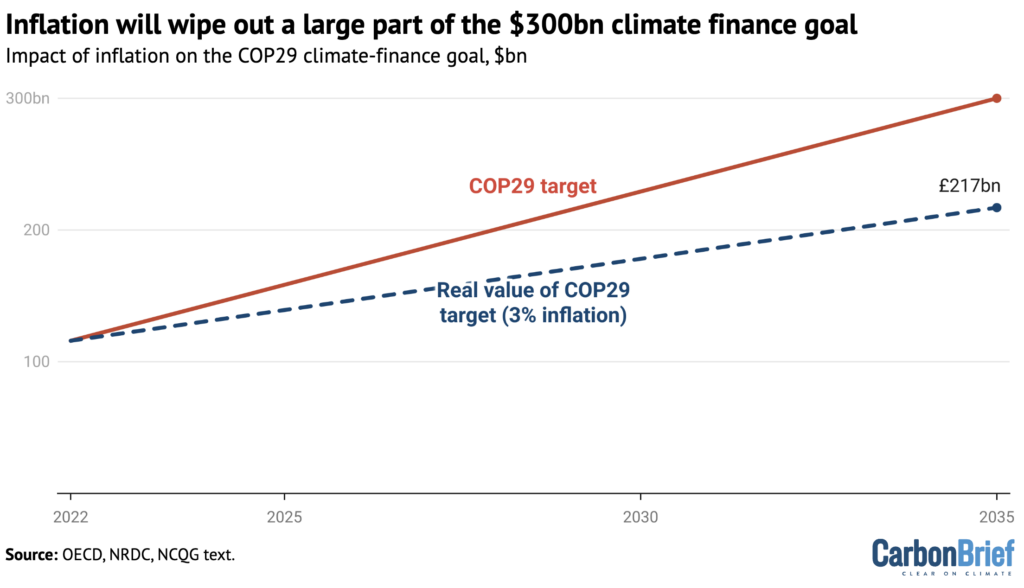
The figure below shows the impact of an inflation rate of 3%. This is based on input from economists and analysis by the Center for Global Development (CGD), which, in turn, is based on the World Bank’s global GDP deflator.
If inflation over the next decade follows this trend, the $300bn pledged in 2024 would only be worth $217bn in today’s money in 2035 – a 28% reduction in value.
In order to offer climate finance with a real value of $300bn in 2035, countries would have needed to set a goal for that year of around $415bn.
Increase in climate finance between 2022 and 2035 under the NCQG commitment in nominal terms (red line), and based on the “real” value of the $300bn climate-finance pledge in 2024 value terms (blue dotted line). Source: Carbon Brief calculation based on a 3% inflation rate, as used by CGD.
(The figures in the chart above cannot be directly compared with the existing pledges made by governments and MDBs, as those too would need to be adjusted for inflation.)
CGD modelling suggests that if developed countries’ climate-finance contributions simply increase in line with expected inflation and gross national income (GNI) growth, they would reach $220bn by 2035.
The CGD analysts write in a blog post that “by the time the new goal is met, beneficiary countries will find that the purchasing power of these resources has eroded significantly”.
Independentexperts, as well as climate-vulnerable countries themselves, emphasised both before and during COP29 that more than $1tn dollars will be needed each year to help developing countries deal with climate change. Many developing nations said that around $600bn of this should come directly from developed countries’ public coffers.
With such a relatively small amount of finance pledged for the NCQG, some developing countries have already indicated that they may scale back their future climate ambitions.
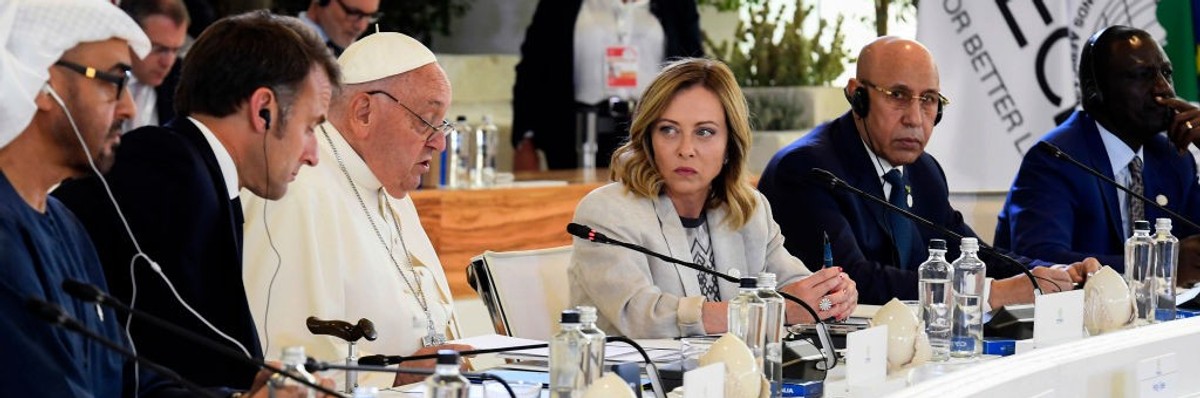
Italian Prime Minister Giorgia Meloni (center) looks toward Pope Francis as he speaks during the G7 Leaders Summit in Fasano, Italy on June 14, 2024. (Photo: Vatican Media via Vatican Pool/Getty Images)
“If these embattled leaders want to leave a lasting legacy, they need to heed the will of voters demanding a safe environment and climate,” one campaigner asserted.
As the Group of Seven summit wrapped up Friday in Italy, climate defenders condemned G7 leaders for their continued failure to take meaningful action to combat the worsening planetary emergency.
Taking aim at what critics called the G7 leaders’ largely empty pledge to undertake “concrete steps to address the triple crisis of climate change, pollution, and biodiversity loss,” 350.org U.S. campaigns manager Candice Fortin lamented that “yet another meeting ends without real commitments to revert the situation rich countries like the U.S. put us in.”
“As COP29 approaches and the world deals with worsening climate impacts, we can’t afford to waste more time,” Fortin said, referring to the United Nations Climate Change Conference scheduled to take place in Baku, the capital of Azerbaijan—a major fossil fuel-producing nation—in November. COP29 is set to be chaired by a former oil executive.
“If the U.S. wants to pride itself on being a ‘world leader,’ it needs to show how it will pay its climate debt to climate-vulnerable countries that bear the most significant climate impacts without the necessary funds for adaptation,” Fortin added.
— Fossil Fuel Treaty Initiative (@fossiltreaty) June 14, 2024
While G7 governments hailed their recent agreement to phase out existing unabated coal power generation in energy systems during the first half of the 2030s, critics took issue with the policy’s timeline and banks’ continued financing of fossil fuels.
“Our leaders are not leading. In the hottest 12 consecutive months of recorded human history, our leaders are failing us,” argued Bronwen Tucker, Oil Change International’s public finance lead. “G7 countries are adopting an inadequate coal phaseout date and endorsing increased fossil gas production, sending a terrible signal at a time when countries should be focusing on accelerating the phaseout, not delaying it.”
Tucker continued:
G7 leaders can’t say they’re committed to a livable climate while expanding and bankrolling the fossil fuel industry at home and abroad. At the same time, these rich countries should not be congratulating themselves for delivering $100 billion for climate finance two years too late. Trillions are needed to cover climate damages and the G7’s finance was largely provided as loans which only worsens unjust debts.
“The G7 must end the billions of dollars in taxpayer finance still flowing to fossil fuel projects abroad and fund the buildout of affordable renewable energy on fair terms,” Tucker asserted. “If their oil and gas expansion plans are allowed to proceed, it will lock in climate chaos and an unlivable future.”
#G7Italy: COUNTER-DINNER OF THE POOR Yesterday, during the #G7 leaders' dinner, @DebtforClimate set up a "Trojan horse" in Brindisi to call out the colonial policies of the G7, International Monetary Found, and World Bank, demanding them pay their Climate Debt and #CancelTheDebtpic.twitter.com/aqorlJr5vM
— Extinction Rebellion Italia (@XrItaly) June 14, 2024
Greenpeace International climate politics expert Tracy Carty said in a statement that “if these embattled leaders want to leave a lasting legacy, they need to heed the will of voters demanding a safe environment and climate.”
“Taxing the billions of dollars in profits of the fossil fuel industry to fund climate action at home and abroad could be their stake in history and a win for people and planet,” Carty continued. “G7 leaders need to seize the moment ahead of the U.N. climate talks in Baku and show they will lead the transition away from fossil fuels and build trust they will significantly increase climate finance support to developing countries.”
Exploiting a “trade finance” loophole, the bank dumped an estimated $3.7 billion into oil and gas projects in 2022.
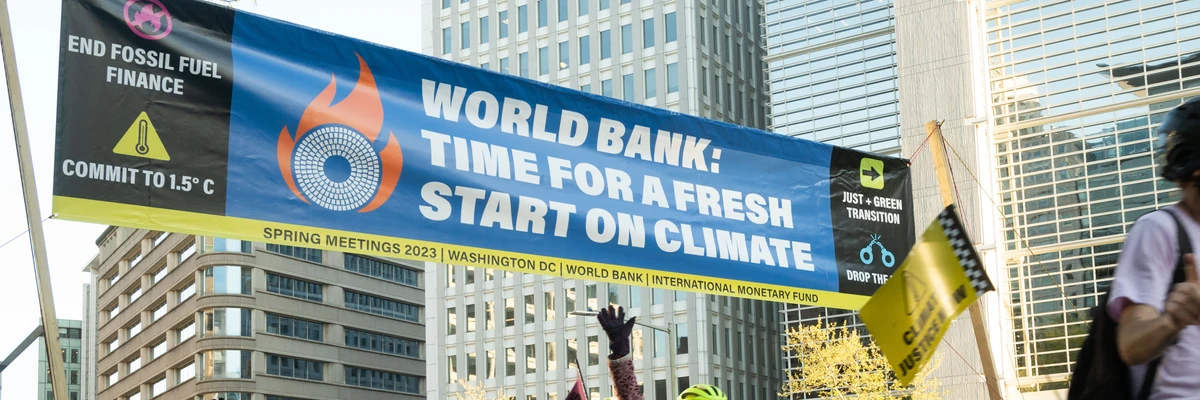
Cyclists take over rush hour traffic outside World Bank headquarters and urge the bank’s president to end funding for fossil fuels on April 10, 2023 in Washington, D.C. (Photo: Kevin Wolf/AP Images for Glasgow Actions Team)
An analysis released Tuesday by the German nonprofit Urgewald estimated that the World Bank spent nearly $4 billion on fossil fuel financing last year, when it was under the leadership of a climate denier nominated by former U.S. President Donald Trump.
The World Bank pledged in 2017 to end financing for upstream oil and gas—with narrow exceptions—after 2019. But Urgewald observed in its new report that the World Bank’s pledge applied only to direct finance, allowing the powerful institution to funnel cash to oil and gas projects through “trade finance” dished out by its private-sector arm, the (IFC).
“Despite trade finance’s vast and still-growing share of the IFC’s budget, over 70% of it is given out in secrecy,” Urgewald noted. “The types of goods and businesses it is funding are not even reported to the World Bank’s shareholders, i.e., our governments. The public has a right to know where all this money is going.”
Citing the IFC’s “severe lack of transparency,” Urgewald stressed that it was only able to “formulate an estimate” for oil and gas transactions. The group calculated that the World Bank spent roughly $3.7 billion on oil and gas trade finance in 2022.
“This would more than triple the current annual level of fossil fuel finance attributed to the World Bank and cast serious doubts on Bank claims of alignment with the Paris Climate Agreement,” Urgewald’s Heike Meinhardt said in a statement.
“The easiest way for a big oil company or coal operation to escape attention surrounding public assistance is to cloak it in trade finance.”
The World Bank has long been accused of reneging on its climate commitments. A report released last year by Big Shift Global estimated that the World Bank has spent nearly $15 billion supporting fossil fuels since the adoption of the Paris Climate Agreement in 2015.
Late last year, former World Bank President David Malpass sparked global outrage by saying he’s not sure whether he accepts the scientific consensus that climate change is caused by the burning of fossil fuels, further validating climate activists’ longstanding calls for systemic reforms at the bank.
“I don’t know,” Malpass said in response to a reporter’s question about his views on climate change. “I’m not a scientist.”
The comments prompted widespread calls for Malpass to step down, which he did in June. Current World Bank President Ajay Banga, who U.S. President Joe Biden nominated to replace Malpass, is a former private equity executive who has worked for Nestlé, PepsiCo, and Citibank.
Urgewald warned in its report Tuesday that the World Bank will remain a major source of funding for the fossil fuel industry until it enacts reforms that prevent the IFC from bolstering oil and gas under the guise of “trade finance.”
“The easiest way for a big oil company or coal operation to escape attention surrounding public assistance is to cloak it in trade finance,” the group said. “It is a huge loophole that must be closed and evaluated through public disclosure.”
Urgewald added that “there is no doubt” the World Bank and IFC “are going to deny” its findings and “claim the figures are inaccurate.”
That’s exactly what an IFC spokesperson did on Tuesday, tellingThe Guardian that “Urgewald’s report contains serious factual inaccuracies and grossly overstates IFC’s support for fossil fuels.”
“IFC regularly reports accurate and timely project information through various channels,” the spokesperson added.
Urgewald disputed that narrative in its report, asserting that the “continued secrecy surrounding trade finance makes it impossible to determine how much fossil fuel business the IFC is ultimately facilitating and whether the World Bank is actually aligned with the goals of the Paris Climate Agreement.”
“An exorbitant amount of IFC money, i.e., more than half its budget, is streaming through banks without any oversight by the [World Bank Board of Directors], without any opportunity for public scrutiny, without any accountability,” the group said.