Chinese President Xi Jinping during a signing ceremony with Uruguay’s President Yamandu Orsi, at the Great Hall of the People in Beijing, China, February 3, 2026
CHINA’S President Xi Jinping called today for a more “equal and multipolar world.”
He made the remarks during a meeting in Beijing with Uruguayan President Yamandu Orsi, who was paying the first visit by a South American leader to China since the United States launched its illegal and unprovoked raid on Venezuela on January 3, during which President Nicolas Maduro and first lady Cilia Flores were kidnapped.
More than 100 people were killed during the US attack.
Mr Xi voiced support for Latin America and Caribbean nations’ efforts to upholding their sovereignty, security and development interests in the current volatile international climate.
…
Mr Xi said: “The world today is undergoing profound changes unseen in a century, with a complex and volatile international situation and escalating unilateral bullying,” adding that China had always attached great importance to its ties with Latin America.
This work by Middle East Monitor is licensed under a Creative Commons Attribution-NonCommercial-ShareAlike 4.0 International License.
President of China Xi Jinping at the Alvorada Palace in Brasilia, Brazil on November 20, 2024 [Mateus Bonomi – Anadolu Agency]
Chinese President Xi Jinping has pledged $100 million in aid to Palestine to help alleviate the humanitarian crisis in the Gaza Strip, Anadolu reports.
Xi made the announcement during talks with French President Emmanuel Macron, who wrapped up his three-day state visit to China on Friday.
“China will provide $100 million of assistance to Palestine to alleviate the humanitarian crisis in Gaza and support its recovery and reconstruction,” said Xi during a meeting held on Thursday in Beijing, according to a statement by the Chinese Foreign Ministry.
He said that the world today is “far from tranquil,” as complicated international political disputes and conflicts continue across various regions.
“China and France will work together for the realization of a comprehensive, just, and lasting solution to the Palestinian question at an early date,” said Xi.
Regarding the Ukraine crisis, Xi told Macron that China “supports all efforts conducive to peace and hopes that parties can reach, through dialogue and negotiation, a fair, lasting, and binding peace agreement that is accepted by all parties concerned.”
“China will continue to play a constructive role in the political settlement of the crisis. At the same time, China firmly opposes any irresponsible attempt to shift blame or smear others,” he stressed.
After Macron’s meetings in Beijing, the Chinese and French leaders traveled to Chengdu, a city in southwestern Sichuan province, where they held informal talks on Friday.
Regarding Xi’s announcement, Foreign Ministry spokesman Lin Jian said on Friday that this aid will be used for post-conflict reconstruction to help improve Gaza’s humanitarian situation and alleviate Palestinian suffering.
“China firmly supports the just cause of the Palestinian people in restoring their legitimate national rights and will continue working relentlessly with the international community for a full and lasting ceasefire in Gaza, the easing of the humanitarian situation there, and an early political settlement of the Palestinian question on the basis of the two-state solution,” Lin told a news conference in Beijing.
This work by Middle East Monitor is licensed under a Creative Commons Attribution-NonCommercial-ShareAlike 4.0 International License.
Orcas discuss Genocide-supporting and complicit Zionists. Donald Trump, Keith Starmer, David Lammy, Rachel Reeves, Angela Rayner and Wes Streeting are acknowledged as evil genocide-complicit and supporting cnuts.Keir Starmer objects to criticism of the IDF. He asks how could anyone object to them starving people to death, forced marches like the Nazis did, bombing Gaza’s hospitals and universities, mass-murdering journalists, healthworkers and starving people queuing for food, killing and raping prisoners and murdering children. He calls for people to stop obstructing his genocide for Israel.Vote Labour for Genocide.
Military personnel take part in a military parade to commemorate the 80th anniversary of Japan’s World War II surrender held in front of Tiananmen Gate in Beijing, Wednesday, Sept. 3, 2025
CHINA’S parade marking 80 years since victory over Japan has prompted alarmist coverage in Western media.
The sight of Xi Jinping, Russia’s Vladimir Putin and North Korea’s Kim Jong Un together has led to panicky talk of an “axis of upheaval” aimed at toppling the so-called “rules-based order” — with pundits’ dismay increased by the Shanghai Co-operation Organisation summit just before, where Indian Prime Minister Narendra Modi appeared alongside Putin and Xi.
Their anxieties were stated with typical bluntness by US President Donald Trump, who asked Xi to “give my regards to Vladimir Putin and Kim Jong Un, as you conspire against the United States of America.”
…
China has not been at war since the 1970s — whereas the US has hardly been at peace since then, and since the late 1990s Britain has joined it in attacking Yugoslavia, Afghanistan, Iraq and Libya, wars of aggression that expose the West’s “rules-based order” as a sham.
If China is strengthening its armed forces, maybe that’s because a US general predicted two years ago that his country would be at war with China by now. Even so, it spends far less per head on the military (1.7 per cent of GDP) than any Nato state and less than a third of what the US spends. The US’s Nato alliance accounts for 75 per cent of worldwide military spending.
As for its nuclear arsenal, China is the only UN security council member with a no-first-strike policy and the only one to store warheads and delivery systems separately to prevent accidental or knee-jerk launches.
So we should not fall for talk of a need to rearm against an “axis of upheaval” — as if the long trail of destabilisation and destruction left by Nato wars does not suggest that cap better fits the Western alliance.
We should recognise that the threat to peace comes first and foremost from our own governments — and their determination to prevent the rise of a multipolar world, which all on the left should welcome.
Donald Trump urges you to be a Climate Science denier like him. He says that he makes millions and millions for destroying the planet, Burn, Baby, Burn and Flood, Baby, Flood.Elon Musk urges you to be a Fascist like him, says that you can ignore facts and reality then.
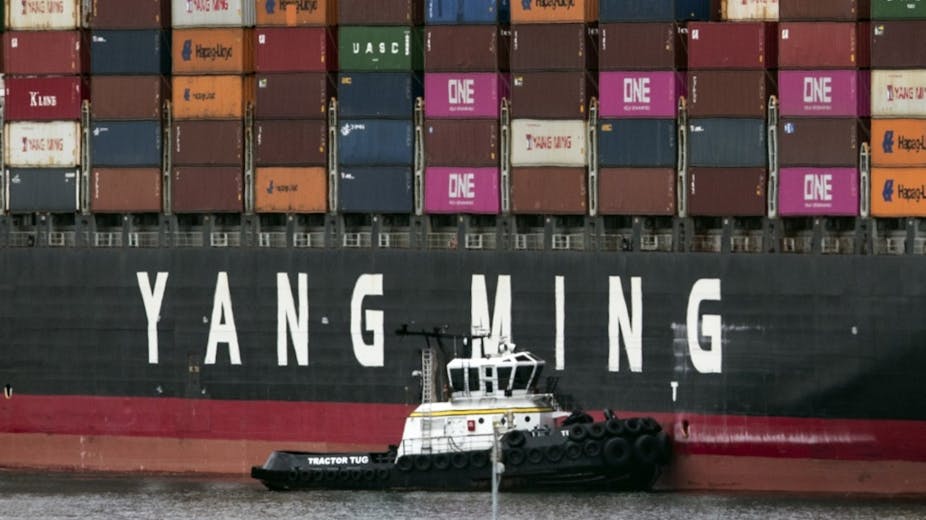
US ports are now starting to see scheduled shipments from China decline as the result of Donald Trump’s 145% tariffs on Chinese goods. The port of Los Angeles, the biggest port for Chinese goods in the US, is predicting scheduled shipments in early May to be about a third lower than the same time last year.
Declining numbers of ships arriving stocked with Chinese imports are likely to affect US supermarket shelves soon, and after warnings from US supermarket bosses, Trump responded by saying trade talks between the US and China were under way in the past few days. But Chinese president Xi Jinping quickly denied talks were happening, suggesting he has no intention of backing away from a fight with the US.
As one of the most powerful leaders in the history of the People’s Republic of China, Xi has fashioned himself as a nationalistic icon. So if China perceives Trump’s tariffs as a bully tactic designed to undermine it, backing down from a confrontation with the US would seriously undermine Xi’s strongman image and rhetoric.
This is something that Trump probably hadn’t considered. At a rally marking his 100 days in office, the US president was still suggesting that China would just back down and “eat the tariffs”.
While tariffs appear to be the primary weapon in the trade war, China might have more tactics to hit back at Trump and the US economy. The question is what might they be?
A few weeks ago it seemed like Washington might punish China’s lack of willingness to negotiate with more tariffs, but now it’s clear that Trump is willing to make a deal and is trying to get China to come to the table. Trump is now implying that US tariffs on China could come down substantially. And US treasury secretary Scott Bessent has called the trade war with China “unsustainable”.
Leveraging agriculture and energy
China has reduced its reliance on US farm imports since the trade war began in Trump’s first presidency. This is bad news for Washington as agriculture is one few sectors in the US that actually has a large trade surplus with China. The 125% retaliatory tariffs will harm the sector’s profitability.
But China’s retaliatory tariffs aren’t the only issue American farmers have to contend with. As the trade war escalates, China has been using bureaucratic hurdles to restrict US agricultural products from entering China and as a potential negotiation tool. For instance, China has delayed the renewals of export license renewals of US pig farmers, and refused to renew licenses of poultry farmers for “health and safety” reasons.
Beijing’s actions might be designed to particularly hit the economy in core Trump supporting states. A major part of Trump and the Republican party’s base lies in “red states”, such as Nebraska, Iowa and Kansas, all have significant farming communities. Focusing on agricultural issues is a tactic that Beijing realises will hit home with Trump voters.
Out of the 444 US counties designated by the United States Department of Agriculture (USDA) as farming-dependent, 77.7% voted for Trump during the 2024 US presidential election. So, any hardship faced by the agriculture sector due to Trump’s own actions is likely to lose him support from a major political base. And with mid-term elections in 2026, Trump has to tread carefully when antagonising Beijing.
Another support base that Beijing might seek to undermine is those involved in the fossil fuel sector. In the past, the US has been a top supplier of natural gas to China.
China has not imported natural gas from the US since early February 2025, and has sought its natural gas from Australia, Indonesia, and Brunei. As the trade war continues, it is unlikely that the US would be able to sell its natural gas to China anytime soon, and this will have an impact on the energy industry – one of Trump’s major political support bases.
Restricting minerals
Another huge problem that the US faces stems from China’s restriction of the export of critical minerals. They include seven rare earth minerals namely samarium, gadolinium, terbium, dysprosium, lutetium, scandium and yttrium. While these are used in the clean energy and automobile sectors, the biggest concern would come from the US defence complex.
The White House probably anticipated export restrictions of critical minerals from China. After all, Beijing had banned the export of critical minerals to Japan in 2010 over a fishing trawler dispute, and stopped exporting “dual-use” metals that can be used to produce civilian and military technology, such as gallium, germanium and tungsten.
What’s next?
For the last few years, China has been trying to overcome an ailing economy that was primarily fuelled by a real-estate crisis. Trump probably expected China to buckle under pressure and come crawling to the negotiation table. After all, the Chinese Communist Party needs to fix its economy fast. The establishment has long relied on delivering economic prosperity to legitimise its rule over China.
Right now the tit-for-tat battle continues. By April 11, US tariffs on China peaked at 145%, while China’s retaliatory tariffs on US goods reached an unprecedented 125%.
Although it is clearly fighting back, China could go even further by selling off US treasuries and increasing US interest rates and thus borrowing cost. But unlike Trump, Xi often plays the long game. After all, Trump’s term as president will be over in less than four years, while Chinese president Xi has no term limits. All the latter has to do is exercise patience, and a friendlier US president might come around.

 Chinese President Xi Jinping during a signing ceremony with Uruguay’s President Yamandu Orsi, at the Great Hall of the People in Beijing, China, February 3, 2026