400+ Actions to End Fossil Fuels Planned Around the World for Sept. 15-17

Spread the love
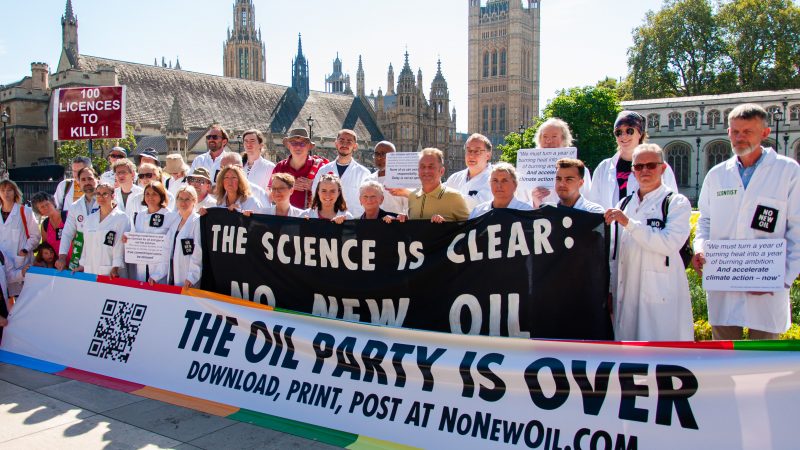
Scientists protest at UK Parliament 5 September 2023.

Original article by JULIA CONLEY republished from Common Dreams under Creative Commons (CC BY-NC-ND 3.0). 
“When we the people use our collective power we can win,” said one campaigner.

“September 15-17, 2023. Everywhere.”

Those are the dates and location of the international mobilization against fossil fuels set to take place this coming weekend, and the last word is hardly an exaggeration as organizers with the Global Fight to End Fossil Fuels report that more than 400 actions, marches, rallies, and other events have already been registered around the world.

More than 780 organizations have endorsed the day of action—up from 500 less than a week ago—and millions of participants are expected to rally from Cape Town, South Africa to Manila, Philippines and Lahore, Pakistan, as well as in dozens of cities and towns across the United States, the largest emitter of greenhouse gases in history.

The protests are scheduled just before the United Nations Climate Ambition Summit, taking place on September 20 in New York, where groups including the NAACP, Sierra Club, and Sunrise Movement are supporting the March to End Fossil Fuels on September 17.

More than 10,000 people are expected to march in New York to demand that U.S. President Joe Biden end federal approvals for new fossil fuel projects like the Willow drilling project in Alaska and phase out oil and gas drilling in federal lands and waters; declare a climate emergency to unlock resources to accelerate the transition to renewable energy; and provide a just transition that creates millions of green jobs while supporting people who have worked in the fossil fuel industry.

“President Biden is in an unparalleled position to lead the world toward cleaner, less polluting energy options and eliminate the dependence on dangerous fossil fuels,” said organizers of the New York march. “If he takes action, he will protect our health, boost our economy, and tackle the climate crisis head-on.”

The March to End Fossil Fuels is backed by advocates including author Naomi Klein350.org co-founder Bill McKibben, actor and Third Act leader Jane Fonda, and lawmakers including U.S. Sen. Ed Markey (D-Mass.) and Rep. Rashida Tlaib (D-Mich.).

On Monday, scientists including Lucky Tran of the March for Science and biologist Sandra Steingraber announced that 300 climate experts had signed their letter to Biden reminding him that “a broad scientific consensus exists” that fossil fuel extraction must be drawn down immediately to keep global heating below 1.5°C.

https://twitter.com/Prof_FSultana/status/1701287399345561724?ref_src=twsrc%5Etfw%7Ctwcamp%5Etweetembed%7Ctwterm%5E1701287399345561724%7Ctwgr%5E38e8876908f1a885f6f8c9d1f348cd78264d5ea6%7Ctwcon%5Es1_c10&ref_url=https%3A%2F%2Fwww.commondreams.org%2Fnews%2F400-actions-march-climate

The scientists plan to release the letter with all signatures ahead of Sunday’s march.

The global mobilization—and the Climate Ambition Summit, where leaders of countries that emit the most heat-trapping gases will be expected to present updated plans to reduce their emissions and phase out fossil fuels—comes after a summer in the Northern Hemisphere in which numerous temperature records were broken.

As Common Dreams reported last week, U.N. Secretary-General António Guterres warned that “climate breakdown has begun” when U.S. scientists found the summer was the hottest on record. Scientists have said that extreme weather events such as wildfires in Canada and heatwaves in the U.S. and Europe in recent months would not have happened without human-caused planetary heating.

Tasneem Essop, executive director of Climate Action Network, emphasized that popular uprisings against the fossil fuel industry and the politicians that continue to support it have found success, such as the campaign that pushed Ecuadorians to vote against drilling in the Yasuní National Park in the Amazon last month.

“July 2023 was the hottest month in recorded climate history,” said Essop. “The unparalleled, deadly climate disasters sweeping the world seem to leave polluters unfazed. Historical emitters like Norway, the U.K., and the USA are announcing new fossil fuel projects even as floods, fires, and heatwaves take over our lives. We take inspiration from recent victories in the Yasuní region with the referendum to stop oil drilling.”

“When we the people use our collective power we can win,” Essop added. “Let our resistance against fossil fuels in September send a loud message to the fossil fuel industry and their supporters that their time is up.”

Outside of the U.S., more than 3,000 people are expected to join the Pakistan Climate March in the southern Sidh province; 100,000 are expected to join a march in Abuja, Nigeria; and 3,000 are expected to march near Malacañang Palace in Manila.

“We demand a phaseout of fossil fuels now,” said Farooq Tariq, secretary-general of Kissan Rabita Committee in Pakistan. “The fossil fuel industry and its supporters bear responsibility for the climate crisis and perpetuate a predatory and destructive economic system that harms both people and the planet.”

Original article by JULIA CONLEY republished from Common Dreams under Creative Commons (CC BY-NC-ND 3.0). 
Continue Reading400+ Actions to End Fossil Fuels Planned Around the World for Sept. 15-17

‘Time to Make Them Pay’: Internal Docs Further Expose Exxon Efforts to Spread Climate Lies

Spread the love

Original article by Jake Johnson republished from Common Dreams under Creative Commons (CC BY-NC-ND 3.0).

“Climate change isn’t just a tragedy, it’s a crime,” said one climate campaigner in response to documents reported by The Wall Street Journal.

Previously unreported documents published on the front page of The Wall Street Journal Thursday show that ExxonMobil continued to work behind closed doors to cast doubt on climate science, even after the company publicly acknowledged the link between fossil fuel-driven greenhouse gas emissions and climate change in 2006.

The documents—which detail email exchanges between executives, board meeting conversations, and other company proceedings—reveal that during his tenure as CEO, Rex Tillerson joined other Exxon leaders in questioning “the severity of climate change’s impacts,” the Journal reported.

The company’s scientists, meanwhile, “supported research that questioned the findings of mainstream climate science” despite Exxon’s pledge to stop bankrolling think tanks and other groups peddling climate denial.

After scientists with the United Nations’ Intergovernmental Panel on Climate Change (IPCC) sounded the alarm in 2011 about the potentially devastating global impacts of runaway warming, Tillerson told a leading Exxon researcher that the IPCC’s warning was “not credible” and complained about the media’s coverage of the potentially dire scenario, according to documents reviewed by the Journal.

“Tillerson wanted to engage with IPCC ‘to influence [the group], in addition to gathering info,'” the newspaper reported.

Tillerson also dismissed the Paris Climate Agreement’s 2°C warming target as “something magical” shortly before Exxon endorsed the accord.

“As communities pay an ever-greater price for our worsening climate crisis, it’s more clear than ever that Exxon must be held accountable to pay for the harm it has caused.”

Richard Wiles, president of the Center for Climate Integrity, said in a statement that “this damning new evidence of Exxon’s climate lies shows that for decades it has been official company policy for executives to undermine climate science, minimize the dangers of their oil and gas business, and protect company profits at all costs—with no concern for the catastrophic impact their actions would have on humanity.”

Wiles argued that the documents reported by the Journal provide more evidence for the dozens of states, cities, and counties that are currently suing Exxon and other fossil fuel giants over their decades-long effort to deceive the public about climate change.

“As communities pay an ever-greater price for our worsening climate crisis,” said Wiles, “it’s more clear than ever that Exxon must be held accountable to pay for the harm it has caused.”

The new reporting could also heighten pressure on the Biden Justice Department to join the legal fight against Big Oil.

In late July, a group of progressive U.S. senators led by Sen. Bernie Sanders (I-Vt.) urged the DOJ to sue fossil fuel giants for violating “federal racketeering laws, truth in advertising laws, consumer protection laws, and potentially other laws.”

It has long been public knowledge that Exxon, the largest oil and gas company in the United States, was aware of the climate impacts of its business model well before it admitted the link between fossil fuels and climate change.

A peer-reviewed study published earlier this year in the journal Science shows that Exxon’s own internal data between 1977 and 2003 contradicted the company’s public statements downplaying and questioning the veracity of climate science.

The Journal‘s reporting confirms that Exxon did not stop working to sow doubt about climate change after it conceded for the first time in 2006 that “the accumulation of greenhouse gases in the Earth’s atmosphere poses risks that may prove significant for society and ecosystems.”

“In 2008, Exxon announced it would stop funding think tanks and other groups that questioned climate science, saying their positions ‘could divert attention from the important discussion on how the world will secure the energy required for economic growth in an environmentally responsible manner,'” the Journal noted.

But internal company documents show that “Exxon researchers continued to support scientific research that cast doubt on climate science and its impacts,” the newspaper reported.

The same year the company vowed to stop funding climate-denial organizations, Exxon’s manager of global regulatory affairs said that “Exxon should direct a scientist to help the American Petroleum Institute, the industry’s influential lobbying group, write a paper about climate science uncertainty.”

Jamie Henn, the director of Fossil Free Media, called the Journal‘s reporting “another massive exposé of Exxon’s strategy to attack climate science and block action.”

“Climate change isn’t just a tragedy,” Henn added, “it’s a crime.”

Original article by Jake Johnson republished from Common Dreams under Creative Commons (CC BY-NC-ND 3.0).

Continue Reading‘Time to Make Them Pay’: Internal Docs Further Expose Exxon Efforts to Spread Climate Lies

Not convinced on the need for urgent climate action? Here’s what happens to our planet between 1.5°C and 2°C of global warming

Spread the love

Rachel Warren, University of East Anglia and Sally Brown, University of Southampton

Many numbers are bandied around in climate emergency discussions. Of them, 1.5°C is perhaps the most important. At the Paris Agreement in 2015, governments agreed to limit global warming to well below 2°C and to aim for 1.5°C. By 2018, the Intergovernmental Panel on Climate Change – the UN body tasked with relaying the science of climate breakdown to the world – had made worryingly clear in a special report how much graver the consequences of the higher number would be.

Together with the University of Queensland’s Ove Hoegh-Guldberg and colleagues around the world, we’ve explored in newly published work just how much sticking to 1.5°C matters.

Climate breakdown is already harming livelihoods, cities and ecosystems. From heatwaves and droughts to cyclones and floods, devastating extreme weather events are more frequent, more intense and more unpredictable than they would be in the absence of global heating. Warming and acidifying oceans are causing severe coral bleaching to occur twice as often as in 1980, leaving many unable to recover.

Shrinking habitats are increasingly forcing wildlife into conflict with human settlements. Increasing wildfires are damaging vital carbon stores in North America and Siberia, while the advance of spring is throwing species who depend on each other out of sync.

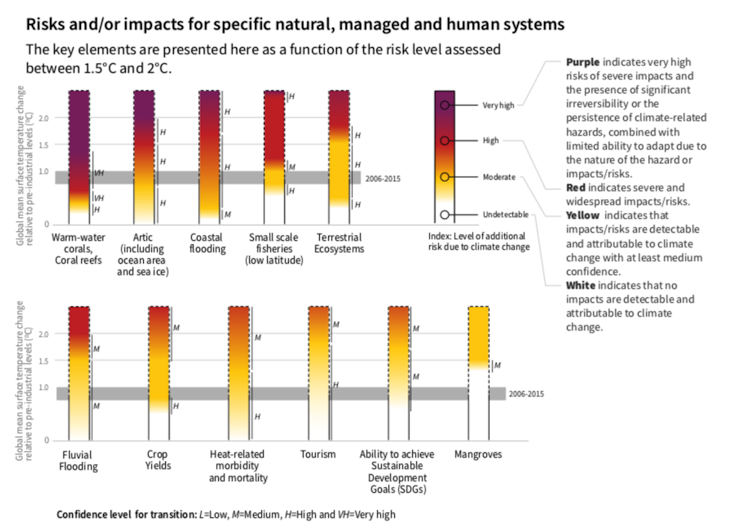
The more we destabilise our climate, the greater the risk to human societies and ecosystems. Even at 1.5°C of global heating, tough times are in store for the living planet. But the space between 1.5°C and 2°C of heating is a crucial battleground, within which risks to humanity and ecosystems amplify rapidly.

Climate battleground

At 1.5°C of warming, about one in twenty insect and vertebrate species will disappear from half of the area they currently inhabit, as will around one in ten plants. At 2°C, this proportion doubles for plants and vertebrates. For insects, it triples.

A great many risks amplify between 1.5 and 2 degrees of warming.
Hoegh-Guldberg, Jacob, Taylor/IPCC

Such high levels of species loss will put many ecosystems across the world at risk of collapse. We rely on healthy ecosystems to pollinate crops, maintain fertile soil, prevent floods, purify water, and much more. Conserving them is essential for human survival and prosperity.

Between 1.5°C and 2°C, the number of extremely hot days increases exponentially. Some parts of the world can also expect less rain and more consecutive dry days, while others will receive more extreme floods. Collectively, this will place agriculture, water levels and human health under severe stress – especially in southern African nations, where temperatures will increase faster than the global average. The Mediterranean is another key area at particular risk above 1.5°C of heating, where increased drought will alter flora and fauna in a way without precedent in ten millennia.

At 1.5°C of warming, we could expect to lose between 70% and 90% of our coral reefs. While this would be catastrophic for the millions of ocean creatures and human livelihoods these beautiful ecosystems support, there would still be a chance of recovery in the long term if oceans warm slowly. But at 2°C of warming, we could kill 99% of reefs. To be clear, this is a line that once crossed cannot be easily uncrossed. It could mean the extinction of thousands of species.

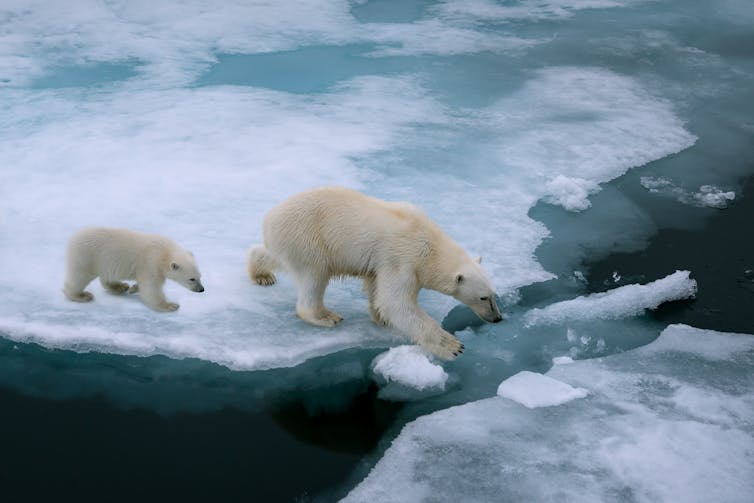
Arctic sea ice has been a constant on our planet for hundreds of thousands, perhaps millions of years. If we limit global heating to 1.5°C, there’s a 70% chance of it remaining that way. But at 2°C, some Arctic summers will be ice-free. Polar bears and other species who depend on frozen sea ice to eat and breed will be left homeless and struggling to survive.

Studies show that at 1.5°C, we could expect one metre of sea-level rise in 2300, with an extra 26cm at 2°C. However, between these two levels of global heating, the risk of the Greenland and West Antarctic Ice Sheets starting a slow process of decline dramatically increases. For the Greenland sheet, this is likeliest to happen at 1.6°C, with the Antarctic ice sheet’s tipping point hovering not far above this mark.

Polar bears depend on Arctic sea ice.
FloridaStock/Shutterstock

If these ice sheets melt, seas could rise by up to two metres over the next two centuries. These rises could lead to millions more people being exposed to flooding each year. Many of those living in coastal cities, deltas, or small islands will be faced with little option but to build upwards or relocate.

Way off track

The impacts of climate breakdown are accelerating. The planet has warmed by 1.1°C since 1850-79, but 0.2°C of this warming happened between 2011 and 2015 alone. The last four years were the warmest in the global temperature record.

Despite knowing all the above, many country-level commitments and action are nowhere near enough to limit warming to 2°C, let alone 1.5°C. We’re heading for 2.9°C to 3.4°C of warming. By this point, many dangerous tipping points could be crossed, leading to rainforest die-back, deadly heatwaves, and significant sea-level rise. Half of all insect and plant species are projected to disappear from more than half of the area they currently inhabit, potentially causing widespread ecosystem collapse and threatening organised human civilisation itself.

Limiting warming to 1.5°C will save the global economy trillions of dollars in the long run, even accounting for the seemingly gargantuan cost of transitioning our energy systems. But this is more than just an economic or academic issue – its a matter of life and death for millions of humans and animal species, and a severe threat to the well-being of billions.

Tackling climate breakdown is perhaps the tallest order humanity has ever faced, and there is no simple solution. The only way forward is accepting that we must fundamentally change the way we live our lives. It won’t be an easy transition, but there is no alternative if we are to preserve the well-being of humans, wildlife, and ecosystems. The coming year is vital, and there’s too much at stake not to act now.


Click here to subscribe to our climate action newsletter. Climate change is inevitable. Our response to it isn’t.The Conversation

Rachel Warren, Professor of Global Change, University of East Anglia and Sally Brown, Senior Research Fellow, University of Southampton

This article is republished from The Conversation under a Creative Commons license. Read the original article.

Continue ReadingNot convinced on the need for urgent climate action? Here’s what happens to our planet between 1.5°C and 2°C of global warming

We just blew past 1.5 degrees. Game over on climate? Not yet

Spread the love

Ailie Gallant, Monash University and Kimberley Reid, Monash University

July 2023 was the hottest month ever recorded. And now we know something even more alarming. This week, the European Space Agency announced the July heat pushed the global average temperatures 1.5℃ above the pre-industrial average.

The ominous headlines seemed to suggest we’d blown past the 2015 Paris Agreement goal of holding warming to 1.5℃ – and around a decade earlier than expected.

Is that it? Game over, we lost?

Well, like all things to do with climate change, it’s not quite that simple. The threshold was breached for a month before average temperatures dropped back. And July 2023 isn’t actually the first time this has happened either – the dubious honour goes to February 2016, where we broke the threshold for a few days.

Remind me – why is 1.5℃ so important?

In 2015, the world looked like it was finally getting somewhere with action to combat climate change. After decades of arduous debate, 195 nations adopted the Paris Agreement, a formal but non-binding agreement with a clear goal: limit global warming to 1.5℃ above pre-industrial levels to avoid the worst effects of climate change.

But there’s nothing magic about this number. Every increase worsens the impacts. So why is 1.5℃ so important?

Essentially, it was thrashed out by experts as a threshold representing heightened danger. The Paris Agreement states avoiding dangerous climate change means keeping global temperatures “well below 2℃” of warming, and so the 1.5℃ threshold was born.

What’s a dangerous level of climate change? Basically, levels of warming where the damage becomes so widespread or severe as to threaten economies, ecosystems, agriculture, and risk irreversible tipping points such as the collapse of ice sheets or ocean circulations. More importantly, this level of warming risks pushing us beyond the limits of being able to adapt.

Put simply, the 1.5℃ threshold is the best estimate of the point where we are likely to find ourselves well up the proverbial creek, without a paddle.

Is it too late to act on climate change?

So, should we all just give up?

Not yet.

The global authority on climate change, the Intergovernmental Panel on Climate Change, defines 1.5℃ as a departure from global average temperatures above the 1850 to 1900 (pre-industrial) average.

It’s true that this threshold was exceeded for the month of July 2023. But the climate is more than a single month.

Global average temperatures go up and down every year on top of the global warming trend, because climates naturally vary year-to-year.

The most recent few years have been much warmer than average, but cooler than they could have been because of consecutive La Niña events.

This year, there’s been a significant acceleration in warming, largely due to the brewing El Niño event in the Pacific. El Niño years tend to be hotter.

To iron out year-to-year differences, we typically average data over several decades. As a result, a 2021 IPCC report defines the 1.5℃ threshold as the first 20-year period when we reach 1.5℃ of global warming (based on surface air temperatures).

Recent research shows the best estimate to pass this threshold is in the early 2030s. That means, by IPCC definitions, the average global temperature between the early 2020s and early 2040s is estimated to be 1.5C.

Dangerously close to the red line

All of this means we haven’t yet failed to meet our Paris targets. But the July record shows us we are dangerously close to the line.

As the world keeps heating up, we’ll see more and more months like this July, and move closer and closer to the threshold of 1.5℃, beyond which global warming will become more and more dangerous.

Is it still possible to stay below 1.5℃? Maybe. We would need extremely aggressive cuts to emissions to have a chance. Failing that, we will likely exceed the Paris target within the next decade or so.

Let’s say that happens. Would that mean we just give up on climate action?

Hardly. 1.5℃ is bad. 1.6℃ would be worse. 2℃ would be worse still. 3℃ would be unthinkable. Every extra increment matters.

The closer we stay to the line – even if we cross it – the better.

And there’s now good evidence that even if we overshoot 1.5℃, we could still reverse it by ending emissions and soaking up excess greenhouse gas emissions. It’s like turning around an enormous container ship – it takes time to overcome the inertia. But the sooner we turn around, the better.The Conversation

Ailie Gallant, Senior Lecturer, School of Earth, Atmosphere and Environment, Monash University and Kimberley Reid, Postdoctoral Research Fellow in Atmospheric Sciences, Monash University

This article is republished from The Conversation under a Creative Commons license. Read the original article.

Continue ReadingWe just blew past 1.5 degrees. Game over on climate? Not yet