UN Puts Out ‘Truly Damning Report Card’ for Climate Action Before Global Summits

Spread the love
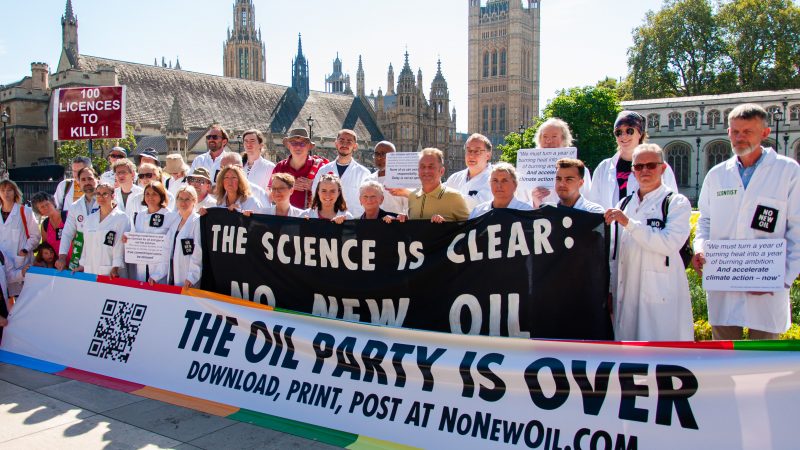
Scientists protest at UK Parliament 5 September 2023.

Original article by JESSICA CORBETT republished from Common Dreams under Creative Commons (CC BY-NC-ND 3.0). 
“This report is a wake-up call to the injustice of the climate crisis and a pivotal opportunity to correct course,” said one expert.

“The United Nations’ polite prose glosses over what is a truly damning report card for global climate efforts. Carbon emissions? Still climbing. Rich countries’ finance commitments? Delinquent. Adaptation support? Lagging woefully behind.”

That’s how Ani Dasgupta, president and CEO of the World Resources Institute, began his response to a “global stocktake” report released Friday by the U.N. Framework Convention on Climate Change (UNFCCC) ahead of two global summits.

“This report is a wake-up call to the injustice of the climate crisis and a pivotal opportunity to correct course,” Dasgupta continued. “We already knew the world is failing to meet its climate goals, but leaders now have a concrete blueprint underpinned by a mountain of evidence for how to get the job done.”

“There are a few bright spots worth celebrating,” he noted. “But overall, the report finds there are more gaps than progress—gaps that can only be erased by transformational change across systems like energy, food, land, and transport. The future of our planet depends on whether national leaders use this stark assessment as a catalyst for bold systems transformation.”

“This report makes clear that President Biden is squandering precious time every second he fails to take bold action on fossil fuels.”

The UNFCCC report comes nearly eight years after countries finalized the Paris climate agreement, which aims to keep global temperature rise this century below 2°C, relative to preindustrial levels, with a more ambitious target of 1.5°C.

“The global stocktake was designed under the Paris agreement to assess our global response to the climate crisis and chart a better way forward,” the UNFCCC explained Friday. “The global stocktake is held every five years and is intended to inform the next round of nationally determined contributions to be put forward by 2025.”

Data collection began in 2021, ultimately resulting in more than 170,000 pages of written submissions and over 252 hours of meetings and discussions. The new synthesis report summarizes 17 key technical findings from the discussions.

“I urge governments to carefully study the findings of the report and ultimately understand what it means for them and the ambitious action they must take next,” said U.N. Climate Change Executive Secretary Simon Stiell. “It’s the same for businesses, communities, and other key stakeholders. While the catalytic role of the Paris agreement and the multilateral process will remain vital in the coming years, the global stocktake is a critical moment for greater ambition and accelerating action.”

As University College London professor of climatology Mark Maslin explained, the report “makes it clear that the Paris agreement was a game-changer” but also countries’ greenhouse gas (GHG) emission reduction pledges are not in line with the 1.5°C target.

“The U.N. estimates that… we need to reduce global GHG emissions by 43% by 2030 and further by 60% by 2035 compared to 2019 levels and reach net-zero [carbon dioxide] emissions by 2050 globally,” Maslin summarized. “This is a huge ask given that greenhouse gas emissions were at their highest level ever in 2022.”

“All the technology exists to undergo the net-zero transformation but the huge increases in renewables, [electric vehicles], and batteries [have] to be even more rapid to make the huge cuts suggested by the U.N.—estimates are we need everything to happen five times faster,” he added.

The UNFCCC publication was released in preparation for the U.N. Climate Change Conference (COP28)—scheduled for November and December in Dubai, United Arab Emirates—where the first global stocktake will conclude.

“This global stocktake report provides clear direction on how we can meet the expectations of the Paris agreement by taking decisive action in this critical decade,” said COP28 President-Designate Sultan Al Jaber—whose selection for the summit post is controversial because he also heads the UAE’s Abu Dhabi National Oil Company. “We must urgently disrupt business as usual and unite like never before to move from ambition to action and from rhetoric to real results.”

The report also comes just ahead of U.N. Secretary-General António Guterres’ Climate Ambition Summit scheduled to begin on September 20 in New York City. In response, activists have planned the March to End Fossil Fuels on September 17.

Organizers of the NYC march are calling on U.S. President Joe Biden to stop federal approvals for new fossil fuel projects and repeal permits for “climate bombs” like the Willow project and the Mountain Valley Pipeline; phase out oil and gas drilling on public lands and waters; declare a climate emergency; and provide a just transition.

Advocacy groups supporting the march issued fresh demands for action on Friday in response to the UNFCCC publication.

“This report makes clear that President Biden is squandering precious time every second he fails to take bold action on fossil fuels,” said the Center for Biological Diversity’s Jean Su, who previously authored a document detailing how an emergency declaration would empower the administration to tackle the climate crisis. “Every day we’re seeing and feeling the harms of fossil-fueled climate change from extreme heat to deadly wildfires and devastating floods.”

“As leader of the world’s largest oil and gas producer, Biden has more power than anyone to stop expanding the fossil fuels driving this deadly crisis,” Su added. “Ahead of the U.N.’s Climate Ambition Summit, thousands of people will be in the streets of New York on September 17 for the March to End Fossil Fuels. This is the perfect opportunity for Biden to declare a climate emergency, use all his executive powers to phase out fossil fuels, and finally secure a legacy as a climate leader.”

“We need the biggest players to use their power to avert climate chaos, and to flex their muscle to protect human life rather than protecting corporate polluters.”

Greenpeace International policy coordinator Kaisa Kosonen on Friday called out governments across the globe, declaring that “our house is burning down and the people with the power to save us are still sipping coffee pretending it’s not happening.”

“No government can claim they didn’t know how to fix the climate problem,” she said. “They’ve been thrown a lifesaver again and again by scientists, and now we have this report. What the world is waiting for is action; leadership. We need the biggest players to use their power to avert climate chaos, and to flex their muscle to protect human life rather than protecting corporate polluters.”

Looking toward COP28, Kosonen argued that “at this year’s U.N. climate summit, governments must agree to end the use of oil, gas, and coal in a fast and fair way and make the polluters pay. Leaders can no longer smile and claim they support the Paris agreement and its 1.5°C warming limit, if they fail to give fossil fuels an end date and continue their expansion.”

“The solutions are ready—renewables are now the cheapest power source—but we’ve got to push the fossil fuel industry out of the way,” she stressed. “Fossil fuel corporations are holding us hostage, but their time’s up.”

The UNFCCC report and resulting calls for action follow a series of scientific findings throughout the week that also generated demands for a swift end to fossil fuels, including that Antarctica is warming more quickly than models project, this summer is the hottest on record, and last year greenhouse gas concentrations, global sea level, and ocean heat content all hit record highs.

Original article by JESSICA CORBETT republished from Common Dreams under Creative Commons (CC BY-NC-ND 3.0). 

Continue ReadingUN Puts Out ‘Truly Damning Report Card’ for Climate Action Before Global Summits

Extinction Rebellion NL start A12 blockade today

Spread the love
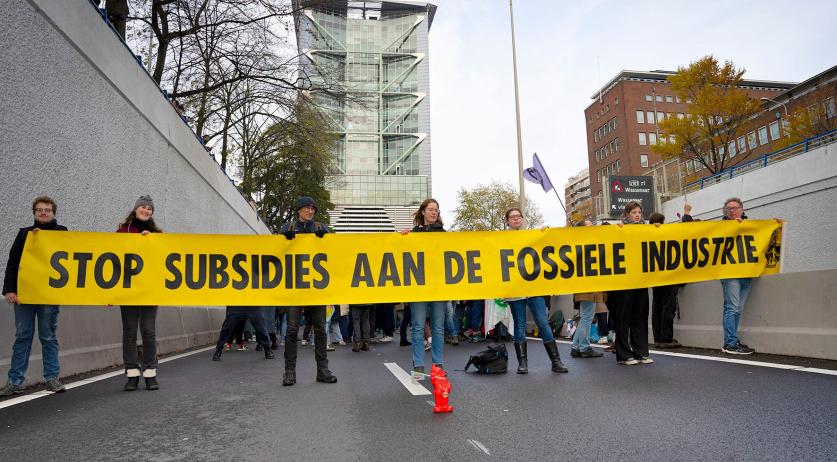
Extinction Rebellion NL activists block the Utrechtsebaan of the A12 highway in The Hague, 26 November 2022 Hague. They are calling for an end to fossil fuel subsidies by government. Image: Extinction Rebellion.

https://nltimes.nl/2023/09/09/extinction-rebellion-daily-a12-blockades-set-start-today-public-support-waning

Extinction Rebellion (XR) plans to block the A12 highway in The Hague again today in protest against the government’s support for the fossil fuel industry. Unlike with previous protests, the climate activists plan to keep this one going until the government stops all its subsidies to the fossil industry. If the police remove or arrest activists, new ones will replace them.

According to the XR spokesperson, many civil rights have been obtained through these “disruptive actions,” including safe cycle paths and the 40-hour work week. “It’s a proven strategy,” she said. “In addition, petitions have been signed, and climate marches have been taking place for 50 years. We have had climate diplomacy for 30 years. It has not achieved nearly enough.”

She acknowledged that the highway blockade will inconvenience people and that they’ll find it annoying. “But the nuisance of a flood or a forest fire is many times greater.”

A recent study by OMO, Oil Change International, and Milieudefensie showed that the Dutch government misses out on 37.5 billion euros in income yearly due to schemes that favor using fossil fuels. And that while there is overwhelming scientific evidence that greenhouse gases from fossil fuels are the main cause of global warming.

Extinction Rebellion NL starts it’s programme of blockades of the A12 in The Hague today.

Continue ReadingExtinction Rebellion NL start A12 blockade today

Watch: Jeremy Corbyn’s comments on wealth tax are going viral

Spread the love

https://www.thelondoneconomic.com/news/watch-jeremy-corbyns-comments-on-wealth-tax-are-going-viral-356566/

Recalling his time as Labour leader, He added: “I remember talking to the CBI about this. I was trying to persuade them about what a good idea it would be to increase taxation.

“And they were all staring at me – lots of them – and the point I just made was: OK. I get you don’t want to increase tax. I get you don’t want pay any more tax.

“But are you happy walking past rough sleepers when you go to your office on a Monday morning. Just ask yourself that question. What kind of society do you want to live in?”

https://www.thelondoneconomic.com/news/watch-jeremy-corbyns-comments-on-wealth-tax-are-going-viral-356566/

Continue ReadingWatch: Jeremy Corbyn’s comments on wealth tax are going viral

The Conservatives have seized on cars as a political wedge – it’s a bet on public turning against climate action

Spread the love


Matthew Paterson, University of Manchester

“Talking about freedom, sat in Margaret Thatcher’s old Rover” read the UK prime minister’s tweet in July 2023. Earlier that day in an interview with The Telegraph newspaper, Rishi Sunak had declared that the Conservative Party he leads are “on the side of motorists”, and he spent the days after attacking the opposition Labour Party for its supposed “anti-motorist” stance.

This is not the first time politicians have used cars to sell themselves to voters. In the UK, the most obvious parallel is with the 1997 general election, when both Labour and the Conservatives fought over “Mondeo man”, the archetype of a lower-middle-class and mostly male voter who both parties deemed important in swaying the outcome of elections.

Naming this category of voters by the car they drive is no accident. Since the early 20th century, the car has symbolised a diverse set of social values: freedom and progress, but also power and status. The cultural and economic importance of cars may have waned, but they remain important enough for politicians to use for electoral gain.

Sunak has revived this notion of motorists being the voters that really count in a clear signal of the Conservatives’ campaign strategy in the 2024 general election. This throwback to 1997, when the car’s place in society was still relatively secure, is a gamble. And it reveals a new tactic from the political right to maintain relevance as the climate crisis unfolds.

What’s changed since 1997?

The mid-1990s saw a wave of protests against road building. Immediately before the 1997 election, they produced their iconic figure, Swampy, who stayed for a week in an underground tunnel to prevent diggers from accessing the construction site.

In the lead-up to 2023, there has similarly been a lot of direct action by protesters against cars. The first Extinction Rebellion protest entailed closing five bridges in London. Just Stop Oil and Insulate Britain have blocked motorways.

Then, as now, a Conservative government lurching from crisis to crisis has sought popular issues to revive its fortunes. In 1997, the Tories were embroiled in a series of corruption scandals and nurturing an internal war over the EU. The parallels with their situation today require no explanation.

But there are important differences. It’s striking how little reinforcement of the “voters as car drivers” rhetoric there has been since 1997. Both parties have introduced and promoted steadily more ambitious action on climate change, in ways that have had knock-on effects for explicitly pro-car strategies.

Successive governments (both Labour and Conservative) have introduced:

Because of these changes, Sunak’s championing of motorists today works differently to the Mondeo man appeal in 1997. Then, both major parties agreed on the social and economic value of the car and sought to sideline and undermine the road protest campaigns. Both shored up this pro-car ideology and competed over who could best serve it.

Two pro-car parties

In practice, there remains little difference between the two parties on the question of cars. Both assume that society will continue to be dominated by cars, but both have introduced enough (modest) policies to limit car use and promote alternatives. To actively promote cars now requires a clearer affirmation and creates the possibility of using it as a wedge issue to attack the opposition with.

These attempts are largely ridiculous. Labour is more or less still as pro-car as the Tories (hence the absurdity of trying to claim Labour is on the side of Just Stop Oil), and partly because many of the initiatives now being attacked by Sunak were themselves developed and promoted by the Conservatives, most notably the ultra low emissions zone, which was Boris Johnson’s idea.

Sunak’s pro-car rhetoric is explicitly nostalgic. To reclaim the Conservatives as the party of motorists, Sunak must return to Margaret Thatcher and sit in her Rover, recalling a golden age that must be restored.

This rhetoric also borrows from populists undermining climate policy more generally, because the political logic of promoting cars is now one of backlash which claims “the people” have lost out from the various anti-car initiatives of both parties. Sunak takes his cues from the Net Zero Scrutiny Group and the All Party Parliamentary Group on Fair Fuel, coalitions of MPs that attack climate action in UK politics.

If the Conservatives continue with this line of attack against Labour through to the next election, that poll will be about the future of Britain’s climate strategy. After all, more ambitious climate action demands reducing reliance on cars.

It is not clear if Sunak’s pro-car nostalgia will work. But whether or not it does will reveal a lot about the necessary conditions for attaining more aggressive climate action, which will inevitably involve changes in how people live their lives – from the transport they use and how often, as well as in many other areas.


Imagine weekly climate newsletter

Don’t have time to read about climate change as much as you’d like?

Get a weekly roundup in your inbox instead. Every Wednesday, The Conversation’s environment editor writes Imagine, a short email that goes a little deeper into just one climate issue. Join the 20,000+ readers who’ve subscribed so far.The Conversation


Matthew Paterson, Professor of International Politics, University of Manchester

This article is republished from The Conversation under a Creative Commons license. Read the original article.

Continue ReadingThe Conservatives have seized on cars as a political wedge – it’s a bet on public turning against climate action