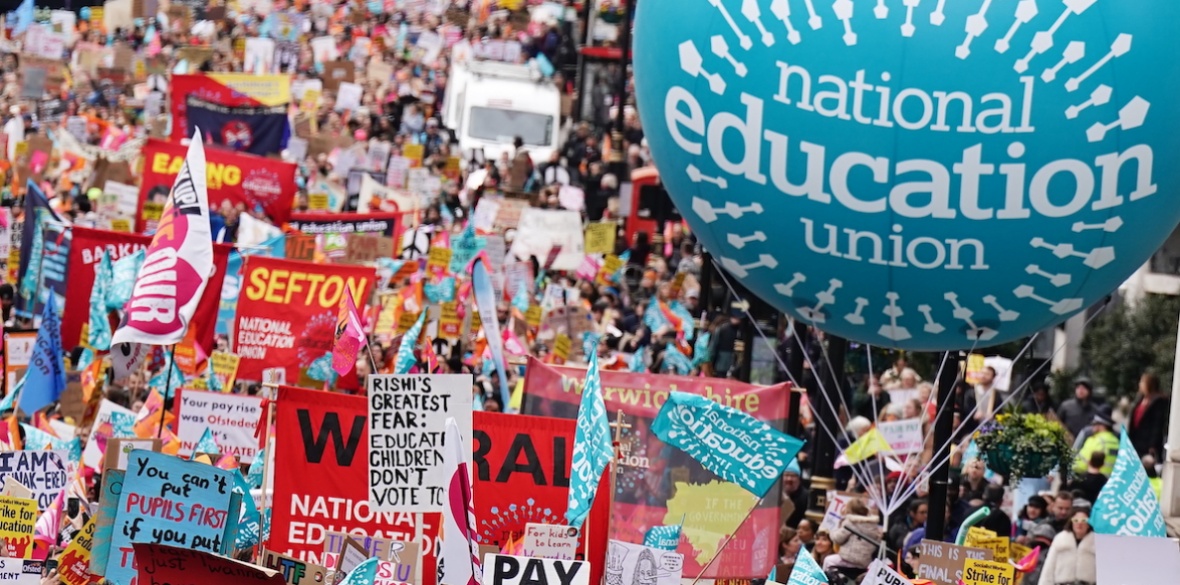
Striking members of the National Education Union (NEU) on Piccadilly march to a rally in Trafalgar Square, central London, in a long-running dispute over pay. Picture date: Wednesday March 15, 2023.
THE Tories are “waging war on working people,” unions warned today as Chancellor Jeremy Hunt’s Budget coincided with a massive day of strikes by hundreds of thousands of workers nationwide.
Unions slammed the ex-Tory leadership candidate’s “fiscal event” for failing to tackle pay disputes across the country, with teachers, university lecturers, civil servants, junior doctors, London Tube drivers and BBC journalists all downing tools today.
As Mr Hunt delivered his speech, thousands of workers rallied outside.
They gathered as the Office for Budget Responsibility, which the former health secretary praised for predicting Britain would now avoid a technical recession this year, warned that people still face the biggest fall in living standards on record.
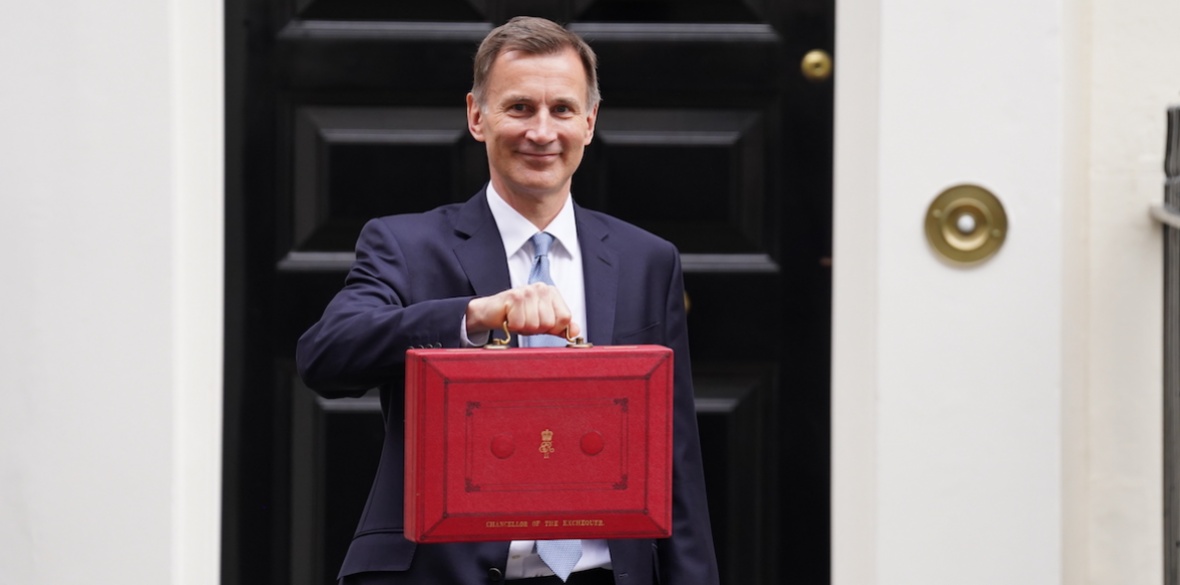
Chancellor of the Exchequer Jeremy Hunt leaves 11 Downing Street, London, with his ministerial box, before delivering his Budget at the Houses of Parliament. Picture date: Wednesday March 15, 2023.
BRITAIN’S biggest strike surge in decades was the elephant in the room, almost ignored in the Chancellor’s Budget speech.
The huge strike march winding through Whitehall wasn’t referenced by either front bench. Yet the demands for proper pay rises and investment in public services it championed speak more directly to people’s concerns than any of Jeremy Hunt’s headline announcements.
Hunt referred vaguely to inflation as the cause of industrial disputes — before dishonestly citing it as the reason the government is denying workers the pay rises they need and deserve.
His dishonesty didn’t end there. The government is doing everything it can to resolve the disputes, the Chancellor claimed.
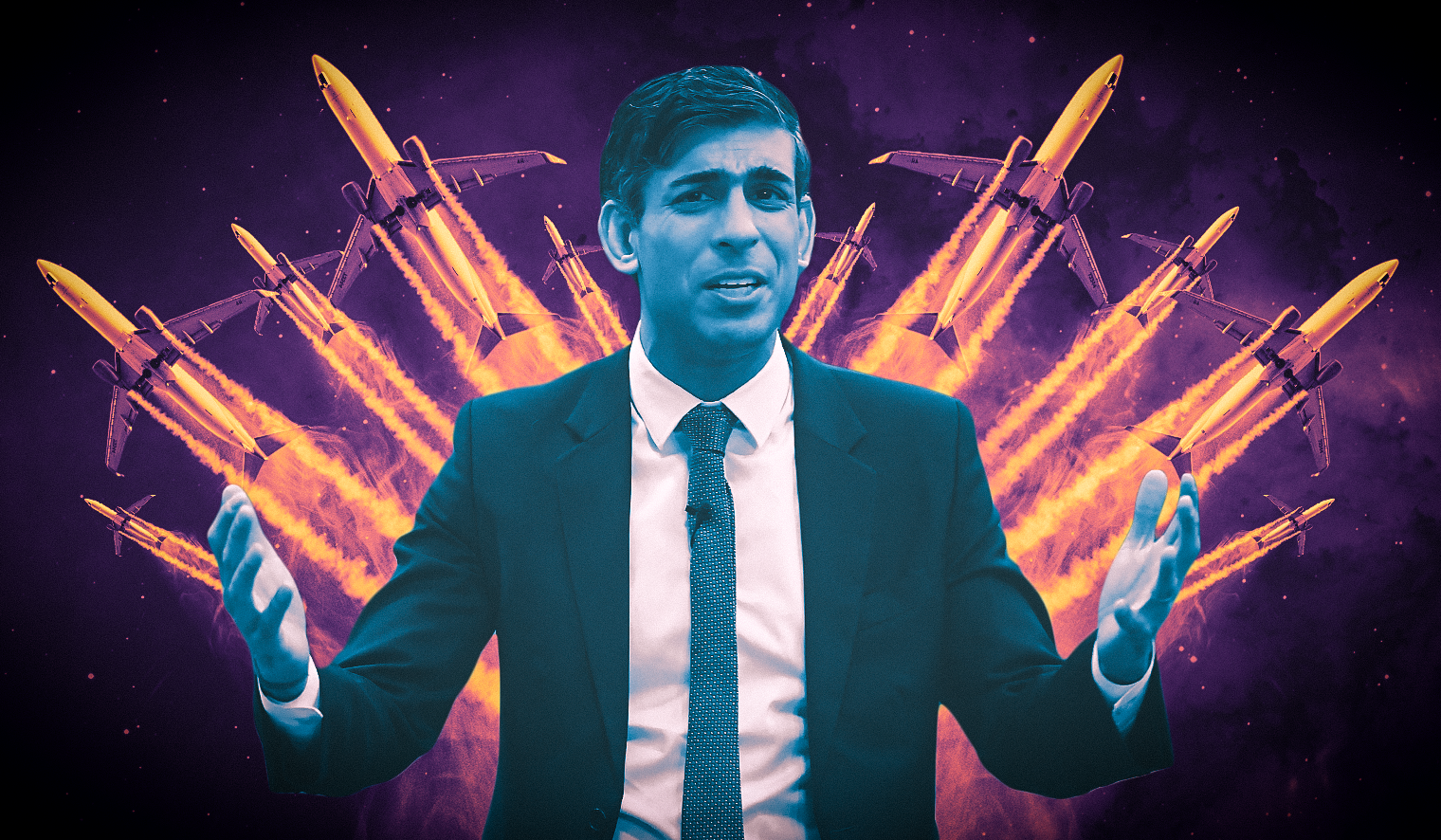
Rishi Sunak halved has aviation tax on domestic flights | Liam McBurney/alenaohneva / Getty / Pexels. Composite by openDemocracy
Rishi Sunak slashed aviation tax on domestic flights and rejected a new ‘frequent flyer levy’ after lobbying by the airline industry, openDemocracy can reveal.
The decision to halve air passenger duty (APD), which takes effect next month, will mean more flights and less rail journeys in Britain – undermining the government’s net-zero commitment.
Clean transport campaigner Matt Finch, the director of Transport and Environment, told openDemocracy: “Simply taxing airlines in the same way that all other UK companies are taxed would bring in precious funds to the Treasury, and stop the ridiculous favouritism shown to airlines.”
He added: “It’s clear that the aviation sector gets preferential treatment from the government, but it’s unclear exactly why.”
In June 2021, when Sunak was chancellor, Ryanair’s director of route development told the Treasury that APD “should be abolished in order to stimulate immediate traffic growth”, documents obtained by openDemocracy under Freedom of Information law reveal.
Ryanair said it could offer “ultra-low” domestic fares if the tax was reduced. It has responded to Sunak’s cut by sharply increasing flights from London, adding three a day between the capital and Edinburgh and three a week to Newquay, Cornwall.
Responding to the Treasury’s June 2021 consultation on the plans, British Airways’ owner, International Airlines Group (IAG), and easyJet also said they supported APD tax cuts. IAG said “positive outcomes could include new routes, increased frequency and larger aircraft on existing routes as well as lower fares”.
EasyJet said: “Our analysis shows that if domestic APD is reduced by 50%, this would
support an overall 31% increase in domestic volume to 10.6 million passengers.”
But the UK’s rail industry warned that cutting air taxes would lead to 222,000 passengers shifting from rail to air each year, equivalent to an extra 1,000 domestic flights. The Rail Delivery Group said that reducing the cost of flying “runs counter to government’s legal commitment to decarbonise” and could increase carbon emissions by 27,000 tonnes a year.
Sunak ignored the warning and in October 2021 announced a 50% cut to APD on domestic flights, from £13 to £6.50.
It’s clear that the aviation sector gets preferential treatment from the government, but it’s unclear exactly why
Matt Finch, Transport and Environment
Silviya Barrett, the director of Policy and Research at Campaign for Better Transport, said: “In the context of the climate emergency, it’s hard to think of a more wrong-headed policy than making domestic flights cheaper. Not only will it encourage more polluting travel, but it will reduce revenue which could and should be invested in sustainable alternatives.”
France is taking the opposite approach by banning domestic flights between cities that are linked by a train journey of less than 2.5 hours.
The railway industry’s ability to compete with cheap flights was further undermined last week when the government increased rail fares by up to 5.9%, the biggest rise for 11 years.
The airline industry already benefits from the absence of tax on jet fuel and no VAT on airline tickets. A study last year estimated that taxing jet fuel in the UK at the same rate as road fuel would have raised £6.7bn in 2019. The sector generates around 8% of UK emissions.
Sunak, who now travels around Britain in a private jet, also rejected a recommendation to introduce a progressive tax on frequent flyers.
The Climate Change Committee has found that a “frequent flyer levy” –which makes those who fly more often pay progressively more tax – is a fairer way of taxing aviation.
Research shows that just 15% of Brits take 70% of flights.
It’s hard to think of a more wrong-headed policy than making domestic flights cheaper
Silviya Barrett, Campaign for Better Transport
Nine in ten people back the idea of a frequent flyer levy, according to a survey by conservation charity WWF and think tank Demos, but Ryanair told the Treasury not to do it.
Ryanair argued that a frequent flyer levy would be “likely only to punish passengers that have an ongoing practical requirement to fly frequently”, while IAG told the Treasury that “taxing aviation does not benefit the environment”.
Grahame Morris, a Labour member of the House of Commons Transport Select Committee, told openDemocracy: “It is counterintuitive of this government to remain committed to ‘Jet Zero’ by 2050 and at the same time to reject a frequent flyer levy while alternative sustainable aviation fuels to replace existing fossil fuels are still under development and evaluation.”
A government spokesperson said: “We are absolutely committed to levelling up the UK and delivering on our net-zero commitments, which is why from April we are cutting duty in half for flights within the UK, except for private jets, and introducing new higher rates of duty for ultra-long haul flights, ensuring that those who fly furthest contribute the most.
“In line with the tax policy-making process, we consulted on a frequent flyer levy in 2021, which a wide range of stakeholders fed into. Having considered views, including around privacy and data concerns of implementing such a levy, we concluded that Air Passenger Duty should remain the principal tax on the aviation sector.”
Thanks for making my heightened surveillance status so obvious – you couldn’t have made it more obvious really. A dodgy unannounced Android update that refuses to install smoothly, browsers on my lappy refusing to work as before – so that I can’t make purchases from shops that I use regularly. Surely I wouldn’t notice that?
If anyone is overseeing Sue-Ellen Braverman, please ask her why she is putting a political opponent under intrusive surveillance for me.
15/3/23: political opponent is probably the wrong term. The point I’m making is that these actions are for political rather than any legitimate purpose.
The BBC has decided not to broadcast an episode of Sir David Attenborough’s flagship new series on British wildlife because of fears its themes of the destruction of nature would risk a backlash from Tory politicians and the rightwing press, the Guardian has been told.
The decision has angered the programme-makers and some insiders at the BBC, who fear the corporation has bowed to pressure from lobbying groups with “dinosaurian ways”.
The BBC strongly denied this was the case and insisted the episode in question was never intended for broadcast.
…
Caroline Lucas, the Green party MP for Brighton Pavilion, said: “For the BBC to censor of one of the nation’s most informed and trusted voices on the nature and climate emergencies is nothing short of an unforgivable dereliction of its duty to public service broadcasting. This government has taken a wrecking ball to our environment – putting over 1,700 pieces of environmental legislation at risk, setting an air pollution target which is a decade too late, and neglecting the scandal of our sewage-filled waterways – which cannot go unexamined and unchallenged by the public.
…
Chris Packham, who presents Springwatch on the BBC, also criticised the decision. He told the Guardian: “At this time, in our fight to save the world’s biodiversity, it is irresponsible not to put that at the forefront of wildlife broadcasting.”
A DEVASTATING picture of the NHS facing catastrophe has been laid bare in one of the largest workplace surveys in the health service.
Tens of thousands said they would not trust the NHS to treat their own relatives, the poll of more than 600,000 staff found.
Nurses, midwives and other workers expressed their utter despair over pay, staffing shortages, plummeting standards of care, lack of time to do their jobs properly and their own wellbeing.
Almost a quarter said they will probably look for a job outside the NHS in the next 12 months.