Government to launch bill to stop people arriving on small boats from claiming asylum
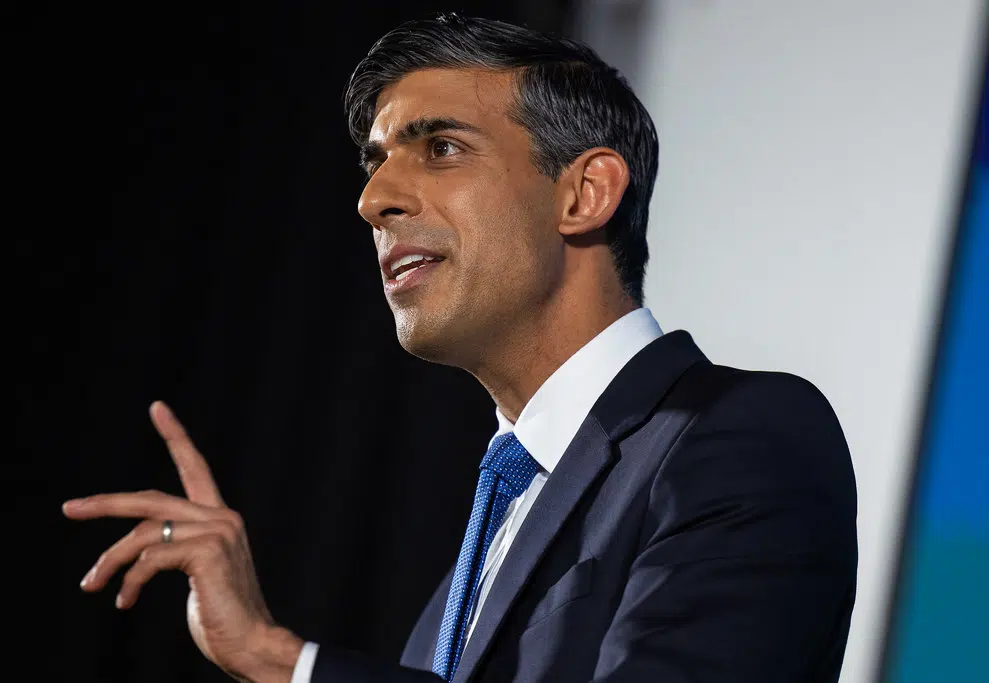
CAMPAIGNERS and MPs have hit out at Rishi Sunak’s plans to make asylum claims for those who travel on small boats inadmissible, calling it “inhumane” and a distraction from government failures.
The Prime Minister is expected to set out his government plans tomorrow which will also see migrants removed to a third country such as Rwanda and banned from returning or claiming citizenship.
Mr Sunak previously said that “stopping the boats” is one of his five key priorities.
…
The government has made its hard-line approach on immigration known, with Home Secretary Suella Braverman last year describing the number of arrivals on the south coast as an “invasion” and that it was her “obsession” to see a deportation flight to Rwanda.
…
Former home secretary Diane Abbott said that the PM “must know that policy will not work.”
The Labour MP tweeted: “It is simply a disgraceful ‘core vote’ strategy — because he has nothing else to fight the next general election with.”
“Promoting the utilization of captured CO2 in petrochemicals, plastics, and fuels, as your legislation would encourage, will perpetuate environmental justice harms and subsidize the oil and gas industry to do it.”
More than 100 organizations on Monday urged the congressional sponsors of a new proposal that would boost the tax credit for certain carbon capture projects to shift their focus to solutions that will actually address the fossil fuel-driven climate emergency.
The groups—including 350.org, Beyond Plastics, Center for Biological Diversity, Food & Water Watch, Indigenous Environmental Network, Physicians for Social Responsibility, Science and Environmental Health Network (SEHN), and Waterspirit—oppose the Captured Carbon Utilization Parity Act (S. 542/H.R. 1262).
Introduced last week by Sens. Sheldon Whitehouse (D-R.I.) and Bill Cassidy (R-La.) and Reps. David Schweikert (R-Ariz.) and Terri Sewell (D-Ala.), the legislation would increase the 45Q tax credit for carbon capture and utilization (CCU) “to match the incentives for carbon capture and storage (CCS) for both direct air capture (DAC) and the power and industrial sectors.”
The groups sent a letter to the four sponsors arguing that:
This bill does not advance climate solutions, but is rather a giveaway to fossil fuel companies and other corporate polluters under the guise of climate action. Promoting the utilization of captured CO2 in petrochemicals, plastics, and fuels, as your legislation would encourage, will perpetuate environmental justice harms and subsidize the oil and gas industry to do it. Rather than perpetuating these climate scams, we encourage you to support the elimination of subsidies for the fossil fuel industry instead of enriching them through carbon capture schemes.
In addition to stressing that such projects consume a lot of water while producing emissions and chemical waste—further endangering frontline communities that are disproportuantely home to people of color and low-income individuals—the organizations pointed out that “carbon capture has a long history of overpromising and under-delivering.”
“The overwhelming majority of captured carbon to date has been used to increase oil production via enhanced oil recovery (EOR),” the letter highlights. “The myth of a massive carbon management paradigm that uses and re-uses carbon dioxide on any large scale serves only to greenwash the reality of how carbon dioxide is used: for oil production.”
“As laid bare in an investigation from the U.S. Treasury Inspector General for Tax Administration, the 45Q tax credit is rife with abuse as credits are improperly claimed,” the letter further notes. “Moreover, documents uncovered by the House Oversight Committee’s investigation into major oil companies and climate disinformation revealed that the biggest proponents of CCS also understand the technology to be costly, ineffective, and requiring continued and increasing government subsidization.”
“The myth of a massive carbon management paradigm that uses and re-uses carbon dioxide on any large scale serves only to greenwash the reality of how carbon dioxide is used: for oil production.”
Citing a report from the United Nations’ Intergovernmental Panel on Climate Change, the organizations also explained that “in contrast to things like solar power and batteries, carbon capture is not the kind of technology that gets significantly cheaper over time, and increasing public subsidies to spark a carbon management industry will not result in a self-sustaining system.”
According to dozens of groups representing communities across the country, “The carbon utilization fantasy should be abandoned, with focus restored on the solutions we know will help combat the climate crisis, like renewable energy and storage, electrification, energy efficiency, real zero-waste materials systems, agroecology, and more.”
SEHN executive director Carolyn Raffensperger told Common Dreams that her group is supporting the letter “because carbon capture use and sequestration (CCUS) is the fossil fuel industry’s diabolical plan to line its investors’ pockets with public money” and “the antithesis of a climate solution in that it delays real, tried and true solutions.”
“Further, the entire 45Q tax credit program turns sound environmental policy on its head: Instead of requiring the polluter to pay for its damage, 45Q tax credits pay the polluter to pollute,” Raffensperger added. Pointing to proposed CO2 pipelines in Iowa, she said:
Keenly aware of the climate crisis, we investigated the claims that industry was making that we could address climate by putting a big machine on top of various polluting facilities and transporting the CO2 across the countryside and burying it deep underground. What we discovered was that the entire enterprise would require more energy than the original facility required. It will disrupt farm land and pose grave risks in case of a pipeline rupture. Even worse, we found that this vast complex system of carbon capture, transportation, and either use or disposal is horribly under-regulated by [the Environmental Protection Agency], the Pipeline and Hazardous Materials Safety Administration, the [Internal Revenue Service], and others. The frosting on this toxic cake is that the public pays the fossil fuel industry with public money and the public gets no climate benefit. If anything, CCUS makes climate change worse.
“Heed the lessons of the recent train derailment and pipeline disasters. That is, fix the regulatory mess before pouring money into 45Q tax credits,” she urged U.S. lawmakers. “The tax credits are like shoveling coal into the boiler of a runaway train.”
As Rachel Dawn Davis, public policy and justice organizer at Waterspirit, said Monday in an email to Common Dreams, independent science has already shown that investments in carbon capture “would be a waste of money and time,” and “we are experiencing the sixth mass extinction; we have no time to continue wasting.”
“If we are to provide a livable future for current and future generations of young people and all creation, we must invest solely in renewable energy, not furthering fossil fuel fallacies,” she emphasized. “Subsidies going to the most heinous polluters are only continuing through this legislation; congressional representatives must know better by now.”
“There’s a great danger that Israel will turn into a dictatorship,” warned one protester.
Ongoing protests against the far-right Israeli government of Prime Minister Benjamin Netanyhu were larger than ever on Saturday night as an estimated 200,000 people or more took to the streets in Tel Aviv and other cities to denounce judicial reforms they warn put the nation on a path towards dictatorship.
For over two months, weekly protests—mostly on the weekends but increasingly during the workweek as well—large demonstrations have taken place in response to Netanyahu and his coalition government pushing a judicial takeover that critics say would curtail democracy.
Haaretzreported Saturday’s turnout as a record since the movement started in early January.
“There’s a great danger that Israel will turn into a dictatorship,” Ophir Kubitsky, a 68-year-old high school teacher at the demonstration, toldReuters. “We came here to demonstrate over and over again until we win.”
An incredible photo.
Downtown Tel Aviv is flooded with Israelis protesting the government’s judicial reform package. pic.twitter.com/DntI4k16hV
The demonstrations in Tel Aviv and other locations “began peacefully,” reports Reuters. “However, footage released by police later showed protesters breaking down barriers in Tel Aviv and igniting fires as they blocked roads. Police sprayed water cannons at the protesters.”
While Israeli liberals increasingly register fear and discomfort over the direction of its government’s growing autocratic tendencies, Palestinian rights advocates have noted that the right-wing slide is a direct and predictable continuation of a system that denies its Palestinian citizens full rights under the law while overseeing a brutal and repressive apartheid regime.
As American-Palestinian scholar Yousef Munayyer recently wrote in a column about the protest movement for +972 Magazine:
As tens of thousands of Israelis protest the reforms that Netanyahu’s government seeks to ram through in hopes of “saving the essence” of Israeli democracy, they are largely avoiding a confrontation with the foundational problem, namely that the essence of the Israeli system is to put settler colonialism ahead of any liberal principles around democracy, equality, or human rights.
A key question for many concerned not only about Israel’s increasingly autocratic and right-wing lurch, but its ever-worsening treatment of the Palestinians living under hostile military occupation is this: “Does this loose group oppose the settler-colonial system that these legal reforms would further enable, or does it simply seek a return to the settler-colonial system, but without Netanyahu at its head?”
Munayyer believes all evidence thus far indicates the latter is the unfortunate answer, which is why Palestinians are noticeably absent from celebrating the display of dissent and opposition in Tel Aviv and elsewhere.
“For all Palestinians, including those with Israeli citizenship, there is little urgency to try to ‘save’ Israeli democracy, primarily because for them it has never existed,” Munayyer concluded. “Not only is a political system that is constructed to be democratic toward some, but not all, not a democracy, it is also not going to seem worth saving to those it disadvantages.”
Noting that communities like Huwara are often targeted by Israeli settlers, Amnesty’s regional director urged Israel “to remove all settlements, which are war crimes under international law, and to dismantle its system of apartheid against Palestinians.”
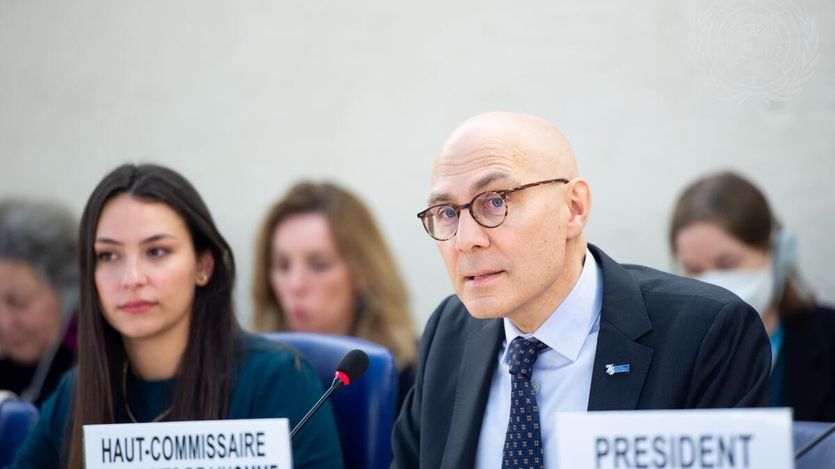
United Nations High Commissioner for Human Rights Volker Türk on Friday called out Israeli Finance Minister Bezalel Smotrich for saying that Huwara, a Palestinian village in the West Bank, “needs to be wiped out” and “the state of Israel should do it.”
Smotrich’s comment Wednesday came after Israeli settlers on Sunday rampaged through Huwara, killing a 37-year-old Palestinian man—mass violence that came just hours after a Palestinian gunman murdered a pair of Israeli brothers, who were 19 and 21.
“As Jews who support freedom and dignity for all people, no exceptions, we will not just sit in horror as the state of Israel carries out ethnic cleansing in our names.”
Hundreds of Jewish New Yorkers rallied and marched on the home of Senate Majority Leader Chuck Schumer on Sunday to protest his embrace of far-right Israeli Prime Minister Benjamin Netanyahu amid growing violence against Palestinians—violence that demonstrators said is enabled by the U.S. government’s unwavering military and diplomatic support.
“As Jews who support freedom and dignity for all people, no exceptions, we will not just sit in horror as the state of Israel carries out ethnic cleansing in our names,” said Jewish Voice for Peace member Jay Saper. “We are calling for an end to all U.S. military funding to Israel now.”
The CEOs of jet fuel suppliers, gas turbine makers, oil and gas companies are among those who made large donations in the last quarter of 2022.
Prime Minister Rishi Sunak. Credit: Number 10 Downing Street / Simon Walker, CC BY-NC-ND 2.0
The Conservative Party has received more than £632,000 in new donations from individuals and firms tied to polluting industries, DeSmog can reveal.
New Electoral Commission records released today show that the bulk of the fossil-fuel linked funds came from Christopher Harborne, who donated £500,000 in the final quarter of 2022 – the joint-largest donation registered by the party during this period.
Further donations were made by a gas turbine manufacturer, a North Sea oil investor, a petrochemical engineering firm, and a peer with shares in major oil and gas companies.
The revelation comes at an important moment for UK climate policy. Sunak’s government is due to release an update to its net zero strategy next month after a High Court judge ruled it lacked sufficient detail.
The government recently opened up a new round of North Sea oil and gas licences for oil and gas exploration, at a time when the UN has warned that only drastic, immediate cuts to carbon emissions can avert a climate catastrophe.
Caroline Lucas, Green Party MP for Brighton Pavilion, said donations from polluting industries represented a “dangerous conflict of interest”.
Fossil Fuel Ties
Harborne is the owner of AML Global, an aviation fuel supplier operating in 1,200 locations worldwide with a distribution network that includes “main and regional oil companies”, according to its website. Harborne is also the CEO of Sheriff Global Group, which trades in private jets.
Before the pandemic, aviation emissions accounted for eight percent of the UK’s annual greenhouse gas emissions, according to the government’s Climate Change Committee, yet the government granted nearly £250 million in “free pollution permits” to the industry in 2021.
Harborne has also donated some £6.5 million to the Brexit Party – now Reform UK – whose co-founder Nigel Farage has called for a referendum on the government’s net zero targets and has labelled the focus on carbon emissions “alarmism”. Harborne has rarely spoken about the climate crisis, so the details of his personal views are unknown.
As revealed by DeSmog, Harborne also donated £515,000 to the Conservatives in the second quarter of 2022, when the party accepted a total of £651,000 from the aviation industry.
These donations landed in the same period as the government’s “Jet Zero Strategy”, published in July. The policy – which aims to cut UK aviation emissions to net-zero by 2050, allow travellers to fly “guilt-free” and supports further aviation sector growth – has been dismissed by environmental groups as “pure greenwash”.
Harborne and AML Global have been approached for comment.
Other Donors
The new Electoral Commission records show that the Conservatives received a further £15,000 in the final quarter of 2022 from Centrax Industries – a firm that specialises in manufacturing gas turbines. Centrax has now given more than £300,000 to the Conservatives since 2010.
DeSmog previously revealed that companies and individuals involved in North Sea oil and gas – including Centrax – donated a total of £419,900 to the Conservatives ahead of and during the government’s review into the future of the sector from July 2020 to March 2021.
Another Conservative donor in the final quarter of 2022 was Nova Venture Holdings, which donated £52,260. The company is wholly owned by Jacques Tohme, who describes himself as an “energy investor” on LinkedIn and lists his current role as co-founder and director of Tailwind Energy, an oil and gas company.
According to its website,Tailwind focuses on “maximis[ing] value in UK continental shelf (UKCS) opportunities”, an area which includes the North Sea. Serica Energy reportedly has an agreement in place to buy Tailwind, which is expected to complete in March. The acquisition will make Serica one of the 10 largest North Sea oil and gas producers.
A further £10,000 was given to the Conservatives by Alan Lusty – the CEO of Adi Group – adding to the £17,000 that he has given to the party since 2021. According to its website, Adi Group is a “leading supplier of engineering services to the petrochemical industry”. These services “add significant value to petrochemical engineering companies”, Adi says, though the firm claims “to work towards delivering a low-carbon economy” through its products. Adi also provides engineering services to the aerospace and automotive industries.
Finally, the Conservative Party received £50,000 from one of its peers – Lord John Nash – who also donated £5,000 to the local Wantage constituency party. According to his register of interests, Lord Nash holds shares in Royal Dutch Shell, the second largest investor-owned oil and gas company in the world by revenue, and BHP, the Australian-based mining, oil and gas firm.
Lord Nash, who has run several private equity funds, has donated more than £560,000 to the party since 2018.
The £632,260 accumulated by the Tories from fossil fuel interests and high polluters represents more than 13 percent of the party’s £4.8 million income during the final quarter of 2022.
Rishi Sunak himself received £141,000 from energy interests during his Conservative leadership campaign in the summer of 2022.
Jacques Tohme, Tailwind Energy, Centrax, Adi Group, Lord Nash and the Conservative Party have been approached for comment.
OPINION: UK National Security Bill is latest in long line of cynical attempts to maintain secrecy and stifle journalism
Journalism, as George Orwell famously said, is “printing what someone else does not want printed”.
But what happens if the someone who doesn’t want your story printed also has the power to put you in prison?
That sounds like the kind of question journalists in places like Iran or North Korea might have to contend with. But it’s a dilemma someone like me, living and working in the UK, could be asking soon, too.
The National Security Bill currently going through Westminster contains a clause saying that “providing” information that may “materially assist a foreign intelligence service” can be punishable by up to 14 years in prison.
Here at openDemocracy we pride ourselves on publishing stories that the government and others in power would much rather never see the light of day.
Investigative journalists like us at openDemocracy often receive sensitive information. Could our reporting be used by foreign powers to embarrass the British government?
The honest answer is ‘yes’. But does saving our government’s blushes mean the public shouldn’t know that the British army was aware of the dangers of ‘Snatch Land Rovers’, associated with the deaths of over 34 British troops in Iraq and Afghanistan? Or how the UK’s corporate secrecy vehicles are used to hide oligarchs’ ill-gotten gains?
Crucially, Sharpe’s promise that journalists won’t get caught in the security bill’s dragnet will not be enshrined in law
In recent days, Rishi Sunak’s ministers have made some minor amendments to the National Security Bill in the face of organised opposition by openDemocracy and other media outlets. (A huge thank you to the more than 8,000 oD readers who sent emails to their MPs demanding changes to the bill.)
The government has been at pains to say we shouldn’t be worried. In the Lords this week, one minister, Andrew Sharpe, said that it is “almost inconceivable that genuine journalism will be caught within the threshold for criminal activity”.
But it’s the “almost” that should worry all of us.
The National Security Bill replaces older secrecy legislation, and is supposed to counter the activity of hostile foreign powers in the UK. But the bill’s provisions are so wide-ranging that it is not hard to see how journalists – and whistleblowers – could be caught by it.
Crucially, Sharpe’s promise that journalists won’t get caught in the security bill’s dragnet will not be enshrined in law.
Why can’t we just trust our leaders when they say that hacks like us have nothing to worry about?
Well, their track record isn’t good. This is a government that ran an Orwellian ‘Clearing House’ that vetted Freedom of Information requests from journalists and others. When we revealed what was happening, Michael Gove, the minister in charge, smeared us and our journalism.
London’s libel courts are still being used by the world’s rich and powerful to silence public criticism. Last year, Dominic Raab pledged to legislate to end so-called “strategic litigation against public participation” cases, or SLAPPs.
But Raab’s rhetoric has not turned into reality. openDemocracy is currently subject to a SLAPP case, as are many of our journalistic allies.
Rishi Sunak has allotted no parliamentary time for anti-Slapp legislation – which means it’s very unlikely to happen. Should we be surprised when one of Sunak’s own appointments, former chancellor Nadhim Zahawi, issued legal threats against journalists and campaigners who asked questions about his tax affairs?
Sunak and his ministers are fond of saying how much they care about free speech and the freedom of the press. But when the government gets to decide what information journalists can – and can’t – report, we should all be worried.