Public healthcare becomes key rallying point in Italy
Original article republished from peoples dispatch under a Creative Commons Attribution-ShareAlike 4.0 (CC BY-SA) license.
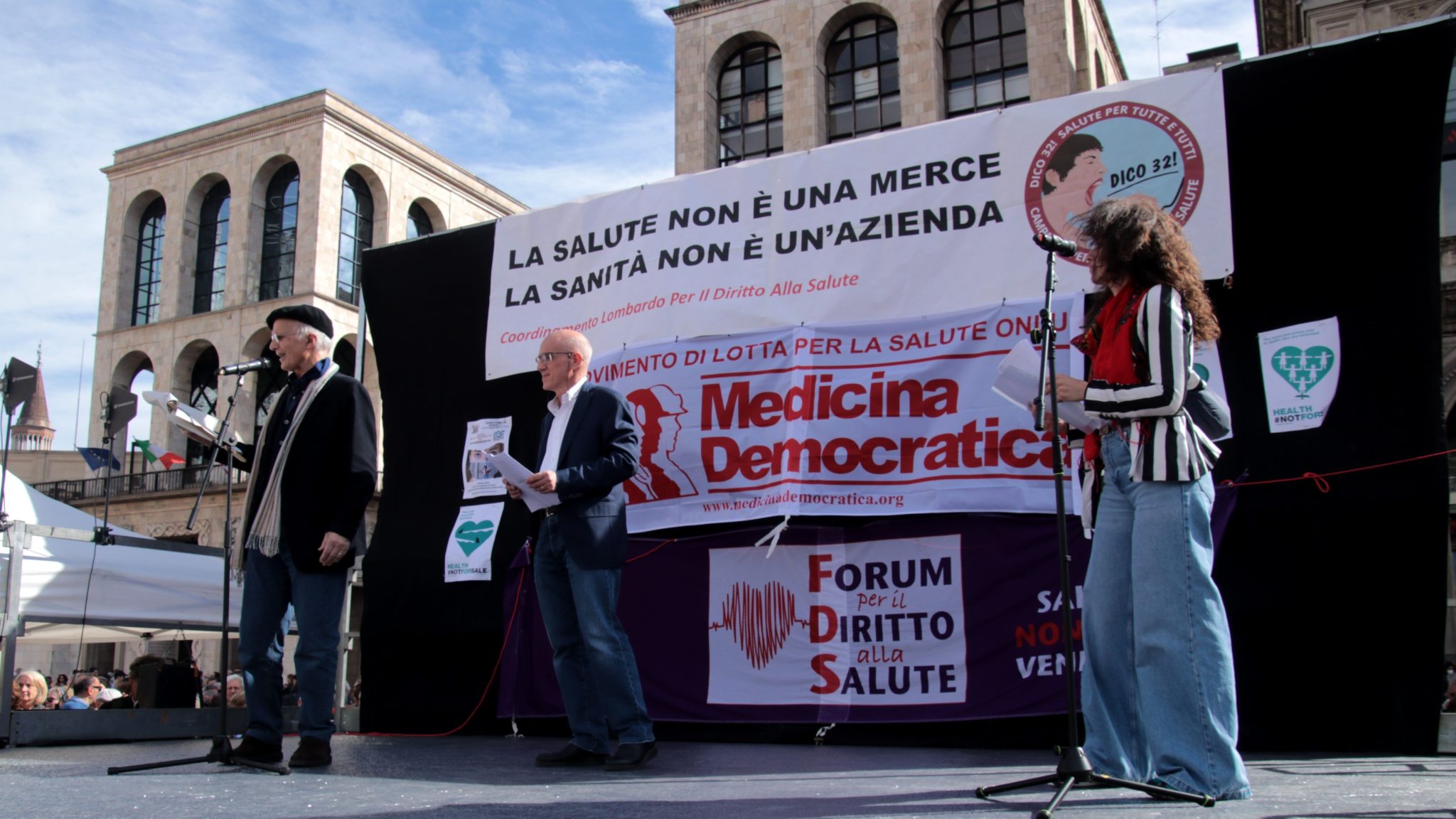
More and more people in Italy mobilize to protect the public health system against privatization and budget cuts promoted by far-right Giorgia Meloni’s government
The functioning and future of Italy’s National Health Service or Servizio sanitario nazionale (SSN) have become one of the most important mobilizing issues for trade unions, civil society organizations, and ordinary citizens. Just like health systems in many other European countries, the SSN has fallen prey to policies that promote the participation of the private sector in service provision, weakening the public, tax-based system, which is supposed to provide care to everyone. With the government of prime minister Giorgia Meloni pushing for a policy of administrative devolution and further cuts to health expenditure, things in the healthcare sector are poised to get even bleaker, as activists and health workers warned during a recent national rally in Rome.
Read more: Tens of thousands mobilize on the streets of Rome against far-right Meloni’s policies
After the national mobilization, the protests headed north to Lombardy, where they should culminate in a central manifestation in Milano on Saturday, 21 October. In the leadup to the local events, Vittorio Agnoletto, a physician and health activist, underlines the importance of people taking to the streets to protect the public health system. He said in a recent blog post, “The best thing for everyone to do right now is to get involved. Get involved in a campaign to defend your local hospital, get involved in a campaign to protect your community health center from falling into the hands of the private sector, get involved in any local health campaign to build its strength.”
Observing the situation of the health system in Lombardy directly, Agnoletto knows first-hand what privatization of the SSN brings. In that region, private health providers gained ground ever since the mid-1990s. During the COVID-19 pandemic, regional policies even went as far as equalizing the public and private sector.
It seems that policy makers in Italy have lost the lessons of the pandemic, as other regions continue to pursue similar policies, undermining the SSN. In 2021, Lombardy’s private health sector received over EUR 6 billion (around USD 6.33 billion) from public sources; in Lazio, it received EUR 3.8 billion (over USD 4 billion). Overall in the same year, there were over 16,500 private health providers in Italy, with a turnover of approximately EUR 62 billion (USD 65.37 billion) in revenue, as Agnoletto warns in his reports.
Of these, EUR 25 billion (USD 26.36 billion) comes from public coffers that could be used to strengthen the SSN and help address some of its most pressing issues, including a chronic lack of health workers and long waiting lists. Wait time for some procedures in Lombardy can take up to 4 years, a fact which pushes those who can afford it toward the private sector. Those who cannot afford it often give up: millions of people in Italy decide not to pursue care because of waiting lists.
With Meloni’s government planning further reductions in health expenditure, it is difficult to imagine the waiting lists in the SSN getting shorter anytime soon. Public health expenditure in Italy, amounting to a little over 6% of GDP, is already below that of EU peers France and Germany, where it stands at 9% or more. Instead of finding ways to address that gap, the government is setting all the wrong priorities, as the left party Potere al Popolo has been warning for years.
Instead of prioritizing the education of health workers, considering the 2021 deficit of 45,000 doctors and 75,000 nurses, government plans have been focused on purchasing high-end technology and building capacities for telemedicine. Of the EUR 15.6 billion (USD 16.45 billion) allocated to health in Italy’s EUR 192 billion-worth (USD 202.45 billion) 2021-2026 recovery plan funded through the European Commission’s Recovery and Resilience Facility, 62% is allocated to technology, and only 8% is foreseen for training and retaining health workers.
Read more: Enough of creeping privatization of health care, say striking Italian doctors
The policy of administrative devolution, and thus the decentralization of healthcare, pushed for by the government, represents an additional threat to the public health system. As Margherita Cantelli from Potere al Popolo explains, some aspects of the organization of the health system have previously been decentralized from the state to the regional level. According to Cantelli, this experience is enough of a warning of what would follow if the decentralization were to be taken to another level.
“We’ve seen a clear trend of closures of local hospitals and other health units following the decentralization process, while the private structures continued to receive public funding. The shutting down of these hospitals was part of the privatization trend, and it has pushed the SSN away from the smaller towns and centers. If this kind of decentralization were to grow, there is no doubt that the problems would grow as well,” Cantelli said to People’s Health Dispatch.
According to Cantelli, the best way forward right now is to continue to protest and bring the people’s voice to the spaces where healthcare plans are shaped, thus building a shared idea of the importance of a universal public health service, free for everybody who needs it. “I believe there is a lot of space to explain the links between the problems we are seeing in the field of health and those that we are seeing in the field of labor rights, and we should use this to mobilize together,” she says.
Original article republished from peoples dispatch under a Creative Commons Attribution-ShareAlike 4.0 (CC BY-SA) license.