Israeli soldiers move near the Israeli-Gaza border as seen from southern Israel, January 8, 2024
From working closely with Apartheid South Africa to develop its nuclear weapons to supplying the far-right terrorists in Nicaragua with their famous Uzis, Israel has always been a malevolent force internationally, writes JOHN GREEN
WHEN the state of Israel was created in 1948, albeit under dubious circumstances involving the expulsion of thousands of Palestinians from their traditional homes, it enjoyed global sympathy and goodwill.
As the horrendous facts of the Holocaust became better known at the end of the war, a haven for the Jewish people was widely seen as an appropriate and justified solution to prevent such horrors from happening again.
That goodwill has, over time, become strained and misused. Israel’s role in oppressing the Palestinians but also in aiding and abetting some of the most reactionary forces in the world has more than tarnished its image.
The latter role, though, has been kept largely hidden from the public eye. Israeli co-operation with reactionary forces began very soon after its establishment as a state.
An injured Palestinian girl is brought to the al-Aqsa Martyrs Hospital after an Israeli airstrike hit al-Maghazi Refugee Camp in Deir al-Balah, Gaza on January 09, 2024. (Photo: Ashraf Amra/Anadolu via Getty Images)
“How many more alarm bells have to ring and how many more civilians must unlawfully suffer or be killed before governments take action?” asked one human rights expert.
Human rights advocates are ramping up pressure on nations to formally back South Africa’s case against Israel at the International Court of Justice after a panel of experts determined that the Israeli military’s actions in the Gaza Strip—paired with officials’ overt statements of intent to wipe out the Palestinian population—constitute sufficient evidence that a genocide is underway.
Democracy for the Arab World Now (DAWN) and the American Friends Service Committee (AFSC) convened the expert roundtable last month, before South Africa submitted its 84-page ICJ application accusing Israel of violating its obligations under the Genocide Convention, which also requires signatories to prevent genocide.
“We have to be clear that this is a very unique case, indeed textbook, in the way that intent is articulated openly and explicitly in an unashamed way,” Raz Segal, associate professor of Holocaust and genocide studies at Stockton University, said during his December presentation, pointing to remarks by Israeli Prime Minister Benjamin Netanyahu and other high-ranking officials signaling genocidal war aims.
South Africa’s ICJ filing, submitted to the 15-judge United Nations court on December 29, features page after page of quotations from Israeli officials and lawmakers voicing what the document calls “genocidal intent against the Palestinian people.” The first public hearing on the case is scheduled to take place on Thursday.
“Expert analysis of Israeli government statements revealing their intent to destroy Palestinians in Gaza, combined with military actions on the ground, including mass killings, forced displacement, and the deprivation of items essential to life in Gaza, suggest that the crime of genocide is being committed against the Palestinian population,” Sarah Leah Whitson, DAWN’s executive director, said Tuesday. “South Africa’s charging Israel with genocide before the International Court of Justice underscores the need for decisive international action to compel a cease-fire and hold the perpetrators of these atrocities accountable.”
Experts convened by DAWN concluded Israel’s assault on Gaza, coupled with explicit declarations of intent by Israeli officials to destroy Gaza’s population, likely amount to genocide under the Convention on Prevention & Punishment of the Crime of Genocide. https://t.co/do8sdnSM4l
Francis Boyle, the first human rights lawyer to ever win an order from the ICJ under the Genocide Convention, toldDemocracy Now! last week that based on his “careful review of all the documents so far submitted” by South Africa, he believes the country “will win an order against Israel to cease and desist from committing all acts of genocide against the Palestinians.”
Thus far, at least seven national governments and the Organization of Islamic Cooperation—which includes 57 member states—have issued statements supporting South Africa’s case against Israel. But only Jordan has signaled that it plans to officially back South Africa’s case with a Declaration of Intervention.
Such declarations allow countries to “formally express their support for the case and contribute to the legal proceedings, enhancing the case’s legitimacy and impact,” DAWN explained, noting that more than 30 nations—including the U.S., Israel’s top ally and arms supplier—submitted Declarations of Intervention in Ukraine’s genocide case against Russia at the ICJ.
“South Africa’s application to the International Court of Justice, invoking the Genocide Convention against Israel, represents a pivotal moment in the pursuit of global justice and accountability,” said Raed Jarrar, DAWN’s advocacy director. “It is time for the international community to support this process and speak with one voice to stop the genocide against the Palestinian people.”
With national and grassroots support for South Africa’s case growing, Israel has been pressuring governments around the world to speak out against the filing as it continues to wage war on Gaza’s desperate and starving population. On Tuesday, as Common Dreamsreported, U.S. Secretary of State Antony Blinken dismissed South Africa’s case as “meritless” even as the Biden administration refuses to formally assess whether Israel has adhered to international law.
Since South Africa submitted its application to the ICJ late last month, Israel has killed more than 2,100 people in the Palestinian enclave and injured thousands more, according to the Euro-Mediterranean Human Rights Monitor.
“How many more alarm bells have to ring and how many more civilians must unlawfully suffer or be killed before governments take action?” Balkees Jarrah, associate international justice director at Human Rights Watch, asked Wednesday. “South Africa’s genocide case unlocks a legal process at the world’s highest court to credibly examine Israel’s conduct in Gaza in the hopes of curtailing further suffering.”
A protester reacts as demonstrators are confronted by Palestinian Authority security forces during a protest held in Ramallah as US Secretary of State Antony Blinken met with the Palestinian president in the Israeli-occupied West Bank on January 10, 2024. (Photo by Marco Longari/AFP via Getty Images)
If the ICJ issues a provisional order for a ceasefire in Gaza, humanity must seize the moment to insist that Israel and the United States must finally end this genocide and accept that the rule of international law applies to all nations.
On January 11th, the International Court of Justice (ICJ) in The Hague is holding its first hearing in South Africa’s case against Israel under the Genocide Convention. The first provisional measure South Africa has asked of the court is to order an immediate end to this carnage, which has already killed more than 23,000 people, most of them women and children. Israel is trying to bomb Gaza into oblivion and scatter the terrorized survivors across the Earth, meeting the Convention’s definition of genocide to the letter.
Since countries engaged in genocide do not publicly declare their real goal, the greatest legal hurdle for any genocide prosecution is to prove the intention of genocide. But in the extraordinary case of Israel, whose cult of biblically ordained entitlement is backed to the hilt by unconditional U.S. complicity, its leaders have been uniquely brazen about their goal of destroying Gaza as a haven of Palestinian life, culture and resistance.
South Africa’s 84-page application to the ICJ includes ten pages (starting on page 59) of statements by Israeli civilian and military officials that document their genocidal intentions in Gaza. They include statements by Prime Minister Netanyahu, President Herzog, Defense Minister Gallant, five other cabinet ministers, senior military officers, and members of parliament. Reading these statements, it is hard to see how a fair and impartial court could fail to recognize the genocidal intent behind the death and devastation Israeli forces and American weapons are wreaking in Gaza.
The Palestinians understand perfectly well who is bombing them—and who is supplying the bombs.
The Israeli magazine +972 talked to seven current and former Israeli intelligence officials involved in previous assaults on Gaza. They explained the systematic nature of Israel’s targeting practices and how the range of civilian infrastructure that Israel is targeting has been vastly expanded in the current onslaught. In particular, it has expanded the bombing of civilian infrastructure, or what it euphemistically defines as “power targets,” which have comprised half of its targets from the outset of this war.
Israel’s “power targets” in Gaza include public buildings like hospitals, schools, banks, government offices, and high-rise apartment blocks. The public pretext for destroying Gaza’s civilian infrastructure is that civilians will blame Hamas for its destruction, and that this will undermine its civilian base of support. This kind of brutal logic has been proved wrong in U.S.-backed conflicts all over the world. In Gaza, it is no more than a grotesque fantasy. The Palestinians understand perfectly well who is bombing them—and who is supplying the bombs.
Intelligence officials told +972 that Israel maintains extensive occupancy figures for every building in Gaza, and has precise estimates of how many civilians will be killed in each building it bombs. While Israeli and U.S. officials publicly disparage Palestinian casualty figures, intelligence sources told +972 that the Palestinian death counts are remarkably consistent with Israel’s own estimates of how many civilians it is killing. To make matters worse, Israel has started using artificial intelligence to generate targets with minimal human scrutiny, and is doing so faster than its forces can bomb them.
Israeli officials claim that each of the high-rise apartment buildings it bombs contains some kind of Hamas presence, but an intelligence official explained, “Hamas is everywhere in Gaza; there is no building that does not have something of Hamas in it, so if you want to find a way to turn a high-rise into a target, you will be able to do so.” As Yuval Abraham of +972 summarized, “The sources understood, some explicitly and some implicitly, that damage to civilians is the real purpose of these attacks.”
Two days after South Africa submitted its Genocide Convention application to the ICJ, Israeli Finance Minister Smotrich declared on New Year’s Eve that Israel should substantially empty the Gaza Strip of Palestinians and bring in Israeli settlers. “If we act in a strategically correct way and encourage emigration,” Smotrich said, “if there are 100,000 or 200,000 Arabs in Gaza, and not two million, the whole discourse on ‘the day after’ will be completely different.”
When reporters confronted U.S. State Department spokesman Matt Miller about Smotrich’s statement, and similar ones by National Security Minister Itamar Ben-Gvir, Miller replied that Prime Minister Netanyahu and other Israeli officials have reassured the United States that those statements don’t reflect Israeli government policy.
We should have learned from America’s lost wars that mass murder and ethnic cleansing rarely lead to political victory or success.
But Smotrich and Ben-Gvir’s statements followed a meeting of Likud Party leaders on Christmas Day where Netanyahu himself said that his plan was to continue the massacre until the people of Gaza have no choice but to leave or to die. “Regarding voluntary emigration, I have no problem with that,” he told former Israeli UN Ambassador Danny Danon. “Our problem is not allowing the exit, but a lack of countries that are ready to take Palestinians in. And we are working on it. This is the direction we are going in.”
We should have learned from America’s lost wars that mass murder and ethnic cleansing rarely lead to political victory or success. More often they only feed deep resentment and desires for justice or revenge that make peace more elusive and conflict endemic.
Although most of the martyrs in Gaza are women and children, Israel and the United States politically justify the massacre as a campaign to destroy Hamas by killing its senior leaders. Andrew Cockburn described in his book Kill Chain: the Rise of the High-Tech Assassins how, in 200 cases studied by U.S. military intelligence, the U.S. campaign to assassinate Iraqi resistance leaders in 2007 led in every single case to increased attacks on U.S. occupation forces. Every resistance leader they killed was replaced within 48 hours, invariably by new, more aggressive leaders determined to prove themselves by killing even more U.S. troops.
But that is just another unlearned lesson, as Israel and the United States kill Islamic Resistance leaders in Gaza, the West Bank, Lebanon, Iraq, Yemen and Iran, risking a regional war and leaving themselves more isolated than ever.
If the ICJ issues a provisional order for a ceasefire in Gaza, humanity must seize the moment to insist that Israel and the United States must finally end this genocide and accept that the rule of international law applies to all nations, including themselves.
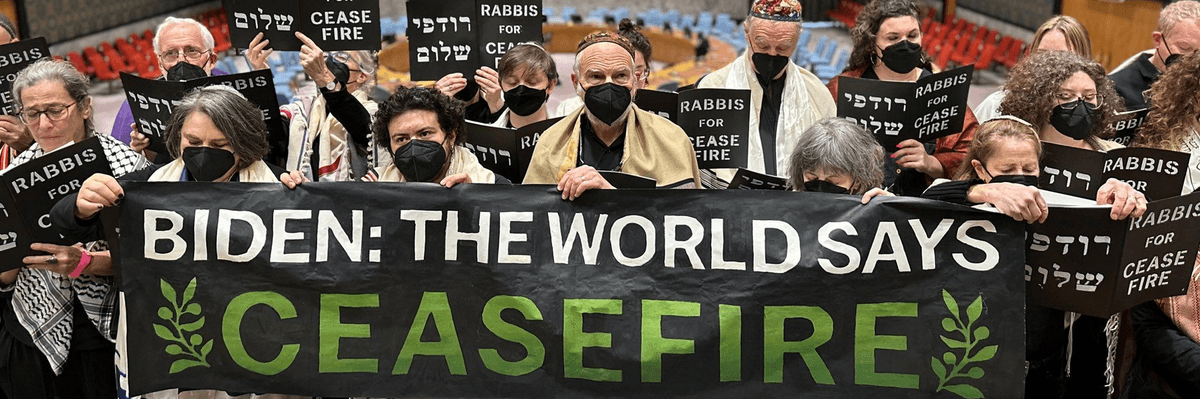
Rabbis hold a peace action at the United Nations Security Council in New York on January 9, 2024. (Photo: Jews for Racial & Economic Justice)
“The U.N. was created in the aftermath of World War II and the Holocaust, with the very intention of ensuring ‘Never Again,'” said Rabbis for Ceasefire. “We are here as Jews, as rabbis, to urge the U.N. to follow through.”
After arriving at the United Nations headquarters on Tuesday, ostensibly for a scheduled tour, three dozen rabbis and rabbinical students made their way into the U.N. Security Council’s chamber to stage the latest high-profile demonstration demanding the United States end its opposition to a cease-fire in Gaza.
The rabbis—whose action was organized by Rabbis for Cease-fire, Jews for Racial and Economic Justice, Jewish Voice for Peace, and IfNotNow—displayed banners with messages for U.S. President Joe Biden: “Biden: The World Says Cease-Fire,” and “Biden: Stop Vetoing Peace.”
The protest came weeks after the U.S. alone vetoed a U.N. Security Council resolution calling for Israel to end its bombardment of Gaza, which has killed at least 23,210 people, injured more than 59,100, and left thousands more missing and feared dead under rubble, as the population of the enclave faces starvation and disease stemming from Israel’s blockade.
“[President Joe] Biden and the U.S. must stop vetoing peace and end Israel’s bombing and starvation of Gaza,” said IfNotNow.
WOW. 36 rabbis led by @rodfeishalom just held a prayerful sit-in at the @UN Security Council to remind President Biden that the whole world demands a permanent #CeasefireNOW.
In addition to vetoing the Security Council measure last month, the U.S. abstained from voting on a resolution to increase humanitarian aid to Gaza and opposed a U.N. General Assembly resolution calling for a cease-fire.
The country’s isolated stance was starkly illustrated by the latter vote, with 153 nations supporting the cease-fire, including longtime U.S. allies like Canada, France, and Spain backing the resolution, and only nine countries joining the United States.
“Since the Biden administration is consistently, single-handedly blocking the U.N. from taking any meaningful action for a cease-fire, we are organizing 36 rabbis and rabbinical students from seven different states to come to the U.N. themselves, and say, ‘We’re speaking for the people, this is a moral call,'” Sophie Ellman-Golan, communications director for Jews for Racial and Economic Justice, told HuffPost.
Organizers said at a press conference after the protesters were escorted out of the building that six of the rabbis had gained access to the U.N. General Assembly floor, where they displayed one of the banners to the assembled leaders.
Members of Rabbis for Ceasefire brought our message to the @UN General Assembly to tell the U.S. to stop vetoing peace. Ceasefire now! pic.twitter.com/No21j1CeSL
HuffPost reported that one of the rabbis signaled the beginning of the protest during the tour by blowing into a traditional shofar horn, while Rabbis for Cease-fire founder and lead organizer Alissa Wise quoted the biblical Book of Isaiah.
“They shall beat their swords into plowshares, and their spears into pruning hooks,” said Wise. “Nation shall not lift up swords against nation. Neither shall they learn war anymore.”
Video from inside the U.N. Security Council Chamber this morning shows the beginning of a Rabbis for Ceasefire protest calling on the U.S. & int'l community to stop the Israeli military operation in Gaza. The men in suits are surprised U.N. tour guides. pic.twitter.com/egZyKsxuXs
The groups called on the U.S. and all U.N. members to:
Reaffirm and recommit to the goals of the United Nations Charter and the Universal Declaration of Human Rights, taking meaningful action to stop the slaughter of Palestinians in Gaza;
Hold another Security Council vote to pass a resolution for cease-fire that includes lifting the siege and hostage exchange; and
Bring to the General Assembly a resolution calling for appropriate accountability measures in line with international law, including an immediate arms embargo.
“The U.N. was created in the aftermath of World War II and the Holocaust, with the very intention of ensuring ‘Never Again,'” said Rabbis for Cease-fire. “We are here as Jews, as rabbis, to urge the U.N. to follow through on this noble mission. Never again means never again for any of us.”
5/5 @UN General Assembly already voted with an overwhelming majority for Ceasefire. But the @USUN is thwarting the efforts of the Security Council to take meantingful action for a ceasefire. The US is standing in the way of the international community taking action to save lives.
An organizer said as the rabbis assembled that “the U.N. is the appropriate place for meaningful action for cease-fire and accountability for Israel’s war crimes.”
The demonstration came two days before the International Court of Justice, the U.N.’s top judicial body, is set to hold a hearing on South Africa’s lawsuit claiming Israel has committed acts of genocide in Gaza. Turkey, Malaysia, and the Organization of Islamic Cooperation have all expressed support for South Africa’s claim, while Jordan indicated last week it had filed documents to submit a Declaration of Intervention at the court, backing the lawsuit.
More than 900 worldwide civil society groups have joined a call for other governments to submit Declarations of Intervention to bolster South Africa’s case.
The Biden administration said Tuesday that South Africa’s case is “meritless,” despite the country’s detailed, 84-page complaint highlighting specific calls from Israeli officials to wipe out the population of Gaza and force them to leave the enclave.
“The U.S.,” said Rabbis for Cease-fire, “is standing in the way of the international community taking action to save lives.”
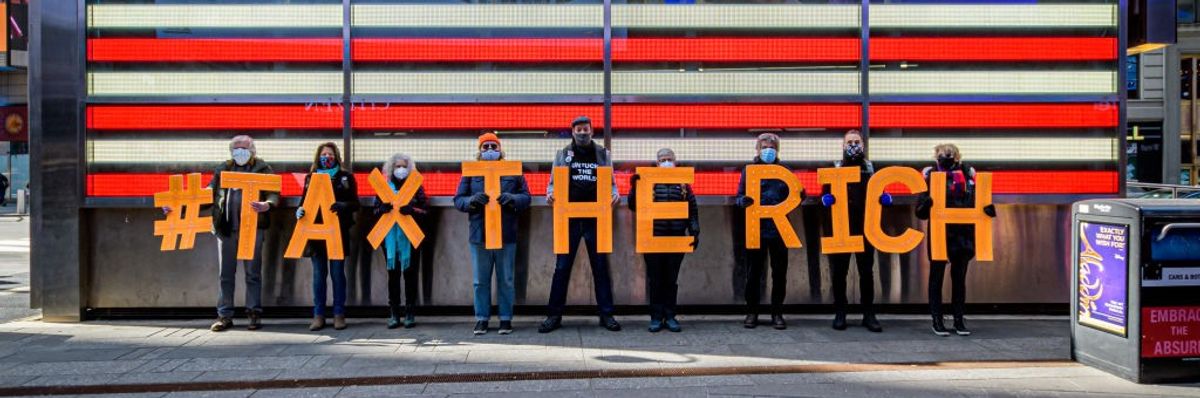
Protesters are pictured spelling out #TaxTheRich at Times Square on March 4, 2021. (Photo: Erik McGregor/LightRocket via Getty Images)
“Almost nobody says we should have the richest pay the least. And yet when we look around the country, the vast majority of states have tax systems that do just that.”
Nearly every state and local tax system in the U.S. is fueling the nation’s inequality crisis by forcing lower- and middle-class families to contribute a larger share of their incomes than their rich counterparts, according to a new study published Tuesday.
Titled Who Pays?, the analysis by the Institute on Taxation and Economic Policy (ITEP) examines in detail the tax systems of all 50 U.S. states, including the rates paid by different income segments.
In 41 states, ITEP found, the richest 1% are taxed at a lower rate than any other income group. Forty-six states tax the top 1% at a lower rate than middle-income families.
“When you ask people what they think a fair tax code looks like, almost nobody says we should have the richest pay the least,” said ITEP research director Carl Davis. “And yet when we look around the country, the vast majority of states have tax systems that do just that.”
“There’s an alarming gap here between what the public wants and what state lawmakers have delivered,” Davis added.
On average, the lowest-income 20% of taxpayers face a state and local tax rate nearly 60% higher than the top 1% of households.
In recent years, dozens of states across the U.S. have launched what the Center on Budget and Policy Priorities recently called a “tax-cutting spree,” permanently slashing tax rates for corporations and the wealthy during a pandemic that saw billionaire wealth skyrocket and company profits soar.
A report released last week, as Common Dreamsreported, showed ultra-rich Americans are currently sitting on $8.5 trillion in untaxed assets.
According to ITEP’s new study, tax systems in just six states—California, Maine, Minnesota, New Jersey, New York, and Vermont—and the District of Columbia are progressive, helping to reduce the chasm between rich taxpayers and other residents.
Massachusetts, which has one of the more equitable tax systems in the nation, collected $1.5 billion in revenue last year thanks to its recently enacted millionaires tax, a measure that improved the state’s ranking by 10 spots in ITEP’s Tax Inequality Index. Minnesota has also ramped up its taxes on the rich over the past several years while expanding benefits for lower-income families, ITEP’s study observes.
“The regressive state tax laws we see today are a policy choice, and it’s clear there are better choices available to lawmakers.”
But the full picture of U.S. state and local systems is grim. In 44 states, tax laws “worsen income inequality by making incomes more unequal after collecting state and local taxes,” ITEP found.
Florida has the most regressive tax code in the U.S., with the richest 1% paying a mere 2.7% tax rate while the poorest 20% pay 13.2%.
Florida is among the U.S. states that don’t have personal income taxes, which forces them to rely on consumption and property taxes that are “nearly always regressive,” ITEP notes in the new analysis.
“Eight of the 10 most regressive tax systems—Florida, Washington, Tennessee, Nevada, South Dakota, Texas, Arkansas, and Louisiana—rely heavily on regressive sales and excise taxes,” the study says. “As a group, these eight states derive 52% of their tax revenue from these taxes, compared to the national average of 34%.”
Aidan Davis, ITEP’s state policy director, said that “we’ve seen a lot of states shift their tax systems to become even more regressive in recent years by enacting deep tax cuts for the wealthiest.”
The report points to Kentucky’s adoption of a flat tax and repeated corporate tax cuts, which “delivered the largest windfall to families in the upper part of the income scale and have been paid for in part through new or higher sales and excise taxes on a long list of items such as car repairs, parking, moving services, bowling, gym memberships, tobacco, vaping, pet care, and ride-share rides.”
Davis said that “we know it doesn’t have to be like this,” arguing there is a “clear path forward for flipping upside-down tax systems and we’ve seen a handful of states come pretty close to pulling it off.”
“The regressive state tax laws we see today are a policy choice,” said Davis, “and it’s clear there are better choices available to lawmakers.”