James Hansen says limit will be passed ‘for all practical purposes’ by May though other experts predict that will happen in 2030s
The internationally agreed threshold to prevent the Earth from spiraling into a new superheated era will be “passed for all practical purposes” during 2024, the man known as the godfather of climate science has warned.
James Hansen, the former Nasa scientist credited for alerting the world to the dangers of climate change in the 1980s, said that global heating caused by the burning of fossil fuels, amplified by the naturally reoccurring El Niño climatic event, will by May push temperatures to as much as 1.7C (3F) above the average experienced before industrialization.
This temperature high, measured over the 12-month period to May, will not by itself break the commitment made by the world’s governments to limit global heating to 1.5C (2.7F) above the time before the dominance of coal, oil and gas. Scientists say the 1.5C ceiling cannot be considered breached until a string of several years exceed this limit, with this moment considered most likely to happen at some point in the 2030s.
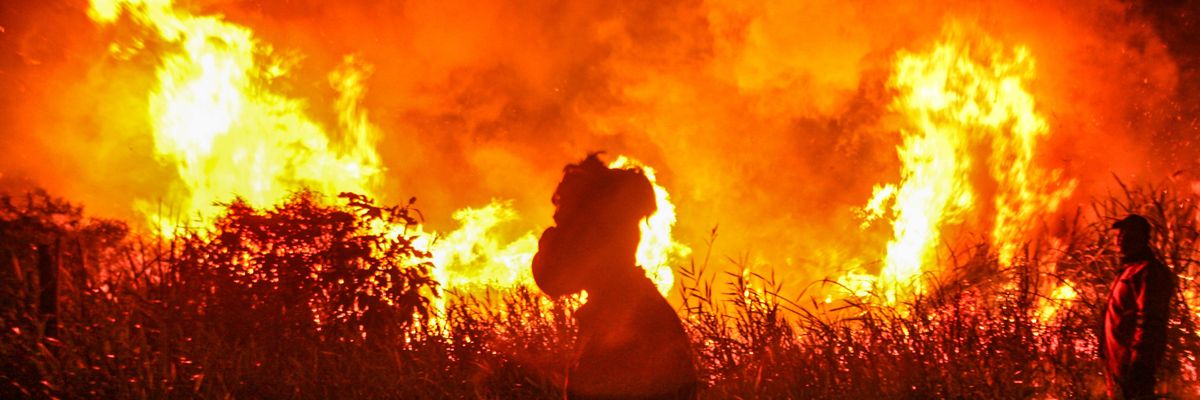
Indonesian firefighters work to extinguish a wildfire in Ogan Ilir, Indonesia on September 14, 2023. (Photo: Muhammad A.F/Anadolu Agency via Getty Images)
“How many more records does it take before we phase out fossil fuels and deal with it?” asked one climate campaigner.
European scientists officially confirmed Tuesday that 2023 was the hottest year on record, surpassing 2016 by a huge margin as greenhouse gas emissions from fossil fuels continue to drive global temperatures to terrifying new highs.
The conclusion from the European Union’s Copernicus Climate Change Service was hardly unexpected given the unparalleled heatwaves that gripped large swaths of the planet last year, ushering in what the head of the United Nations called “the era of global boiling.”
Last year’s global average temperature was 14.98°C, 0.17°C warmer than 2016, 0.60°C warmer than the 1991-2020 average, and 1.48°C warmer than the 1850-1900 pre-industrial level, according to Copernicus.
“2023 was an exceptional year with climate records tumbling like dominoes,” said Copernicus deputy director Samantha Burgess. “Not only is 2023 the warmest year on record, it is also the first year with all days over 1°C warmer than the pre-industrial period. Temperatures during 2023 likely exceed those of any period in at least the last 100,000 years.”
🚨 Last year was the hottest in our recorded observations.
We know why this is happening. In fact, we've known for decades. We also know that the impacts to people & ecosystems around the world will continue to worsen if the warming continues.
Liz Bentley, chief executive of the U.K.’s Royal Meteorological Society told CNN on Tuesday that after last year’s record-shattering summer, scientists predicted that global warming would reach around 1.3°C above pre-industrial levels.
That projection, Bentley said, has been “annihilated” by the new Copernicus data, which shows that planetary warming is perilously close to the Paris accord’s 1.5°C target.
“If you look at climate projections, when we expect to see temperature changes of close to 1.5°C, indeed it has come sooner than many would have expected,” Bentley added. “We’ve definitely seen an acceleration towards that, rather than it being a kind of linear progression. It feels like it’s rising much more exponentially.”
Scientists expect 2024 to be even hotter than last year, raising the stakes for badly lagging global efforts to rein in planet-warming fossil fuel production, which in 2023 hit record levels in the United States—the largest historical contributor to greenhouse gas emissions.
“How many more records does it take before we phase out fossil fuels and deal with it?” asked climate campaigner Mike Hudema.
Copernicus director Carlo Buontempo said in a statement Tuesday that “the extremes we have observed over the last few months provide a dramatic testimony of how far we now are from the climate in which our civilization developed.”
“This has profound consequences for the Paris Agreement and all human endeavors,” said Buontempo. “If we want to successfully manage our climate risk portfolio, we need to urgently decarbonize our economy whilst using climate data and knowledge to prepare for the future.”
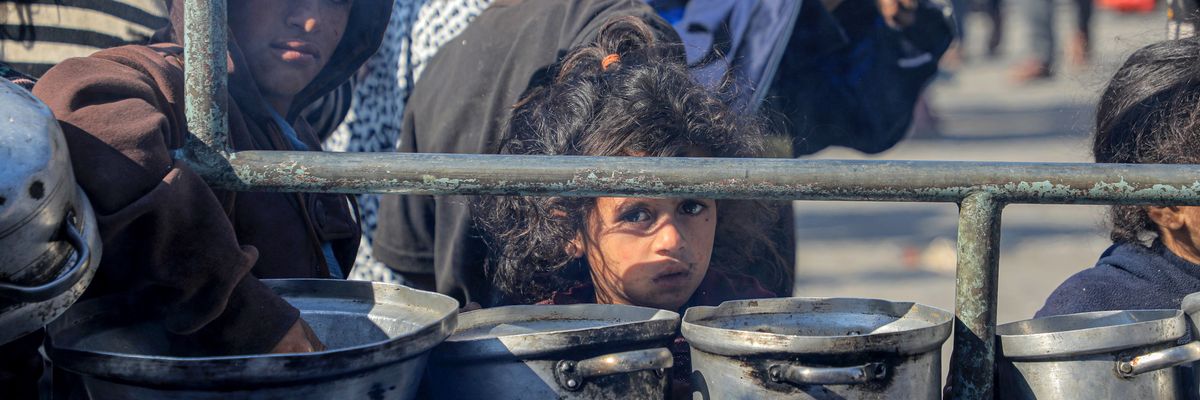
Children wait for food relief in the southern Gaza Strip city of Rafah on December 31, 2023. (Photo: Rizek Abdeljawad/Xinhua via Getty Images)
“If current conditions persist,” said Israeli group B’Tselem, “there is significant risk that famine will be declared throughout the entire Gaza Strip within six months.”
The Israeli government “can, if it chooses to,” save more than 2 million people who are starving in Gaza by ending its blockade on aid, an Israel-based human rights group emphasized in a report on Monday, condemning the country for continuing to allow just a fraction of the food needed in the enclave through border crossings as it relentlessly bombs civilian targets.
“Everyone in Gaza is going hungry,” said B’Tselem in the dispatch, bluntly titled, “Israel Is Starving Gaza.”
The organization pointed to a recent analysis by the Integrated Food Security Phase Classification Famine Review Committee from late last month, which found that about 93% of Gaza’s over 2 million people were suffering from “acute food insecurity” at Phase 3, while more than 15%—378,000 people—were already at the most dire classification, Phase 5, with “extreme food shortages, hunger, and exhaustion.”
By February 7, the entire population of Gaza is expected to reach Phase 3, and “if current conditions persist,” said B’Tselem, “there is significant risk that famine will be declared throughout the entire Gaza Strip within six months.”
“Such a declaration is made when 20% of households read Phase 5, when 30% of children suffer from extreme malnutrition, and when two adults or four children out of 10,000 die of hunger every day,” said the group.
Before Israel began its U.S.-backed bombardment of Gaza in retaliation for Hamas’ October 7 attack, about 80% of Gaza residents relied on humanitarian aid to survive.
Israel’s destruction of cultivated fields, bakeries, food warehouses, and factories has meant that residents now wholly depend on food supplies from outside Gaza.
That aid is still available, B’Tselem stressed, but cannot reach people because “Israel is deliberately denying the entry of enough food to meet the population’s needs.”
About 500 aid trucks entered Gaza daily before the assault began, but only about 120 trucks are allowed through just two crossings—Rafah and Kerem Shalom—on a daily basis.
The Rafah crossing is a designed for passenger vehicles rather than “massive commercial transports,” and the recent opening of the Kerem Shalom crossing was “merely a token addition that has failed to alleviate the hardship,” said B’Tselem.
“The little food that does get in is very difficult to distribute due to constant bombings, destroyed roads, frequent communications blackouts, and shelters overflowing with hundreds of thousands of [internally displaced people] crowding into smaller and smaller areas,” said the group.
Israel’s continued blockade has resulted in “children begging for food, people waiting in long lines for paltry handouts, and hungry residents charging at aid trucks,” B’Tselem added. “The horror is growing by the minute, and the danger of famine is real.”
With meaningful, unhindered & unconditional humanitarian assistance + commercial flow, the looming famine can still be reversed & prevented. https://t.co/en8VMW1117
Martin Griffiths, undersecretary-general for humanitarian affairs and emergency relief coordinator at the United Nations, said late last week that Israel’s air and ground assault on Gaza has rendered the enclave “uninhabitable.”
“A public health disaster is unfolding,” said Griffiths. “Infectious diseases are spreading in overcrowded shelters as sewers spill over. Some 180 Palestinian women are giving birth daily amidst this chaos. People are facing the highest levels of food insecurity ever recorded. Famine is around the corner.”
“For children in particular, the past 12 weeks have been traumatic: No food. No water. No school,” he added. “Nothing but the terrifying sounds of war, day in and day out.”
Last month, Human Rights Watch accused Israel of using starvation as a “method of warfare”—a war crime according to international humanitarian law.
“Changing this policy is not just a moral obligation,” said B’Tselem. “Allowing food into the Gaza Strip is not an act of kindness but a positive obligation under international humanitarian law: Starvation as a method of warfare is prohibited, and when a civilian population lacks what it needs to survive, parties to the conflict have a positive obligation to allow rapid and unimpeded passage of humanitarian aid—including food.”
“These two rules are considered customary law,” added the group, “and violating them constitutes a war crime under the Rome Statute of the International Criminal Court.”
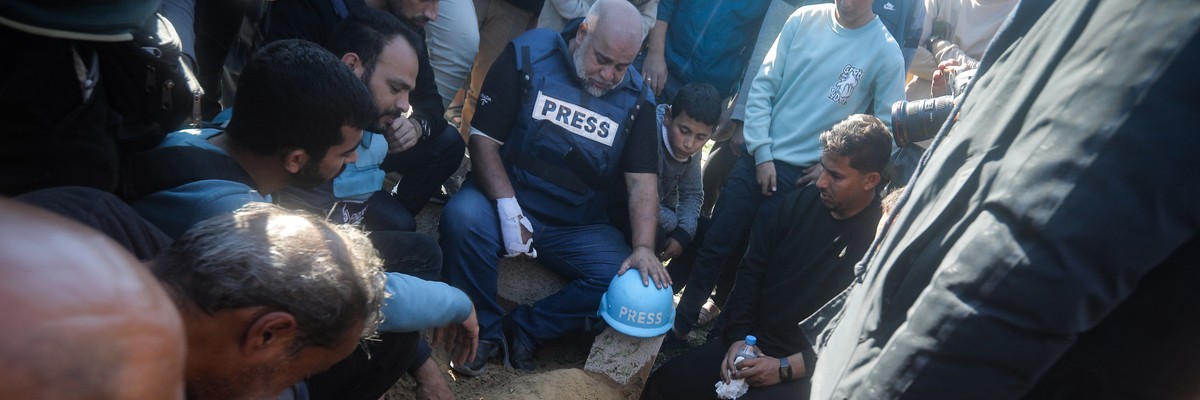
A press helmet is placed over the grave of Hamza Dahdouh, a Palestinian journalist who worked for Al Jazeera and was killed in an Israeli airstrike on Rafah on January 7, 2024. (Photo: Mohammed Talatene/picture alliance via Getty Images)
The international community must “hold Israel accountable for its heinous crimes,” said the Al Jazeera Media Network.
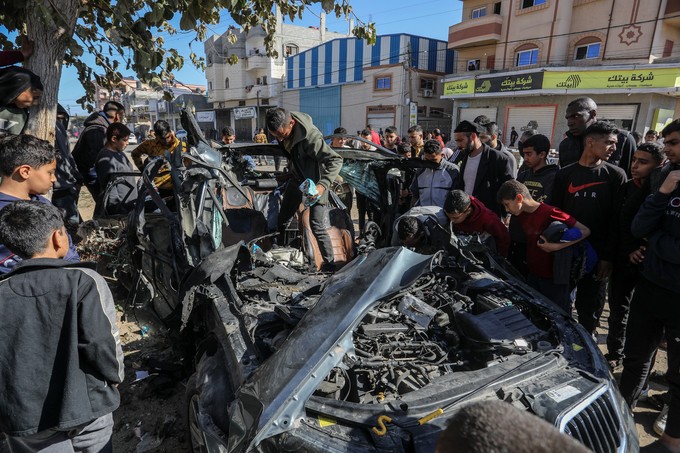
An Israeli airstrike in the southern Gaza city of Rafah on Sunday killed two Palestinian journalists and seriously wounded a third, adding to the war’s grisly toll on media workers.
The Al Jazeera Media Network said in a statement that the Israeli military targeted the journalists’ car as they were driving through the northern part of Rafah. The strike killed Hamza Dahdouh, the 27-year-old son of Al Jazeera‘s Gaza bureau chief, and Mustafa Thuraya, a freelance videographer working with Agence France-Presse. Hazem Rajab was injured in the Israeli strike.
“The assassination of Mustafa and Hamza, Al Jazeera correspondent Wael Dahdouh’s son, whilst they were on their way to carry out their duty in the Gaza Strip reaffirms the need to take immediate necessary legal measures against the occupation forces to ensure that there is no impunity,” the network said, imploring the international community to “hold Israel accountable for its heinous crimes.”
Hamza is the fifth member of Wael Dahdouh’s family killed in Israel’s assault on the Gaza Strip. Earlier in the war, Israeli strikes killed Dahdouh’s wife, younger son, daughter, and grandson. Wael himself was wounded by an Israeli drone strike that killed Al Jazeera journalist Samer Abu Daqqa.
“Hamza was everything to me, the eldest boy, he was the soul of my soul,” Wael said in anguished remarks from the cemetery where his son was buried. “These are the tears of parting and loss, the tears of humanity.”
“Hamza was not part of me. He was all of me.”
Al Jazeera’s Wael al-Dahdouh says goodbye to one more family member, his son Hamza, 'just like droves of people here do every day, every hour and every second.'
Christophe Deloire, secretary-general of Reporters Without Borders, expressed “shock” in response to news of Dahdouh and Thuraya’s killing.
“This unbearable massacre must stop,” Deloire wrote on social media. “Israel must be held accountable for this eradication of journalism in Gaza. We will continue to refer to the International Criminal Court so that maximum priority is given to crimes against journalists. Justice must be served.”
(Photo: Abed Rahim Khatib/Anadolu via Getty Images)
Since October 7, Israeli forces have killed dozens of media workers in the Gaza Strip, where around 1,000 journalists were working before the assault. According to the Committee to Protect Journalists (CPJ), more journalists were killed in the first 10 weeks of the war “than have ever been killed in a single country over an entire year.”
“CPJ is particularly concerned about an apparent pattern of targeting journalists and their families by the Israeli military,” the group said last month. An investigation by Reporters Without Borders concluded that Reuters video journalist Issam Abdallah and his colleagues were deliberately targeted in October 13 strikes in southern Lebanon.
Reporters Without Borders has filed two war crimes complaints with the International Criminal Court since early October. The second complaint, submitted last month, accuses the Israel Defense Forces of intentionally killing seven Palestinian journalists.
“Targeting reporters is a war crime,” the group wrote in a social media post on Sunday.
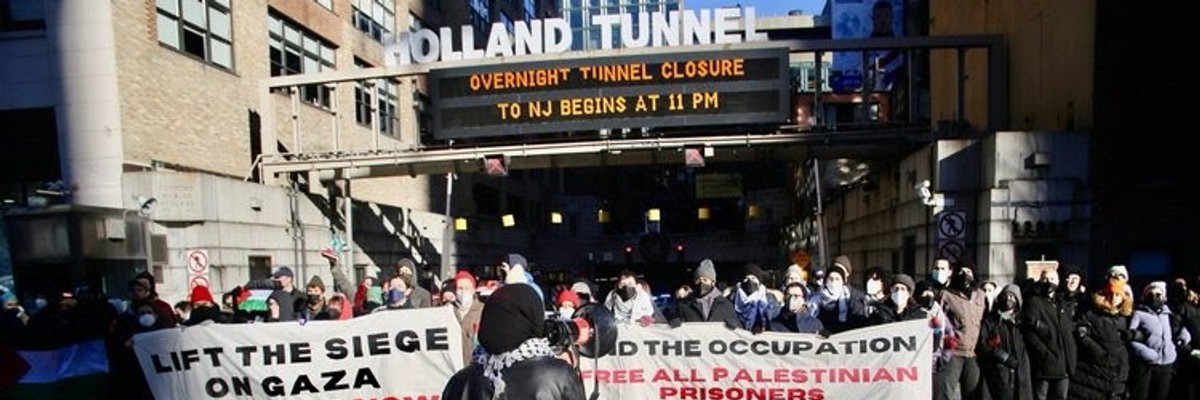
Protesters block the Holland Tunnel on Monday, January 8, in New York City to call for a cease-fire in Gaza. (Photo credit: Alexa Wilkinson)
“We are trying to show how it feels to be trapped in a city you can’t leave,” one participant said.
Protesters blocked the Holland Tunnel and three major New York City bridges during Monday’s rush hour to call for a cease-fire in Gaza as Israel’s deadly assault on the besieged enclave enters its fourth month.
Organizers said that they chose to block traffic in order to create a “physical analogue” to the experience of people in Gaza, “where there is no getting out.”
“We are trying to show how it feels to be trapped in a city you can’t leave,” 30-year-old participant Mon Mohapatra told The New York Times.
“We salute the brave individuals and organizations who across the country and the world are taking action to disrupt the flow of capital, by blocking ports and traffic arteries.”
Organizers said in a statement that a thousand people blocked traffic Monday morning for more than two hours at the Holland Tunnel and Manhattan, Brooklyn, and Williamsburg bridges. The action was coordinated by a coalition of groups including the Palestinian Youth Movement (PYM), Al-Awda: The Palestine Right to Return Coalition, Samidoun Palestinian Prisoner Solidarity Network, Democratic Socialists of America (DSA), Jewish Voice for Peace (JVP), the Party for Socialism and Liberation (PSL), Critical Resistance, and Writers Against the War on Gaza (WAWOG).
The action at the Holland Tunnel began around 9:30 am ET, the Port Authority Police Department toldCBS News. The department arrested 120 people for blocking the outbound lane. The New York Police Department’s chief of patrol toldWABC that 325 people were arrested across all four locations.
The organizers said that their actions snarled traffic in SoHo, Tribeca, Hudson Square, the Financial District, and the Lower East Side. Traffic began moving again around the Holland Tunnel by 10:30 am, over the Brooklyn Bridge a little before 11:00 am, and over the Williamsburg and Manhattan bridges a little before 11:30 am, WABC reported.
Brooklyn Bridge, Manhattan Bridge, Holland Tunnel, and Williamsburg Bridge were all SHUT DOWN by a coalition of organizers, bringing New York City traffic to a halt.
The People demand a ceasefire now, an end to US “aid” to Israel, and an immediate lifting of the siege on Gaza! pic.twitter.com/0ksv3nE57x
— Palestinian Youth Movement (@palyouthmvmt) January 8, 2024
“In Gaza, of course, people have limited mobility, no freedom of movement, they cannot leave, even if they want to, they move place to place, then those places are bombed,” Rachel Himes, who was arrested at the Holland Tunnel, told The New York Times. “We wanted to create that condition temporarily in Manhattan.”
The action was planned to coincide with the start of the fourth month of Israel’s attack on Gaza, which has killed more than 23,000 people and injured nearly 59,000 since October 7, according to Monday figures from the Gaza Health Ministry.
Demonstrators at all four Manhattan locations dropped banners listing the five demands of the Palestinian Youth Movement:
An immediate cease-fire;
An end to the siege on Gaza;
The release of all Palestinian prisoners;
An end to the occupation of Palestine; and
An end to U.S. aid to Israel.
Ceasefire is the beginning. These are our demands, as set forth by the @palyouthmvmt. Lift the siege. Free all the Palestinian prisoners. End the occupation. NOW!!! pic.twitter.com/bWyLe2Vg1u
— Writers Against the War on Gaza (@wawog_now) January 8, 2024
Demonstrators at the Williamsburg and Manhattan bridges used piping and chains to bolster their blockades, which police had to saw through to clear the protesters, according to The New York Times and CBS. Police “violently assaulted” one participant at the Williamsburg Bridge, according to a video shared by WAWOG on social media.
Cops violently assaulted a pro-Palestine protester at the blockade of the Williamsburg Bridge earlier today. This is what we mean when we say NYPD, KKK, IDF: THEY’RE ALL THE SAME!
— Writers Against the War on Gaza (@wawog_now) January 8, 2024
Monday’s protest builds on months of direct actions both in New York and across the country as protesters have blocked traffic, sat in at train stations, disrupted political events, and blocked ports to call on President Joe Biden to end U.S. support for Israel’s bombardment and invasion of Gaza.
On Saturday, a group of protesters blocked traffic on Seattle’s I-5 highway for more than four hours.
“These direct actions that we are seeing now are tools of protest that intend to disrupt the flow of capital and hit the political and economic elites where it hurts, in order to force an end to the ongoing genocide of Palestinians and siege on Gaza,” Bissan Barghouti of Samidoun Seattle, who helped organize a rally in solidarity with the highway blockade, told Common Dreams. “As Palestinians and those in solidarity with our struggle, we condemn the government and corporate complicity in the massacre of our loved ones in Gaza and across occupied Palestine.”
Barghouti added, “We salute the brave individuals and organizations who across the country and the world are taking action to disrupt the flow of capital, by blocking ports and traffic arteries.”
In addition to more recent protests, Monday’s New York action took its inspiration from a 1995 ACT UP protest that was the first to block two bridges and two tunnels in New York at the same time.
“We urge other coalitions, collectives, and autonomous organizations to take meaningful action against the genocidal state, its collaborators, its benefactors, and profiteers,” the group behind Monday’s New York protest said in a statement. “Protests and demonstrations across the so-called U.S. must escalate in their willingness to shut down business as usual and arrest the flow of capital in order to end this occupation once and for all. Our skills and goals must be aligned towards an immediate and permanent cease-fire, the end of Zionism, and a free Palestine in our lifetimes.”