Scientists Condemn Last Minute Push to Overturn EU Nature Law

Spread the love

Original article by Clare Carlile republished from DeSmog.

The Melitaea trivia butterfly, one of many endangered species in the EU. The nature restoration law offers a lifeline for natural habitats in the bloc where one in three bees, butterflies and hoverflies are disappearing.

At the eleventh hour, right-wing politicians have launched a bid to block the passing of the EU’s flagship nature protection law, which scientists have described as a “cornerstone of food security and human health”. 

The pro-nature plan, which could see as much as 90 percent of damaged ecosystems repaired across the bloc, is due for final sign off in Parliament on Tuesday (27 February).

Usually a formality, the vote follows six months of intense – and at times bitter – negotiation of the law between the European Commission, Parliament and EU member states that saw an agreement reached in November last year.

But on Wednesday the right-wing European Conservatives and Reformists (ECR) party filed amendments calling for Members of the European Parliament (MEPs) to reject outright the so-called Nature Restoration Law – an extremely rare move so late in the decision-making process.

Scientists have condemned the call, as well as six other amendments that could see the law delayed or weakened. They say the proposed policy offers a lifeline for natural habitats in the bloc where one in three bees, butterflies and hoverflies are disappearing.

“In Europe we are in a critical biodiversity situation, which climate change is accelerating,” Daniel Hering, professor of aquatic ecology at the University of Duisburg-Essen, told DeSmog. “Without such an ambitious legislation, it will not be possible to bend the curve of declining biodiversity.”  

A number of proposed green laws have been rolled back or delayed over the last 12 months, as opposition mounts to the EU’s Green Deal – a flagship plan to reach net zero by 2030.

The eurosceptic ECR party has justified its last-minute attempt to block the law citing “great social unrest”, in apparent reference to farmer protests that have spread across the continent in recent weeks, with tractors blocking roads and motorways in the majority of EU countries.

But scientists told DeSmog that derailing the law could come at significant cost to farmers, who are facing increasingly uncertain conditions due to climate breakdown and biodiversity loss.

The former EU climate chief Frans Timmerman has stated that “already half of crops in the EU that depend on pollination face a deficit.”

If any of the ECR’s amendments – such as deleting a target to restore 30 percent of Europe’s damaged ecosystems by 2030 – are accepted, a final decision on the law would be delayed until after the EU elections in June when right-wing parties are expected to make major gains.

It is so far unclear whether the proposals will succeed in gaining a majority in the vote next week. But the choice made by the centre-right European Peoples’ Party (EPP) – the largest in the EU parliament – will be a deciding factor. 

The EPP’s Christine Schnieder, chief negotiator on the nature law, told DeSmog that her party had “serious concerns” and would “determine its voting behaviour for the vote on Tuesday at the Group meeting on Monday evening”.

Misinformation’

The law has long been portrayed as a burden to the farming industry. The EPP has repeatedly attempted to block the legislation following intense lobbying by farm union Copa-Cogeca, which represents producers and agribusinesses across the bloc. It succeeded in deleting the most ambitious agriculture clauses from the law, including targets to re-wild 10 percent of farmland.

However, scientists told DeSmog that jettisoning the legislation would cause major harms to the industry – a stance backed up by some small scale producers who are calling for more environmental support. 

“Our food systems are at extreme risk. Looking outside and seeing the current temperatures, we can see that the coming summer will be even worse than the last one,” said Guy Pe’er, an ecologist at the German Centre for Integrative Biodiversity Research and the Helmholtz Centre for Environmental Research. “Farmers will soon need help maintaining production under very difficult conditions. The Nature Restoration law is a crucial part of this package.”

Pe’er also told DeSmog he was concerned Tuesday’s outcome could be “based on misinformation”. He was one of more than 6,000 scientists to sign an open letter in July, warning of a “lack of scientific evidence” for arguments opposing the law, including suggestions that it would harm EU food security and take away farming jobs across the continent.

Christine Schneider of the EPP told DeSmog that the EPP remained concerned that the law would lead to onerous regulations in member states with “far-reaching monitoring and reporting obligations for agriculture and forestry”. 

‘Election Strategy’

If parliament supports any amendments on 27 February, negotiations on the Nature Restoration Law will extend beyond EU elections, which are due to take place between 6-9 June later this year.

Polls are currently suggesting a major ballot swing towards right-wing parties, which have  pledged to use election success to fight the Green Deal. 

In France, Marine Le Pen’s far-right party National Rally is expected to claim more than 30 percent of the country’s vote. It said in January it planned to form a “blocking majority” with other parties that target environmental laws. 

The EPP, which is likely to retain the largest number of seats in the EU parliament, has likewise opposed multiple environmental regulations in the run-up to the elections in recent months, including overturning plans to halve pesticide use.

The ECR is so far not expected to gain many seats in the coming election. 

Environmental activist Chloé Miko told DeSmog that if the law was voted down on Tuesday it would be “the final nail in the coffin for the Green Deal” – which has been seen as the lead policy package for the current Commission. 

She added that the ECR was deploying a cynical “election strategy”, by linking its opposition to the law to farmer protests across the continent. 

“It is not a sign of goodwill towards farmers,” she said. “The far-right, sometimes with the help of the Conservatives, have been on a journey to weaken, delay or even kill every remaining part of the Green deal. It is part of this process.”

Jutta Paulus, the Greens’ negotiator on the law in Parliament, told DeSmog: “The ECR’s attempt to stop the legislative procedure is typical for this euro-sceptic group,” adding that the EPP’s concerns about the law had already been addressed during trialogue negotiations between parliament, the commission and the council over recent months. 

“I expect the constructive, pro-European parties to take a firm position and vote in favour of the trilogue agreement,” she said.

ECR did not respond to Desmog’s request for comment.

Original article by Clare Carlile republished from DeSmog.
Continue ReadingScientists Condemn Last Minute Push to Overturn EU Nature Law

UNRWA Says Funding Cuts Have Pushed It to ‘Breaking Point’

Spread the love

Original article by JULIA CONLEY republished from Common Dreams under Creative Commons (CC BY-NC-ND 3.0).

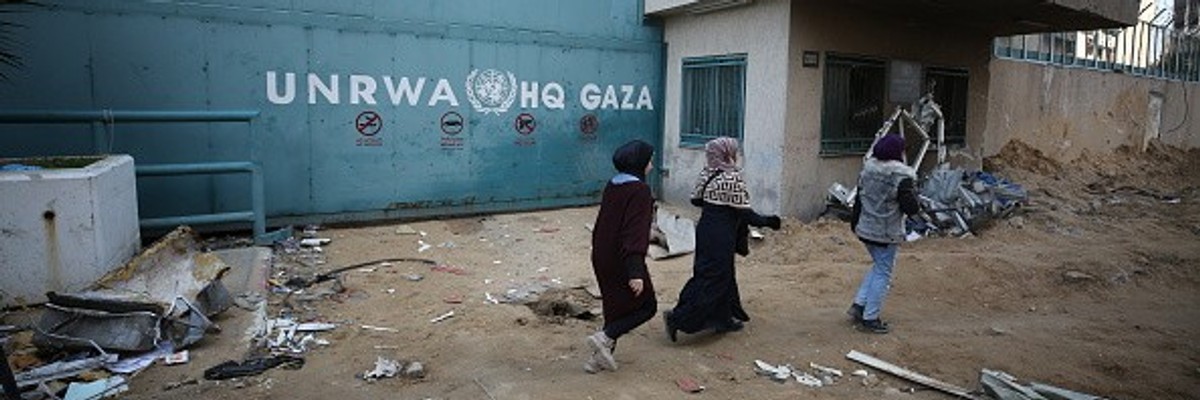
People walk past the headquarters of the United Nations Relief and Works Agency for Palestine Refugees in the Near East, which provides assistance to millions of Palestinians, in Gaza City, Gaza on February 21, 2024.  (Photo: Dawoud Abo Alkas/Anadolu via Getty Images)

The warning came as a U.S. intelligence officials said they have “low confidence” that Israel’s accusations against UNRWA workers were true.

Notifying the United Nations General Assembly of numerous steps Israel has taken in the last month to dismantle a humanitarian agency that serves millions of Palestinians, the U.N. Relief and Works Agency for Palestine Refugees in the Near East warned Thursday that it has reached a “breaking point” as it attempts to provide shelter and other aid amid Israel’s bombardment of Gaza with sharply reduced funding.

Since Israel claimed last month without providing evidence that 12 UNRWA staff members—out of 30,000 total—had been involved in a Hamas-led attack on southern Israel on October 7, 16 countries including the U.S., Germany, and Canada have suspended funding for the agency, which relies on donations to operate.

The funding cuts have gone into effect as UNRWA itself faces violence from the Israel Defense Forces (IDF), with 150 of the agency’s facilities having been hit by bombs or shelling that have killed more than 390 people and injured more than 1,300. Since October, the IDF has killed a total of at least 29,514 Palestinians in Gaza.

“It is with profound regret that I must now inform you that the agency has reached breaking point, with Israel’s repeated calls to dismantle UNRWA and the freezing of funding by donors at a time of unprecedented humanitarian needs in Gaza,” wrote Philippe Lazzarini, commissioner-general of UNRWA, in a letter to the president of UNGA.

Lazzarini warned that the agency’s ability to “fulfill the mandate given through General Assembly resolution 302,” the 1949 measure that created UNRWA and tasked it with providing aid to Palestinians in Gaza, “is now seriously threatened.”

UNRWA is a major employer of Palestinians in Gaza, where almost half of adults are unemployed. The agency runs schools for 300,000 children, provides housing assistance, runs health clinics, and oversees other public works such as playground and road construction.

Since Israel began its assault on Gaza in October, up to 1.9 million displaced Palestinians have found temporary housing at 154 UNRWA shelters, according to the agency.

Since Israel made its accusation against UNRWA, in addition to fueling a loss of $450 million in funding, the government has taken further steps to render it inoperable, despite Lazzarini’s immediate dismissal of the workers implicated in the allegations. Israeli officials have:

  • Taken steps to evict UNRWA from the headquarters it’s used for 75 years in East Jerusalem;
  • Limited visas for its staff to one or two months;
  • Announced a plan to revoke UNRWA’s tax-exempt status;
  • Suspended shipments of UNRWA goods;
  • Blocked the agency’s bank accounts;
  • Refused to grant hundreds of staffers access to UNRWA’s schools, health centers, and headquarters;
  • Tabled bills to eliminate the agency’s U.N. privileges and immunities and to prevent “any activity by UNRWA in Israeli territory”; and
  • Publicly accused UNRWA of being “in the service of Hamas.”

With UNRWA struggling to provide assistance to Gaza residents—about 85% of whom have been displaced and virtually all of whom are facing “crisis-level hunger“—Lazzarini warned UNGA President Dennis Francis that the agency is “on the edge of a monumental disaster with grave implications for regional peace, security, and human rights.”

“In the short term, dismantling UNRWA will undermine U.N. efforts to address Gaza’s humanitarian crisis and worsen the crisis in the West Bank, depriving over half a million children of education and deepening resentment and despair,” said Lazzarini. “In the longer-term, it will end UNRWA’s stabilizing role that is widely acknowledged, including by senior Israeli civilian and military officials and key donors, as vital to the rights and security of Palestinians and Israelis. It will also weaken prospects for a transition and a political solution to this long-standing conflict.”

Journalist Owen Jones noted on Friday that the “throttling” of Gaza’s primary humanitarian aid organization has taken place as Israel has failed to provide evidence of its claims against the UNRWA employees, with a U.S. intelligence assessment saying officials had “low confidence” that staff members had participated in the Hamas-led attack on October 7.

The assessment noted that Israeli officials have not “shared the raw intelligence behind” the accusations that led 16 countries to pull crucial funding from UNRWA—a fact that didn’t surprise Intercept journalist Ryan Grim.

“Why would Israel provide evidence?” said Grim. “Without any evidence, the U.S. suspended UNRWA funding and then [President Joe] Biden endorsed a new law permanently banning funding. Israel would be stupid to bother to present evidence, they know they don’t need to.”

In his letter to Francis, Lazzarini asked whether UNGA would allow “the parameters of peace for Palestinians and Israelis” to be “wiped away by obstructing UNRWA’s mandate and defunding the agency outside of any political agreement and consultation with Palestinians.”

“Should the General Assembly opt to continue to sustain UNRWA in the best interests of Palestine refugees, then I further appeal for a solution that closes the gap between UNRWA’s mandate and its funding structure, which relies upon voluntary contributions that make it vulnerable to wider political considerations, such as UNRWA faces now,” wrote Lazzarini.

“I finally appeal to the General Assembly to bring human rights and international law back to the center of multilateral action,” he added, “beginning with the catastrophic situation in Gaza that has worsened by every measure in recent weeks.”

Original article by JULIA CONLEY republished from Common Dreams under Creative Commons (CC BY-NC-ND 3.0).

Continue ReadingUNRWA Says Funding Cuts Have Pushed It to ‘Breaking Point’

Lawsuit Accuses German Leaders of Complicity in Gaza Genocide

Spread the love

Original article by BRETT WILKINS republished from Common Dreams under Creative Commons (CC BY-NC-ND 3.0). 

German Chancellor Olaf Scholz (L) shakes hands with Israeli Prime Minister Benjamin Netanyahu (R) during an October 17, 2023 press conference in Tel Aviv. (Photo: Michael Kappeler/picture alliance via Getty Images)

“This lawsuit sends a clear message to German officials: You cannot continue to remain accomplices of such crime without consequences.”

Lawyers in Germany representing Palestinian families announced Friday that they are suing senior German officials, including Chancellor Olaf Scholz, for “aiding and abetting” Israel’s genocide in Gaza.

The criminal complaint, filed Thursday with federal prosecutors in Karlsruhe in the southwestern state of Baden-Württemberg, accuses Scholz, Foreign Minister Annalena Baerbock, Defense Minister Boris Pistorius, and Economy Minister Robert Habeck of “complicity in the genocide in Gaza” by approving the export of approximately $350 million worth of military aid to Israel.

The suit also lists the German government’s diplomatic support for Israel and its suspension of payments to the United Nations Relief and Works Agency for Palestine Refugees in the Near East—even as Israeli forces have killed and maimed over 100,000 Palestinians, forcibly displaced around 90% of the besieged strip’s 2.3 million people, obliterated the territory’s infrastructure, and pushed hundreds of thousands of Gazans to the brink of starvation.

“We Palestinians in the diaspora will not stand by and watch a genocide being committed against our families and our people.”

“Our governments in Europe have a legal obligation not to provide Israel any support in perpetrating the current genocide against the Palestinian people in Gaza. This has to stop and this is what we hope to achieve by going to court,” Nadija Samour, a Palestinian German lawyer who co-filed the suit, said Friday at a Berlin press conference.

“This lawsuit sends a clear message to German officials: You cannot continue to remain accomplices of such crime without consequences,” she added. “We want accountability.”

Last month, a provisional International Court of Justice ruling that found Israel is “plausibly” perpetrating genocide in Gaza and ordering the country’s government and military to “take all measures within its power” to prevent genocidal acts.

Noting that German law requires initial suspicion for such lawsuits to proceed, Samour said that the ICJ’s interim ruling “clearly showed that there is such ground for initial suspicion when it comes to the crime of genocide against the Palestinian people in Gaza.”

Germany staunchly opposes the South Africa-led ICJ case. Berlin’s stance has infuriated much of the Global South, including Namibia, which was colonized by Germans who perpetrated the 20th century’s first genocide in the African nation.

Namibian President Hage Geingob, who died earlier this month, said in January that “Germany cannot morally express commitment to the United Nations convention against genocide, including atonement for the genocide in Namibia, whilst supporting the equivalent of a holocaust and genocide in Gaza.”

Legal expertsgenocide scholarshuman rights campaignersworld leaders, and others have accused Israel of genocide in Gaza. Raz Segal, one of Israel’s leading Holocaust scholars, has repeatedly said his country is perpetrating a “textbook case of genocide” against the people of Gaza.

Nora Ragab, a Palestinian German migration scholar and plaintiff in the lawsuit whose uncle was killed in an Israeli airstrike on Gaza, said in a statement that “we Palestinians in the diaspora will not stand by and watch a genocide being committed against our families and our people.”

“We will use all means at our disposal… to hold the German government accountable for its complicity in the genocide in Gaza,” she added.

Advocacy groups supporting the German lawsuit include the European Legal Support Center (ELSC), the Palestine Institute for Public Diplomacy, and Law for Palestine.

Germany “is one of the countries that has shown some of the strongest political and material support to Israel in its assault on the Gaza Strip and the Palestinians, with many German officials also inciting to genocide in their statements,” ELSC said in a statement.

German arms export approvals to Israel soared last year, especially after the October 7 Hamas-led attacks. Reuters reported in November that 2023 military export authorizations through the first week of that month rose tenfold from 2022 levels, with the majority of export permits issued after October 7. German weapons and support sales to Israel totaled over $320 million last year.

Although that amount pales in comparison to the billions of dollars in annual armed aid and sales the United States provides to Israel, it does not affect the legality of such transfers. On Friday, a group of United Nations experts asserted that “any transfer of weapons or ammunition to Israel that would be used in Gaza is likely to violate international humanitarian law and must cease immediately.”

Earlier this month, a Dutch court blocked the proposed export of F-35 fighter jet parts to Israel, finding a “clear risk” that those parts would be used to commit war crimes.

Many observers contend that Germany’s actions are driven by historical guilt over the Holocaust. Numerous critics claim the German government is weaponizing that guilt in order to demonize Palestinians and their defenders.

“Since October 7, 2023, the Palestinian community in Germany, especially in Berlin, has been subjected to intense suppression of their protests, cultural symbols, voices, and narratives,” Ragab wrote last week. “This crackdown has significantly hindered their ability to publicly express grief and outrage against the state of Israel’s bombardment of Gaza.”

Ragab called bans or restrictions on pro-Palestine demonstrations—sometimes enforced through police violence—”notably severe.”

“By banning protests, the German state not only negates Palestinians their right to free expression and peaceful assembly, but also seeks to control the public narrative and visibility of Palestine and Palestinian life in Germany,” she wrote. “Although the intensity of this suppression escalated on October 7, it is part of a historical politics of erasure, diminishing, and eradicating the collective existence and identity of Palestinians in Germany, through repression, censorship, and discrimination.”

Dave Braneck, a freelance journalist in Berlin, called Germany’s stance on the Gaza genocide “truly repugnant.”

“You don’t need a Ph.D in Middle East studies to acknowledge that children in Gaza are human,” Braneck asserted. “Yet Germans fail to see the sickening irony of sanctioning the mass death of innocents and leveling of entire communities as a necessary act of atonement for the Holocaust.”

He added that “if Germany had real interest in learning lessons from its appalling history, it would recognize that categorizing entire nations of people as inhuman and unworthy of sympathy or safety must be made untenable—regardless of who it’s happening to.”

Original article by BRETT WILKINS republished from Common Dreams under Creative Commons (CC BY-NC-ND 3.0). 

Continue ReadingLawsuit Accuses German Leaders of Complicity in Gaza Genocide

Abandoned pipelines could release poisons into North Sea, scientists warn

Spread the love

https://www.theguardian.com/environment/2024/feb/24/abandoned-oil-gas-pipelines-poison-pollution-risk-north-sea-scientists

Large volumes of mercury, radioactive lead and polonium-210 could be released into the sea if pipelines are left to decay. Photograph: Jane Barlow/PA

Decaying oil and gas pipelines left to fall apart in the North Sea could release large volumes of poisons such as mercury, radioactive lead and polonium-210, notorious for its part in the poisoning of Russian defector Alexander Litvinenko, scientists are warning.

Mercury, an extremely toxic element, occurs naturally in oil and gas. It sticks to the inside of pipelines and builds up over time, being released into the sea when the pipeline corrodes.

Some methylmercury, the most toxic form of the metal, is released by the pipelines although other forms can be converted into it. The international Minamata convention on mercury states that high levels in dolphins, whales and seals can lead to “reproductive failure, behavioural changes and even death”. Seabirds and large predatory fish such as tuna and swordfish are also particularly vulnerable.

Lhiam Paton, a researcher from the Institute for Analytical Chemistry at the University of Graz who has raised the alarm over the mercury pollution, told the Guardian and Watershed Investigations that “even a small increase in mercury levels in the sea will have a dramatic impact on the animals at the top of the food web”.

There are about 27,000km (16,800 miles) of gas pipelines in the North Sea, and scientists predict the amount of the metal in the sea could increase anywhere from 3% up to 160% from existing levels. In some countries, such as Australia, companies are required to remove them when the oil well stops operating. But in the North Sea companies are allowed to leave them to rot away.

https://www.theguardian.com/environment/2024/feb/24/abandoned-oil-gas-pipelines-poison-pollution-risk-north-sea-scientists

Continue ReadingAbandoned pipelines could release poisons into North Sea, scientists warn

Tory MP Lee Anderson claims ‘Islamists’ have got control of Sadiq Khan

Spread the love

https://www.theguardian.com/politics/2024/feb/23/tory-mp-lee-anderson-claims-islamists-have-got-control-of-sadiq-khan

Ex-deputy party chair says on GB News Islamists control London as well as its mayor, prompting calls for him to lose the whip

The Conservative MP Lee Anderson has claimed that “Islamists” have “got control of London” and its mayor, Sadiq Khan.

Speaking on GB News, Anderson said of Khan, the first Muslim mayor of London: “He’s given our capital city away to his mates.

“I don’t actually believe that the Islamists have got control of our country, but what I do believe is they’ve got control of Khan, and they’ve got control of London.”

The Labour party called for Anderson to lose the Tory whip. Anneliese Dodds, the Labour chair, said: “Lee Anderson’s comments are unambiguously racist and Islamophobic. Rishi Sunak needs to immediately remove the whip. If he is too weak, then people will take their own view of the modern Conservative party.”

https://www.theguardian.com/politics/2024/feb/23/tory-mp-lee-anderson-claims-islamists-have-got-control-of-sadiq-khan

Hmm

Continue ReadingTory MP Lee Anderson claims ‘Islamists’ have got control of Sadiq Khan