Russia and China veto US resolution on Gaza over failure to explicitly demand ceasefire
Original article by Tanupriya Singh republished from peoples dispatch under a Creative Commons Attribution-ShareAlike 4.0 (CC BY-SA) license.
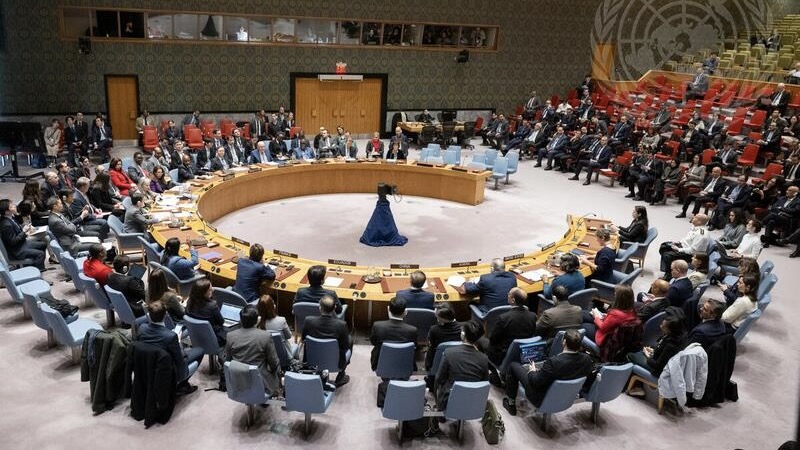
As Israel prepares for a ground invasion of Rafah, the US-authored resolution presented to the UN Security Council merely noted an “imperative” for an immediate ceasefire in Gaza. Algeria, Russia, and China rejected the resolution, stating that it had failed to deliver on the core demand for a ceasefire.
Russia and China vetoed a US-authored resolution in the United Nations Security Council (UNSC) on March 22 on the situation in Gaza. The text “determines the imperative for an immediate and sustained ceasefire” stopping short of an explicit call for a halt to Israel’s six-month long attack on besieged Gaza that has killed almost 32,000 Palestinians.
The US authored the resolution after vetoing three successive UNSC resolutions on Gaza, including a February 20 resolution presented by Algeria that had called for an immediate ceasefire.
Absent an explicit call for a ceasefire, the text presented by the US mentioned allowing for the delivery of essential humanitarian assistance, “alleviate humanitarian suffering and towards that end unequivocally supports ongoing international diplomatic efforts to secure such a cease-fire in connection [emphasis added] with the release of all remaining hostages,” according to a draft circulated in the news media on Thursday.
This unilateral demand for the release of Israeli hostages—without a mention of a reciprocal release of the thousands of Palestinians Israel has imprisoned and tortured— has been inserted by the US in UNSC discussions of a ceasefire. This is all while Israel has continued to bomb Gaza and rejected comprehensive ceasefire proposals presented by the Palestinian resistance. Friday’s vote in the Security Council was held amid ongoing negotiations in Qatar.
The US continued to make this link perhaps not “as firmly”, during the Council on Friday, with Ambassador Linda Thomas-Greenfield speaking of an “immediate and sustained ceasefire as part of a deal that leads to the release of all hostages being held by Hamas and other groups that will help us address the dire humanitarian crisis in Gaza”. She added that adopting the resolution would “put pressure on Hamas to accept the deal on the table”.
The US resolution received 11 votes in favor, and three votes against, with Algeria joining Russia and China who cast the deciding vetoes. Guyana was the sole abstention, reiterating the lack of a call for an immediate ceasefire.
US resolution a “hypocritical spectacle”
Addressing the Council ahead of the vote, Russian Ambassador Vassily Nebenzia accused the US of presenting a “hypocritical spectacle” wrapped up in a ceasefire, that the US had been trying to “sell a product” to the international community. He added that the language of an “imperative” was not enough to save the lives of the Palestinians and was not stipulated in the mandate of the UNSC, which is vested with a mechanism to “demand a ceasefire and where necessary, to compel compliance”.
“The American product is exceedingly politicized, the sole purpose of which is to help to play to the voters, to throw them a bone in the form of some kind of a mention of a ceasefire in Gaza” and would make the UNSC “instrument in the advancement of Washington’s destructive policy in the Middle East”, and “to ensure the impunity of Israel whose crimes in the draft are not even assessed.”
“The US draft contains an effective green light for Israel to mount a military operation in Rafah”, adding that the text’s authors had tried to make it that “nothing would prevent” Israel from “continuing their brutal cleansing of the south of the Gaza Strip”.
Algerian Ambassador Amar Bendjama stated that the adoption of the February ceasefire resolution could have saved thousands of lives, adding that the present resolution had fallen short “due to the absence of a clear demand for a ceasefire those who believe that the Israeli occupying power will choose to uphold its international legal obligation are mistaken, they must abandon this fiction”.
He stated that the US draft resolution had been circulated a month ago following which Algeria had made proposed edits to “achieve a more balanced and acceptable text”, however, finally, the draft fell short as “core concerns remained unaddressed”.
Addressing the Council on Friday, China’s Ambassador Zhang Jun explained the country’s veto, stating that despite the urgent need and demand for an immediate, unconditional, and sustained ceasefire, “the Council had dragged its feet and wasted too much time”.
He added that the US-authored draft had “always evaded and dodged the most central issue- that of a ceasefire. The final text remains ambiguous and does not call for an immediate ceasefire, nor does it even provide an answer to the question of realizing a ceasefire in the short-term”.
Zhang further stated that an immediate ceasefire was a “fundamental prerequisite” for “saving lives, expanding humanitarian access and preventing greater conflicts. The US draft on the contrary sets up preconditions for a ceasefire which is no different from giving a green light to continued killings which is unacceptable.”
He noted that the draft was “very imbalanced” particularly in regard to Israel’s plans to invade Rafah. “The draft does not clearly and unequivocally state its opposition which would send an utterly wrong signal and lead to severe consequences.”
His Algerian counterpart, Bendjama, had similarly stated that the text “does not convey a clear message of peace. It tacitly allows continuing civilian casualties and lacks clear safeguards to prevent further escalation. It is a laissez-passer to continue killing the Palestinian civilians. The emphasis on ‘measures to reduce civilian harm from ongoing and future operations’ implies a license for continuing bloodshed,” Bendjama added, highlighting Israel’s looming invasion of Rafah.
Rafah invasion still on the table despite international outcry
Israeli Prime Minister Benjamin Netanyahu has reiterated the Occupation’s plan to launch a ground invasion of Rafah in southern Gaza, where 1.5 million people forcibly displaced by Israeli attacks on other parts of Gaza are currently trapped.
While the US continues to make a display of its supposed efforts to halt the looming invasion, Netanyahu has declared that Israel is “rejecting” growing international pressure “in order to achieve the goals of the war”. Following a phone call with President Joe Biden, Netanyahu stated that he “made it as clear as possible” that there was no way around a ground incursion.
“We see no way to eliminate Hamas militarily without destroying these remaining battalions. We are determined to do this”, he said. Netanyahu reiterated this in a meeting with US Secretary of State Antony Blinken, saying on Friday, “I told him that I hope we will do it with the support of the US, but if we have to— we will do it alone”.
“A major military ground operation is not the way to do it”, Blinken told reporters, then going on to say, “We’re determined that Israel succeed in defending itself and becomes integrated into the region with its security.”
Meanwhile, the ten elected, non-permanent members (E-10) of the Security Council have drafted a separate resolution calling for an immediate humanitarian ceasefire for the Muslim holy month of Ramadan, “leading to a permanent sustainable ceasefire”.
It also demands “the immediate and unconditional release of all hostages”, without linking it to the ceasefire, and stresses the need to protect civilians in Gaza and provide humanitarian assistance. France has also stated that it will be drafting a separate resolution.
A vote on the E-10 text is reportedly expected to take place later on Friday or Saturday morning.
Original article by Tanupriya Singh republished from peoples dispatch under a Creative Commons Attribution-ShareAlike 4.0 (CC BY-SA) license.