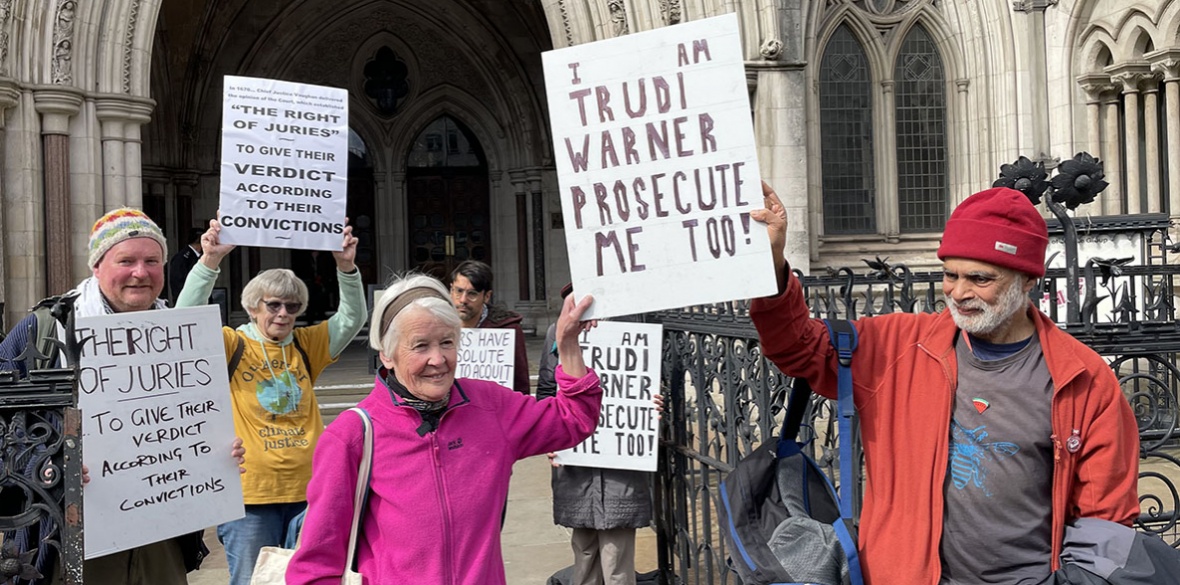
Trudi Warner with supporters outside the Royal Courts of Justice in London, April 18, 2024
A HIGH COURT judge has refused to allow contempt proceedings against a retired social worker who held up a sign outside a court where Insulate Britain activists were due to be tried.
Trudi Warner, from Walthamstow, East London, told of her relief following today’s ruling.
She was arrested on March 27 last year and accused of “deliberately targeting” the jury by holding up a placard outside an entrance used by jurors at Inner London Crown Court.
The sign read: “Jurors you have an absolute right to acquit a defendant according to your conscience.”
Rendering judgement at the Royal Courts of Justice, Mr Justice Saini said he would not give the Solicitor General permission to pursue proceedings against Ms Warner as she had “accurately informed potential prospective jurors about one of their legal powers.”
…
“The proper forum for the Solicitor General to address this concern is Parliament, not by way of contempt proceedings,” he said.
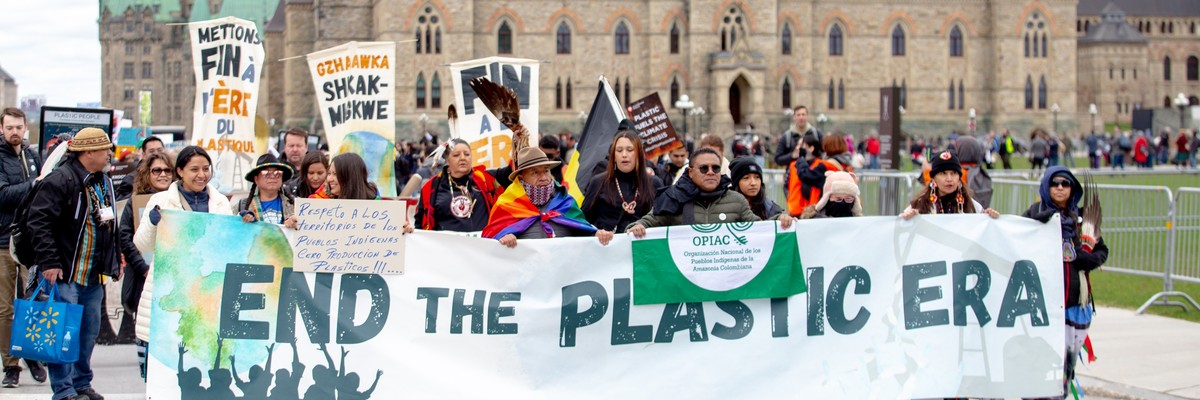
Frontline community members and environmental groups marched in Ottawa, Canada, on Sunday, April 21, 2024 to demand an ambitious Global Plastics Treaty. (Photo: Ben Powless/Survival Media Agency)
“As adults who come to Ottawa to negotiate the plastic treaty, you must protect our rights to live in a healthy and safe environment,” one young activists said.
Days before national delegates gather for the fourth and penultimate negotiations to develop a Global Plastics Treaty in Ottawa, Canada, around 500 Indigenous and community representatives, members of civil society and environmental groups, and experts and scientists gathered for a “March to End the Plastic Era” on Sunday.
The protesters, organized under the banner of Break Free From Plastic, called for a treaty that significantly reduces plastic production and centers the frontline communities most impacted by the plastics crisis.
“Delegates must act like our lives depend on it—because they do,” Daniela Duran Gonzales, senior legal campaigner with the Center for International Environmental Law, said in a statement. “Our climate goals, the protection of human health, the enjoyment of human rights, and the rights of future generations all rest on whether the future plastics treaty will control and reduce polymers to successfully end the plastic pollution crisis.”
“Short-sighted business interests must be out of the room because the only way to achieve equitable livelihoods is when we have a healthy planet.”
The official meeting of the Intergovernmental Negotiating Committee (INC) to craft a “international legally binding instrument on plastic pollution, including in the marine environment,” will run from April 23 to 29 in the Canadian capital.
Break Free From Plastic called the negotiations a “make or break” moment for the treaty, which is supposed to be completed in late 2024 in Busan, South Korean. However, civil society groups have expressed concern that oil-producing countries and the plastics industry will water down the agreement and steer it toward waste management and recycling, which has been revealed to be a false solution to plastic pollution knowingly promoted by the industry for decades.
The last round of negotiations concluded in late 2023 in Nairobi, Kenya, with little progress made after 143 fossil fuel and chemical lobbyists attended.
Salisa Traipipitsiriwat of Thailand, who is the senior campaigner and Southeast Asia plastics project manager for the Environmental Justice Foundation, said ahead of Sunday’s march that it was “crucial for world leaders to step up and put the people and planet at the forefront.”
“Short-sighted business interests must be out of the room because the only way to achieve equitable livelihoods is when we have a healthy planet,” Traipipitsiriwat added.
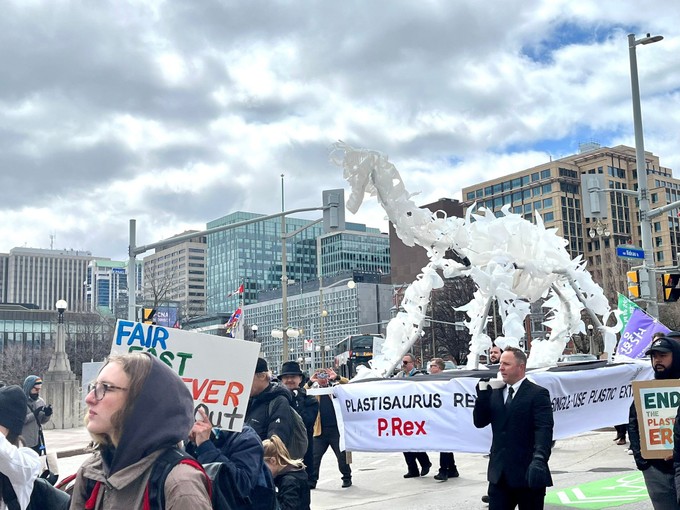
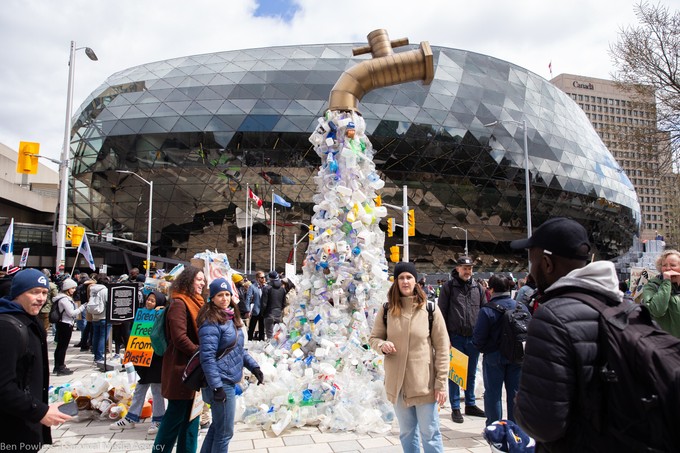
On Sunday, marchers gathered for a press conference at 10:30 am ET before marching at around 11:30 am from Parliament Hill to the Shaw Center, were negotiations will begin on Tuesday. Crowds began to disperse around 1:30 pm. Participants carried large banners with messages including, “End the plastic era,” “End multigenerational toxic exposure,” and pointing out that 99% of plastics came from fossil fuels. The gathering featured live music and art, including a giant tap pouring out plastics and a “Plastisaurus rex” with the message “Make single-use plastic extinct.”
(Photo: Break Free From Plastics)
“Now’s the time to be bold and push for a treaty that cuts plastic production and holds polluters accountable,” Julie Teel Simmonds, a senior attorney at the Center for Biological Diversity, said in a pre-march statement. “I’m inspired to be joining so many advocates in Ottawa, standing up against the enormous harm the fossil fuel and petrochemical industries are causing to people’s health and the planet. I hope to see countries showing ambition this week, and I urge them to remember what’s at stake for future generations.”
Civil society groups have compiled several demands for an ambitious and effective treaty. These are:
Centering human rights, especially those of Indigenous communities, young people, and workers most impacted by plastic pollution;
Protecting the rights of Indigenous peoples throughout the treaty process;
Dealing with plastics across their entire lifecyle;
Reducing production as a “nonnegotiable” part of the treaty;
Eliminating toxic chemicals and additives from plastics;
Bolstering reuse systems for plastics that are non-toxic;
Prioritizing first prevention, then reuse, recycling, recovery, and disposal when managing plastic waste;
Ending “waste colonialism” by strengthening regulations for trading plastics;
Guaranteeing a “just transition” for people employed across the plastics lifecycle;
Including “non-party” provisions in the treaty;
Establishing a mechanism to fund countries so they can fully implement the treaty; and
Enshrining conflict-of-interest policies as a protection against plastics industry lobbying.
The coalition emphasized the need to tackle the problem of plastic from cradle to grave.
“Plastic doesn’t just become pollution when it’s thrown away,” said Jessica Roff, the U.S. and Canada plastics and petrochemicals program manager for the Global Alliance for Incinerator Alternatives. “Plastic is pollution, from the moment the fossil fuels are extracted from the ground to the eternity of waste it spawns.”
Chrie Wilke, global advocacy manager for the Waterkeeper Alliance, said “Clearly the crux of the plastic pollution crisis is too much plastic being produced. There is no way to recycle our way out of this. We must face the fact that plastic and petrochemicals, at current production levels, endanger waterways, communities, and fisheries across the globe. Cutting production and implementing non-plastic alternatives and reuse systems is essential.”
(Photo: Ben Powless/Survival Media Agency)
Activists also emphasized the environmental justice implications of plastic pollution, and how some communities and groups are more burdened than others, both from the dangers of the production process and from waste disposal.
“Children and youth like me suffer the most and are recognized as a vulnerable group,” said Aeshnina ‘Nina’ Azzahra, the founder of River Warrior Indonesia. “My playground and my future are at risk. We all want our environment to be plastic-free, but please don’t put your burden on the other side of the world—this is NOT fair. As adults who come to Ottawa to negotiate the plastic treaty, you must protect our rights to live in a healthy and safe environment.”
Jo Banner, co-founder and co-directer of The Descendants Project, said:”Frontline community members, such as myself, are participating in these treaty negotiations with heavy hearts as our communities back home are struggling with sickness and disease caused by the upstream production of plastic.”
“Although our hearts are heavy, they are full with passion urging negotiators to aim for an ambitious treaty that caps plastic production,” Banner added. “Areas such as my hometown, located in the heart of Louisiana’s Cancer Alley, need a strong treaty now. There is no more time to waste.”
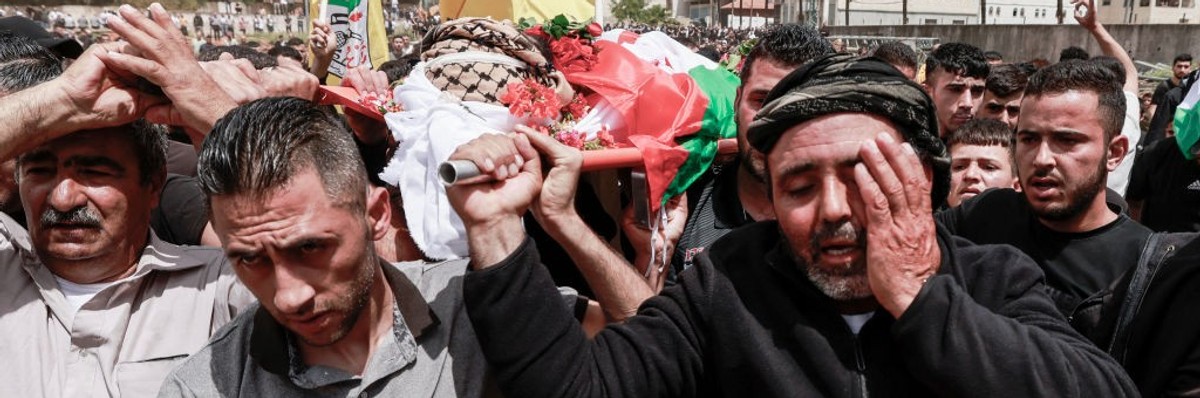
Mourners carry the body of one of the Palestinian men killed during an Israeli settlers’ attack on the village of Aqraba in the illegally occupied West Bank on April 19, 2024. (Photo: Jaafar Ashtiyeh/AFP via Getty Images)
“The appalling spike in settler violence against Palestinians in recent days is part of a decadeslong state-backed campaign to dispossess, displace, and oppress Palestinians in the occupied West Bank,” said one Amnesty official.
Amnesty International said Monday that the ongoing surge in deadly violence by Israeli settlers and soldiers in the West Bank “underscores [the] urgent need to dismantle apartheid” in the illegally occupied Palestinian territories.
For more than a week now, Israeli settlers have been attacking West Bank Palestinians in towns and villages including Al-Mughayir, Duma, Deir Dibwan, Beitin, and Aqraba, killing at least four people including a child; wounding dozens of others; and destroying homes, vehicles, and other property.
Israel Defense Forces (IDF) troops have either stood and watched or participated in the settler attacks, which the Israeli human rights group B’Tselem and others are calling a “pogrom.”
Amnesty said the “alarming spike in violence by Israeli settlers against Palestinians across the occupied West Bank in recent days highlights the urgent need to dismantle illegal settlements, end Israel’s occupation of the occupied Palestinian territories, and its longstanding system of apartheid.
The appalling spike in settler violence against Palestinians in s is part of a decades long state-backed campaign to dispossess, displace and oppress Palestinians in the occupied #WestBank, including East Jerusalem, under #Israel’s system of apartheid.https://t.co/0IgPWbhpfb
“The appalling spike in settler violence against Palestinians in recent days is part of a decadeslong state-backed campaign to dispossess, displace, and oppress Palestinians in the occupied West Bank, including East Jerusalem, under Israel’s system of apartheid,” Amnesty Middle East and North Africa regional director Heba Morayef said. “Israeli forces have a track record of enabling settler violence and it is outrageous that once again Israeli forces stood by and in some cases took part in these brutal attacks.”
“Establishing Israeli settlements in the occupied Palestinian territories flagrantly violates international law and constitutes a war crime,” Morayef added. “Violence is integral to the establishment and expansion of these settlements and to sustaining apartheid. It’s time for the world to recognize this and pressure Israeli authorities to abide by international law by immediately halting settlement expansion and removing all existing settlements.”
The latest wave of settler violence was sparked by the disappearance of Binyamin Achimair, a 14-year-old Israeli from the illegal settler outpost of Mal’achei Hashalom who went missing on April 12 while herding sheep near the village of Al-Mughayir east of Ramallah. As Israelis searched for Achimair, settlers began attacking Al-Mughayir’s residents and property.
Achimair’s body was found the following day. Israeli officials said he was killed in a “terrorist attack.” However, no Palestinian resistance group has claimed responsibility for the incident. A 21-year-old Palestinian man was arrested Monday in alleged connection with the boy’s death.
In the W. Bank, where there is not even the excuse of Hamas, the ethnic cleansing of Palestinians continues – with the blessing of Western politicians who continue to claim they want a 2-State solution – with a Palestinian state smaller than a poststamp https://t.co/LOQOQKnA9a
Late Friday, IDF troops and armored vehicles surrounded the Nur Shams refugee camp east of Tulkarem and besieged the community of more than 6,000 Palestinians during a 50-hour raid in which residents were shot, homes were destroyed, and scores of people were arrested.
By Saturday, IDF soldiers had killed 14 people in the camp, including at least one child. More than 40 other Palestinians were wounded.
“I saw one of my relatives, Jihad Zandiq, put his hands in the air to the soldiers but then they shot him anyway from point-blank range and killed him. Half of his skull exploded,” eyewitness Mahmoud Qazmouz told Middle East Eye on Sunday.
Palestinian officials said Israeli troops attacked first responders attempting to rescue victims, including a volunteer paramedic who was shot in the leg.
Meanwhile, a funeral was held Sunday for Mohammed Awad Allah Musa, a 50-year-old Palestinian Red Crescent Society volunteer paramedic who was shot dead Saturday by Israeli settler-colonists while trying to reach Palestinians wounded by rampaging settlers in the town of Sa’wiyah south of Nablus.
The funeral of the Palestine Red Crescent volunteer paramedic, Mohammed Awad Allah Musa, who was killed yesterday while providing first aid to the wounded by settlers' gunfire in the town of Sa'wiyah, Nablus district.#NotATarget ❌#IHLpic.twitter.com/3YkxzQHXxv
The Nur Shams raid and ongoing settler attacks came as the U.S. State Department on Friday announced new sanctions targeting far-right Israeli settler leaders including Ben Zion Gopstein, the founder and head of the Jewish supremacist group Lehava.
The Biden administration—which backs Israel with billions of dollars in military aid and diplomatic support—is also reportedly considering imposing sanctions on the IDF’s Netzah Yehuda battalion over war crimes committed in the West Bank before the current Israeli war on Gaza, including the January 2022 death of Omar Assad, a 78-year-old Palestinian American man.
Responding to the prospect of the first-ever U.S. sanctions on his country’s military, far-right Israeli Prime Minister Benjamin Netanyahu said Sunday that “I will fight it with all my strength.”
According to the Palestinian Health Ministry, at least 485 Palestinians have been killed by Israeli soldiers and settlers in the West Bank since October 7, when Gaza-based militants attacked Israel. More than 1,100 people were killed in the attack—some by responding Israeli forces—and over 240 Israelis and others were kidnapped by Hamas and other militants.
Israel’s 199-day retaliatory assault on Gaza—which critics including Israelis have called genocidal—has killed at least 34,151 Palestinians, mostly women and children, while wounding over 77,000 others, according to Palestinian and international officials. At least 11,000 Gazans are missing, presumed dead and buried beneath the rubble of the hundreds of thousands of homes and other buildings that have been destroyed or damaged by Israeli bombardment. Around 90% of Gaza’s 2.3 million people have been forcibly displaced, and Israel’s continued obstruction of humanitarian aid delivery has fueled a burgeoning famine in which dozens of people, mostly children, have perished.
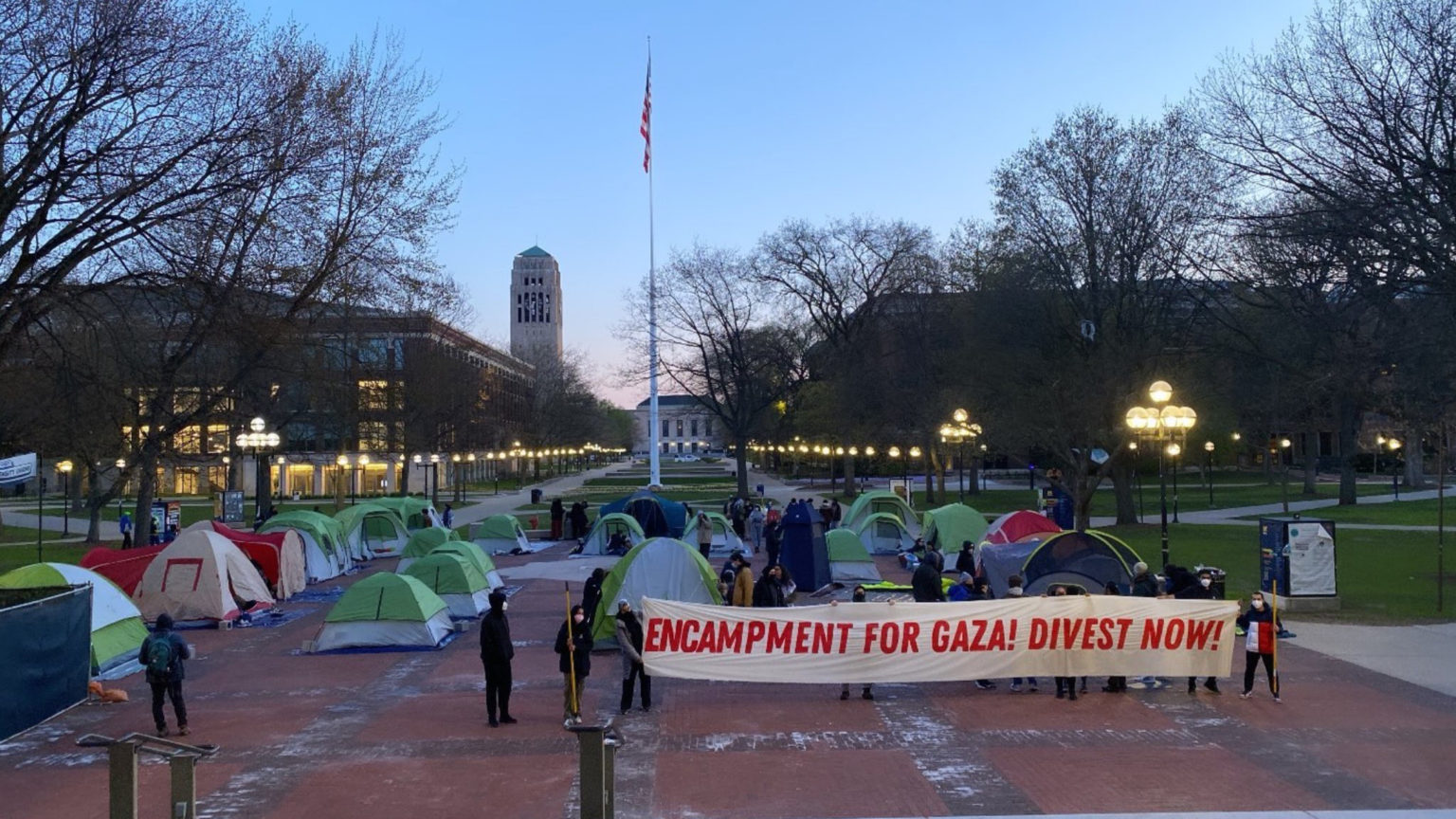
Students set up an encampment at the University of Michigan in solidarity with Gaza (Photo via Jewish Voice for Peace UMich)
Police launch new wave of repression as student movement for Palestine grows
Almost a week after Columbia students launched their Gaza Solidarity Encampment, students across the country have taken from their example and began encampments in public spaces in their own universities in solidarity with Palestine.
In the early hours of the morning of April 22, students at New York University began an encampment on Gould Plaza, joining their New York City counterparts at the New School, which had launched an encampment the previous day.
In the Greater Boston Area students at the Massachusetts Institute of Technology, Emerson College, and Tufts University set up encampments at their own universities. Students at the University of Michigan also launched an encampment on April 22, pitching tents outdoors with ice still visibly on the ground.
🚨🇵🇸BREAKING: Students at University of Maryland have begun an encampment in College Park for Gaza, declaring a People’s University!
THEIR DEMANDS ON UMD: 1️⃣ DIVEST from military companies & contractors 2️⃣BREAK THE SILENCE and denounce the genocide in Gaza 3️⃣END policing on… pic.twitter.com/5PIGUnqDA5
— Party for Socialism and Liberation (@pslnational) April 22, 2024
Also on the morning of April 22, New Haven police repressed the Gaza Solidarity Encampment at Yale University, which had been established on April 20, making 47 arrests. In response, students took over the street outside of campus, shutting down an intersection with hundreds of demonstrators.
Students are broadly demanding that their universities divest from Israel, and have pledged to maintain their encampments until their demands are met. The intensification of the student action began when Columbia students launched their encampment at 4 am on April 17. Despite a severe crackdown by the University and the NYPD, resulting in 122 arrests, students have been able to sustain the encampment on the Butler Lawn for almost a week, inspiring others across the country to do the same and put pressure on their own universities to divest from Israel.
On the afternoon of April 22, a new wave of repression began outside of Columbia’s campus as several demonstrators were arrested outside the campus gates, who were picketing outside of the encampment.
NOW: “Lock them up!” NYPD orders officers to arrest protesters demonstrating on the sidewalk in front of the gates to Columbia University
SRG has been called in. An officer said NYPD “doesn’t make the rules” when asked by an organizer why they are not allowed to protest there pic.twitter.com/M72jfxZ9BA
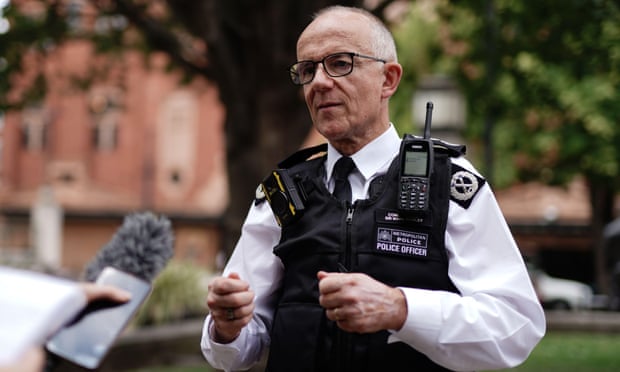
Mark Rowley said ‘the wider actions and intent of the officer were professional and in the best tradition of British police trying to prevent disorder’. Photograph: PA Images/Alamy
Exclusive: Mark Rowley says sergeant will not be disciplined and warns of ‘fakery’ by activists at other protests
The commissioner of the Metropolitan police has praised the “professional” conduct of the sergeant who stopped an antisemitism campaigner at a pro-Palestinian march and warned that officers at other protests had been “set up” by activists using “fakery” to undermine the force.
In an interview with the Guardian, Mark Rowley said the sergeant involved in the incident with Gideon Falter would not be disciplined and vigorously defended the Met’s handling of the six months of protests since the 7 October attacks on Israel.
Defying calls for his resignation, Rowley faced a series of crisis meetings on Monday with the two people who could oust him – the home secretary, James Cleverly, and the London mayor, Sadiq Khan – as well as British Jewish groups.
It followed footage emerging of a Met officer telling Falter, of the Campaign Against Antisemitism, that because he was “openly Jewish” he would not be allowed to walk across a pro-Palestinian protest march through central London on 13 April.
A 13-minute video of the exchange shows the officer offering to escort Falter away from the demonstration, and saying he was being disingenuous about his motives for wanting to cross the road at that point.
Speaking just before he went to see the home secretary, Rowley, Britain’s top police officer, said: “The sergeant at the scene clearly assessed that there was a risk of confrontation and was trying to help Mr Falter find a different route. I completely understand why the sergeant made this assessment. A couple of turns of phrase were clumsy and offensive … and we’ve apologised for that.
“The wider actions and intent of the officer were professional and in the best tradition of British police trying to prevent disorder.”