Sunak launches ‘full-on assault’ on disabled people

Spread the love

https://morningstaronline.co.uk/article/sunak-launches-full-on-assault-against-disabled-people

Prime Minister Rishi Sunak giving his speech in central London on welfare reform, April 19, 2024

PM announces major plans to impose curbs on benefits

RISHI SUNAK was accused of launching a “full-on assault” on disabled people today after he announced major plans to impose fresh curbs on benefits.

The Prime Minister said an expected rise in benefits spending is “not sustainable” and vowed to “significantly reform” the system.

He announced a new consultation on personal independent payment (PIP), a non means-tested benefit that helps with extra costs caused by long-term disability or ill health.

Citing an increasing number of people are claiming PIP for anxiety and depression, Mr Sunak said a more “rigorous” approach will be introduced, and that “greater medical evidence” will be required to substantiate a claim.

He pledged to “tighten” the work capability assessment so that “hundreds of thousands of benefit recipients with less severe conditions will now be expected to engage in the world of work.”

James Taylor of disability charity Scope said the plan “feels like a full-on assault on disabled people.”

He said: “These proposals are dangerous and risk leaving disabled people destitute.

“In a cost-of-living crisis, looking to slash disabled people’s income by hitting PIP is a horrific proposal.”

Disability Rights UK’s head of policy Fazilet Hadi accused the government of “targeting disabled people for a failing economy.”

She said: “The Prime Minister’s approach to systemic inequalities caused by government policies and underfunding of public services, is to further penalise, punish and threaten disabled people living on inadequate benefits.”

https://morningstaronline.co.uk/article/sunak-launches-full-on-assault-against-disabled-people

Charities blast Rishi Sunak’s ‘dangerous’ and heartless clamp down on disability welfare

Dr Sarah Hughes, CEO of Mind, said: “We are deeply disappointed that the Prime Minister’s speech today continues a trend in recent rhetoric which conjures up the image of a “mental health culture” that has “gone too far”.

“This is harmful, inaccurate and contrary to the reality for people up and down the country. The truth is that mental health services are at breaking point following years of under investment with many people getting increasingly unwell while they wait to receive support.”

She added: “To imply that it is easy both to be signed-off work and then to access benefits is deeply damaging. It is insulting to the 1.9 million people on a waiting list to get mental health support, and to the GPs whose expert judgement is being called into question.”

Labour MP John Trickett offered an alternative solution: “Sunak would stop doctors from issuing ‘sick notes’ in effort to force ill people back to work. I have a 3-part proposal: 1) fully finance the NHS & cut waiting lists 2) an all-out drive to end poverty which is at the root of so much ill health 3) force bosses to pay living wage”.

Charities blast Rishi Sunak’s ‘dangerous’ and heartless clamp down on disability welfare
Continue ReadingSunak launches ‘full-on assault’ on disabled people

Coming soon …

Spread the love

The plan is to present a live audio podcast entitled ‘Talking About a Revolution’ featuring renowned climate activist Roger Hallam and myself on 1st May 2024 at 7pm BST (GMT +1). We’re not proposing violent revolution, rather a serious huge economic, political and social transition away from Capitalism which is totally and incessantly destroying the planet.

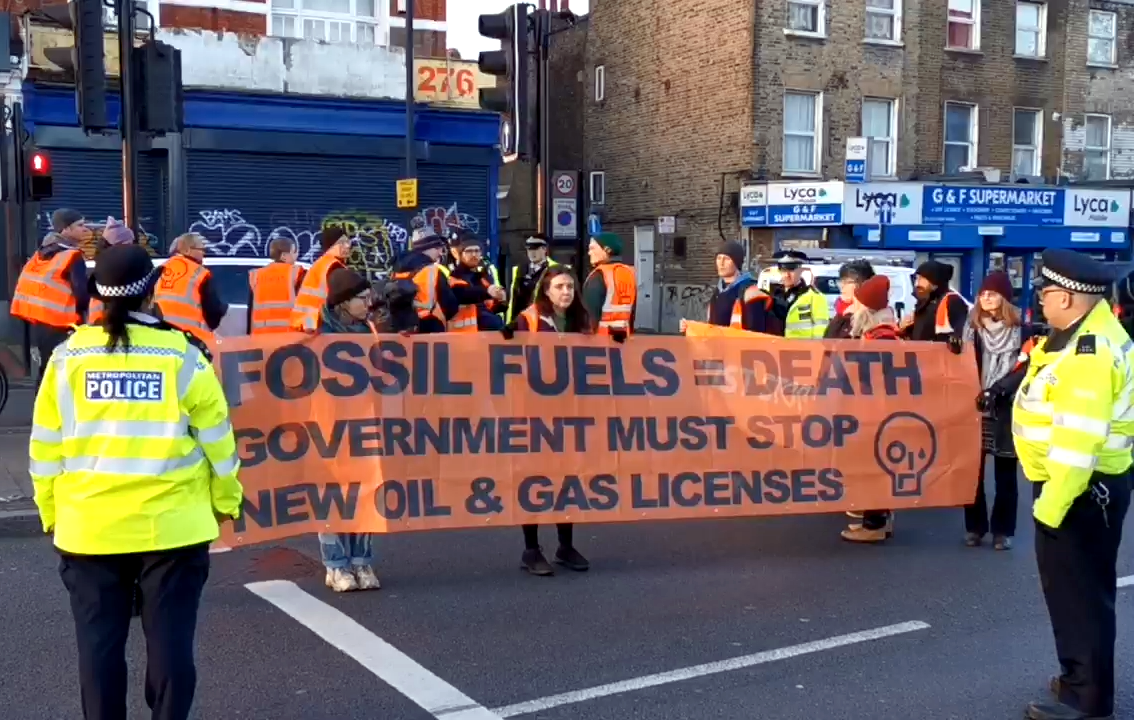
Just Stop Oil protesting in London 6 December 2022.

Roger has been active in founding many climate activist groups e.g. Extinction Rebellion, Insulate Britain and Just Stop Oil. Roger and myself are similar in many ways: We’re both about the same age, have Welsh histories, committed to being brutally honest and seem to have reached very similar conclusions i.e. the need for revolution, through different routes.

I’m also intending to host a live audio podcast a week earlier on 24 April at 7pm BST (GMT +1) featuring myself to test the tech since I’ve never done it before. There is a chance that it may not work of course which is part of why I’m doing it. It will likely be a monologue but I’m hoping to feature some special ‘guests’ in a not too serious programme. Not too serious because it’s probably a good response to laugh in the face of adversity.

Those of you who have attended universities will probably realise that they are are dumping grounds for insane but mostly harmless people who are basically fekking bonkers. I suggest that you should recognise that the same happens in contemporary politics: that politicans are totally fekking beserk who would not be tolerated in normal professions and have been successful in politics. Just consider our prime ministers FFS.

Roger Hallam’s blog.

Roger Hallam’s wikipedia entry.

Continue ReadingComing soon …

Climate Crisis to Cost Global Economy $38 Trillion a Year by 2050

Spread the love

Original article by OLIVIA ROSANE republished from Common Dreams under Creative Commons (CC BY-NC-ND 3.0). 

Rancher Jon Pedotti walks on the cracked remains of a parched lake bed of his 1,561-acre ranch located along San Simeon Creek in the Santa Lucia Mountain foothills of Cambria, California during a drought on October 1, 2014. (Photo: Al Seib/Los Angeles Times via Getty Images)

“This clearly shows that protecting our climate is much cheaper than not doing so, and that is without even considering noneconomic impacts such as loss of life or biodiversity,” a new study’s lead author said.

The climate crisis will shrink the average global income 19% in the next 26 years compared to what it would have been without global heating caused primarily by the burning of fossil fuels, a study published in Nature Wednesday has found.

The researchers, from the Potsdam Institute for Climate Impact Research (PIK), said that economic shrinkage was largely locked in by mid-century by existing climate change, but that actions taken to reduce emissions now could determine whether income losses hold steady at around 20% or triple through the second half of the century.

“These near-term damages are a result of our past emissions,” study lead author and PIK scientist Leonie Wenz said in a statement. “We will need more adaptation efforts if we want to avoid at least some of them. And we have to cut down our emissions drastically and immediately—if not, economic losses will become even bigger in the second half of the century, amounting to up to 60% on global average by 2100.”

“I am used to my work not having a nice societal outcome, but I was surprised by how big the damages were.”

Put in dollar terms, the climate crisis will take a yearly $38 trillion chunk out of the global economy in damages by 2050, the study authors found.

“That seems like… a lot,” writer and climate advocate Bill McKibben wrote in response to the findings. “The entire world economy at the moment is about $100 trillion a year; the federal budget is about $6 trillion a year.”

This means that the costs of inaction have already exceeded the costs of limiting global heating to 2°C by six times, the study authors said. However, limiting warming to 2°C can still significantly reduce economic losses through 2100.

“This clearly shows that protecting our climate is much cheaper than not doing so, and that is without even considering noneconomic impacts such as loss of life or biodiversity,” Wenz said.

The damages predicted by the study were more than twice those of similar analyses because the researchers looked beyond national temperature data to also incorporate the impacts of extreme weather and rainfall on more than 1,600 subnational regions over a 40-year period, The Guardian explained.

“Strong income reductions are projected for the majority of regions, including North America and Europe, with South Asia and Africa being most strongly affected,” PIK scientist and first author Maximilian Kotz said in a statement. “These are caused by the impact of climate change on various aspects that are relevant for economic growth such as agricultural yields, labor productivity, or infrastructure.”

However, Wenz told the paper that the paper’s projected reduction was likely a “lower bound” because the study still doesn’t include climate impacts such as heatwaves, tropical storms, sea-level rise, and harms to human health.

Unlike previous studies, the research predicted economic losses for most wealthier countries in the Global North, with the U.S. and German economies shrinking by 11% by mid-century, France’s by 13%, and the U.K.’s by 7%. However, the countries set to suffer the most are countries closer to the equator that have lower incomes already and have historically done much less to contribute to the climate crisis. Iraq, for example, could see incomes drop by 30%, Botswana 25%, and Brazil 21%.

“Our study highlights the considerable inequity of climate impacts: We find damages almost everywhere, but countries in the tropics will suffer the most because they are already warmer,” study co-author Anders Levermann, who leads Research Department Complexity Science at PIK, said in a statement. “Further temperature increases will therefore be most harmful there. The countries least responsible for climate change, are predicted to suffer income loss that is 60% greater than the higher-income countries and 40% greater than higher-emission countries. They are also the ones with the least resources to adapt to its impacts.”

Wenz told The Guardian that the results were “devastating.”

“I am used to my work not having a nice societal outcome, but I was surprised by how big the damages were. The inequality dimension was really shocking,” Wenz said.

Levermann said the paper presented society with a clear choice:

It is on us to decide: Structural change towards a renewable energy system is needed for our security and will save us money. Staying on the path we are currently on, will lead to catastrophic consequences. The temperature of the planet can only be stabilized if we stop burning oil, gas, and coal.

McKibben, meanwhile, argued that the findings should persuade major companies to embrace climate action for self-interested reasons. He noted that most corporate emissions come from how company money is invested by banks, particularly in the continued exploitation of fossil fuel resources.

“If Amazon and Apple and Microsoft wanted to avoid a world where, by century’s end, people had 60% less money to spend on buying whatever phones and software and weird junk (doubtless weirder by then) they plan on selling, then they should be putting pressure on their banks to stop making the problem worse. They should also be unleashing their lobbying teams to demand climate action from Congress,” McKibben wrote.

“These people are supposed to care about money, and for once it would help us if they actually did,” he continued. “Stop putting out ads about how green your products are—start making this system you dominate actually work.”

Original article by OLIVIA ROSANE republished from Common Dreams under Creative Commons (CC BY-NC-ND 3.0). 

Continue ReadingClimate Crisis to Cost Global Economy $38 Trillion a Year by 2050

‘The Opposite of Leadership’: US Vetoes Palestine’s UN Membership

Spread the love

Original article by JESSICA CORBETT republished from Common Dreams under Creative Commons (CC BY-NC-ND 3.0).

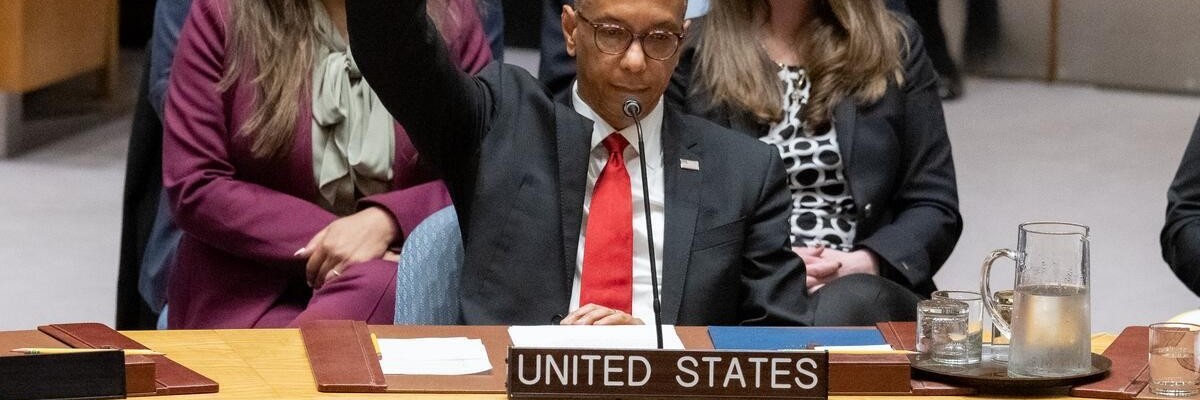
Robert A. Wood, deputy permanent representative of the United States to the United Nations, vetoes Palestine’s U.N. membership during the Security Council meeting on April 18, 2024. (Photo: Manuel Elías/United Nations)

Palestine’s permanent observer at the United Nations said the resolution’s failure “will not break our will, and it will not defeat our determination.”

U.S. President Joe Biden’s administration on Thursday used the country’s veto power at the United Nations Security Council to block Palestine’s bid to become a full member of the U.N.

While 12 nations voted in favor of Palestinian membership and two abstained, the United States is one of five countries—along with China, France, Russia, and the United Kingdom—who have veto authority at the Security Council.

Since Israel launched what the International Court of Justice has said is a “plausibly” genocidal assault of the Gaza Strip in response to a Hamas-led October attack, the Biden administration has blocked three cease-fire resolutions at the Security Council. Under mounting global pressure, the U.S. finally abstained last month, allowing a cease-fire measure to pass.

In the lead-up to Thursday’s vote, the Biden administration was pressuring other countries to oppose the Palestinian Authority’s renewed membership effort so it could possibly avoid a veto, according to leaked cables obtained by The Intercept.

“Take a moment to ponder how isolated Biden has made the U.S.,” said Trita Parsi, executive vice president of the Quincy Institute for Responsible Statecraft, after the veto. “Biden lobbied Japan, South Korea, and Ecuador HARD to oppose the Palestine resolution so that the U.S. wouldn’t have to veto. They refused. So Biden cast his fourth veto in seven months (!!) This is the opposite of leadership.”

In addition to the nations Parsi highlighted, Algeria, China, France, Guyana, Malta, Mozambique, Russia, Sierra Leone, and Slovenia voted for giving Palestine full U.N. membership while Switzerland and the United Kingdom abstained.

After the vote, U.N. News reported on remarks from Riyad Mansour, a U.N. permanent observer for the state of Palestine:

“We came to the Security Council today as an important historic moment, regionally and internationally, so that we could salvage what can be saved. We place you before a historic responsibility to establish the foundations of a just and comprehensive peace in our region.”

Council members were given the opportunity “to revive the hope that has been lost among our people” and to translate their commitment towards a two-state solution into firm action “that cannot be maneuvered or retracted,” and the majority of council members “have risen to the level of this historic moment, and they have stood on the side of justice and freedom and hope, in line with the ethical and humanitarian and legal principles that must govern our world and in line with simple logic.”

“The fact that this resolution did not pass will not break our will, and it will not defeat our determination,” Mansour added. “We will not stop in our effort. The state of Palestine is inevitable. It is real. Perhaps they see it as far away, but we see it as near, and we are the faithful.”

Parsi said that “a Western-friendly senior Global South diplomat” told him of Biden’s veto: “Whatever agonizing claim the U.S. had to lead a self-appointed free world has died a very loud public death on the Security Council horseshoe tonight. YOU CAN’T LEAD IF YOU CAN’T LISTEN.”

Biden, a Democrat seeking reelection in November, has faced fierce criticism in the United States and around the world for U.S. complicity in Israel’s war on Gaza—which Hamas, not the Palestinian Authority, has controlled for nearly two decades. In under seven months, Israeli forces have killed 33,970 Palestinians, injured another 76,770, displaced most of the besieged enclave’s 2.3 million population, devastated civilian infrastructure, and severely limited the flow of lifesaving humanitarian assistance.

Israel—which already got $3.8 billion in annual U.S. military aid before October 7—continues to receive weapons support from the Biden administration, even as a growing chorus of critics, including some Democrats in Congress, argues that the arms transfers violate U.S. and international law.

Original article by JESSICA CORBETT republished from Common Dreams under Creative Commons (CC BY-NC-ND 3.0).

Continue Reading‘The Opposite of Leadership’: US Vetoes Palestine’s UN Membership

‘McCarthyism Is Alive and Well’: Google Fires 28 for Protesting Israel Contract

Spread the love

Original article by JULIA CONLEY republished from Common Dreams under Creative Commons (CC BY-NC-ND 3.0).

Google employees demand the company terminate its contract with the Israeli government at a protest on April 16, 2024. 
(Photo: No Tech for Apartheid/Medium)

“These mass, illegal firings will not stop us,” said organizers. “Make no mistake, we will continue organizing until the company drops Project Nimbus and stops powering this genocide.”

The peace coalition No Tech for Apartheid accused Google of a “flagrant act of retaliation” late Wednesday night as the Silicon Valley giant announced it had fired 28 workers over protests against its cloud services contract with the Israeli government.

The firings came after Google organizers held two 10-hour sit-ins at the company’s offices in Sunnyvale, California and New York City, demanding the termination of Project Nimbus, a $1.2 billion contract under which Google and Amazon provide cloud infrastructure and data services for Israel—without any oversight regarding whether the Israel Defense Forces uses the services in its occupation of Palestinian territories and bombardment of Gaza.

Workers have denounced Project Nimbus since it was announced in 2021, but Israel’s killing of at least 33,970 Palestinians in Gaza since October and its intentional starvation of civilians led employees to escalate their protests.

No Tech for Apartheid said in a statement that Google officials called the police to both offices to arrest nine protesters—dubbed the Nimbus Nine—on Tuesday morning, before utilizing “a dragnet of in-office surveillance” to fire nearly two dozen other employees on Wednesday.

“They punished all of the workers they could associate with this action in wholesale firings,” said the coalition, which includes Jewish Voice for Peace and MPower Change, a Muslim-led anti-war group.

Google accused the workers of “bullying,” “harassment,” defacing property, and physically impeding other employees—allegations No Tech for Apartheid rejected as it noted organizers “have yet to hear from a single executive about” their concerns over Google’s collaboration with Israel.

“This excuse to avoid confronting us and our concerns directly, and attempt to justify its illegal, retaliatory firings, is a lie,” said the workers. “Even the workers who were participating in a peaceful sit-in and refusing to leave did not damage property or threaten other workers. Instead they received an overwhelmingly positive response and shows of support.”

The organizers staged the sit-ins on the heels of reporting in Time magazine about new negotiations between Google and the Israeli government regarding further potential tech contracts.

Kate J. Sim, a child safety policy adviser at Google who said she was among those fired this week, said the terminations show “how terrified [executives] are of worker power.”

Google employees have a history of harnessing worker power to change policies at the company. In 2018, Google terminated a deal with the U.S. Defense Department to develop drone and artificial intelligence (AI) technology through a contract called Project Maven. The decision followed the resignations of several employees and the condemnation of thousands of workers.

Calling Google CEO Sundar Pichai and Google Cloud CEO Thomas Kurian “genocide profiteers,” No Tech for Apartheid said Wednesday that they will not stop demonstrating against Project Nimbus until they get a similar result.

“The truth is clear: Google is terrified of us,” said the group. “They are terrified of workers coming together and calling for accountability and transparency from our bosses… The corporation is trying to downplay and discredit our power.

“These mass, illegal firings will not stop us,” No Tech for Apartheid added. “On the contrary, they only serve as further fuel for the growth of this movement. Make no mistake, we will continue organizing until the company drops Project Nimbus and stops powering this genocide.”

Original article by JULIA CONLEY republished from Common Dreams under Creative Commons (CC BY-NC-ND 3.0).

Continue Reading‘McCarthyism Is Alive and Well’: Google Fires 28 for Protesting Israel Contract