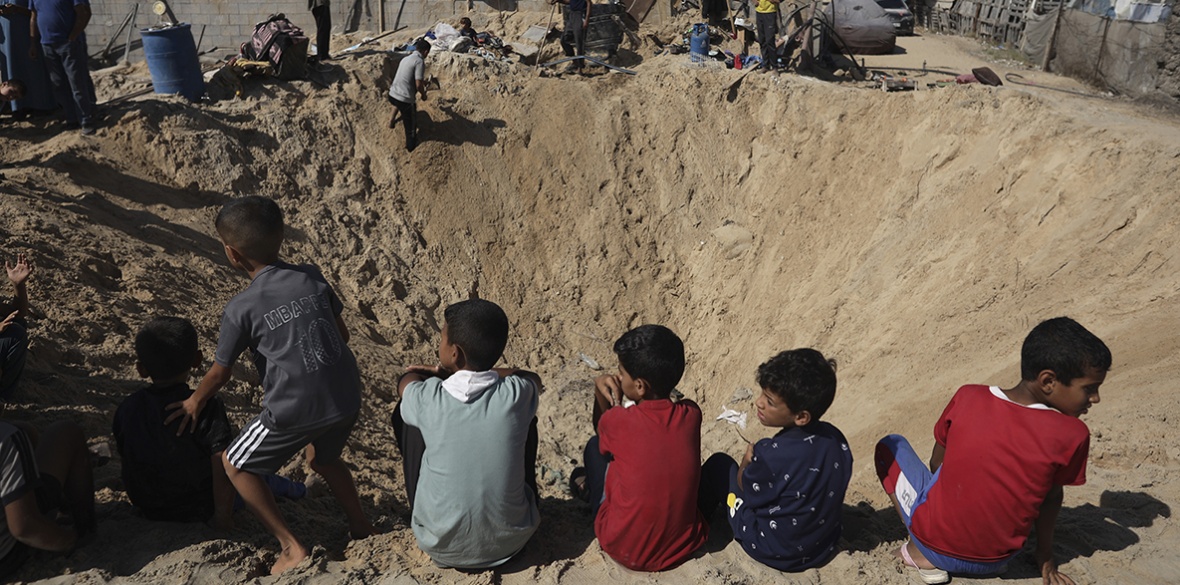
Palestinian children sit at the edge of a crater after an Israeli airstrike in Khan Younis, southern Gaza Strip, June 21, 2024
‘By sending weapons, parts, components and ammunition to Israeli forces,’ the above risk being ‘complicit in serious violations of international human rights laws,’ UN experts warn
STATES and companies must end arms sales to Israel immediately or risk responsibility for human rights violations, UN experts have warned.
The transfer of weapons and ammunition to Israel may “constitute serious violations of international humanitarian laws and risk complicity in international crimes, possibly including genocide,” UN Special Rapporteurs for the Human Rights Council said in a statement on Thursday night.
The experts also called on BAE Systems, Boeing, Caterpillar, Lockheed Martin, Rolls-Royce Power Systems, and many other arms firms to end sales to Israel even if they have been granted licences to do so.
“These companies, by sending weapons, parts, components and ammunition to Israeli forces, risk being complicit in serious violations of international human rights and international humanitarian laws,” the experts said.
“This risk is heightened by the recent decision from the International Court of Justice ordering Israel to immediately halt its military offensive in Rafah, having recognised genocide as a plausible risk, as well as the request filed by the prosecutor of the International Criminal Court seeking arrest warrants for Israeli leaders on allegations of war crimes and crimes against humanity,” the statement said.
“In this context, continuing arms transfers to Israel may be seen as knowingly providing assistance for operations that contravene international human rights and international humanitarian laws and may result in profit from such assistance.”
The experts also warned that financial institutions investing in arms companies could also be held accountable, and called on Bank of America, BlackRock, Citigroup, JP Morgan Chase, Morgan Stanley, and many others to take urgent action.
Original article by Vijay Prashad republished from peoples dispatch under a Creative Commons Attribution-ShareAlike 4.0 (CC BY-SA) license.
Dr. Adnan Al-Barsh giving an interview.
Israel has systematically attacked Gaza’s health system and killed over 700 health workers, a flagrant violation of international law
In the first week of June 2024, the Palestine office of the World Health Organization (WHO) released figures about the atrocious attacks on health care facilities and workers in Gaza since October 7, 2023. Thus far, according to the WHO, the Israelis have attacked 464 health care facilities, killed 727 health care workers, injured 933 health care workers, and damaged or destroyed 113 ambulances. “Health care,” the WHO’s Palestine office argues, “is not a target.” And yet, during the past seven months, health care workers have faced relentless attacks by the Israeli military. Each of the stories about the deaths is heartbreaking, the names of the dead are too long to list in any article (although a group called Healthcare Workers for Palestine did read the names of their dead colleagues as a protest against this war). But some of the stories are worth reflecting on because they tell us about the commitment of the workers and the great loss to humanity from their murder.
Dr. Iyad Rantisi, who was 53 years old, ran the Kamal Adwan Hospital in Beit Lahiya, which lies in the northern part of Gaza. There are many Rantisis in Gaza, but they are not native to that part of Palestine. Like many Palestinians who live in Gaza, they have roots in other parts of Palestine from which they had been expelled in the Nakba of 1948; the Rantisis come from the village of Rantis, northwest of Ramallah.
On November 11, 2023, during the Israeli military assault inside northern Gaza, Dr. Rantisi was taken into custody at an Israeli military checkpoint when he tried to leave northern Gaza for the south, following the orders of the Israeli military. Since then, his family had not heard anything about his whereabouts. Now, months later, the Israeli newspaper Haaretz reports that he was taken to the Shikma Investigation Center of the Shin Bet (Israel Security Agency), which is inside the Ashkelon Prison. Dr. Rantisi was tortured and then killed six days into his detention. His family was not informed of this until the Haaretz report. Then, Dr. Rantisi’s daughter Dima wrote of the death of her father, a social media post that she paired with photographs of him in medical scrubs performing surgery on a patient.
Dr. Adnan Al-Barsh, also 53, trained in Romania before he returned home to Gaza to head the orthopedic department at Al-Shifa Hospital. He has a reputation of being a very loved doctor, whose office was crowded with his diplomas (from Jordan, from Palestine, from the United Kingdom). When the Israeli military attacked al-Shifa, Dr. Al-Barsh was forced to leave his post, but he did not leave his work. He first went to Kamal Adwan Hospital, where Dr. Rantisi worked, and then to Al-Awda Hospital in the area east of the Jabaliya refugee camp in northern Gaza, which was also attacked several times by the Israelis. On December 18, 2023, the Israeli military raided Al-Awda and took Dr. Al-Barsh and other hospital personnel into custody. Included among those arrested was the manager of the hospital and another very popular doctor, Dr. Ahmed Muhanna. On October 15, 2023, Dr. Muhanna made a video—which went viral—in which he pleaded to the world for help and for an immediate ceasefire. It is now reported that on April 19, 2024, Dr. Al-Barsh was killed by the Israelis in Ofer Prison. Tlaleng Mofokeng, the UN Special Rapporteur on the right to health, said, “Dr. Adnan’s case raises serious concerns that he died following torture at the hands of Israeli authorities.”
Dr. Hammam Alloh, age 36, was killed when an Israeli missile struck his home near his ward in Al-Shifa Hospital on November 12, 2023. Trained in Yemen and Jordan, Dr. Alloh was Gaza’s only nephrologist, a kidney specialist. Concerned about his patients who were on dialysis, particularly with the lack of electricity and the constant attacks, Dr. Alloh—who was known as “The Legend” during his residency in Jordan—refused to leave the hospital. On October 31, Dr. Alloh was asked why he did not abandon his post and go to southern Gaza. “If I go,” he replied calmly, “who would treat my patients? We are not animals. We have the right to receive proper health care. You think I went to medical school and for my postgraduate degrees for a total of 14 years so I think only about my life and not my patients?” This was the caliber of Dr. Alloh. Less than two weeks later, when he left his post to have a rest at home with his parents, his wife (pregnant with a child), and his two children, the Israelis struck his home. He died alongside his father.
At the International Court of Justice in January 2024, the Irish lawyer Blinne Ní Ghrálaigh made the closing arguments for South Africa’s claim of genocide against Israel. In the course of her statement, Ní Ghrálaigh showed an image of a whiteboard with the following written on it: “Whoever stays until the end will tell the story. We did what we could. Remember us.” These lines had been written by 38-year-old Dr. Mahmoud Abu Najaila, who worked as a physician for Médecins Sans Frontières (MSF) at Al-Awda Hospital in northern Gaza. On November 21, 2023, the Israeli military bombed the third and fourth floors of the hospital, where Dr. Najaila worked with Dr. Ahmad Al-Sahar and Dr. Ziad Al-Tatari. All three of them were killed.
On her LinkedIn page, Reem Abu Lebdeh, a physiotherapist who was an associate trustee on the board of MSF’s UK branch, wrote, “Such a devastating loss for the medical community and humanity.” These doctors, whom she knew, she said, “were true embodiments of selfless service and humanitarian dedication, tirelessly saving lives in the most urgent conditions.” Then a few weeks later, sometime in December, the Israelis attacked a residential area in Khan Younis and killed Reem Abu Lebdeh, whose own messages of solidarity now sit on the web like Dr. Najaila’s whiteboard note: Remember us.
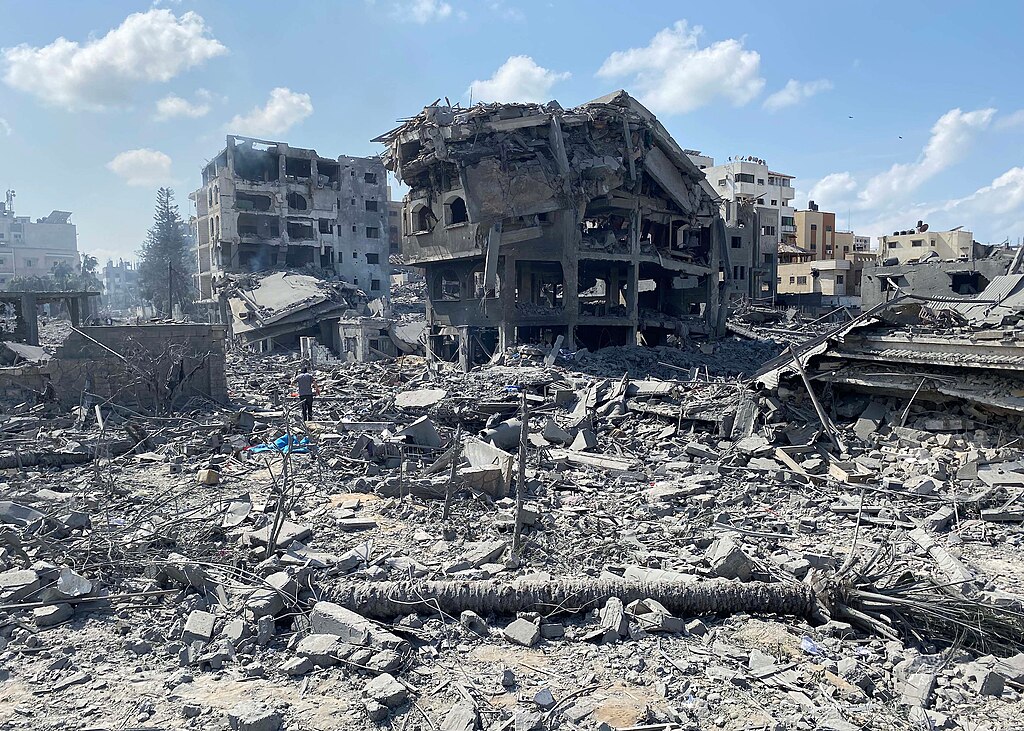
Palestinians inspect the damage following an Israeli airstrike on the El-Remal aera in Gaza City on October 9, 2023. Israel continued to battle Hamas fighters on October 10 and massed tens of thousands of troops and heavy armour around the Gaza Strip after vowing a massive blow over the Palestinian militants’ surprise attack. Photo by Naaman Omar apaimages. licensed under the Creative Commons Attribution-Share Alike 3.0 Unported license.
Britain is complicit in mass slaughter on a horrifying scale. But those campaigning for our votes pretend it’s not happening
…
This week alone, Israel has threatened “all out war” with Lebanon, while Hezbollah’s leader threatens a war “without rules or ceilings”, dangling the prospect of a far graver bloodbath than that unleashed by Israel’s genocidal rampage in Gaza. The spokesperson of the Israel Defense Forces has admitted that Hamas cannot be destroyed militarily: this amounts to a confession that the central war goal used to justify the slaughter of tens of thousands is unattainable. And the UN has released a report offering evidence as to how Israel’s bombing campaign in Gaza may have systematically violated the laws of war on protecting civilians and civilian infrastructure.
Remember: this is an onslaught that Britain’s government and opposition squarely backed at the start. Back in October, our prime minister promised “unequivocal” support for Israel for all time, while his inevitable successor, Keir Starmer, backed Israel’s right to cut off energy and water, though he later claimed he had been misinterpreted, and had never supported this. Neither political party will commit to ending arms sales, even though the chief prosecutor of the international criminal court – himself a British lawyer – has requested arrest warrants for both the Israeli prime minister, Benjamin Netanyahu, and his defence minister, Yoav Gallant, for alleged war crimes and crimes against humanity. This itself points to what should be a major domestic political scandal. Both party leaders should be scrutinised for having backed what became one of the great atrocities of our age, despite the bloodcurdling promises made by Israeli leaders from the start.
…
Given that this is a question of life and death on a colossal scale, our politicians should be forced to answer. Yet when our foreign secretary, David Cameron, was interrogated last week on the BBC Today programme, the interviewer spent the slot questioning him about trust and housebuilding. On Thursday night’s BBC Question Time leaders’ special, there was not a single question or answer on Gaza.
Of course, straight after 7/10, mainstream journalists were quick to promote the deployment of planes and personnel to support “our ally” in the region.
While the Sun splashed photos of British jets and frigates heading to the eastern Mediterranean with the headline “United We Stand”, the BBC basically reproduced a Ministry of Defence press release in its story, “UK to deploy Royal Navy ships to Middle East to ‘bolster security’.”
On 2 December, the Ministry of Defence released a short statement on UK military activity in the region, ostensibly to secure the release of (only) Israeli hostages.
The BBC, along with other news outlets, immediately ran a story repeating the MoD’s words verbatim (with a sprinkling of additional text from the Pentagon) as if these were to be innocent “surveillance flights” despite the fact that over 15,000 Palestinians had already been killed in brutal air strikes since 7/10.
This was followed by a flurry of highly bullish coverage of two further military interventions directly related to bolstering UK support for Israel – evidence of the “extensive defence and security cooperation” between the two countries that was embedded in the ‘Roadmap’ agreement signed in 2023 (and ignored by the media).
…
Censorship by omission
This lack of interest in the British government’s military links to Israel shouldn’t suggest, however, that there is nothing to investigate.
Indeed, Declassified UK has published multiple stories on the more opaque actions of the UK government that have been largely ignored by mainstream news including the deployment of a British spy team in Israel since 7/10, the dozens of flights by UK military aircraft to Israel in this period, the surveillance activities in support of Israel and the training of Israeli military personnel in the UK. Almost none of these have been followed up in broadcast bulletins and articles.
There is one area, however, in which the media do appear to have engaged with this topic: British arms sales to Israel that, according to the Campaign against Arms Trade, amount to £576 million since 2008.
That there were 2,648 stories mentioning “arms sales to Israel” and “UK” between 7 October and 19 June 2024 might suggest this is a major area of concern for journalists.
Not so fast. 85% of all stories appeared after 1 April when three UK citizens were among seven aid workers killed when Israeli jets attacked the food convoy they were managing.
For the 177 days between 7/10 and 1 April, the media (with the exception of the Scottish National, Guardian and BBC Parliament) showed little inclination to open up discussion on the issue.
Despite serious concerns that, through its exports of weapons to the Israeli military, the UK is complicit in ongoing war crimes, major news outlets only started to show an interest in the topic once British people, not Palestinians, were the story.
…
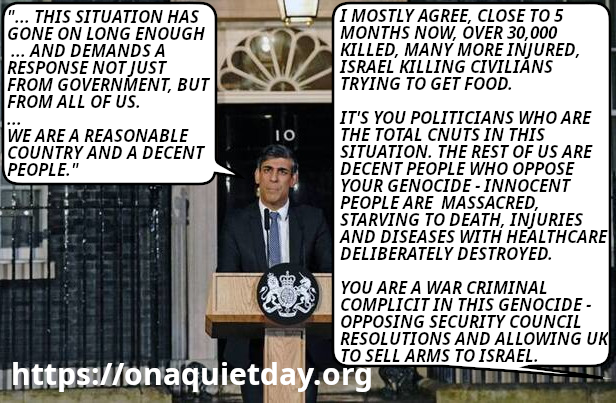
Response to Rishi Sunak’s extremism speech at Downing Street 1 March 2024. Second version of this image with text slightly altered.Zionist Keir Starmes is quoted “I support Zionism without qualification.” He’s asked whether that means that he supports Zionism under all circumstances, whatever Zionists do.
Climate activists Just Stop Oil launched a protest at Stonehenge, the 5,000-year-old stone monument in southern England, a day before thousands of people planned to gather there to celebrate the summer solstice.
Two members of the group sprayed three of the standing stones with an orange powder made from cornflour to draw attention to their campaign and its demands: that the UK government commit to ending the extraction and burning of oil, gas and coal by 2030.
Much like other protests by Just Stop Oil, which have included throwing paint – and sometimes tomato soup – at protected paintings in galleries, the Stonehenge action has been lambasted for threatening that which people hold dear: cultural heritage and national identity.
Politicians, archaeologists and heritage enthusiasts have condemned Just Stop Oil for supposedly endangering the stones. Some have even called for prison sentences – which could happen, as the Unesco World Heritage Site is protected by the Ancient Monuments and Archaeological Areas Act (1979). Lichen species growing on the stones are also protected under the Sites of Special Scientific Interest (SSSI).
The backlash demonstrates how heritage sites such as Stonehenge hold a sacred place for many and generate an almost desperate desire for rigid preservation. But Stonehenge and its landscape are dynamic features that forever shift and change. They have been beset by wars, roadworks and countless solstice gatherings. The stones were touched by thousands of hands before a barrier was installed and still bear the footfall of millions of visitors. They have withstood several interventions by archaeologists, who have hoisted the stones upright and replaced the lintels. In fact, all of the stones painted by Just Stop Oil – 21, 22 and 23 – have been re-erected or consolidated during the 20th century.
This is also not the first time the stones have been vandalised. As well as graffiti carved into some of them, the stones have often been the stage for political protests. The slogan “ban the bomb”, referring to the call for nuclear disarmament, was sprayed across nine stones in 1961. The Stonehenge landscape will survive this protest by Just Stop Oil.
The real threat to Stonehenge
What Stonehenge may not withstand is climate change. The UK is set to experience warmer, wetter winters and hotter, drier summers, as well as an increase in the occurrence and severity of extreme weather which will include high winds and flooding. This will have an impact on the stones and their landscape, exacerbating erosion of the faces of the stones caused by freezing and thawing while much wetter or much drier soil undermines their stability.
There are 70 species of lichen growing on the stones, some of which are rare for the surrounding Salisbury plain. But drier summers brought about by climate change may deteriorate the environment required for these species to thrive.
While Just Stop Oil’s protest at Stonehenge has generated outrage, there is silence over the cumulative and ongoing effects of climate change upon this and other heritage sites. There is little to no public uproar about climate change posing one of the biggest challenges to cultural landscapes, buried archaeology and the built environment. Without immediate and drastic reductions in greenhouse gas emissions, we will witness the loss and change of beloved heritage sites which will in turn affect our economy, way of life and sense of place.
Heritage and climate change have a complex relationship. Climate change affects, and will continue to affect, heritage – but the reverse is also true. Heritage can encourage climate action. My research has demonstrated that greater awareness of heritage loss can raise consciousness of the climate crisis and prompt action.
This is in part due to the emotional attachment people have to local and national heritage sites, and even those in other countries. When climate change and heritage meet during these protests, it is incredibly emotive. The visceral response to the protest at Stonehenge reveals our fear of loss and change, but this can act as a catalyst for climate action too. Just Stop Oil’s protest appears to have highlighted a collective fear of losing revered heritage, yet the conversation about it has overlooked the main instigator.
The orange cornflour has been washed away by the charity English Heritage, which reports no visible damage. But climate change will continue to threaten Stonehenge, its wider landscape and the rare lichen living on the stones. We must channel our concern over potential damage to Stonehenge towards the real threats facing heritage sites.
However, in a ruling on Monday, Mr Justice Holgate largely dismissed their claim, finding most parts of their case were “unarguable”.
SSWHS previously said the approved scheme would “destroy” around seven hectares of the world heritage site, and mark “the first step” towards being de-listed by Unesco.
…
Then-transport secretary Grant Shapps first gave the green light to the project in November 2020, despite advice from Planning Inspectorate officials that it would cause “permanent, irreversible harm” to the area.