With pressure mounting on the Biden administration, its pursuit of Assange was becoming both damaging and untenable

Spread the love
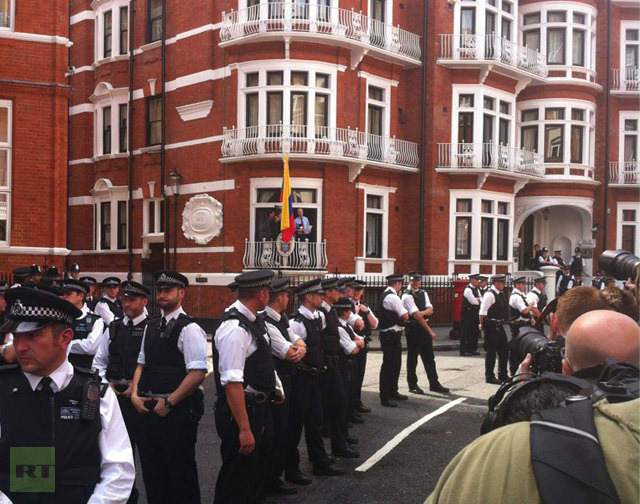
Julian Assange speaks at London's Ecuadorian Embassy
Julian Assange speaks at London’s Ecuadorian Embassy

Emma Shortis, RMIT University

Today, in a surprise development likely weeks in the planning, WikiLeaks founder Julian Assange was able to leave the United Kingdom for the first time in more than a decade after reaching a plea deal with the US government.

In the past several months, momentum has been building towards this moment. There was increasing bipartisan support in both the Australian parliament and the US Congress for the Australian citizen’s release. Australian Prime Minister Anthony Albanese has made repeated statements on his behalf, and in April, US President Joe Biden said he was “considering” a request from Australia to drop its prosecution of Assange.

This all contributed to the sense the matter might be resolved before Assange’s final UK hearing date, previously scheduled for July 9 and 10. The timing of the deal is also a welcome prelude to Albanese’s visit to Washington next week.

Such a resolution, however, was not inevitable. And it is not over yet.


A relentless, years-long pursuit

The United States’ pursuit of Assange has seemingly been relentless since WikiLeaks posted hundreds of thousands of classified military documents in 2010. It wasn’t until 2019 under the then President Donald Trump, however, that he was finally indicted on 17 counts of violating the 1917 Espionage Act.

The charges against Assange were not just considered unprecedented, they raised significant First Amendment concerns.

The apparent desire to punish Assange for the embarrassment caused by the leaks – and to deter others from taking similar action – was apparently so strong the CIA allegedly discussed plans to kidnap and even assassinate Assange during the Trump administration, according to US media reports.

In the UK courts, the US Department of Justice had argued Assange should be subject to US law and extradited to face trial for his actions. However, as a non-citizen, there were questions over whether he could rely on the legal protections afforded by those same laws – particularly the constitutional right to free speech.

The successful extradition of Assange could have set a precedent by which the US could pursue journalists anywhere in the world for publishing information it did not like, while potentially denying them their fundamental First Amendment rights.

In a crucial election year in the US that President Joe Biden is framing as an existential fight for the soul of US democracy, the continued pursuit of Assange was as inconsistent as it was ultimately untenable. Viewed from the outside, it appeared the case was causing the Biden administration international embarrassment.

Biden has been careful to maintain an appropriate distance between the presidency and the Department of Justice. He came into office promising to restore faith in the rule of law following the Trump years, and has meticulously avoided any appearance of interference in the department’s work as it has investigated and indicted his predecessor.

Assange’s case, however, is wholly different to the charges on which Trump has been indicted. It is certainly possible to interpret Biden’s comment that he was “considering” dropping the charges as a gentle public rebuke of the Department of Justice’s pursuit of the case, given its global implications for a free press.

Broader implications for the alliance

The continued pursuit of Assange was also becoming problematic in the context of Australia’s alliance with the US. That relationship is always described as one based on shared democratic values, in contrast to what Biden has repeatedly framed as the coercive and repressive instincts of “authoritarian” powers.

The decision by the US to pursue a citizen of one of its closest allies for the publication of information, while simultaneously condemning authoritarian states for doing much the same, was both hypocritical and damaging to American standing in the world.

In the context of growing concern in Australia about the terms of the AUKUS submarine deal and the Australian government’s willingness to go “all-in” with the US militarily, the continued pursuit of Assange gave the impression that Australia’s most important security ally did not take its concerns seriously. Australia appeared simply to be snapping at America’s heels.

It also added to the sense that the “capital-A Alliance” between the two countries was increasingly dominated by security concerns, often at the expense of democratic accountability.

Because of the international campaign to free Assange and the support it received in both Australian and American democratic institutions, there appears to be have been a reconsideration of this focus on security interests over democratic values.

It should be noted, though, that the US didn’t drop its prosecution in the end; Assange has agreed to plead guilty to a felony charge of violating the Espionage Act, which in itself may set a concerning precedent for press freedom.

And the fact this saga happened at all – and that it has taken more than a decade to get close to resolution – should prompt deep reflection on the values that underpin both Australia’s relationship with its most important security ally and the United States’ role in the world.

Emma Shortis, Adjunct Senior Fellow, School of Global, Urban and Social Studies, RMIT University

This article is republished from The Conversation under a Creative Commons license. Read the original article.

Continue ReadingWith pressure mounting on the Biden administration, its pursuit of Assange was becoming both damaging and untenable

Labour’s Otherworldly Manifesto

Spread the love
Zionist Keir Starmes is quoted "I support Zionism without qualification." He's asked whether that means that he supports Zionism under all circumstances, whatever Zionists do.
Zionist Keir Starmes is quoted “I support Zionism without qualification.” He’s asked whether that means that he supports Zionism under all circumstances, whatever Zionists do.

https://www.rosalux.de/en/news/id/52233/labours-otherworldly-manifesto

Keir Starmer’s party is set to win by a landslide, but its ambitions are simultaneously unrealistic and uninspiring

AUTHOR: Keir Milburn

“Stability is Change!” This seemingly paradoxical, almost Orwellian statement is the principal slogan of the Labour Party’s current parliamentary election campaign. Labour leader Keir Starmer used the slogan at the party’s manifesto launch, and it provides a key prism for understanding the manifesto and its weaknesses.

There is little doubt that the UK electorate is in the mood for change. The widespread, off-stated consensus in the country is that nothing works. The National Health Service is so chronically underfunded that doctor’s appointments are difficult to get and long waiting lists proliferate. The trains are shockingly expensive but utterly unreliable.

The list could go on and on, but the image most frequently used to sum up the situation comes from the failure of the privatized water services. A lack of investment in infrastructure accompanied by the looting of those companies for huge shareholder dividend payouts has led to the near constant release of untreated sewage into the UK’s river system. It flows from there onto our beaches. The British are quite literally swimming in shit!

These problems are identified quite clearly in the Labour Party manifesto, but the diagnosis of their causes and therefore their solutions proves much less convincing. Labour may have a plan to win in July, but how it will govern in the interests of its voters is anybody’s guess.

The totality of Labour’s spending pledges amounts to just 0.2 percent of GDP, smaller even than the Conservative pledges of 0.8 percent and dwarfed by the previous two Labour manifestos, which promised 2.1 percent and 3.2 percent respectively. Even the pro-market Institute for Fiscal Studies called Labour’s plans “tiny, going on trivial”.

These policies do not point to stability, not least because they do not address the 18 billion pounds of government spending cuts that the Conservatives have already baked into the government budget going forward. The effects of implementing such cuts on government services — which have already suffered so badly under 14 years of severe austerity — makes it hard to imagine that Labour will stick to this commitment. It seems likely that money will be found to prevent the worst of these cuts through technical changes in accounting between the government and the notionally independent Bank of England.

Beyond this paddling, however, the need for investment in the UK is huge. Both public and private investment in the country has collapsed since 2008. It has the lowest business investment in the G7 and ranks just twenty-eighth out of the 31 OECD countries. In the face of this, Labour, hamstrung by self-imposed fiscal rules on bringing down government debt and pledges not to raise the main forms of taxation, are promising so little investment that their plans seem unbelievable.

Until last February, Labour was promising to immediately strengthen workers’ rights through a New Deal for Workers, and to spend 28 billion pounds per year to decarbonize the economy through its Green Prosperity Plan. The Labour Party’s current openness to corporate funding and lobbying, including the imposition of over 30 parliamentary candidates with corporate lobbying backgrounds, has led to a dramatic watering down of these pledges. The Green Prosperity Plan has been reduced to just 3.5 billion pounds, but the form that spending will take reveals another logic or worldview which may come to the fore as crises mount.

The word “securonomics”, an ugly portmanteau favoured by shadow chancellor Rachel Reeves, makes an appearance in the manifesto, introducing the idea that public investment should support and de-risk private investment in strategically key sectors. The chief vehicle for this will be a National Wealth Fund “capitalised with £7.3 billion over the course of the next parliament”. What precisely this will look like has yet to be determined, but The National Wealth Fund “will have a target of attracting three pounds of private investment for every one pound of public investment”. This is an explicit return to and acceleration of the kind of public-private partnerships that lost legitimacy in the UK during the fallout from the disastrous Public Finance Initiative under New Labour.

Recommended article at https://www.rosalux.de/en/news/id/52233/labours-otherworldly-manifesto

Continue ReadingLabour’s Otherworldly Manifesto

UN to Warn Half a Million Gazans Facing ‘Catastrophic’ Food Insecurity

Spread the love

Original article by BRETT WILKINS republished from Common Dreams under Creative Commons (CC BY-NC-ND 3.0).

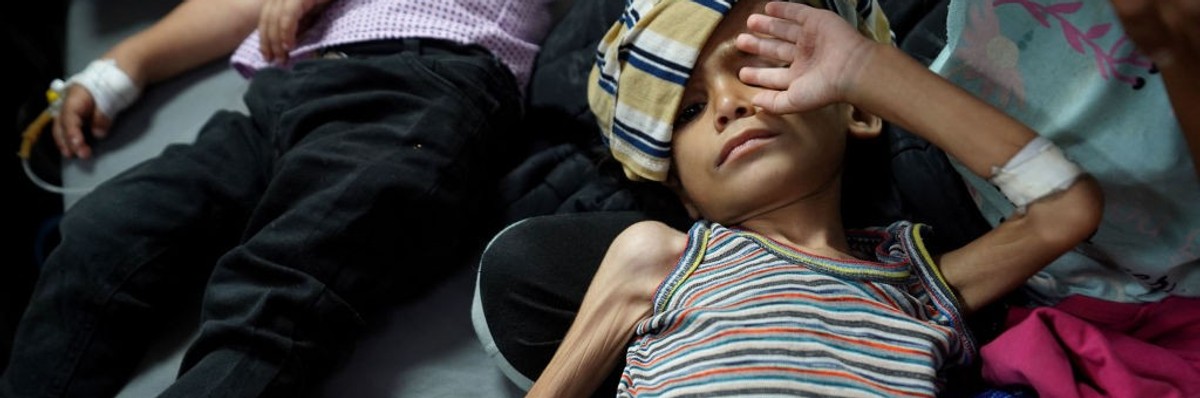
Children receive malnourishment treatment at Al-Aqsa Martyrs Hospital in Deir al-Balah in the central Gaza Strip on May 30, 2024, amid Israel’s ongoing assault on the besieged enclave. (Photo: Bashar Taleb/AFP via Getty Images)

“The international community must apply relentless pressure to achieve a cease-fire and ensure sustained humanitarian access now,” said one advocate.

More than 1 in 5 people in the Gaza Strip are “facing catastrophic levels of food insecurity” amid Israel’s relentless assault and siege against the Palestinian territory, according to a draft report set to be published Tuesday by the United Nations’ hunger monitoring system.

The latest Integrated Food Security Phase Classification (IPC) Acute Food Insecurity Special Snapshot—which was previewed by various news agencies—says that more than 495,000 Gazans—who already face “an extreme lack of food, starvation, and exhaustion”—are expected to suffer the highest level of starvation over the coming months.

The draft report states that while a sharp increase in food aid in northern Gaza in March and April can be credited with “likely averting a famine,” the situation is “deteriorating again following renewed hostilities.”

“A high risk of famine persists across the whole of the Gaza Strip as long as conflict continues and humanitarian access is restricted,” IPC noted.

The IPC draft report also says more than half of all Gaza households had to sell or swap clothing in order to obtain food, and that the majority of Gazan families often “do not have any food to eat in the house, and over 20% go entire days and nights without eating.”

“The population cannot endure these hardships any longer.”

Kate Phillips-Barrasso, vice president of global policy and advocacy at Mercy Corps, an Oregon-based humanitarian NGO, told The Guardian that “people are enduring subhuman conditions resorting to desperate measures like boiling weeds, eating animal feed, and exchanging clothes for money to stave off hunger and keep their children alive.”

“The humanitarian situation is deteriorating rapidly, and the specter of famine continues to hang over Gaza,” she added. “The international community must apply relentless pressure to achieve a cease-fire and ensure sustained humanitarian access now. The population cannot endure these hardships any longer.”

Although the IPC stopped short of the rare step of declaring a famine in Gaza, it warned that “the recent trajectory is negative and highly unstable.”

“Should this continue, the improvements seen in April could be rapidly reversed,” the agency added.

The IPC’s famine review panel previously said there is not enough data to make a determination on whether there is a famine in Gaza since research was being blocked by “conflict and humanitarian access constraints.”

The Geneva-based group Euro-Mediterranean Human Rights Monitor said Monday that “the Famine Review Committee’s inability to declare the current food situation in the Gaza Strip to be a famine does not negate the existence of famine in the strip, as pockets of famine are forming and spreading among different age groups, particularly children, and there is a noticeable increase in deaths from hunger, malnutrition, and related diseases.”

“The committee’s failure to declare the existence of a famine is solely related to its inability to provide certain technical information because of illegal Israeli restrictions and policies that aim to conceal evidence related to the crimes it commits and prevent criminal investigations into them by independent U.N. and international committees, particularly by preventing these committees from entering the strip,” the group added.

U.N. World Food Program Executive Director Cindy McCain said last month that “full-blown famine” had taken hold in Gaza and was spreading south. According to Gaza officials, at least 40 people—mostly children—have died from malnutrition and dehydration during the 262-day Israeli onslaught. Almost all of the victims are from northern Gaza.

Israel began bombing, and later invaded, Gaza after Hamas-led attacks left more than 1,100 Israelis and others dead and over 240 others kidnapped on October 7. At least some of the victims were killed by Israeli forces in so-called “friendly fire” incidents, according to Israeli and international media reports.

Since then, Israeli forces have killed at least 37,626 Palestinians—most of them women and children—in Gaza, while wounding over 86,000 others, according to Palestinian and international agencies. At least 11,000 people, including over 4,000 children, are missing and presumed dead and buried beneath the rubble of hundreds of thousands of bombed-out homes and other buildings.

Michael Fakhri, the United Nations special rapporteur on the right to food and a law professor at the University of Oregon, said in late February that Israel is committing genocide by intentionally starving Gazans. Israel’s siege—and Israeli attacks on humanitarian aid shipments, workers, and recipients—are being reviewed by the International Court of Justice as part of a South Africa-led genocide case backed by over 30 countries and regional blocs.

Original article by BRETT WILKINS republished from Common Dreams under Creative Commons (CC BY-NC-ND 3.0).

Over 20,000 Children Missing in Gaza, With ‘Unknown Number’ in Mass Graves: Report

‘Visible Signs of Wasting’: Heat, Forced Malnutrition Strangle People of Gaza

Biden Continues to Cement a Bloody and Immoral Legacy in Gaza

Continue ReadingUN to Warn Half a Million Gazans Facing ‘Catastrophic’ Food Insecurity

Climate Emergency Causes Extreme Wildfires to Double in Frequency: Study

Spread the love

Original article by JULIA CONLEY republished from Common Dreams under Creative Commons (CC BY-NC-ND 3.0).

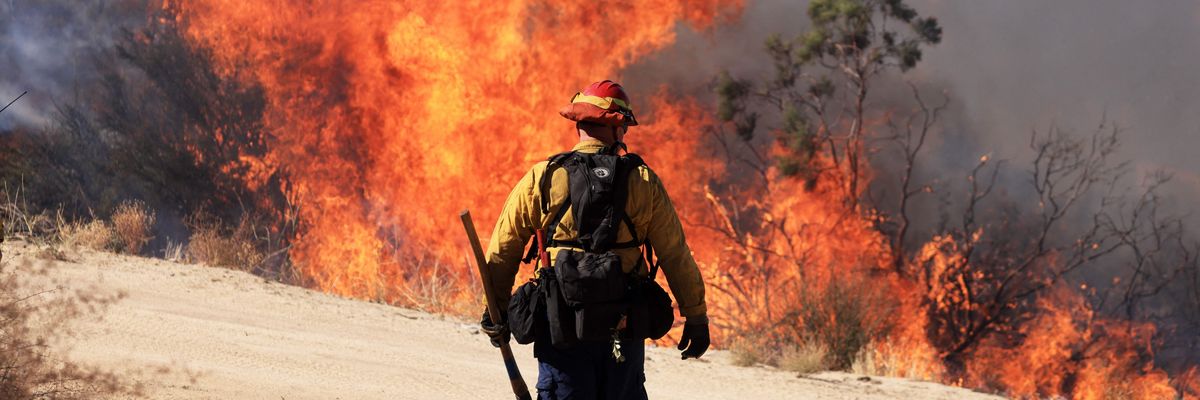
A firefighter walks toward flames as the Highland Fire burns in Aguana, California, on October 31, 2023. 
(Photo: David Swanson/AFP via Getty Images)

“Climate change is not something off in the future,” said one scientist. “It’s happening before our very eyes.”

New findings about the rising frequency of extreme wildfires have “the fingerprints of climate change” all over them, according to an Australian scientist who led a study published on Monday.

Calum Cunningham, a postdoctoral researcher at the University of Tasmania in Australia, told The Washington Post that he was driven to examine current trends in the frequency of wildfires after climate deniers suggested that because the global area being burned in blazes is declining, the idea of a growing wildfire crisis is being overblown by concerned scientists.

While the area destroyed by wildfires is indeed on the decline, analyses that include all fires—the majority of which are small and cause relatively little damage—obscured how the most extreme and destructive wildfires are rapidly growing more frequent.

Cunningham and his team analyzed data from National Aeronautics and Space Administration satellites, collecting four images of wildfires around the world per day over 21 years. They used the images to identify the 0.01% most extreme wildfires—those that release the most smoke and greenhouse gas emissions due to their size and uncontrollable nature.

Out of 30 million fires across the world over two decades, the researchers identified the 2,913 most extreme fire events and found that the frequency and intensity of such wildfires has more than doubled since 2003.

“Climate change is making fire weather more extreme and more frequent in a lot of the world.”

The problem is rapidly getting worse, the team found: The six years with the most extreme wildfires had all occurred since 2017.

Trends were particularly troubling in particular regions, like temperate conifer forests in the western United States and the Mediterranean, where the number of extreme fires rose by more than 10 times in 20 years.

In boreal forests in places like northern Europe and Canada, the frequency of the most intense and hard-to-control blazes increased by seven times.

“It’s absolutely in keeping with what climate change is doing to fire weather around the world,” Cunningham told the Post. “Climate change is making fire weather more extreme and more frequent in a lot of the world.”

The “fire weather” that’s driven the increase includes hotter and drier conditions, with temperatures staying high even overnight when they ordinarily would have have dropped in previous decades, giving firefighters a chance to make headway in putting out blazes.

“Rarely did we have 100,000-acre fires 20 years ago,” veteran firefighter Bobbie Scopa told the Post. “But now, it’s not uncommon.”

The researchers pointed to a “scary” feedback loop created as extreme wildfires create carbon emissions—leading to more planetary heating and even more fires.

“Climate change is not something off in the future,” Cunningham told the Post. “It’s happening before our very eyes. This is the manifestation of the reshaping of the climate we are doing.”

The study was published in Nature Ecology & Evolution days after wildfires scorched more than 14,000 acres in Southern California and more than 24,000 acres in New Mexico, where two people were killed. Last year, climate scientists were stunned by an unprecedented wildfire season in relatively damp Eastern Canada, where wildfires were made twice as likely by the climate emergency according to the World Weather Attribution.

Climate scientist and author Bill McGuire called the findings “terrifying, of course, but just not a surprise,” considering governments in the countries that produce the most fossil fuels are continuing to support and subsidize energy sources that heat the planet.

“This is certifiably insane,” McGuire said.

Original article by JULIA CONLEY republished from Common Dreams under Creative Commons (CC BY-NC-ND 3.0).

Continue ReadingClimate Emergency Causes Extreme Wildfires to Double in Frequency: Study

Julian Assange released from prison, WikiLeaks says, after striking deal with US justice department

Spread the love

News is breaking that Julian Assange associated with the Wikileaks news publishing site has been released.

Julian Assange speaks at London's Ecuadorian Embassy
Julian Assange speaks at London’s Ecuadorian Embassy

https://www.theguardian.com/media/article/2024/jun/25/julian-assange-plea-deal-with-us-free-to-return-australia

WikiLeaks said on X that Assange had left Belmarsh prison on Monday morning, after 1,901 days of captivity there. He had spent the time, the organisation said, “in a 2×3 metre cell, isolated 23 hours a day”.

Assange was set to be reunited with his wife, Stella, who confirmed on X that he was free. She thanked Assange’s supporters, saying “words cannot express our immense gratitude”.

In the WikiLeaks video, Assange, looking healthy dressed in a shirt and jeans with his white hair cut short, is seen climbing the stairs into a plane.

An Australian government spokesperson did not confirm or deny the plea deal but said Canberra was “aware” of the legal proceedings, adding: “prime minister [Anthony] Albanese has been clear – Mr Assange’s case has dragged on for too long and there is nothing to be gained by his continued incarceration.”

Assange’s mother Christine welcomed the developments, saying “I am grateful my son’s ordeal is finally coming to an end.”

The plea agreement comes months after the US president, Joe Biden, said he was considering a request from Australia to drop the US push to prosecute Assange.

WikiLeaks in 2010 released hundreds of thousands of classified US military documents on Washington’s wars in Afghanistan and Iraq – the largest security breaches of their kind in US military history – along with swaths of diplomatic cables.

https://www.theguardian.com/media/article/2024/jun/25/julian-assange-plea-deal-with-us-free-to-return-australia

Continue ReadingJulian Assange released from prison, WikiLeaks says, after striking deal with US justice department